
1. Facts About Manama
| Category | Details |
|---|---|
| Country | Bahrain (Kingdom of Bahrain) |
| Region / Province | Capital Governorate |
| Official Language | Arabic; English very widely spoken |
| Currency | Bahraini Dinar (BHD) — 1 BHD ≈ 2.65 USD (third most valuable currency globally) |
| Best Time to Visit | November to March (cool, dry season) |
| Time Zone | Arabia Standard Time (AST) — UTC+3 |
| Weather | Arid desert climate — extremely hot summers, mild winters, minimal rainfall |
| Temperature | 14°C – 42°C (57°F – 108°F) depending on season |
| Map | Located on Bahrain Island — the largest of Bahrain’s 33 islands — in the Arabian Gulf, connected to Saudi Arabia by the King Fahd Causeway |
| Airport | Bahrain International Airport (BAH) — 6 km north of Manama city center |
| Top Tourist Places | Bahrain Fort (Qal’at Al Bahrain), Bahrain National Museum, Bab Al Bahrain Souq, Al-Fatih Grand Mosque, Tree of Life, Bahrain International Circuit, Manama Souq |
| Avg. Trip Cost/Day | Budget: $55–90 / Mid-range: $130–250 / Luxury: $280–600+ |
| Nearest Major Airport | Bahrain International Airport (BAH) — Bahrain’s only international airport |
| Population | Approx. 600,000 (Manama city); 1.5 million (all Bahrain, 2026); Bahraini nationals approx. 47% |
| Famous For | The world’s oldest pearl diving civilization, the Formula 1 Bahrain Grand Prix, the extraordinary Tree of Life standing alone in the desert, the most liberal social environment in the Gulf, some of the finest traditional gold and pearl jewelry in Arabia, and an island kingdom that has been at the crossroads of trade and civilization for 5,000 years |
2. Manama City Overview & Background
Manama welcomes you differently from the way other Gulf capitals do. There is no single overwhelming gesture — no single tower that defines the skyline or single monument that announces the city’s ambitions. Instead, Manama offers something more layered and more genuinely interesting: a compact island capital where 5,000 years of trading civilization sit quietly beneath a modern Gulf city, where the world’s oldest pearl diving industry shaped a culture of remarkable sophistication, and where the particular social liberalism that has always characterized Bahrain — the crossroads island, the meeting place of cultures — creates a city of unusual openness and unusual warmth.
Bahrain is the Gulf’s smallest country — a cluster of 33 islands in the northwestern Arabian Gulf with a total land area of barely 780 square kilometres. Its capital, Manama, occupies the northern tip of Bahrain Island — the largest of the archipelago — facing the Gulf on three sides and connected to Saudi Arabia by the remarkable King Fahd Causeway, the world’s longest over-water bridge when it was built in 1986. This physical connection to the Saudi mainland has made Manama simultaneously a Saudi weekend destination and a cultural counterweight — a place where the Gulf’s most conservative society can encounter the Gulf’s most liberal one across a 25-km bridge.
What makes Manama extraordinary is the density of its history in such a small space. The Bahrain Fort (Qal’at Al Bahrain) — a UNESCO World Heritage Site — sits just kilometers from the city center on a tell that has been continuously occupied for 4,000 years — revealing Dilmun civilization, Kassite, Assyrian, Persian, Greek, Parthian, Sasanian, Arab, and Portuguese layers simultaneously. Beneath Manama’s modern streets lie the remains of the ancient Dilmun civilization — one of the earliest complex societies on earth, mentioned in the Epic of Gilgamesh as the paradise of the immortals.
Yet Manama is also thoroughly modern. It is home to the Bahrain International Circuit — where the Formula 1 season regularly opens each spring with the Bahrain Grand Prix, one of the most atmospheric night races on the calendar. It has the Gulf’s most developed financial services sector — a banking hub that competes directly with Dubai for regional financial business. It has the most sophisticated contemporary art and design scene in the Gulf outside of Dubai. And it has the most genuinely relaxed social atmosphere in Arabia — where alcohol is available in licensed venues, where women have driven freely for decades, and where the complex sectarian tensions beneath the surface coexist with a genuine tradition of mercantile cosmopolitanism going back millennia.
For travelers, Manama offers a genuinely distinctive Gulf experience — one where history is tangible rather than reconstructed, where the old and new sit in immediate proximity, and where the particular charm of a small, confident, ancient island kingdom creates an atmosphere unlike anywhere else in the region.
“Bahrain is unlike the rest of the Gulf in a way that is immediately palpable. It is older, more layered, more at ease with itself. Manama has a quality of lived history that no amount of museum-building or heritage restoration can manufacture — it is simply there, in the fabric of the place.”
— Anonymous travel journalist, National Geographic Traveller, 2025
3. Manama History Timeline
3000–2000 BCE — The Dilmun civilization flourishes on the islands of Bahrain. Dilmun — mentioned in Sumerian texts as a paradise land where the sun rises, and in the Epic of Gilgamesh as the immortal realm — is one of the earliest complex trading societies on earth, controlling the sea trade between Mesopotamia (modern Iraq) and the Indus Valley civilization (modern Pakistan). The Bahrain Fort site shows occupation from this earliest period. Dilmun’s freshwater springs — extraordinary on a Gulf island — make the archipelago legendary in the ancient world.
2000–600 BCE — Bahrain passes through successive phases of influence from the Kassite Babylonian Empire, the Assyrian Empire, and various Arabian tribal confederations. The island remains a critical node in Gulf maritime trade throughout this period. The extraordinary burial mounds covering much of Bahrain — an estimated 170,000 ancient burial mounds — are built during this period, making Bahrain one of the largest ancient burial sites on earth.
4th century BCE — Following Alexander the Great’s campaigns, Greek influence reaches the Gulf. Classical sources refer to Bahrain as Tylos — a significant island in the eastern trading network.
250 BCE–224 CE — The Parthian Empire controls much of the Gulf region. Bahrain’s trading importance continues under Parthian influence.
3rd–7th centuries CE — The Sasanian Persian Empire dominates the Gulf. Bahrain — known in this period as Awal — comes under Persian influence while maintaining its role as a critical maritime trading hub.
630 CE — Islam arrives in Bahrain. The Prophet Muhammad sends letters to Bahrain’s ruler Al-Mundhir ibn Sawa Al-Tamimi inviting conversion to Islam. Al-Mundhir accepts, and Bahrain becomes one of the first territories outside Arabia to adopt Islam. The Al-Khamis Mosque — one of the oldest mosques in the Islamic world — is believed to have been built in Bahrain during this early Islamic period.
7th–11th centuries CE — Bahrain becomes part of the Islamic Caliphate’s Gulf trading network. The islands continue their ancient role as a maritime trading hub, now within the framework of Islamic civilization.
1521 — The Portuguese seize Bahrain as part of their aggressive expansion of control over Gulf trade routes. They construct or fortify the Bahrain Fort, adding Portuguese military architecture to the 4,000-year-old tell. Portuguese control lasts approximately 80 years.
1602 — Safavid Persian forces expel the Portuguese and assert Persian control over Bahrain — beginning a period of Iranian-Arab competition for the islands that echoes into the present day.
1783 — The Bani Utub confederation — specifically the Al Khalifa family — expel the Persians from Bahrain after a decisive military campaign. The Al Khalifa family establishes its rule over Bahrain, a rule that continues to the present day under the Al Khalifa ruling dynasty.
Early 19th century — Bahrain’s economy is dominated by pearl diving — one of the most important pearl fishing industries in the world. Bahraini pearl traders export to India, Persia, and Europe. The pearl industry creates extraordinary wealth and a sophisticated merchant culture.
1820 — Britain signs the first of a series of treaties with Gulf rulers — including Bahrain’s Al Khalifa — that progressively draws Bahrain into the British sphere of influence.
1861 — Bahrain becomes a British Protectorate under the Treaty of Perpetual Peace — with Britain controlling Bahrain’s foreign policy in exchange for protection. The relationship shapes Bahrain’s modern institutions, legal system, and international orientation.
1930s — The collapse of the pearl trade — destroyed by Japanese cultured pearls — devastates Bahrain’s economy. The timing is again providential.
1932 — Oil is discovered in Bahrain — the first commercial oil discovery on the Arabian Peninsula — beginning the transformation of the Gulf’s economy. Bahrain’s oil reserves are modest compared to Saudi Arabia or Kuwait, making it a pioneer in Gulf oil but also an early example of the need to diversify.
1971 — Bahrain achieves full independence from Britain on August 15. Manama becomes the capital of the independent State of Bahrain. Sheikh Isa bin Salman Al Khalifa becomes the first Emir of independent Bahrain.
1970s–1980s — Bahrain develops rapidly into the Gulf’s premier financial services center — partly as an alternative to the oil-boom centers and partly because of its relative social liberalism and established legal infrastructure. The Bahrain Monetary Agency (now Central Bank) is established. International banks set up regional headquarters.
1986 — The King Fahd Causeway connecting Bahrain to Saudi Arabia opens — a 25-km engineering achievement that transforms Bahrain’s economy and social life by making it accessible to Saudi visitors by road for the first time.
1994–1999 — A period of significant political unrest — primarily in the Shia-majority communities — challenges the Sunni Al Khalifa government. The unrest reflects deep sectarian tensions rooted in Bahrain’s complex demographic history.
2002 — Bahrain transitions from an emirate to a Kingdom. Sheikh Hamad bin Isa Al Khalifa becomes King. A new constitution is adopted providing for a partially elected parliament.
2004 — The Bahrain International Circuit opens. The inaugural Bahrain Grand Prix — the first Formula 1 race in the Middle East — takes place in April 2004. Bahrain becomes a landmark on the global motorsport calendar.
2011 — The Arab Spring reaches Bahrain. Massive protests — led primarily by Shia communities demanding political reform — fill Pearl Roundabout (the equivalent of Cairo’s Tahrir Square). The government, with Saudi military assistance, suppresses the protests. The Pearl Monument at the roundabout is demolished. The political tensions that the uprising revealed remain partially unresolved.
2020 — Bahrain signs the Abraham Accords — normalizing relations with Israel alongside the UAE. The decision is controversial within Bahrain and the wider Arab world but reflects Bahrain’s long-standing pragmatic foreign policy approach.
2022 — King Hamad’s son, Crown Prince Salman bin Hamad Al Khalifa, assumes day-to-day governance as Prime Minister — a position he has increasingly occupied as Bahrain navigates economic diversification and regional diplomacy.
2024–2026 — Manama continues developing its position as the Gulf’s financial center, cultural hub, and most liberal social environment. The Bahrain Economic Vision 2030 — focusing on diversification beyond oil — drives investment in tourism, financial services, manufacturing, and culture. International visitor numbers grow year on year as Bahrain’s distinctive combination of ancient history, contemporary culture, and social openness attracts a growing international audience.
4. Manama Geography & Neighborhoods
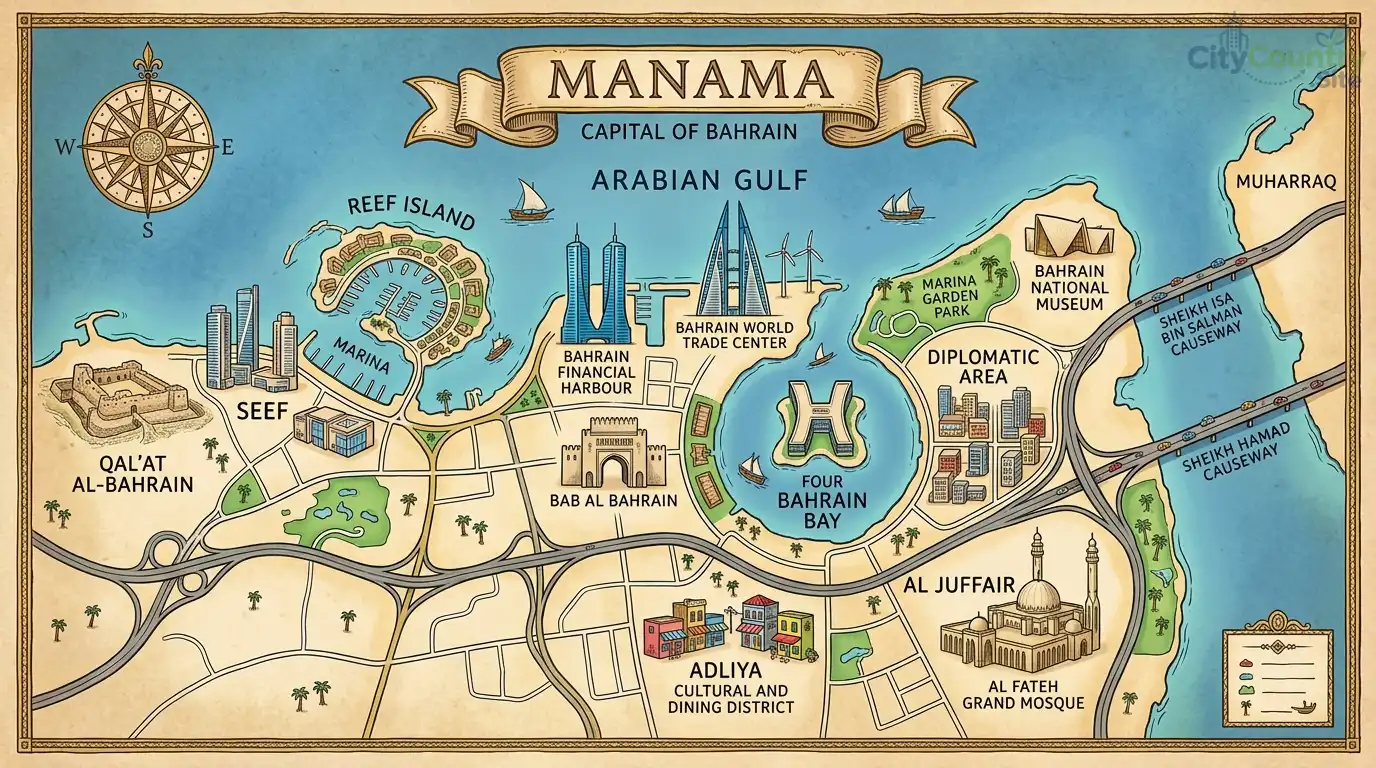
Manama occupies the northern tip of Bahrain Island — the largest of Bahrain’s 33 islands — facing the Arabian Gulf on three sides. The city is remarkably flat — the highest point in all of Bahrain is barely 135 metres above sea level — but the coastal configuration, with reclaimed land extending the shoreline outward in several directions, creates a varied urban geography of downtown districts, waterfront developments, and suburban residential areas.
The Manama Souq area and the old city occupy the historic core — the area around Bab Al Bahrain (Gate of Bahrain) and the traditional market streets. North of the old center, the Diplomatic Area and the Seef District represent modern Manama — the financial towers, luxury malls, and international hotels. East of the city, the remarkable Bahrain Bay reclaimed land development has created a new urban district of contemporary architecture and waterfront living.
Neighborhood Comparison Table
| Area | Best For | Vibe | Price Level |
|---|---|---|---|
| Manama Souq / Old City | History, markets, authentic life | Traditional, atmospheric, dense | Budget–Mid |
| Diplomatic Area | Banks, business, upscale hotels | Modern, financial, professional | High |
| Seef District | Luxury malls, restaurants, entertainment | Modern, commercial, family | Mid–High |
| Adliya | Cafés, galleries, restaurants, nightlife | Hip, creative, cosmopolitan | Mid |
| Juffair | Nightlife, bars, US Naval Base proximity | International, lively, mixed | Mid |
| Bahrain Bay | New waterfront development, contemporary hotels | Modern, ambitious, spectacular | High–Luxury |
| Amwaj Islands | Luxury waterfront living, restaurants, marina | Upscale, resort-feel, relaxed | High–Luxury |
| Muharraq | Old Bahrain, pearl heritage, traditional architecture | Historic, quiet, authentic | Budget–Mid |
Adliya is Manama’s most vibrant and creatively interesting neighborhood — a grid of low-rise streets that has become the city’s arts, dining, and café hub, with galleries, independent restaurants, coffee shops, and boutiques creating the liveliest urban street culture in the Gulf outside of Dubai. Muharraq — on the adjacent island connected by a causeway — is the old capital of Bahrain and the historic center of the pearl diving industry — its traditional courtyard houses and narrow lanes representing the finest surviving example of traditional Gulf architecture in Bahrain.

5. Manama Weather & Temperature Guide
Manama’s climate is similar to Kuwait’s — extremely hot in summer, mild in winter, with almost no rainfall. Bahrain’s position entirely surrounded by water adds significant Gulf humidity to the summer heat, making the period from June to September particularly challenging.
Month-by-Month Weather Table
| Month | Avg Temp (°C) | Humidity | Crowd Level | Travel Recommendation |
|---|---|---|---|---|
| January | 14–20 | Medium | Medium | ⭐ Excellent — cool and comfortable |
| February | 15–21 | Medium | Medium | ⭐ Excellent |
| March | 18–26 | Medium | High | ⭐ Excellent — Formula 1 season |
| April | 23–32 | Medium | High | ✅ Good — warming pleasantly |
| May | 28–38 | High | Low–Medium | ⚠️ Hot — limit outdoor time |
| June | 31–42 | Very High | Very Low | ⚠️ Extreme heat and humidity |
| July | 33–42 | Very High | Very Low | ⚠️ Hottest month |
| August | 33–42 | Very High | Very Low | ⚠️ Unbearable outdoors |
| September | 30–40 | High | Low | ⚠️ Still very hot |
| October | 24–34 | Medium | Medium | ✅ Good — cooling improving |
| November | 19–28 | Medium | High | ⭐ Excellent — season begins |
| December | 15–22 | Medium | Medium–High | ⭐ Excellent |
November through March is Manama’s finest season. January and February deliver the most comfortable temperatures — cool evenings around 14°C, warm sunny days of around 20°C — perfect for exploring the souqs, the Fort, and the island’s outdoor heritage sites.
March is particularly significant — this is when the Bahrain Grand Prix typically takes place, filling the island with motorsport enthusiasts and creating an extraordinary atmosphere of international energy. Accommodation books out months in advance for Grand Prix weekend.
April is transitional — still very pleasant in the first half, warming notably by month’s end.
June through September is extreme Gulf summer — temperatures above 40°C with very high humidity making outdoor time genuinely dangerous. Everything moves indoors.
💡 Did You Know? Bahrain’s extraordinary humidity in summer — driven by its position surrounded entirely by the warm, shallow waters of the Arabian Gulf — creates a “feels like” temperature significantly above the actual thermometer reading. On the hottest summer days, the combination of 42°C temperature and 90% humidity creates an apparent temperature approaching 60°C — one of the most hostile outdoor environments of any inhabited location on earth. The Gulf’s warm shallow water essentially acts as a giant humidifier for the islands sitting in it.
6. Manama Airport & Getting There
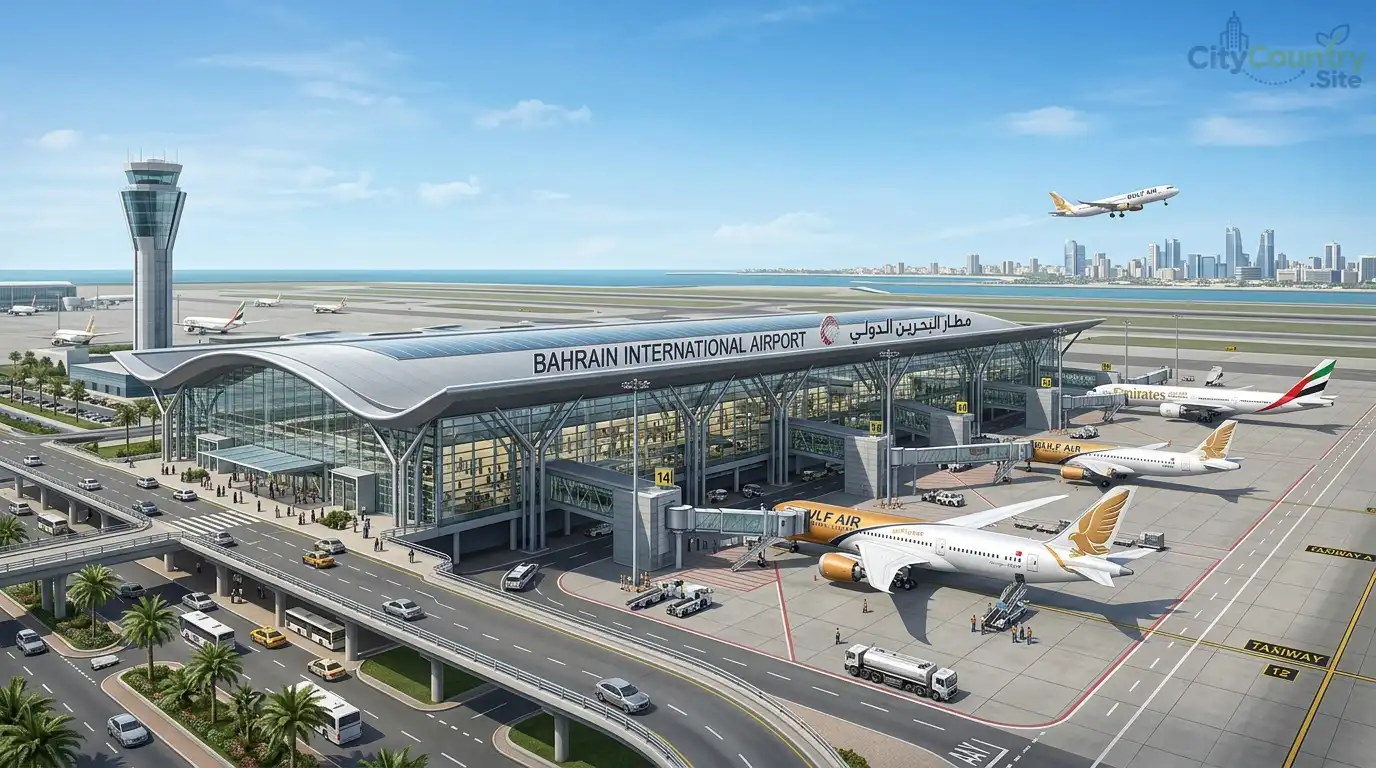
Bahrain International Airport (BAH)
Bahrain International Airport (IATA: BAH) is located approximately 6 km north of Manama city center on Muharraq Island — one of the shortest airport-to-city distances in the Gulf. A magnificent new Modernization Project — the largest infrastructure investment in Bahraini history — dramatically expanded and upgraded the terminal, completing in phases from 2021, creating a beautiful, efficient gateway that reflects Bahrain’s ambitions as a regional aviation hub.
The airport is the hub of Gulf Air — Bahrain’s national carrier and one of the oldest commercial airlines in the Arab world, founded in 1950. International connections include London Heathrow, Frankfurt, Paris, Istanbul, Dubai, Abu Dhabi, Doha, Kuwait, Riyadh, Cairo, Beirut, Mumbai, Delhi, Bangkok, Manila, and many others. Airlines including Gulf Air, flydubai, Air Arabia, British Airways, Lufthansa, Turkish Airlines, Emirates, and EasyJet (seasonal European connections) serve Bahrain.
Getting from BAH to the City Center:
| Transport Option | Duration | Cost (Approx.) | Notes |
|---|---|---|---|
| Taxi (metered) | 10–20 min | BHD 3–5 (~$8–13) | Short distance; one of the easiest airport transfers in Gulf |
| Uber / Careem | 10–20 min | BHD 2–4 (~$5–11) | Reliable; app-based |
| Hotel transfer (pre-booked) | 15–25 min | BHD 5–10 (~$13–27) | Comfortable; pre-arrange |
| Public bus (No. 1) | 25–35 min | BHD 0.100 (~$0.27) | Very cheap; drops at Manama city center |
Getting to Manama from Neighboring Countries:
| Origin | Transport | Duration | Cost (Approx.) |
|---|---|---|---|
| Dubai, UAE | Flight | 1 hour | $60–150 |
| Riyadh, Saudi Arabia | Flight | 1 hour | $60–150 |
| Abu Dhabi, UAE | Flight | 1 hour 15 min | $70–160 |
| Kuwait City | Flight | 1 hour | $70–160 |
| Doha, Qatar | Flight | 45 min | $60–140 |
| Dammam, Saudi Arabia | Road (King Fahd Causeway) | 1.5–2 hrs | $5–15 (causeway toll) |
The King Fahd Causeway — connecting Bahrain to Saudi Arabia’s Eastern Province at Dammam — is one of the remarkable engineering achievements of the Gulf, and driving across it (particularly at night when Manama’s lights are visible ahead across the dark water) is a memorable experience in itself. For visitors already in Saudi Arabia, the causeway makes Manama accessible as an easy weekend trip.
💡 Did You Know? Gulf Air — Bahrain’s national airline — was originally founded as Gulf Aviation in 1950 by a British pilot named Freddie Bosworth, using a single de Havilland Dragon Rapide biplane. It is one of the oldest continuously operating commercial airlines in the Middle East and has the distinction of having been jointly owned by Bahrain, Qatar, UAE, and Oman during its early decades before each country established its own national carrier. Its history mirrors the broader story of Gulf aviation — from a single biplane carrying mail and occasional passengers to one of the region’s significant international carriers.
7. Getting Around Manama
Manama is relatively compact by Gulf standards — considerably smaller than Kuwait City or Doha — making it more manageable for visitors, though still requiring transport between most attractions and neighborhoods.
Uber and Careem are the primary recommended options — widely available, reliably priced, and straightforward. A typical city journey costs BHD 1–4 (~$2.65–10.60). For the short distance from the airport to the city, Uber or taxi is very quick and inexpensive.
Taxis — red-and-white metered vehicles — are plentiful throughout the city. Ensure the meter is running before departing. A typical city ride costs BHD 2–5 (~$5.30–13.25).
Public Buses operate throughout Manama and to all main areas of Bahrain at very low cost (BHD 0.100–0.300 per journey). Service is reasonable by Gulf standards; routes connect the airport, souq, Seef Mall, Muharraq, and other major destinations.
Walking is practical and rewarding in specific areas — the Manama Souq, Bab Al Bahrain, and the Adliya neighborhood are all very walkable during cooler months (November–March). The Corniche waterfront area provides pleasant walking with Gulf views. In summer, walking between attractions is impractical due to heat.
Car Rental is available at the airport and throughout the city. Driving is on the right side of the road. Roads are generally excellent; traffic is manageable by Gulf standards. A rental car is useful for visiting the Bahrain Fort, the Tree of Life, the Bahrain International Circuit, and the southern parts of the island.

8. Top Attractions & Amazing Places in Manama
Top Attractions Table
| Attraction | Type | Entry Fee | Best Time | Time Needed |
|---|---|---|---|---|
| Bahrain Fort (Qal’at Al Bahrain) | UNESCO World Heritage Site | BHD 1 (~$2.65) | Morning | 2–3 hours |
| Bahrain National Museum | National history museum | BHD 1 (~$2.65) | Morning | 2–3 hours |
| Al-Fatih Grand Mosque | Historic mosque / architecture | Free (with guide, mornings) | Morning | 1.5 hours |
| Bab Al Bahrain Souq | Traditional market / heritage | Free | Morning / Evening | 1.5–2 hours |
| Al-Khamis Mosque | Ancient mosque (7th century) | Free | Morning | 1 hour |
| Muharraq Old Town | Pearl heritage neighborhood | Free | Morning | 2–3 hours |
| Pearling Path (UNESCO) | Heritage trail / pearl history | BHD 1 (~$2.65) | Morning | 2–3 hours |
| Bahrain International Circuit | F1 circuit / motorsport | Track tours available | Morning | 1–2 hours (non-race) |
| Tree of Life | Ancient natural wonder | Free | Morning or Evening | 1 hour |
| Qal’at Bu Mahir Fort | Coastal fort / views | Free | Morning | 45 min |
| Adliya Art District | Galleries / cafés / culture | Free | Afternoon | 2–3 hours |
| Manama Corniche | Waterfront / views | Free | Morning / Sunset | 1 hour |
Bahrain Fort (Qal’at Al Bahrain) is the most extraordinary and most important historical site in the Arabian Gulf — a UNESCO World Heritage Site whose significance extends far beyond Bahrain itself. The tell (artificial mound created by accumulated centuries of habitation and rebuilding) rises 12 metres above the surrounding palm gardens, and excavations have revealed an extraordinary stratigraphic sequence from the Dilmun Bronze Age (2300 BCE) through Kassite, Assyrian, Persian, Greek, Hellenistic, Sasanian, Arab Islamic, and finally Portuguese layers, all visible in the archaeological sections exposed by ongoing excavations. Standing on the Fort’s ramparts looking out over the Gulf — the same view that Dilmun traders, Persian administrators, Greek merchants, Arab sailors, and Portuguese soldiers have shared across four millennia — is one of the most humbling historical experiences available in the Middle East.
The Bahrain National Museum — a beautifully designed building on the Manama Corniche — is the finest museum in the Gulf for understanding the deep history of the Arabian Peninsula. The collection spans from prehistoric Dilmun (extraordinary grave goods, decorated pottery, and ancient trading objects) through the pearl diving era to the present day. The Dilmun Gallery is extraordinary — displaying the material culture of a civilization that flourished when Egypt was building its pyramids and Mesopotamia was inventing writing. The museum also contains the only full ‘Ain Ghazal-style plaster statue found outside Jordan — a window into the Neolithic world of the Gulf 7,000 years ago.
The Pearling Path — a UNESCO World Heritage Site designated in 2012 — is a heritage trail through Muharraq Island that preserves the physical landscape of the pearl diving industry that sustained Bahrain for centuries. The trail connects merchants’ houses, diver’s quarters, water cisterns, a fort, and a mosque in an authentic urban fabric that has been thoughtfully preserved rather than reconstructed. Walking the Pearling Path with the excellent audio guide provides a moving, intelligent account of the industry that made Bahrain wealthy and culturally sophisticated long before oil arrived.
Al-Fatih Grand Mosque — built in 1988 and named after Ahmad Al Fatih, the Bahraini leader who first brought Islam to the islands — is one of the largest mosques in the world, capable of accommodating 7,000 worshippers. Its massive white dome — made from fiberglass, making it the largest fiberglass dome on earth — and elaborate interior of Italian marble, Austrian crystal chandeliers, and teak woodwork from India create a space of extraordinary visual richness. Unlike many Gulf mosques, Al-Fatih actively welcomes non-Muslim visitors during morning hours with free guided tours that provide intelligent context about Islam and Bahraini religious culture. Dress very modestly; women are provided abayas at the entrance.
The Tree of Life — located in the southern Bahraini desert approximately 40 km from Manama — is one of the most genuinely mysterious natural wonders in the Arabian Peninsula. A single 400-year-old mesquite tree stands completely alone in the middle of a flat, absolutely barren desert landscape — with no water source for kilometers in any direction. How it survives — and has survived for four centuries — remains unexplained. Local legend holds that the tree marks the location of the biblical Garden of Eden; Bahraini folklore gives it supernatural significance. Whatever its explanation, the sight of a single massive tree in the middle of total desert emptiness is deeply memorable and slightly eerie.
The Bahrain International Circuit — even outside of Formula 1 race weekends — is a fascinating destination. Track tours are available year-round, allowing visitors to walk the famous circuit, stand at the iconic turn one, and understand the engineering achievement of a Grand Prix track cut from desert rock. During the Bahrain Grand Prix (typically March or April), the circuit is electric with international energy — the night race under floodlights, with the desert darkness beyond and the sound of F1 engines filling the warm Gulf air, is one of motorsport’s great spectacles.
💡 Did You Know? The Pearling Path in Muharraq — Bahrain’s UNESCO-listed pearl heritage — preserves the complete economic and social system of the Gulf pearl industry that operated for at least 4,000 years before its collapse in the 1930s. At its peak in the early 20th century, Bahrain operated approximately 3,000 pearl diving boats with nearly 30,000 men diving in the Gulf each summer season. The pearls they recovered — naturally formed in the oyster beds of the Gulf’s warm, shallow waters — were among the most prized in the world, sold in Bombay, Paris, London, and New York as the ultimate symbols of natural luxury. Bahraini pearls were literally worth their weight in gold in the international luxury market of the 19th century.
9. Manama Food & Cuisine Guide
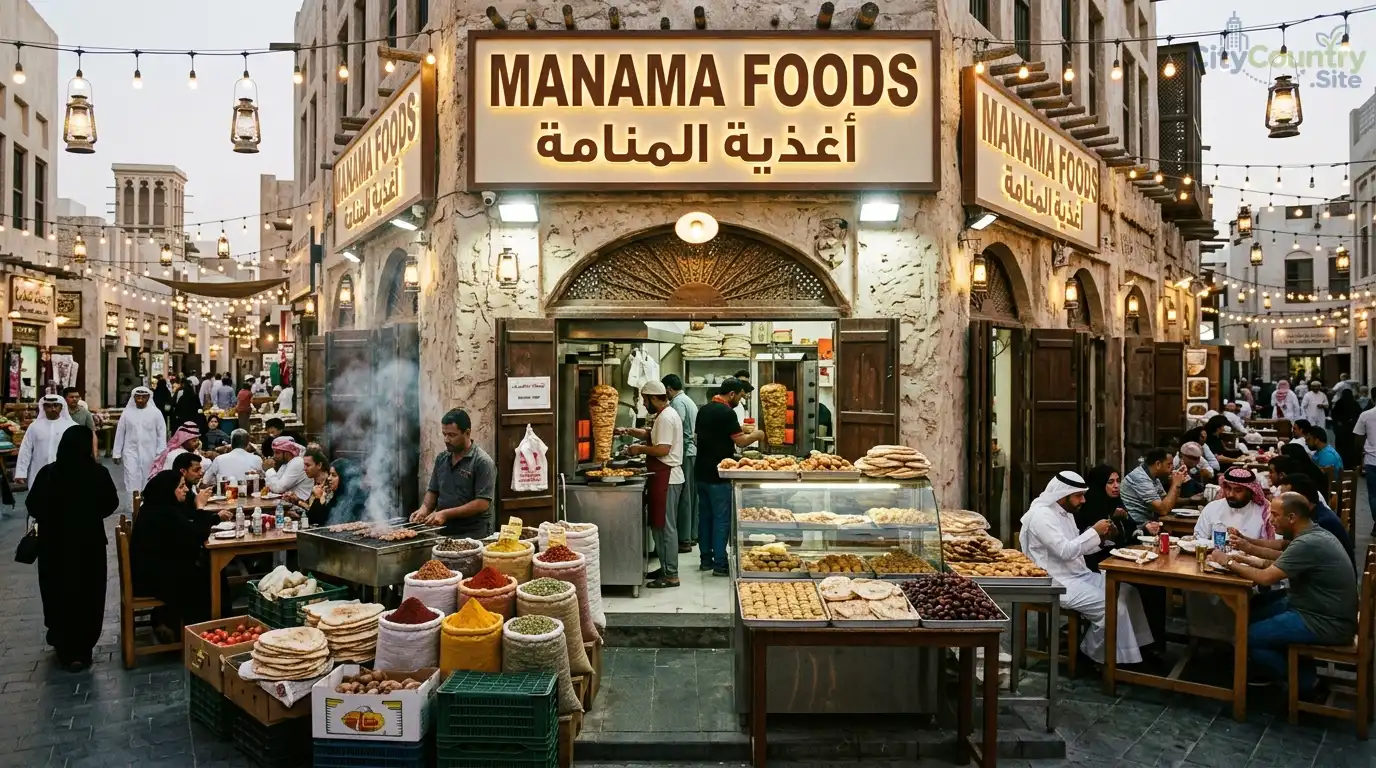
Bahraini cuisine is one of the Gulf’s most distinctive and most overlooked culinary traditions — a sophisticated reflection of the island’s centuries of maritime trade with Persia, India, East Africa, and the Indian Ocean world. Manama’s food scene combines outstanding traditional Bahraini cooking with the remarkable diversity of cuisines brought by its international community.
Must-Try Dishes in Manama
Machboos Al Laham / Machboos Al Samak — Bahrain’s version of the Gulf’s great spiced rice dish — long-grain basmati rice slow-cooked with lamb (al laham) or fish (al samak) in a deeply aromatic broth of dried limes, saffron, rose water, cardamom, cinnamon, and black lime, resulting in a rice of extraordinary complexity and depth. Each Gulf country believes its own version is definitive; Bahrain’s fish machboos — cooked with locally caught hammour or zubaidi from the surrounding Gulf — is genuinely exceptional and arguably the finest in the region.
Muhammar — One of Bahrain’s most distinctive dishes and one that surprises most visitors entirely — sweetened rice cooked with dates, sugar, and rose water into a fragrant, mildly sweet accompaniment served alongside grilled or fried fish. The combination of sweet rice and savory fish creates a flavor pairing that is completely unique to the Gulf and initially unexpected but deeply satisfying once experienced.
Harees Al Bahraini — Whole wheat grains slow-cooked with meat (lamb or chicken) and pounded until they reach a smooth, silky, porridge-like consistency — then topped generously with clarified butter (samn) and a dusting of cinnamon. Bahrain’s version tends to be slightly silkier and more aromatic than other Gulf versions — the result of generations of refinement. An ancient dish that has sustained island communities for millennia.
Saloona — A rich, warmly spiced stew of meat or fish with seasonal vegetables — tomatoes, potatoes, eggplant — slow-cooked until deeply flavored. The Bahraini family’s everyday evening meal, eaten with rice or fresh flatbread. Honest, nourishing, and deeply satisfying in the way that food prepared with genuine care always is.
Balaleet — Bahrain shares with Qatar and Kuwait this unusual but deeply traditional dish — sweetened vermicelli noodles cooked with cardamom, saffron, and rose water, topped with a fried egg. The sweet-savory combination is startling to an unaccustomed palate but entirely right once tasted — a breakfast or light meal of ancient origin.
Khubz Regag — Paper-thin, translucent flatbread cooked on a curved iron griddle with extraordinary speed and lightness — eaten with cheese, eggs, or sweet toppings for breakfast throughout Bahrain. The finest version is found at traditional breakfast stalls in the souq, where expert cooks produce them in rapid succession on outdoor griddles.
Qoozi — Whole roasted lamb served over saffron rice with fried onions and nuts — the Bahraini version of the region’s great celebration dish. Served at weddings, national holidays, and important family gatherings. Rich, aromatic, and deeply satisfying.
Halwa Bahrainiya — Bahrain’s distinctive version of the Gulf’s beloved dense sweet — slightly lighter and more intensely rose-water-scented than the Omani or Kuwaiti versions, with a distinctive texture that melts against the tongue. Available at specialist halwa shops throughout the souq and old neighborhoods. Always accompanied by Bahraini coffee (qahwa).
Best Restaurants and Food Spots in Manama
Al Safir Restaurant (Muharraq) — One of the finest traditional Bahraini restaurants in the country — a beautifully run establishment in Muharraq serving outstanding machboos, muhammar, and fresh Gulf fish in the most authentic setting available. BHD 3–7 (~$8–19) per person.
La Visite Restaurant (Adliya) — A beautifully restored heritage building in Adliya serving excellent Lebanese and Bahraini cuisine with exceptional attention to ingredient quality. One of Manama’s most atmospheric dining spaces. BHD 5–12 (~$13–32).
Flamingo Restaurant (Adliya) — A beloved long-running Adliya institution — unpretentious, consistently excellent Indian-influenced Bahraini cooking with generous portions and outstanding value. A true neighborhood restaurant. BHD 2–5 (~$5–13).
Ric’s Kountry Kitchen (Adliya) — Manama’s most famous breakfast spot — a legendary establishment on Adliya’s restaurant street serving outstanding American-style breakfasts to an eclectic mix of expats, Gulf visitors, and adventurous tourists. The eggs benedict and pancakes are the stuff of Manama legend. BHD 3–6.
Ishbilia House (Seef) — Outstanding Lebanese cuisine in an elegant setting — the finest meze spread in Manama, excellent grills, and a comprehensive arak selection. BHD 6–15 (~$16–40).
Manama Souq Fish Stalls — The freshest and most authentic eating in Manama is found at the fish market adjacent to the souq — vendors selling freshly caught Gulf fish and cooking it to order by weight. Arriving early morning for the freshest selection; eating at plastic tables beside the water while the city wakes up around you.
Luqaimat Stalls (Souq area) — Small stalls throughout the old city selling freshly fried Bahraini luqaimat — small golden dough balls drizzled with date syrup and sesame — for barely BHD 0.200–0.500. Hot from the oil, with the date syrup’s deep caramel sweetness and the sesame’s nuttiness — one of the Gulf’s great simple street food pleasures.
💡 Did You Know? Bahrain’s extraordinary pearl diving history is directly reflected in its cuisine. The pearl divers — who spent months at sea in difficult conditions — required food that was high in calories, preserved without refrigeration, and quick to prepare. Dried fish (achar), rice, dried dates, and simple grain-based dishes were the staples of the pearl diving boat’s galley. When the divers returned to shore with their season’s earnings, the wealthy merchants celebrated with elaborate machboos and roasted meats. This two-tier food culture — the food of the sea and the food of the land — shaped Bahraini cuisine’s distinctive combination of simple, robust seafood preparations and elaborate aromatic rice dishes.
10. Manama Accommodation Guide
Manama has a well-developed luxury and upscale hotel sector alongside growing mid-range options. The city is more affordable than Dubai but prices the equivalent of Doha’s mid-range for most categories.
Best Areas to Stay:
- Bahrain Bay / Diplomatic Area: Best for luxury, Gulf views, and proximity to financial and business districts
- Adliya: Best for cultural immersion, café culture, independent restaurants, and the most interesting neighborhood atmosphere
- Seef District: Best for malls, family-friendly hotels, and modern convenience
- Juffair: Best for those wanting access to Manama’s most active nightlife scene
- Muharraq: Best for atmosphere, heritage proximity, and a more authentic Bahraini experience
Accommodation Price Ranges (2026)
| Category | Price/Night (USD) | Examples |
|---|---|---|
| Budget Hotel / Guesthouse | $35–70 | Various apartment hotels in Manama center |
| Mid-Range Hotel | $80–150 | Gulf Hotel Bahrain, Ramada by Wyndham Manama |
| Upscale Hotel | $150–280 | The Domain Bahrain, Elite Grande Hotel |
| Luxury Hotel | $280–600+ | Four Seasons Bahrain Bay, Ritz-Carlton Bahrain, Sofitel Bahrain Zallaq |
The Four Seasons Bahrain Bay is Manama’s most spectacular hotel — a stunning glass tower rising from the reclaimed Bahrain Bay development, with extraordinary views of the Gulf and the city from every room, outstanding restaurants, a magnificent pool deck, and the Four Seasons’ trademark service perfection. Rates: approximately $350–700 per night.
The Ritz-Carlton Bahrain is a sprawling beachfront resort on the western coast — a magnificent property with a private beach, outstanding sea-facing restaurants, excellent spa, and beautifully maintained grounds. Rates: approximately $280–550 per night.
Gulf Hotel Bahrain is a long-established Manama institution — a comfortable, well-located hotel with multiple excellent restaurants (including the famous Chinese Lantern and Talk of the Town), a good pool, and the kind of reliable quality that comes from decades of operation. Rates: approximately $100–180 per night.
11. Best Time to Visit Manama
November through March is Manama’s finest season for visitors — the same pattern that applies throughout the Gulf, with mild winter temperatures creating perfect conditions for outdoor exploration, heritage site visits, and the full enjoyment of Bahrain’s distinctive island character.
March is particularly significant — the Bahrain Grand Prix (typically held in late March or early April) transforms the island for a week with international energy, extraordinary atmosphere, and the spectacle of Formula 1 racing in the desert night. Grand Prix weekend is one of the most exciting times to be in Manama — but accommodation must be booked many months in advance and prices increase substantially.
December and January offer the finest weather — cool, clear, and comfortable for walking the Pearling Path, exploring the Bahrain Fort, and experiencing the island at its most relaxed.
February is excellent — warming slightly from January’s coolest temperatures while still entirely comfortable. A great time for combining city culture with outdoor site visits.
October and November are good shoulder months — temperatures dropping from summer extremes to manageable levels, with lower accommodation prices than peak season.
April is transitional — warming rapidly but still pleasant in the first half. A good budget-season option.
Key Festivals & Events in Manama
- Bahrain Grand Prix (Formula 1) (March/April) — The most internationally visible annual event in Bahrain — the F1 season’s opening race or second race, held as a spectacular night race under the desert floodlights at the Bahrain International Circuit. One of the most atmospheric races on the F1 calendar
- Bahrain International Airshow (November, biennial) — One of the world’s major aerospace events, held at the Sakhir Air Base — attracting military and commercial aviation orders and aerial displays of extraordinary skill
- Bahrain National Day (December 16) — Celebrates the independence declaration of 1971, marked with fireworks, cultural events, and national celebrations throughout the island
- Spring of Culture Festival (February–March) — An annual cultural festival bringing international and Bahraini performing artists, exhibitions, and cultural programs to venues across Manama
- Bahrain Food Festival (spring/winter) — An annual celebration of Bahraini and international cuisine — food stalls, cooking demonstrations, and culinary competitions
- Ramadan (dates vary) — Manama’s Ramadan atmosphere — particularly the evening Ghabqa (late night feast) culture — is one of the most authentic and generous expressions of Gulf Islamic tradition available to visitors
12. Manama Shopping Guide
Manama offers a distinctive combination of traditional Arabian market culture and excellent modern retail — with the particular advantage that Bahraini prices for gold, pearls, and traditional crafts are often more competitive than in larger Gulf cities.
What to Buy:
Natural Bahraini Pearls — Bahrain’s greatest and most historically significant product. Natural Bahraini pearls — formed in the Gulf’s oyster beds without human intervention — are extraordinarily rare and precious in a world dominated by Japanese cultured pearls. A small number of Bahraini pearl dealers still sell natural pearls of genuine provenance — certifiably natural, with the warm, silky luster that distinguishes them from cultured alternatives. Prices vary enormously based on size, shape, and quality — from a few hundred dollars for small loose pearls to tens of thousands for a graduated strand. Buy only from dealers who provide certificates of authenticity and natural origin. The Manama Souq gold market and specialist pearl shops near Bab Al Bahrain are the best locations.
Gold Jewelry — Bahrain’s gold souq is one of the finest in the Gulf — traditional Arabian designs in 21 and 22-carat gold at competitive prices. The traditional khaleeji (Gulf-style) gold designs — heavy, elaborate pieces in intricate geometric patterns — are distinctively beautiful and much less expensive than comparable pieces in European jewelry markets.
Traditional Dhow Models — Intricately crafted models of traditional Gulf dhow sailing vessels — the ships that made Bahrain’s pearl and trading culture possible. Beautiful decorative objects with genuine cultural significance.
Bahraini Basket Weaving — Traditional woven baskets from Bahrain’s crafting tradition — geometric patterns in natural materials that reflect the island’s Bedouin weaving heritage.
Saffron and Bahraini Spices — The souq’s spice section sells outstanding saffron, dried limes (loomi), cardamom, and the Gulf spice blends used in machboos and other traditional dishes.
Where to Shop:
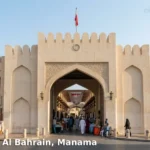
Bab Al Bahrain Souq — The traditional heart of Manama’s commercial life — a beautifully maintained covered market accessed through the iconic Bab Al Bahrain (Gate of Bahrain) archway. The souq contains the gold market, pearl shops, fabric section, spice alley, and a clothing market — all in a dense, atmospheric warren of covered lanes. The Bab Al Bahrain building itself — a beautiful white British Mandate-era structure — is one of Manama’s most photographed landmarks.
Manama Souq (Gold Souq) — The adjacent gold market — dozens of shops displaying extraordinary quantities of gold jewelry in traditional Gulf and contemporary designs. One of the finest gold markets in the Gulf.
City Centre Bahrain — The most comprehensive modern shopping mall in Bahrain — international brands, anchor department stores, a large food court, cinema, and excellent entertainment facilities.
Moda Mall (Bahrain World Trade Centre) — Luxury retail in a spectacular setting — housed at the base of the iconic Bahrain World Trade Centre (the world’s first building to integrate wind turbines between its two towers, an engineering landmark).
13. Manama Nightlife & Entertainment
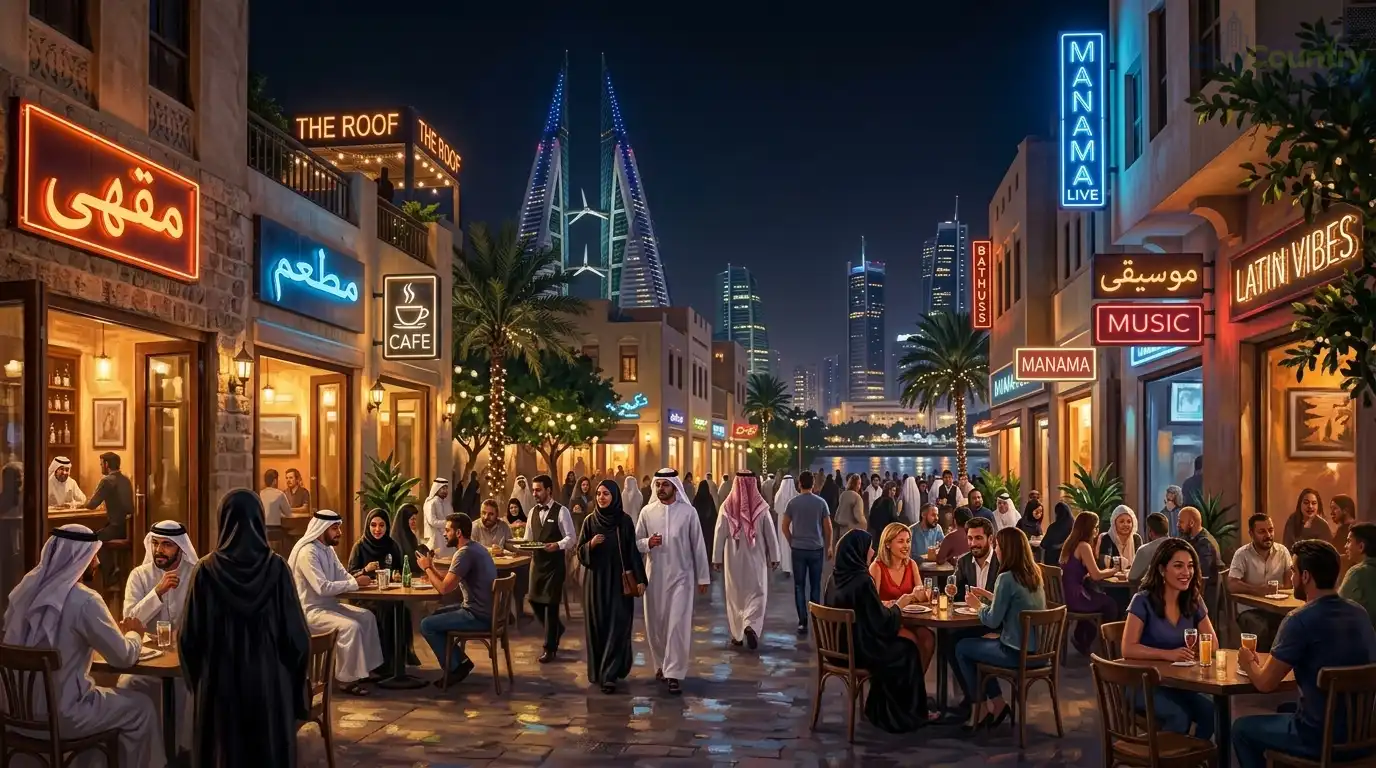
Manama has the Gulf’s most genuinely developed nightlife scene outside of Dubai — a consequence of Bahrain’s social liberalism, its longstanding position as a weekend destination for Saudi visitors, and the presence of a substantial international community including US Naval Base personnel.
Live Music and Cultural Venues:
The Bahrain National Theatre — A beautiful contemporary theater offering regular performances of Arabic drama, music, and dance throughout the cultural season (October–May). One of the finest cultural institutions in the Gulf.
La Fontaine Centre of Contemporary Art (Adliya) — A spectacular arts center housed in a beautifully renovated traditional mansion with a fountain courtyard — regular exhibitions of contemporary art, cultural events, and creative programming that makes it the finest independent art space in Bahrain.
Adliya Art District — The galleries, studios, and creative spaces concentrated in Adliya provide a genuine contemporary arts scene that is the most developed in the Gulf outside of Dubai’s Alserkal Avenue. Regular opening nights, artist talks, and exhibitions throughout the cultural season.
Bars, Restaurants and Rooftop Experiences:
Unlike Kuwait, Bahrain has an extensive licensed alcohol sector — restaurants, hotel bars, and many standalone licensed establishments serve alcohol throughout the city.
Haji’s (Adliya) — A legendary Manama bar institution — one of the first licensed establishments in Bahrain, still serving cold Heineken and simple food in an atmosphere of timeless Gulf bar culture. Historic, unpretentious, essential.
Block 338 (Adliya) — A beautifully developed outdoor courtyard complex of restaurants, bars, and cafés in a restored traditional neighborhood — one of Manama’s finest evening destinations for dining and drinks.
The Roof (Adliya) — A rooftop bar and restaurant with one of the finest city and Gulf views available — excellent cocktails, relaxed atmosphere, and the particular pleasure of drinking a cold drink on a warm Gulf evening under an extraordinary sky.
Buddha Bar Bahrain (various locations) — The internationally branded Buddha Bar has a strong Manama presence — beautiful design, excellent cocktails, and international DJ programming that makes it one of the more glamorous evening options.
Clubs:
The Dubliner’s — The most reliably popular Irish pub-style bar in Manama — consistently busy, with live music several nights a week and the all-inclusive camaraderie of a good bar.
Vasco’s (Intercontinental Hotel) — A long-running Manama institution — one of the most popular clubs in the city, drawing a Gulf-wide crowd on weekends with international DJs and commercial music.
14. Hidden Gems & Local Secrets
Al-Khamis Mosque — Located in the southern suburbs of Manama, the Al-Khamis Mosque is believed to be among the oldest mosques in the Islamic world — with foundations dating to approximately 692 CE (the early Umayyad period). Two distinctive stone minarets from different periods (11th and 14th centuries) rise from the ancient structure. Almost entirely unknown to international visitors, it sits quietly in an ordinary residential neighborhood — its extraordinary antiquity entirely unremarked by the surrounding modern buildings. Free to visit; dress modestly.
Riffa Fort (Qal’at Riffa) — A beautifully restored hilltop fort in the inland town of Riffa — once the residence of Bahrain’s ruling family — with commanding views over the surrounding palm date groves and desert. The restored interior is atmospheric and excellently presented; the view from the ramparts is one of the finest in all of Bahrain. Almost entirely free of tourists despite being easily accessible.
The Pottery Village of A’ali — A village in central Bahrain where families have been producing traditional pottery using locally sourced clay for hundreds of years — using techniques and kiln forms virtually unchanged since antiquity. Visiting the working pottery workshops, watching potters form traditional water jugs and vessels on hand-turned wheels, and buying directly from the makers is one of the most authentic craft experiences in the Gulf. Prices are extremely modest.
Al-Areen Wildlife Park — A nature reserve in southern Bahrain containing the Arabian oryx, gazelle, flamingos, and various other desert and wetland species in natural surroundings. Quiet, well-managed, and a genuine surprise for those who expect the Gulf to be entirely without natural wildlife. Particularly beautiful in the early morning.
Manama Souq at Iftar Time (During Ramadan) — The moment that Ramadan’s fast breaks at sunset transforms the souq into something extraordinary — stalls open simultaneously, families spread rugs for outdoor iftar meals, the smell of fresh bread and grilled meat fills the alleys, and a collective exhale of relief and joy transforms the space. The most authentic and most moving experience of traditional Bahraini culture available to visitors.
Al Dar Islands — A cluster of small natural islands just offshore from the Bahraini coast — accessible by boat from the Sitra area — with natural beaches, clear water, and remarkably accessible marine life including rays, small reef fish, and occasional sea turtles. Almost entirely free of tourists; genuinely beautiful; extraordinarily affordable.
15. Day Trips from Manama
Bahrain is a tiny island country — the entire island of Bahrain is barely 55 km long — meaning that every significant attraction is accessible within 45 minutes of the capital. The concept of “day trip” in Bahrain means exploring the island rather than leaving it; longer excursions cross the King Fahd Causeway to Saudi Arabia.
Day Trips Table
| Destination | Distance | Travel Time | Method | Highlights |
|---|---|---|---|---|
| Bahrain Fort (Qal’at Al Bahrain) | 8 km west | 15 min | Car / Taxi | UNESCO World Heritage — 4,000 years of history |
| Muharraq Island / Pearling Path | 5 km north | 15 min by bridge | Car / Taxi | UNESCO pearl heritage, traditional architecture |
| Al-Areen Wildlife Park | 35 km south | 40 min | Car | Arabian oryx, flamingos, desert wildlife |
| Riffa Fort | 15 km south | 20 min | Car | Historic fort, excellent views, royal heritage |
| Tree of Life | 40 km south | 45 min | Car | Mysterious ancient tree in empty desert |
| Bahrain International Circuit | 35 km south | 40 min | Car | F1 track tours, motorsport heritage |
| A’ali Pottery Village | 20 km southwest | 25 min | Car | Traditional pottery workshops, ancient craft |
| Hawar Islands | 40 km south (by boat) | 1 hour by ferry | Ferry | Remote island paradise, flamingos, diving |
| Dammam, Saudi Arabia | 40 km (by causeway) | 1.5–2 hrs | Car | Saudi Eastern Province city, oil heritage |
Muharraq Island and the Pearling Path — accessible across the causeway from Manama — is the single finest historical day trip available on the island. The UNESCO-listed Pearling Path connects 17 heritage buildings — pearl merchants’ mansions, divers’ houses, the harbor, storehouses, and a mosque — in an authentic traditional urban landscape that preserves the complete social and economic world of the pearl industry. The Bin Matar House and Sheikh Isa bin Ali Al Khalifa House — both beautifully restored traditional courtyard mansions with wind towers and carved wooden screens — are among the finest examples of traditional Gulf domestic architecture in existence.
The Tree of Life is perhaps Bahrain’s most surreal attraction — a 400-year-old mesquite tree standing completely alone in the middle of totally barren desert, with no water source for many kilometers. The drive south through the increasingly empty desert landscape heightens the impact of the tree’s sudden appearance. At sunset, when the dying light turns the desert copper and the tree stands dark against it, the scene is almost metaphysically powerful.
Hawar Islands — a cluster of remote islands near the Qatari coast — offer extraordinary birdwatching (the largest flamingo colony in the Gulf), beautiful beaches, excellent diving, and a sense of absolute remoteness just an hour from Manama by ferry. A beautiful and genuinely underexplored corner of Bahrain.

16. Manama Local Culture, Customs & Etiquette
Bahrain is one of the Gulf’s most socially open societies — a consequence of its millennia-long role as a trading crossroads, its diverse demographic composition, and the particular character of a small island nation that has always needed to accommodate difference. This openness, however, coexists with deep religious values and traditional social norms that visitors should understand and respect.
Religious Diversity: Bahrain is unique in the Gulf for having a Shia Muslim majority (approximately 50–60% of Bahraini nationals) governed by a Sunni Muslim ruling family. This demographic reality has shaped Bahraini politics, architecture, and social life in ways that are visible throughout the island — Shia mosques and Hussainiyyas (community meeting centers) alongside Sunni mosques; Shia religious observances (particularly Ashura, when the mourning processions through Muharraq are deeply moving) alongside Sunni ones. Bahrain also has significant Christian, Hindu, and Jewish communities — the latter documented since antiquity and including the Al-Eshkhenazi Synagogue, one of the oldest in the Gulf.
Social Liberalism: By Gulf standards, Bahrain is remarkably open — women have driven freely for decades, mixed-gender social spaces are normal, and the dress code is relaxed by regional standards. Western women can walk in most areas of Manama in ordinary Western clothing without incident. At religious sites and in more conservative areas, modest dress is appropriate.
Hospitality: Bahraini hospitality follows the same deep Gulf tradition of generous welcome — the offer of coffee and dates at every social encounter, the insistence that guests eat more than they think they can manage, and the genuine warmth of invitation. Accept all offers graciously.
Photography: Ask permission before photographing individuals. The Bahrain International Circuit has specific photography rules during events. Government and military installations must not be photographed. The heritage sites — Fort, Pearling Path, mosques — are freely photographable with appropriate respect.
Tipping:
- Restaurants: 10–15% tip is standard and appreciated
- Taxis / Uber: rounding up is appreciated
- Hotel staff: BHD 0.500–1 (~$1.30–2.65) per service
- Tour guides: BHD 5–10 (~$13–27) per day
Dos and Don’ts:
- ✅ Do visit Al-Fatih Grand Mosque — the free guided tours are excellent and the building is extraordinary
- ✅ Do engage with the Pearling Path audio guide — it provides the finest available account of what Bahrain was before oil
- ✅ Do try the traditional breakfast of khubz regag with eggs at a souq stall — the most authentic morning experience in Manama
- ❌ Don’t assume Bahrain’s social liberalism means the same values as a Western city — it is a different kind of openness, rooted in different traditions
- ❌ Don’t photograph Ashura mourning processions without extreme sensitivity — these are deeply sacred religious observances
- ❌ Don’t discuss sectarian politics carelessly — the Sunni-Shia tensions are a sensitive and ongoing reality
17. Safety & Travel Tips
Manama is a very safe city for tourists — low crime, efficient policing, and a stable social environment make it one of the safer Gulf destinations. The 2011 political unrest has not recurred at significant scale, though the underlying tensions remain.
Safe Areas: The entire tourist circuit — the souq, Adliya, the Diplomatic Area, Bahrain Bay, and all major hotels — is completely safe. Muharraq and southern Bahrain are equally safe.
Main Practical Concerns:
- Summer heat — as throughout the Gulf, the primary physical danger; avoid outdoor activity between 10 AM and 6 PM in summer
- Traffic — driving standards can be aggressive; exercise defensive driving
- Alcohol awareness — while alcohol is available in licensed premises, public intoxication is illegal and disrespectful; drink within licensed venues only
Emergency Numbers:
- Police: 999
- Ambulance: 999
- Fire: 999 (unified emergency number)
- Coast Guard: 17737400
Health Tips:
- Medical facilities in Bahrain are excellent — Bahrain Defense Force Hospital and multiple private facilities provide good care
- Tap water is treated and technically drinkable but bottled water is recommended
- Sunscreen is essential year-round — the Gulf sun is intense even in winter
- Travel insurance with medical coverage is recommended
18. Manama Budget Tour
Daily Cost Table
| Category | Budget Traveler | Mid-Range | Luxury |
|---|---|---|---|
| Accommodation | $35–70 (budget hotel) | $100–200 (hotel) | $280–600+ (luxury hotel) |
| Food | $8–18 (local restaurants, souq stalls) | $30–65 (restaurant meals) | $80–200+ (fine dining) |
| Transport | $4–10 (Careem, bus) | $15–35 (taxis, Careem) | $50–100 (private car) |
| Activities | $5–15 (Fort, museum, Pearling Path) | $20–50 (guided tours, Circuit) | $60–150+ (private guide) |
| Total/Day | ~$52–113 | ~$165–350 | ~$470–1,050+ |
Manama is moderately priced by Gulf standards — more affordable than Dubai and Doha at the luxury level, competitive at the mid-range. Budget travelers who use local restaurants and budget hotels can manage well below $100 per day. Grand Prix weekend dramatically increases all prices — a basic hotel room that costs $100 normally may cost $500+ during F1 weekend.
19. Practical City Information
Visa & Entry: Bahrain has one of the most accessible visa policies in the Gulf. Citizens of GCC countries enter without visa. Citizens of most Western countries — EU, USA, UK, Canada, Australia, Japan, and many others — can obtain a visa on arrival or e-visa online at evisa.gov.bh before travel. Standard visa on arrival: BHD 5 (~$13.25) for most eligible nationalities, valid for 14 days; extendable. Citizens of over 60 nationalities qualify for a free visa on arrival as of 2026 — check the Bahrain e-Government portal for current eligibility. The visa process at Bahrain airport is one of the fastest and most straightforward in the region.
Currency: The Bahraini Dinar (BHD) — at approximately 1 BHD = 2.65 USD — is one of the world’s three most valuable currencies by exchange rate. It is divided into 1,000 fils. ATMs are widely available; credit cards accepted throughout the city. Carry BHD cash for markets, taxis, and smaller establishments. Saudi Riyals are accepted in many Bahraini establishments near the causeway, reflecting the regular Saudi visitor traffic.
Vaccinations: No mandatory vaccinations for most travelers. Recommended: Hepatitis A, Typhoid, Tetanus, routine immunizations. Yellow fever certificate required if arriving from endemic countries.
Emergency Contacts:
- All emergencies: 999
- Bahrain Tourism & Exhibitions Authority: 17518888
SIM Cards and Internet: Available at the airport and throughout the city. Batelco and Zain Bahrain and STC Bahrain are the operators. A tourist SIM with 10–20 GB data costs approximately BHD 3–5 (~$8–13). 4G and 5G coverage is excellent throughout Bahrain. Wi-Fi available at all hotels, cafés, and malls.
Power: Bahrain uses Type G plugs — UK-style three-pin square plugs — at 230V, 50Hz. UK visitors need no adapter; others need a universal adapter.
Alcohol: Available at licensed hotel bars, restaurants, and some standalone licensed venues. Not available in souqs, non-licensed restaurants, or public spaces. Bahrain is the most alcohol-accessible Gulf state after UAE.
20. How to Be a Responsible Traveler in Manama
Support the Pearling Heritage: The UNESCO Pearling Path represents Bahrain’s most important non-oil cultural heritage. Visit with the audio guide, pay the entry fee, and engage seriously with the history. The pearl diving tradition sustained an extraordinary civilization for millennia; it deserves more than a quick walk-through.
Buy Natural Bahraini Pearls Ethically: If buying pearls in Manama — and you should consider it — buy only from reputable dealers who provide genuine certificates of natural origin and can explain the pearl’s provenance. The trade in fake “natural Bahraini pearls” (actually cultured) is unfortunately common in tourist markets. Ethical purchasing supports the small number of dealers maintaining the genuine natural pearl tradition.
Visit A’ali Pottery Village: Buying pottery directly from the artisan families of A’ali supports a craft tradition that has survived for centuries and deserves continuation. The prices are extremely modest; the impact on artisan livelihoods is significant.
Environmental Awareness of the Gulf: Bahrain’s surrounding waters — the source of its pearl wealth and the sustainer of its fishing communities for millennia — face significant environmental pressure from pollution, coastal development, and warming temperatures. Support organizations working on Gulf marine conservation. Never purchase coral, shells, or other marine-derived products.
Water Conservation: All of Bahrain’s fresh water comes from desalination — one of the most energy-intensive processes on earth. Be genuinely conservative with water use.
Engage with Both Communities: Bahrain’s Sunni-Shia demographic complexity is a social reality that shapes the country profoundly. Engaging with both communities — visiting both Sunni mosques and Shia shrines, eating in both Sunni and Shia neighborhoods, listening to perspectives from both sides of Bahrain’s social fabric — produces a much richer and more accurate understanding of the country than remaining only in the comfortable international hotel bubble.
21. Travel Media: Documentaries, Books & Channels
Books:
- The History of Bahrain by Fuad Khuri — A comprehensive academic account of Bahrain’s social and political history from pre-Islamic times to the 20th century
- Pearls, Politics and Power by Nelida Fuccaro — An outstanding scholarly account of Manama’s development as a modern city through the lens of the pearl trade, migration, and colonial politics
- The Shia Revival by Vali Nasr — Essential reading for understanding the Sunni-Shia dynamics that shape Bahrain’s political reality
- Stories from the Gulf (various anthologies) — Traditional Gulf folk tales that illuminate the cultural world of the pearl diving era
Documentaries:
- Various F1 Documentary productions (Netflix Drive to Survive series includes significant Bahrain Grand Prix content) provide excellent context for the circuit and its role in Formula 1
- Al Jazeera English documentaries on Bahrain’s political situation and pearl heritage provide good background context
YouTube Channels:
- Mark Wiens — Good Manama food content
- Bahrain Tourism — Official destination content with improving production quality
- Lost With Purpose — Bahrain travel content with good historical context
22. Manama vs. Similar Cities
| Feature | Manama | Dubai (UAE) | Doha (Qatar) |
|---|---|---|---|
| Historical depth | ⭐⭐⭐⭐⭐ 5,000 years — deepest in Gulf | ⭐⭐ Limited pre-oil history | ⭐⭐⭐⭐ Good |
| Museum quality | ⭐⭐⭐⭐⭐ National Museum outstanding | ⭐⭐⭐⭐ Very good | ⭐⭐⭐⭐⭐ MIA world-class |
| Social liberalism | ⭐⭐⭐⭐⭐ Most liberal Gulf state | ⭐⭐⭐⭐⭐ Very liberal | ⭐⭐⭐ Moderate |
| Nightlife | ⭐⭐⭐⭐ Very good | ⭐⭐⭐⭐⭐ Outstanding | ⭐⭐⭐ Moderate |
| Architecture | ⭐⭐⭐ Good | ⭐⭐⭐⭐⭐ Exceptional | ⭐⭐⭐⭐⭐ Exceptional |
| Affordability | ⭐⭐⭐⭐ Good value | ⭐⭐ Expensive | ⭐⭐ Expensive |
| Pearl / maritime heritage | ⭐⭐⭐⭐⭐ UNESCO — finest in world | ⭐⭐ Limited | ⭐⭐⭐ Good |
| Formula 1 | ⭐⭐⭐⭐⭐ Legendary night race | ⭐⭐⭐⭐⭐ Abu Dhabi finale | ⭐ No race |
Choose Manama if you want the Gulf’s deepest historical layers — genuinely ancient rather than reconstructed — alongside the region’s most relaxed social atmosphere, outstanding pearl heritage, competitive prices, and the extraordinary atmosphere of a Grand Prix weekend in the desert.
23. Manama City Travel Tips
- Visit between November and March — Bahrain’s summer heat combined with Gulf humidity is genuinely extreme
- The Bahrain Fort at opening time (8 AM) before tour groups arrive is the finest single historical experience in the Gulf
- Buy Bahraini natural pearls only from certified dealers with provenance documentation — fakes are common
- Adliya neighborhood for dinner and evening is the finest urban cultural experience in Manama
- Grand Prix weekend (March/April) — book accommodation 6+ months in advance; prices triple or more
- The Pearling Path audio guide is outstanding — do not walk the path without it
- Al-Fatih Grand Mosque free tours are excellent — dress very modestly and go in the morning
- The Bahraini Dinar is worth approximately $2.65 — check your arithmetic carefully before paying
- Download Careem before arriving — the most reliable ride-hailing option in Bahrain
- King Fahd Causeway — the drive to/from Saudi Arabia across the causeway at night is beautiful
- Muhammar (sweet rice with fish) is Bahrain’s most distinctive dish — order it at any traditional Bahraini restaurant
- Bahrain is the most alcohol-accessible Gulf state after UAE — licensed hotel bars are well-stocked and the nightlife in Juffair and Adliya is genuine
💡 Did You Know? The Bahrain World Trade Centre — completed in 2008 — was the world’s first skyscraper to integrate wind turbines directly into its structure. Three large horizontal-axis wind turbines, each 29 metres in diameter, are mounted on bridges connecting the building’s two tapering towers. The towers themselves are designed aerodynamically to channel the prevailing Gulf wind between them and through the turbines — generating approximately 11–15% of the building’s energy needs. It remains one of the most intelligent integrations of renewable energy into a major commercial building ever achieved and was a landmark in sustainable architecture globally.
24. Is Manama Worth Visiting?
Yes — and with particular enthusiasm for travelers who care about genuine historical depth and authentic cultural encounter. Manama is the Gulf’s most historically layered capital — a city whose 5,000-year story is legible in its landscape and preserved in some of the finest museum collections in the Arab world. It is simultaneously the Gulf’s most socially relaxed destination, its finest pearl heritage center, one of the most atmospheric Formula 1 venues on earth, and a genuinely pleasant, human-scale city that has not yet been overwhelmed by the kind of hyper-development that makes some of its neighbors feel slightly unreal.
Manama is best suited for:
- History and archaeology enthusiasts — The Bahrain Fort and Bahrain National Museum represent the finest ancient history collection in the Gulf; the Pearling Path is genuinely world-class
- Pearl and jewelry lovers — Manama is the only place on earth where natural Bahraini pearls can be purchased with genuine provenance — one of the world’s most precious natural objects
- Formula 1 enthusiasts — The Bahrain Grand Prix is consistently ranked among the most atmospheric events on the F1 calendar; attending the night race in the desert is a genuinely extraordinary experience
- Cultural and arts travelers — Adliya’s gallery scene, La Fontaine Centre, and the Spring of Culture Festival represent the Gulf’s most accessible and genuine contemporary arts culture outside Dubai
- Travelers seeking a more relaxed Gulf experience — Manama’s social liberalism and human scale create a Gulf experience that is less frenetic and more genuinely comfortable than the larger Gulf capitals
- Saudi visitors and regional travelers — The King Fahd Causeway makes Manama uniquely accessible to Saudi Arabia’s Eastern Province, creating a dynamic cross-border cultural exchange that adds to the city’s energy
- Business and finance travelers — Bahrain’s financial services sector is the Gulf’s most established and internationally connected
Less suited for travelers seeking the most spectacular contemporary architecture (Dubai and Doha are superior), those primarily interested in beach resort holidays, or visitors requiring the extreme luxury and scale of Dubai’s hotel offering.
The verdict: Give Manama three full days minimum — four is ideal. Spend a morning at the Bahrain Fort at opening time, an afternoon walking the Pearling Path, an evening discovering Adliya’s restaurant scene. Visit Al-Fatih Mosque in the morning, the National Museum before lunch, the Tree of Life at sunset. Eat machboos and muhammar at a Muharraq family restaurant. Browse the gold souq for Bahraini pearls. And if the Grand Prix calendar aligns with your travel dates — rearrange your entire schedule to be there. Few experiences anywhere in travel combine history, culture, spectacle, and sheer visceral excitement quite like a Formula 1 night race in the Bahraini desert.
25. Frequently Asked Questions About Manama
Q1: Is Manama safe for tourists?
Manama is a very safe city for international tourists. The main tourist areas — the souq, Adliya, Bahrain Bay, Diplomatic Area, and all major hotels — are completely safe at all hours. General urban precautions apply but violent crime against tourists is extremely rare. Women travelers report feeling comfortable and safe in most areas of the city. Check current travel advisories before visiting, as Bahrain’s political environment can occasionally become tense.
Q2: Do I need a visa to visit Bahrain?
Citizens of many nationalities — including EU member states, USA, UK, Canada, Australia, and Japan — qualify for free visa on arrival or low-cost e-visa at Bahrain airport. GCC citizens enter without visa. The application process at Bahrain airport is one of the fastest in the Gulf. Check the Bahrain e-Government portal (evisa.gov.bh) for current eligibility for your specific nationality before travel.
Q3: Can I drink alcohol in Manama?
Yes — Bahrain is the Gulf’s most alcohol-accessible state. Alcohol is available at licensed hotel bars, restaurants, and some standalone licensed establishments throughout Manama and particularly in the Juffair neighborhood. It is not available in non-licensed restaurants, the souq, or public spaces. Public intoxication is illegal. Drink responsibly and only within licensed premises.
Q4: What is the Pearling Path and why is it UNESCO listed?
The Pearling Path is a heritage trail through Muharraq Island that preserves the complete physical landscape of Bahrain’s pearl diving industry — merchants’ mansions, divers’ quarters, water cisterns, a fort, and a mosque — in an authentic urban fabric entirely unchanged from the pearl era. UNESCO listed it in 2012 as an outstanding example of a complete economic and social system preserved in its physical setting. Bahrain was the center of the Gulf pearl industry for centuries before Japanese cultured pearls destroyed the trade in the 1930s; the Pearling Path is what survives of that extraordinary civilization.
Q5: When is the Bahrain Grand Prix and how do I attend?
The Bahrain Grand Prix is typically held in late March or early April — often as the opening race or second race of the F1 season. It is held as a night race under floodlights at the Bahrain International Circuit, approximately 35 km south of Manama. Tickets range from $100 for general admission to $500+ for grandstand seats for race weekend. The atmosphere — F1 cars thundering through the desert night with the Gulf darkness beyond the circuit’s ring of light — is extraordinary and unlike any European circuit. Book tickets and accommodation at least 6 months in advance; the island fills completely.
Q6: What is the Tree of Life and how do I get there?
The Tree of Life is a single 400-year-old mesquite tree standing completely alone in the flat, barren desert of southern Bahrain — with no visible water source for many kilometers in any direction. How it survives — and has survived for four centuries — remains unexplained. Located approximately 40 km south of Manama (about 45 minutes by car), it is best visited by rental car or hired taxi rather than public transport. Go either early morning or at sunset for the most atmospheric experience. There is no entry fee; the surrounding area is open and unguarded.
Q7: What makes Bahraini pearls special and where do I buy them?
Natural Bahraini pearls — formed in the Gulf’s oyster beds without human intervention — are among the rarest and most precious natural objects in the world. Unlike Japanese cultured pearls (which involve human implantation of a nucleus), natural pearls form entirely naturally and take years to develop. Bahraini natural pearls have a distinctive warm luster and surface quality prized by jewelers globally. Buy only from certified dealers in the Manama Souq gold market or specialist pearl shops near Bab Al Bahrain who provide certificates of natural origin. Prices vary from a few hundred dollars for small loose pearls to tens of thousands for exceptional strands.
Q8: How do I travel between Manama and Saudi Arabia?
The King Fahd Causeway connects Bahrain to Saudi Arabia’s Eastern Province (Dammam area) — a 25-km road bridge across the Gulf that takes approximately 20 minutes to drive under normal traffic conditions. The causeway carries extremely heavy Saudi visitor traffic on weekends. Allow 1.5–2 hours for the total journey including border formalities. Saudi visa requirements apply; check current visa requirements for your nationality well in advance. The drive across the causeway at night — with the Gulf on both sides and Manama’s lights ahead or behind — is genuinely beautiful.
Q9: How many days should I spend in Manama?
Two full days covers the major sites — Bahrain Fort, National Museum, Pearling Path, Al-Fatih Mosque, Bab Al Bahrain Souq, and Adliya evening. Three days adds the Tree of Life, Muharraq old town, Riffa Fort, and more leisurely exploration of the souq and pearl market. Four days allows for the Hawar Islands day trip and full appreciation of everything Manama offers. During Grand Prix weekend, add an extra day for circuit-related activities and the extraordinary event atmosphere.
Q10: Is Manama expensive?
Manama is moderately priced by Gulf standards — more affordable than Dubai and Doha at most accommodation and dining levels. Budget travelers using local restaurants and mid-range hotels can manage for $80–120 per day. The main expense driver is accommodation during peak periods — particularly Grand Prix weekend, when prices across the island increase dramatically. Food at local traditional restaurants is genuinely affordable; even upscale Bahraini dining is less expensive than equivalent quality in Dubai.
26. Sources & References
This article was researched using information from the following trusted sources:
- Lonely Planet Bahrain — lonelyplanet.com
- TripAdvisor Manama — tripadvisor.com
- Booking.com Manama Hotels — booking.com
- Wikipedia — Manama — en.wikipedia.org
- Bahrain Tourism & Exhibitions Authority — bahrain.bh/tourism
- Numbeo — Cost of Living Manama — numbeo.com
- Google Maps — maps.google.com
- Wikitravel Manama — wikitravel.org
- Skyscanner Bahrain Flights — skyscanner.com
- World Travel Guide — worldtravelguide.net
- Bahrain e-Government Portal (visas) — evisa.gov.bh
- UNESCO Bahrain Pearl Heritage — whc.unesco.org
- Bahrain International Circuit — bahraingp.com
- Condé Nast Traveller Bahrain — cntraveller.com
- Bahrain National Museum — nationalmuseum.gov.bh
27. Manama Travel Guide Images