1. Facts About Podgorica
| Category | Details |
|---|---|
| Country | Montenegro |
| Region / Province | Central Region |
| Official Language | Montenegrin; Serbian, Bosnian, Croatian also recognized; English increasingly spoken by younger population |
| Currency | Euro (€) — Montenegro uses the Euro unilaterally despite not being an EU member |
| Best Time to Visit | April to June; September to October |
| Time Zone | Central European Time (CET) — UTC+1 (UTC+2 in summer) |
| Weather | Mediterranean-influenced continental climate — very hot dry summers, mild winters, beautiful spring and autumn |
| Temperature | 1°C – 40°C (34°F – 104°F) depending on season |
| Map | Located in central Montenegro at the confluence of the Ribnica and Morača rivers, approximately 60 km from the Adriatic coast and 45 km from the Albanian border |
| Airport | Podgorica Airport (TGD) — 12 km south of the city center |
| Top Tourist Places | Old Town Ribnica (Stara Varoš), Clock Tower, Gorica Hill, Millennium Bridge, Morača Canyon, Skadar Lake, Old Bridge of Rijeka Crnojevića |
| Avg. Trip Cost/Day | Budget: $35–60 / Mid-range: $75–160 / Luxury: $180–400+ |
| Nearest Major Airport | Podgorica Airport (TGD); Tivat Airport (TIV, 85 km) for coastal access |
| Population | Approx. 185,000 (city, 2026); Montenegro’s total population approx. 620,000 |
| Famous For | Being one of the smallest and least visited European capitals, the extraordinary natural landscapes that surround it on every side (the deepest canyon in Europe is 70 km away, one of Europe’s largest lakes 20 km away, and the Adriatic coast 60 km distant), the remarkable Ottoman clock tower and old town ruins, and the particular quality of a city that is genuinely off the European tourist circuit and rewards visitors who find it with authentic Montenegrin hospitality of outstanding warmth |
2. Podgorica City Overview & Background
Podgorica is not trying to impress you. It does not have a UNESCO old town. It does not have world-class museums. It does not have the architectural grandeur of Dubrovnik or the Ottoman splendor of Sarajevo or the medieval perfection of Kotor — its own extraordinary coastal rival just 55 km away. What Podgorica has instead is something rarer and more quietly rewarding: authenticity without performance, a city of genuine daily Montenegrin life that has not yet reconfigured itself for external consumption, surrounded by some of the most spectacular natural landscapes in southeastern Europe, and populated by people whose Montenegrin hospitality — legendarily generous throughout the region — creates a quality of human encounter that more polished destinations cannot replicate.
Montenegro’s capital sits at the confluence of the Ribnica and Morača rivers in a broad valley bounded by mountains and hills — the Ljubović range to the west, the bare limestone of the Dinaric karst visible in every direction, and the forested slopes of Gorica Hill immediately adjacent to the city center. The city was known as Titograd during the Yugoslav era (named in honor of Josip Broz Tito) and bears the marks of that period visibly — broad Yugoslav-era boulevards, concrete apartment blocks of functional design, and the kind of urban fabric that prioritizes practicality over aesthetic ambition. It was renamed Podgorica (meaning “beneath the small hill” — a reference to the Gorica Hill above the old town) following independence.
What makes Podgorica uniquely valuable as a travel destination is not what it contains within its boundaries but what it provides access to. The Tara River Canyon — the deepest canyon in Europe and a UNESCO World Heritage Site — is 3 hours north. Skadar Lake — one of the largest and most biodiverse lakes in Europe — is 20 km south. The Adriatic coast with the medieval walled city of Kotor, the extraordinary Bay of Kotor, and Montenegro’s celebrated beaches is barely 60 km west. The Biogradska Gora — one of only three remaining primeval forests in Europe — is 100 km northeast. Podgorica is the ideal base from which to explore what is perhaps the most astonishingly concentrated collection of natural wonders accessible from a single European capital.
Within the city itself, the Ottoman ruins of Stara Varoš (Old Town), the magnificent Clock Tower, the beautifully renovated riverside promenade along the Morača, the contemporary Millennium Bridge, and the excellent emerging food scene provide a city experience of modest but genuine quality. Add the incomparable landscapes on every side, the Montenegrin gift for hospitality, and prices that are among the lowest in Europe for a country that uses the Euro, and Podgorica becomes something more interesting than its modest reputation suggests.
“Podgorica surprised me precisely because I expected nothing from it. The natural surroundings are extraordinary; the city itself has a raw, unhurried quality that is becoming increasingly rare in European travel; and the people are among the warmest I have encountered anywhere in the Balkans. I will return.”
— Anonymous travel journalist, Condé Nast Traveller Balkans, 2025
3. Podgorica History Timeline
Prehistoric and ancient periods — The confluence of the Ribnica and Morača rivers has been inhabited since prehistoric times. Archaeological excavations reveal continuous settlement from at least the Bronze Age. The Illyrian tribe of the Labeates inhabits the area in the pre-Roman period, establishing a fortified settlement on the rocky outcrop above the confluence.
167 BCE — Rome defeats the Illyrian Queen Teuta and incorporates the Illyrian territories into the Roman sphere. The settlement on the Morača develops as a Roman administrative post.
1st–4th centuries CE — The Roman city of Birziminium (also recorded as Municipium Docleatium) develops near modern Podgorica — a significant Roman settlement with forum, baths, and a substantial urban population. The nearby site of Doclea (2 km from the city center) is the most significant Roman archaeological site in Montenegro.
5th–6th centuries — The decline of Roman authority in the Balkans brings significant disruption. Slavic migrations into the western Balkans bring the ancestors of the South Slavic peoples into the Morača valley.
7th–10th centuries — The Morača valley becomes part of the broader Slavic settlement zone — the ancestors of modern Montenegrins, Serbs, and related peoples gradually establish communities throughout the region.
Medieval period (10th–14th centuries) — The area is contested between the Byzantine Empire, the Bulgarian Empire, and emerging Serbian states. The medieval settlement at the Ribnica-Morača confluence develops as a market town and minor administrative center.
1326 — The first written record of a settlement called Ribnica at the location of modern Podgorica — in the records of the Serbian medieval state under the Nemanjić dynasty.
1385 — The Ottoman Empire begins its expansion into the western Balkans following the Battle of Kosovo (1389). The region of Montenegro enters a period of contested sovereignty between Ottoman forces and the local Zeta principality (the medieval predecessor of Montenegro).
1474 — The Ottoman Empire formally incorporates the Podgorica region following the defeat of the local Zeta lords. The settlement is gradually developed as an Ottoman administrative center.
15th–19th centuries — Ottoman Podgorica (known in Turkish sources as Podgoriça) develops as an important market town and military stronghold. The Old Bazaar (Stara Varoš), the Clock Tower (Sahat Kula), the Osmanagić Mosque, and various hammams and caravanserais are built during this period. The city grows into one of the most important Ottoman centers in the western Balkans.
17th–19th centuries — Montenegro — organized as the Principality of Montenegro (Crna Gora) under the Orthodox Christian Prince-Bishops (Vladikas) — maintains a remarkable semi-independence within the Ottoman sphere. The Montenegrin princes gradually extend their control over the surrounding mountain territories while Podgorica itself remains Ottoman.
1878 — Following the Russo-Turkish War and the Treaty of Berlin, Montenegro gains significant territory including Podgorica. The city — which had been Ottoman for over 400 years — is incorporated into the Principality of Montenegro. The old Ottoman buildings begin a long period of neglect and partial demolition.
1910 — Montenegro is proclaimed a Kingdom under King Nikola I Petrović-Njegoš — the last Montenegrin king.
1918 — Following World War I and the collapse of the Austro-Hungarian Empire (which had occupied Montenegro during the war), Montenegro is incorporated into the Kingdom of Serbs, Croats and Slovenes — later Yugoslavia. Podgorica loses its status as a capital and becomes a provincial city.
1941–1944 — Italian and then German forces occupy Yugoslavia and Montenegro. Italian Fascist architecture leaves several notable buildings in Podgorica from this period. The Montenegrin Partisans — communist resistance fighters under Tito’s overall command — conduct an active liberation struggle.
1944 — The Allied bombing of Podgorica, targeting the city’s German military infrastructure, destroys much of the remaining Ottoman architectural heritage. The city that emerges from World War II is drastically altered from its pre-war character.
1944–1945 — Tito’s Yugoslavia is established. Montenegro becomes the People’s Republic of Montenegro — one of the six constituent republics of federal Yugoslavia. Podgorica is renamed Titograd in honor of Josip Broz Tito.
1945–1990 — Yugoslav Titograd grows rapidly as the capital of the Montenegrin republic — broad boulevards, concrete apartment blocks, industrial development, and the infrastructure of a Yugoslav socialist city are constructed. The city grows from approximately 20,000 people in 1945 to over 130,000 by 1990.
1991 — Yugoslavia begins its catastrophic dissolution. Montenegro initially sides with Serbia in the Yugoslav conflicts under the leadership of Momir Bulatović and later Milo Đukanović. Montenegro participates in the siege of Dubrovnik (1991) — a fact that remains deeply sensitive in the region.
1992 — Montenegro and Serbia form the Federal Republic of Yugoslavia — a rump successor to the former Yugoslavia. The city is officially renamed Podgorica (reverting to its pre-communist name).
1997–2006 — A gradual political divergence develops between Montenegro and Serbia — driven partly by international pressure following Serbia’s role in the Yugoslav wars and partly by Montenegro’s own economic and political interests. Milo Đukanović leads Montenegro toward increasing autonomy.
June 3, 2006 — Montenegro declares independence from the State Union of Serbia and Montenegro following a referendum on May 21, 2006, in which 55.5% voted for independence (just above the required 55% threshold). Montenegro becomes the world’s newest state at the time and Europe’s smallest newly independent country. Podgorica becomes the capital of an independent Montenegro.
2017 — Montenegro joins NATO — a significant security achievement and a source of considerable internal political controversy.
2018 — Montenegro begins EU accession negotiations — the process is advanced but complex, with judiciary reform and rule of law issues being the primary sticking points.
2020 — A landmark parliamentary election ends Milo Đukanović’s Democratic Party of Socialists’ 30-year dominance — a coalition of opposition parties wins and subsequently forms government, beginning a period of significant political turbulence that continues into 2026.
2024–2026 — Podgorica continues developing — the political landscape is contested and sometimes turbulent; economic development proceeds alongside governance challenges; EU accession negotiations continue; and the city’s natural surroundings attract increasing numbers of visitors who use Podgorica as a base for exploring Montenegro’s extraordinary landscapes.
4. Podgorica Geography & Neighborhoods
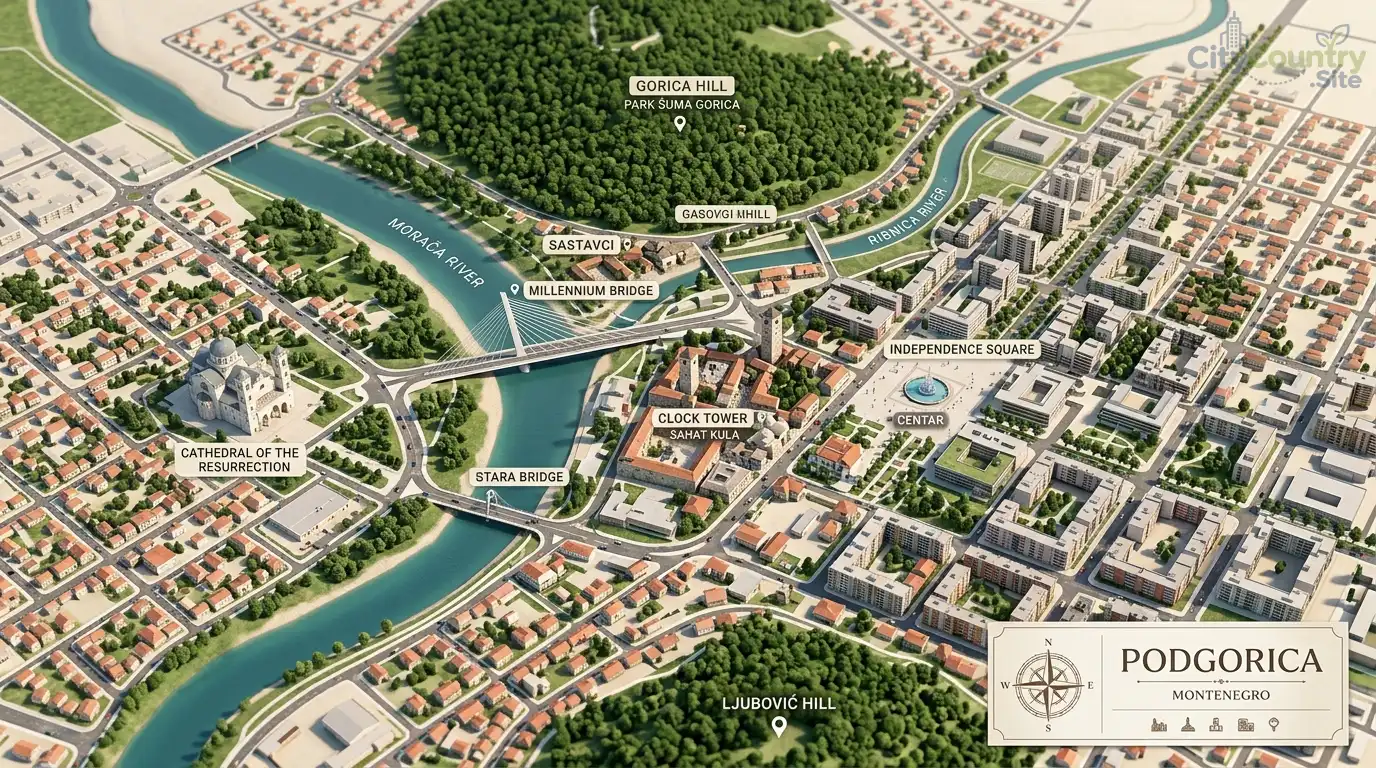
Podgorica sits in a broad river valley at the confluence of the Ribnica and Morača rivers — the Morača flowing south to north through the city before eventually reaching Skadar Lake. The surrounding terrain is characteristic Dinaric karst — bare limestone mountains and plateaus broken by deeply carved river canyons, with sparse but dramatic vegetation giving way to lush riverside greenery in the valley bottom.
Gorica Hill — a forested rocky knoll rising approximately 107 metres above the surrounding valley floor — sits immediately adjacent to the old town and provides the finest viewpoint over the city. The hill is a public park and one of the city’s most beloved recreational spaces.
The city’s urban geography reflects its layered history: the Ottoman old town (Stara Varoš) occupies the rocky area near the Ribnica-Morača confluence; the Yugoslav-era city center spreads northward and westward in broad boulevards and functional apartment blocks; and more recent development extends in all directions.
Neighborhood Comparison Table
| Area | Best For | Vibe | Price Level |
|---|---|---|---|
| Stara Varoš (Old Town) | Ottoman ruins, Clock Tower, authentic atmosphere | Historic, atmospheric, modest | Budget–Mid |
| City Center (Centar) | Hotels, restaurants, shopping, central access | Modern, functional, mixed | Mid |
| Nova Varoš | Local cafés, restaurants, residential life | Local, authentic, neighbourhood | Budget–Mid |
| Malo Polje | Upscale residential, quieter streets | Affluent, green, quiet | Mid–High |
| Kruševac | Embassies, residential, parks | Quiet, leafy, diplomatic | Mid–High |
| Blok 5 / Blok 6 | Modern residential, local life | Soviet-style, authentic, functional | Budget |
| Riverside (Morača embankment) | Promenade, cafés, Millennium Bridge views | Pleasant, walkable, open | Mid |
| Airport area (Golubovci) | Budget accommodation, functional | Functional, suburban | Budget |
The City Center — centered on Slobode Street and the main pedestrianized boulevard — is the commercial and social hub of contemporary Podgorica, with the main hotels, restaurants, and shops. Stara Varoš — the old Ottoman neighborhood — is the most historically interesting area, its narrow lanes and ruined mosques providing a counterpoint to the modern city surrounding it. Nova Varoš — the neighborhood adjacent to the center — is where the finest independent cafés and local restaurants are concentrated.

5. Podgorica Weather & Temperature Guide
Podgorica has one of the most extreme climates of any European capital — a Mediterranean-continental hybrid that produces very hot, dry summers (regularly among the hottest in Europe), mild winters (significantly warmer than inland Balkan capitals), and beautiful, brief spring and autumn seasons. The city’s position in a sheltered valley, surrounded by karst mountains that trap hot air in summer, amplifies the temperature extremes.
Month-by-Month Weather Table
| Month | Avg Temp (°C) | Rainfall | Crowd Level | Travel Recommendation |
|---|---|---|---|---|
| January | 1–10 | High | Very Low | ✅ Good — mild, green, very quiet |
| February | 3–12 | High | Very Low | ✅ Good — spring beginning |
| March | 6–16 | Medium–High | Low | ✅ Good — warming rapidly |
| April | 10–21 | Medium | Medium | ⭐ Excellent — finest spring weather |
| May | 14–26 | Low–Medium | High | ⭐ Excellent — warm and beautiful |
| June | 18–32 | Very Low | High | ⭐ Excellent — hot and lively |
| July | 21–37 | Extremely Low | High | ⚠️ Extremely hot — limit outdoor time |
| August | 21–40 | Extremely Low | High | ⚠️ Hottest in Europe — survive rather than explore |
| September | 16–33 | Very Low | High | ⭐ Excellent — still warm, less brutal |
| October | 11–24 | Low–Medium | Medium | ⭐ Excellent — golden autumn |
| November | 6–15 | Medium–High | Low | ✅ Good — quieter, pleasant |
| December | 3–11 | High | Very Low | ✅ Good — mild winter |
April through June is Podgorica’s finest season — warm temperatures (20–28°C), very low rainfall, the surrounding mountains spectacularly green after the winter rains, and the city’s outdoor café culture in full operation. May is outstanding — warm enough for the Adriatic coast (water temperature around 19–20°C), cool enough for comfortable canyon hiking, and the landscape at its most vividly beautiful.
September and October are excellent — the brutal summer heat has broken, the autumn light is golden, Skadar Lake’s bird populations are building for autumn migration, and accommodation throughout Montenegro is more available and affordable after the peak coastal season.
July and August must be approached with respect — Podgorica regularly records 38–40°C and is consistently one of the hottest cities in Europe in peak summer. Outdoor activity is essentially limited to before 9 AM and after 7 PM. The city empties as residents head to the coast; tourists who visit in peak summer should have the canyon landscapes and air-conditioned museums as their primary activities.
Winter (December–February) is the mildest of any Balkan capital — temperatures rarely drop below freezing in the valley, making Podgorica one of the most comfortable European capitals for winter visitors. The surrounding mountains are snow-covered; Skadar Lake’s bird populations peak; and the city is entirely authentic and very affordable.
💡 Did You Know? Podgorica holds the distinction of being one of the sunniest cities in Europe — receiving approximately 2,600 hours of sunshine per year, more than Nice, Barcelona, or Athens. The city’s position in a sheltered karst valley, combined with the Mediterranean climate system of the western Balkans, creates this extraordinary sunshine total. The irony is that Podgorica’s summer sunshine, while spectacular in quantity, is accompanied by temperatures so extreme (regularly 38–40°C) that the sunshine itself becomes a threat rather than an amenity for outdoor activity. The finest enjoyment of Podgorica’s sunshine comes in May and October, when the temperatures are warm and the light is extraordinary.

6. Podgorica Airport & Getting There
Podgorica Airport (TGD)
Podgorica Airport (IATA: TGD) — officially Podgorica Airport — is located approximately 12 km south of the city center near the small town of Golubovci. A relatively small airport that has seen significant growth in recent years as Montenegro’s tourism profile has expanded.
Wizz Air is a significant carrier at Podgorica, alongside Air Montenegro (the national carrier), Turkish Airlines, Pegasus Airlines, Austrian Airlines, easyJet (seasonal), Ryanair (seasonal), and several charter operators. International connections include Istanbul, Vienna, Frankfurt, London, Ljubljana, Zurich, Rome, Moscow (suspended), and several other European cities. The route network is somewhat limited compared to Tirana or Skopje; many visitors to Montenegro fly into Tivat Airport (TIV) on the coast for the Adriatic-focused journey, or use Dubrovnik Airport (DBV) in Croatia (accessible by bus via the Boka crossing).
Getting from TGD to the City Center:
| Transport Option | Duration | Cost (Approx.) | Notes |
|---|---|---|---|
| Taxi (official) | 20–30 min | €15–25 | Official taxis at airport; agree price |
| Bolt | 20–30 min | €8–15 | App-based; cheaper than taxi |
| Bus (line 22) | 30–40 min | €1.50 | Inexpensive; runs to bus station |
| Hotel shuttle (pre-booked) | 25–35 min | €15–30 | Some hotels offer transfers |
Getting to Podgorica from neighboring countries:
| Origin | Transport | Duration | Cost (Approx.) |
|---|---|---|---|
| Tirana, Albania | Bus | 4–5 hours | €10–20 |
| Dubrovnik, Croatia | Bus | 2.5–3 hours | €10–20 |
| Sarajevo, Bosnia | Bus | 5–6 hours | €15–25 |
| Belgrade, Serbia | Bus / Train | 8–9 hrs / 10 hrs | €15–25 |
| Skopje, N. Macedonia | Bus | 5–6 hours | €15–25 |
| Bar (coast) | Train | 1.5 hours | €3–5 |
| Kotor | Bus | 1 hour | €5–8 |
The Belgrade–Bar railway — one of the most spectacular train journeys in Europe, traversing the extraordinary mountain landscapes of Montenegro including the famous Mala Rijeka viaduct (the highest railway bridge in the world at the time of its completion in 1966) — arrives at Bar on the Adriatic coast, from where a local train connects to Podgorica in approximately 1.5 hours. The full Belgrade–Bar journey (approximately 10–12 hours) is genuinely extraordinary as a train travel experience.
💡 Did You Know? Montenegro unilaterally adopted the Euro as its official currency in 2002 — without being a member of the European Union or the Eurozone, and without formal permission from the European Central Bank. This remarkable monetary decision (Montenegro was using the German Deutsche Mark before switching to the Euro when the DM was replaced) has given Montenegro the practical advantages of Euro usage (no currency exchange, stability, international confidence) without the political and institutional obligations of formal EU membership. The EU has accepted this situation pragmatically; Montenegro’s use of the Euro is expected to continue through and after its anticipated EU accession.
7. Getting Around Podgorica
Podgorica is a relatively small city — the historic center, the riverside promenade, and the main neighborhoods are all connected by a walkable network that makes the central area easily explorable on foot. For reaching outer areas, the airport, and day trip destinations, taxis and Bolt are the primary options.
Walking is entirely practical for the city center — the Old Town (Stara Varoš), the Clock Tower, the main pedestrianized boulevard (Slobode Street), the Millennium Bridge, the Morača riverside promenade, and the Gorica Hill park are all accessible on foot within 20–30 minutes of each other. The city is flat and compact in its central areas; the Montenegrin summer heat is the primary limitation on extended walking (plan for early morning walks in July–August).
Bolt operates in Podgorica with reasonable availability — the primary recommended transport option for airport transfers and reaching more distant neighborhoods. A typical city ride costs €3–8.
Taxis — widely available throughout the city. Agree on the price before departing; €3–7 for most city rides.
City Buses — operate throughout Podgorica at very low cost (€1–1.50 per journey). Coverage of the city center is reasonable; more useful for reaching the airport (Line 22) and outer neighborhoods.
Car Rental — strongly recommended for day trips to the canyon landscapes, Skadar Lake, and the coast. International companies (Avis, Hertz, Budget, Europcar) and local operators are available at the airport and in the city. Roads are generally good; mountain roads require appropriate driving skills.

8. Top Attractions & Must-See Places in Podgorica
Top Attractions Table
| Attraction | Type | Entry Fee | Best Time | Time Needed |
|---|---|---|---|---|
| Clock Tower (Sahat Kula) | Ottoman tower / city symbol | Free | Morning | 30 min |
| Stara Varoš (Old Town) | Ottoman ruins / old neighborhood | Free | Morning | 1.5–2 hours |
| Gorica Hill (Gorica Park) | Forested hill / viewpoint / park | Free | Morning | 1.5–2 hours |
| Millennium Bridge (Milenijumski Most) | Contemporary bridge / landmark | Free | Any time | 20–30 min |
| Morača River Promenade | Riverside walkway / cafés | Free | Morning / Evening | 1–1.5 hours |
| Cathedral of the Resurrection | Contemporary Orthodox cathedral | Free | Morning | 45 min |
| Petrović Palace and Gardens | Former royal palace / museum | Free | Morning | 1 hour |
| Natural History Museum | Natural history / geology / biology | €2 | Morning | 1 hour |
| City Museum | Local history museum | €2 | Morning | 1 hour |
| Ribnica Fortress ruins | Medieval fortress ruins / riverside | Free | Morning | 30–45 min |
| Doclea Roman Ruins | Roman archaeological site | Free | Morning | 1.5 hours |
| Morača Monastery | Medieval Orthodox monastery | Free | Morning | 1 hour (40 km north) |
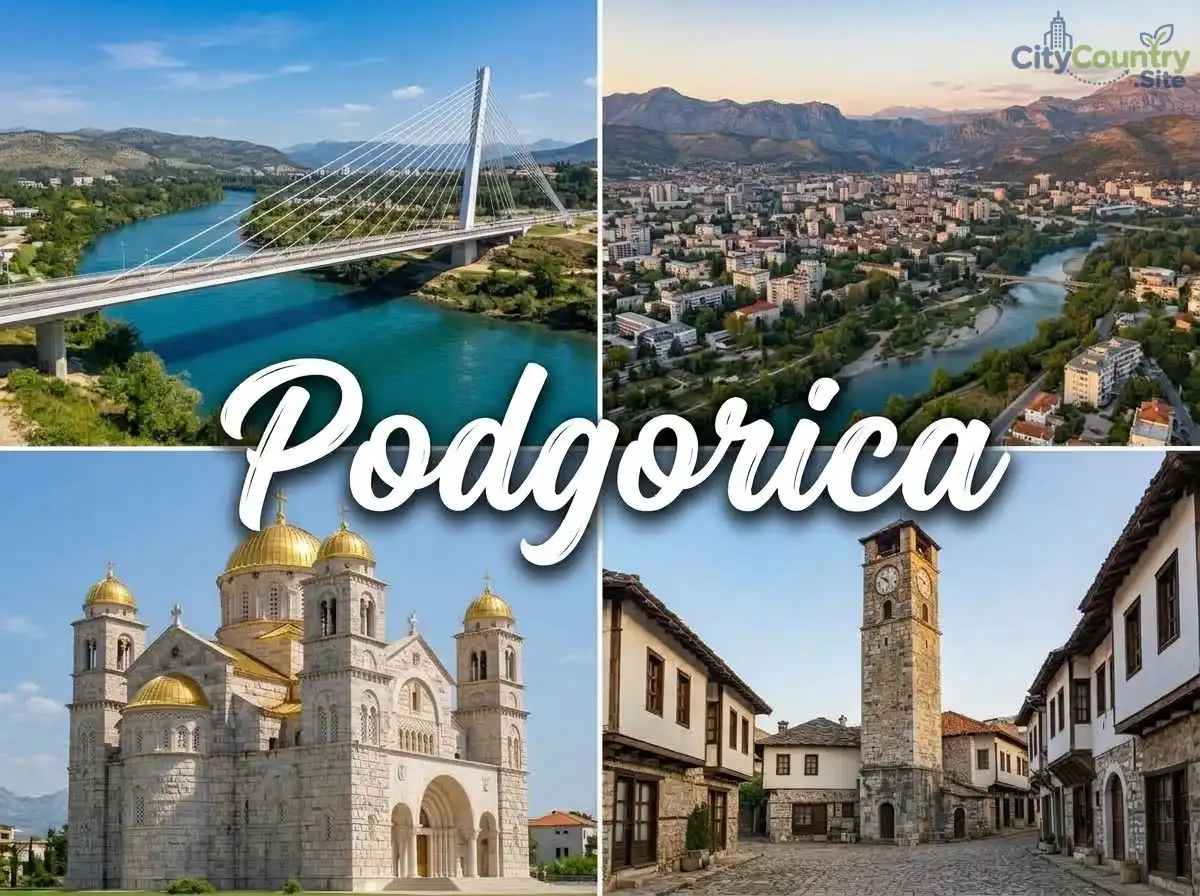
The Clock Tower (Sahat Kula) is the single most important and most beautiful surviving Ottoman monument in Podgorica — a slender stone tower of considerable elegance dating from the 19th century, standing at the edge of the Stara Varoš old town quarter. The tower is the city’s most recognizable landmark and its best photograph — particularly beautiful in the early morning when the limestone glows in the first light. The surrounding Stara Varoš neighborhood — with its Ottoman-era lanes, the ruins of the Osmanagić Mosque (destroyed in the Allied bombing of 1944), the remaining Ottoman residential architecture, and the atmospheric density of a genuinely ancient neighborhood — provides the most historically interesting walking in the city.
The Morača River Promenade — the beautifully developed riverside walkway along the eastern bank of the Morača — is the finest public space in contemporary Podgorica. Completed in phases over the past decade, the promenade connects the city center with the Millennium Bridge and the southern neighborhoods through a sequence of cafés, green spaces, art installations, and the extraordinary visual experience of the Morača River flowing clear and fast through the limestone gorge that deepens progressively as it moves northward toward the spectacular Morača Canyon.
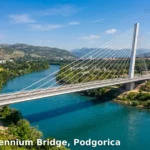
The Millennium Bridge (Milenijumski Most) — completed in 2005 and one of the most distinctive pieces of contemporary architecture in Montenegro — spans the Morača River with a dramatic asymmetric cable-stayed design of considerable visual elegance. The bridge is particularly beautiful when viewed from the promenade or from Gorica Hill above, especially at night when it is illuminated.
Gorica Hill (Brdo Gorica) — the forested knoll immediately adjacent to the old town — is Podgorica’s most beloved public space: a park of pine and oak forest with walking trails, viewpoints, and the extraordinary panorama of the city from its summit. The cross at the summit (visible from much of the city) marks the finest viewing point. Walking up through the cool forest (20–25 minutes from the old town) and emerging onto the summit to look over the city, the river confluence, and the surrounding mountains is the single finest experience available within the city limits.
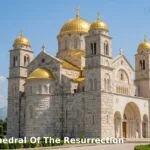
The Cathedral of the Resurrection of Christ (Hram Hristovog Vaskrsenja) — completed in 2014 — is Montenegro’s largest Orthodox church and one of the most significant contemporary religious buildings in the western Balkans. Built in a Neo-Byzantine style of considerable ambition, with elaborate exterior mosaics and an interior of extraordinary richness — gold leaf, Venetian glass mosaics, and carved marble — it represents a significant artistic achievement regardless of one’s religious orientation. The exterior design, with its multiple domes and elaborate iconographic program, is best seen in the morning light.
The Roman Ruins of Doclea — located approximately 2 km north of the city center — are the most important archaeological site in Montenegro. The ancient city of Doclea (also known as Duklja) was a significant Roman urban center of the 1st–4th centuries CE, eventually giving its name to the medieval Duchy of Duklja (the earliest precursor of Montenegro). The ruins include a forum, basilica, temples, baths, and residential structures — spread across a large open site that is freely accessible and largely unexcavated. The combination of the historical significance and the relative obscurity of the site (few visitors come here despite its importance) gives Doclea a quality of undisturbed authenticity rare in European archaeology.
💡 Did You Know? Montenegro (Crna Gora — “Black Mountain”) holds the world record for the highest number of UNESCO World Heritage Sites per square kilometre of national territory — with four UNESCO sites (the Natural and Culturo-Historical Region of Kotor, the Durmitor National Park and Tara River Canyon, the Old Olive Trees of Bar, and the Venetian Works of Defence Between the 17th and 18th Centuries) in a country of barely 13,812 square kilometres. No other country in the world concentrates so many UNESCO-recognized landscapes and heritage sites in so small a geographic area — a fact that makes Montenegro one of the most extraordinary countries in Europe for the natural and heritage traveler, with Podgorica as the central hub from which all of them are accessible.

9. Podgorica Foods Podgorica & Cuisine Guide
Montenegrin cuisine is one of the most generously portioned, most meat-centric, and most genuinely satisfying traditional food cultures in the Balkans — a cooking tradition shaped by the mountains, the coast, the Ottoman legacy, and the extraordinary dairy heritage of Montenegrin pastoral farming. The discovery of Montenegrin food is a genuinely rewarding culinary experience for visitors arriving without specific expectations.
Must-Try Dishes in Podgorica
Njeguški Pršut — Montenegro’s most celebrated food product and one of the finest cured meats in the Balkans. Dry-cured ham from the Njeguši plateau — the small highland village near Kotor where this tradition has been practiced for centuries — produced by a process of salting, cold smoking over beech wood, and air-drying in the mountain winds that creates a flavor of extraordinary depth and complexity. The Njeguši plateau’s microclimate — cold, dry winds combining with the beech forests’ wood smoke — produces a pršut entirely unlike Italian prosciutto or Spanish jamón, with a firmer texture and a smokier, more robust character. Available at every Montenegrin restaurant; the finest versions are served in thin slices at room temperature with Montenegrin white cheese.
Njeguški Sir (Njeguški Cheese) — The partner to the pršut — a semi-hard white cheese from the same Njeguški tradition, produced from sheep’s or cow’s milk and matured in olive oil or under salt. Rich, slightly crumbly, with a mild tang and a buttery quality. Served alongside pršut at the beginning of every traditional Montenegrin meal — the combination is one of the finest simple first courses in Balkan cooking.
Kacamak — Montenegro’s most traditional everyday dish and the closest thing to a Montenegrin national staple — cornmeal cooked with potatoes until it forms a dense, creamy mass, then generously enriched with kajmak (clotted cream) and sometimes cheese or pork fat. Humble, deeply nourishing, and in its finest form — made by cooks who have prepared it for decades — extraordinarily satisfying. The dish of the Montenegrin highlander, consumed before long days of mountain labor.
Lamb Under the Peka (Sač) — The most important preparation for special occasions in Montenegrin cuisine — lamb (or sometimes veal) covered with vegetables and cooked slowly under a metal dome (peka or sač) covered with live coals. The result is extraordinarily tender, deeply aromatic, and possessed of a quality of slow-cooked richness that is entirely different from any other lamb preparation. Available at traditional restaurants throughout Montenegro but requires ordering in advance (2–3 hours minimum preparation time).
Cicvara — A simpler Montenegrin cornmeal preparation than kacamak — cooked with cream and cheese until thick and rich, eaten for breakfast or as a quick meal. Less elaborate than kacamak but equally nourishing and entirely delicious.
Trout from the Morača and Tara Rivers — Montenegro’s rivers produce outstanding freshwater trout — cold, fast-flowing, crystal-clear water creating fish of exceptional flavor and texture. River trout (pastrmka) simply grilled with butter, lemon, and herbs is one of the finest things on any Montenegrin menu. The Morača Canyon restaurant (accessible on the road to the canyon) serves river trout pulled fresh from tanks within the canyon itself.
Grilled Meats (Roštilj) — The entire Balkan tradition of mixed grilled meats — ćevapi (minced meat rolls), pljeskavica (grilled meat patty), vešalice (pork neck) — is enthusiastically practiced throughout Montenegro. The finest grilled meats in Podgorica are found at the dedicated roštilj restaurants of the Nova Varoš neighborhood.
Montenegrin Wine — Montenegro has a significant wine tradition centered on the Plantaže winery near Podgorica — the largest winery in the region, managing approximately 2,300 hectares of vineyards and producing wines of increasing international recognition. The Vranac grape (the same indigenous red variety grown in North Macedonia, where it is spelled Vranec) produces Montenegro’s finest wines — powerful, deeply colored reds with a characteristic tannic structure and rich fruit. The Krstač white variety produces interesting, crisp whites from the limestone soils of the Montenegrin karst. Plantaže wines are available at very modest prices throughout Podgorica.
Best Restaurants and Food Spots in Podgorica
Pod Volat (City Center) — One of the finest traditional Montenegrin restaurants in the capital — outstanding njeguški pršut, excellent kacamak, superb lamb under the peka (ordered in advance), and an excellent Plantaže wine list. €15–30 per person.
Restoran Lanterna (City Center) — A beautifully designed restaurant serving excellent contemporary Montenegrin and Mediterranean cuisine — creative preparations of traditional ingredients with genuine ambition. €18–35 per person.
Stara Kuća (“Old House”) — A traditional konoba in the Stara Varoš area — outstanding grilled meats, excellent njeguški platters, and the most atmospheric setting available for traditional Montenegrin cuisine in the old town neighborhood. €12–25 per person.
Konoba Adžić — A beloved local institution serving outstanding traditional Montenegrin food — kacamak, cicvara, lamb, and exceptional Plantaže wine at very reasonable prices. The kind of restaurant where Podgorica locals celebrate family occasions. €10–20 per person.
Fresh Market (Green Market — Zelena Pijaca) — The city’s main fresh produce market near the old town — outstanding Montenegrin vegetables, dairy products (including excellent kajmak and sir), honey, and seasonal produce from the surrounding farmland. Best mornings.
💡 Did You Know? The Plantaže winery near Podgorica — with its approximately 2,300 hectares of Vranac and other varieties — manages one of the largest single vineyard holdings in all of Europe. Established during the Yugoslav period as a state enterprise and subsequently privatized, Plantaže produces approximately 26 million bottles of wine per year — an extraordinary volume for a country of 620,000 people. The winery’s size means that Montenegrin wine is consumed primarily for export; within Montenegro itself, local consumption is surprisingly modest. Visitors to Podgorica can visit the Plantaže winery and cellars as a day trip — one of the finest and most accessible wine tourism experiences in the western Balkans.
10. Podgorica Accommodation Guide
Podgorica offers modest but improving accommodation — from budget hostels to international hotels — at prices that are among the most reasonable of any European capital, particularly given the Euro currency’s use throughout the country.
Best Areas to Stay:
- City Center: Best for proximity to restaurants, the main boulevard, and walking access to most attractions
- Near the Old Town (Stara Varoš): Best for atmosphere and historical character
- Riverside (near Millennium Bridge): Best for the promenade access and pleasant morning walks
Accommodation Price Ranges (2026)
| Category | Price/Night (USD) | Examples |
|---|---|---|
| Budget Hostel / Guesthouse | $15–35 | Hostel Podgorica, Oldtown Hostel, various guesthouses |
| Mid-Range Hotel | $50–100 | Hotel Eminent, Hotel Maksim, Hotel Kerber |
| Upscale Hotel | $100–180 | Hotel Hemera, Hotel Crna Gora, Hotel Avala |
| Luxury Hotel | $180–400+ | Hotel Hilton Podgorica (when available), Ramada by Wyndham |
Hilton Podgorica Crna Gora — when fully operational — is the city’s finest luxury property, with outstanding facilities and the international service standards expected of the brand. Rates: approximately $160–300 per night.
Hotel Eminent — a well-run mid-range hotel in a convenient central location — offers comfortable rooms, a reliable breakfast, and good proximity to the city’s main attractions. Rates: approximately $60–100 per night.
Oldtown Hostel — located in the Stara Varoš area — provides the most atmospheric budget option, with clean facilities and the best location for exploring the old town. Dorm beds from $15; private rooms from $35.
11. Best Time to Visit Podgorica
April through June is overwhelmingly the finest season for visiting Podgorica — mild temperatures (20–28°C), very low rainfall, the surrounding mountains dramatically green and snow-capped, and the full range of day trip activities (canyon hiking, lake visits, coastal excursions) in optimal condition. May is the single finest month for the complete Montenegrin experience — warm enough for the Adriatic coast, cool enough for canyon hiking, and the landscape at its most spectacularly beautiful.
September and October are the excellent autumn alternatives — the brutal summer heat has broken, the autumn light is extraordinary, Skadar Lake’s bird populations are at their autumn peak, and accommodation throughout Montenegro is more available after the coastal peak season. September combines well with the coastal towns (sea water still warm at 24–25°C) and the canyon landscapes in their first autumn colors.
July and August are genuinely challenging — Podgorica’s 38–40°C summer temperatures make it one of the hottest European capitals. If visiting in peak summer, plan accordingly: early morning outdoor activity, afternoon retreat to air-conditioned spaces or the coast, evening return to outdoor life. The city is not at its finest in high summer.
Winter (November–March) is quiet, very affordable, and entirely authentic. Temperatures are mild by Balkan standards (rarely below 3–4°C in the valley). The surrounding mountains are snow-covered for skiing; Skadar Lake’s wintering bird populations are the most spectacular of the year.
Key Festivals and Events in Podgorica
- Podgorica Cultural Summer (July–August) — Annual outdoor cultural festival with concerts, theater, and art events in various venues throughout the city
- FIAT International Theatre Festival (May) — Growing annual theater festival bringing regional and international companies to Podgorica venues
- Montenegro Film Festival (summer, various locations) — Annual celebration of Montenegrin and regional cinema
- Podgorica Half Marathon (April) — Annual running event through the city
- Statehood Day (July 13) — Montenegro’s most important national holiday, commemorating the 1878 Berlin Congress recognition and the 1941 Uprising against Italian occupation; celebrated with cultural events throughout the country
- Orthodox Christmas (January 7) and Easter — The most important religious celebrations in Montenegro’s predominantly Orthodox society
12. Podgorica Shopping Guide
Podgorica’s shopping scene is modest — the city is not a significant retail destination — but offers genuine opportunities for purchasing quality Montenegrin food and craft products.
What to Buy:
Njeguški Pršut and Sir — The finest food products Montenegro produces — dry-cured ham and semi-hard white cheese from the Njeguški tradition. Available vacuum-packed for transport at the Green Market, specialty food shops, and better supermarkets throughout the city.
Montenegrin Wine (Plantaže Vranac) — Excellent Montenegrin wine at very modest prices. The Plantaže winery shop near the city offers the full range of their production; good wine shops throughout the center stock selected bottles.
Montenegrin Honey — Outstanding mountain honey from Montenegrin highland beekeepers — produced in environments of extraordinary botanical diversity. Available at the Green Market.
Olive Oil from Bar — The ancient olive groves of Bar on the Adriatic coast — some trees estimated to be over 2,000 years old — produce extraordinary olive oil of UNESCO-recognized heritage significance. Available in Podgorica’s better food shops.
Traditional Crafts — Various traditional Montenegrin crafts are available through the small shops in Stara Varoš — embroidery, woolen products, and traditional decorative objects. Quality varies; the finest pieces come from the rural craft cooperatives rather than tourist-facing shops.
Where to Shop:
Green Market (Zelena Pijaca) — The primary fresh produce and food market near the old town — the finest source of Montenegrin agricultural products and traditional foods in the city.
City Center Shops (Slobode Street) — The main pedestrianized boulevard hosts a range of shops from international brands to local retailers; food shops and specialty wine stores are distributed throughout.

13. Podgorica Nightlife & Entertainment
Podgorica has a nightlife scene that is more developed than its modest reputation suggests — driven by its relatively young population, the characteristic Montenegrin sociality, and the café culture that permeates daily life in the western Balkans.
The café culture is the primary social institution — Montenegrin café life, conducted at outdoor terraces from spring through autumn, is one of the most relaxed and most genuinely sociable in the Balkans. The Slobode Street pedestrianized zone and the Morača riverside promenade are the primary outdoor café venues; the Nova Varoš neighborhood has the finest concentration of independent cafés and bars.
Cultural Venues:
Montenegrin National Theatre (Crnogorsko Narodno Pozorište) — Regular drama productions in Montenegrin/Serbian; occasional international productions and guest performances.
Cultural Centre “Budo Tomović” — The primary multipurpose cultural venue in Podgorica — concerts, exhibitions, film screenings, and cultural events throughout the year.
Cinematheque of Montenegro — Regular film screenings, including the Montenegro Film Festival programming and ongoing arthouse cinema programming.
Bars and Nightlife:
Hemingway Bar (City Center) — A reliable, well-run bar in the city center — good cocktails, warm atmosphere, and the kind of enduring quality that makes it a consistent Podgorica social destination.
Vanilla Bar — One of Podgorica’s most popular cocktail bars — creative drinks, good music, and a lively atmosphere particularly on weekends.
Cezanne — A beloved local bar with excellent wine selection — particularly strong on Montenegrin and regional wines — in a comfortable, intellectually oriented atmosphere.
Club scene: Podgorica’s club scene is modest — Discothèque Sound and a few other venues offer DJ events on weekend nights. The city’s social life is primarily oriented toward café and bar culture rather than club-based nightlife.
14. Hidden Gems & Local Secrets
The Morača Canyon at Sunset — The Morača Canyon — which begins effectively at the northern edge of the city and deepens dramatically as the river cuts northward through the limestone plateau — is Podgorica’s most extraordinary natural attribute. Driving north from the city along the canyon road as the afternoon light drops and the limestone walls glow gold and amber is one of the most visually spectacular experiences accessible within 30 minutes of a European capital. The road follows the canyon for approximately 50 km before reaching the medieval Morača Monastery — the finest Orthodox monastery in Montenegro — set into the canyon wall above the river.
Doclea Roman Ruins at Dawn — The Roman ruins of Doclea — just 2 km north of the city center — are at their finest in the early morning when the low sunlight illuminates the ancient stonework and no other visitors are present. Walking the exposed Roman streets, standing in the former forum, and looking over the valley that the ancient city once dominated creates a genuine connection with Podgorica’s deepest historical layer. The ruins are freely accessible at all times.
The Ribnica River Walk — The small Ribnica River — which joins the Morača at the old town — can be followed on foot from the ancient Ribnica Fortress ruins upstream through a surprisingly wild and beautiful gorge that cuts through the city’s urban fabric. The walk is almost entirely unknown to visitors and provides a 30-minute escape into genuine nature within the city limits.
The Petrović Summer Palace Gardens — The beautifully maintained gardens of the former Petrović royal family’s summer palace in the Kruševac neighborhood provide the finest formal green space in Podgorica — a well-kept secret among the city’s residents and virtually unknown to international visitors. The palace building itself houses various cultural exhibitions; the gardens are freely accessible.
Skadar Lake at Dusk — While Skadar Lake is accessible as a day trip, arriving at the lake’s northern shore near the village of Vranjina at dusk — when the flamingo-pink light reflects on the water, the surrounding mountains turn deep purple, and the pelicans and herons return to their reed beds for the night — is one of the most beautiful natural moments accessible from Podgorica. Just 20 km from the city; accessible by Bolt or car.
15. Day Trips from Podgorica
Podgorica’s greatest asset is its extraordinary position as a gateway to some of the finest natural landscapes in Europe. Within 3 hours in any direction lie World Heritage Sites, pristine river canyons, an ancient lake of global biodiversity significance, a medieval walled city of extraordinary beauty, and primeval forests that predate human settlement.
Day Trips Table
| Destination | Distance | Travel Time | Method | Highlights |
|---|---|---|---|---|
| Skadar Lake | 20 km south | 30 min | Car / Boat tour | Europe’s largest Adriatic-basin lake; pelicans; medieval castles; wine villages |
| Morača Canyon and Monastery | 40 km north | 45 min | Car | Spectacular limestone canyon; finest Orthodox monastery in Montenegro |
| Kotor | 55 km west | 1 hour | Bus / Car | UNESCO medieval walled city; Bay of Kotor; extraordinary setting |
| Ostrog Monastery | 70 km northwest | 1.5 hrs | Car / Tour | Most visited sacred site in Montenegro; carved into sheer cliff face |
| Bar (Old Town + Olive Trees) | 65 km south | 1 hour | Bus / Car / Train | Ancient olive trees (2,000+ years); Ottoman old town ruins; Adriatic coast |
| Durmitor National Park | 150 km north | 2.5 hrs | Car | UNESCO World Heritage; Black Lake; mountain scenery |
| Tara River Canyon | 180 km north | 3 hours | Car / Tour | Deepest canyon in Europe; rafting; UNESCO World Heritage |
| Cetinje (Former Royal Capital) | 37 km west | 45 min | Bus / Car | Historical royal capital; fine museums; Ostrog road stop |
| Nikšić | 59 km northwest | 1 hour | Bus / Car | Second city; Trebjesa Fortress; wine festival |
Skadar Lake (Skadarsko jezero) is the most immediately accessible and most extraordinary natural day trip from Podgorica — one of Europe’s largest and most biodiverse lakes, shared between Montenegro and Albania, in a landscape of extraordinary limestone-karst beauty. The lake — formed by the subsidence of the Morača River valley along fault lines — hosts the largest Dalmatian pelican colony in Europe, along with cormorants, herons, egrets, spoonbills, and hundreds of other water bird species. Boat tours from the village of Murići or Virpazar provide access to medieval island fortresses, traditional fishing communities, and the extraordinary reed beds where the bird life concentrates. The Skadar Lake National Park winery villages (particularly Godinje) produce excellent wines using ancient viticulture methods in the warmth of the lakeside microclimate.
Kotor — one of the most beautiful medieval cities in the entire Mediterranean — is barely an hour from Podgorica and constitutes the single finest day trip from the capital. The UNESCO-listed walled city of Kotor sits at the innermost point of the extraordinary Bay of Kotor — a drowned river canyon that creates the only fjord-like geography in the Mediterranean basin. The medieval walls climb 1,350 metres up the sheer cliff above the town; the city’s Baroque streets, Venetian architecture, and magnificent churches create an urban environment of exceptional beauty. The walk up the city walls (1,300+ steps) provides a panoramic view over the bay and the surrounding mountains that is among the finest in the entire Balkans.
Ostrog Monastery — carved directly into the sheer face of a white limestone cliff at an altitude of 900 metres — is the most visited sacred site in Montenegro and one of the most dramatically situated religious monuments in Europe. The monastery, dedicated to Saint Basil of Ostrog (a 17th-century bishop whose relics are housed within), draws over 100,000 pilgrims per year — Orthodox Christians, Catholics, and Muslims all visiting in a remarkable expression of cross-religious reverence. The approach road is spectacular; the monastery itself, embedded in the cliff with its white façade and golden domes against the bare rock face, is extraordinary.
The Tara River Canyon — at 1,300 metres deep, the deepest canyon in Europe and the second deepest in the world after the Grand Canyon — is the crown jewel of Montenegro’s natural heritage and a UNESCO World Heritage Site (as part of Durmitor National Park). The three-hour drive north from Podgorica passes through increasingly dramatic mountain landscapes before the canyon opens in its full, staggering scale. White-water rafting on the Tara (available from May to October) is one of the finest adventure activities in Europe; the gentler boat excursions on the calmer upper sections provide access to the canyon’s beauty for non-rafters.

16. Podgorica Local Culture, Customs & Etiquette
Montenegrins have a cultural character that is distinctively their own — shaped by centuries of mountain independence, Ottoman proximity, Serbian cultural kinship, and the particular psychology of a very small people who have always lived in extraordinary landscapes.
Montenegrin Hospitality: Montenegro has a legendary reputation for hospitality throughout the Balkans — the particular warmth of Montenegrin welcome, the insistence that guests eat more than they can manage, and the generosity of personal engagement create a quality of human encounter that visitors consistently cite as the most memorable aspect of their stay. The traditional Montenegrin code of hospitality — gostoprimstvo — is considered a moral obligation and a matter of personal honor. Accept every offer of coffee, food, or drink graciously.
The Montenegrin Pace: Montenegro — and Podgorica specifically — operates at a pace that is more relaxed than Western European norms and more relaxed even than most Balkan capitals. Montenegrins have a reputation within the former Yugoslavia for their unhurried, philosophical approach to life — a reputation they embrace with considerable humor. The café culture reflects this: coffee is drunk slowly, conversations continue for hours, and the concept of rushing through social interactions is culturally alien. Adjust your pace accordingly.
Orthodox Culture: Montenegro is a predominantly Orthodox Christian country — the relationship between the Serbian Orthodox Church and the newly established Montenegrin Orthodox Church is a significant source of political and social tension, reflecting the broader question of Montenegrin versus Serbian national identity. Religious sites — the Cathedral of the Resurrection, Ostrog Monastery, the Morača Monastery — should be visited with appropriate modesty and respect.
National Identity Complexity: The question of Montenegrin versus Serbian identity is genuinely complex and politically sensitive. A significant portion of Montenegro’s population identifies as Serbian rather than Montenegrin; the 2006 independence referendum revealed a country almost evenly divided. This is not a topic to introduce casually; engage with genuine curiosity and sensitivity rather than with presumed conclusions.
Tipping:
- Restaurants: 10% tip is standard and appreciated — especially meaningful given relatively modest service wages
- Taxis / Bolt: rounding up is appreciated
- Hotel staff: €1–2 per service
- Tour guides: €10–20 per day for good guiding
Dos and Don’ts:
- ✅ Do accept all offers of coffee and hospitality — Montenegrin gostoprimstvo is genuine and deserves genuine reciprocation
- ✅ Do try kacamak and njeguški pršut — the most authentic expressions of the Montenegrin culinary tradition
- ✅ Do rent a car for the day trips — the canyon landscapes and Skadar Lake reward unhurried exploration that public transport cannot provide
- ✅ Do visit Ostrog Monastery — regardless of religious affiliation, it is one of the most dramatically situated monuments in Europe
- ❌ Don’t rush — the Montenegrin pace is different from Western European norms; adjusting is both respectful and personally rewarding
- ❌ Don’t make definitive statements about Montenegrin versus Serbian identity — a genuinely complex question
- ❌ Don’t skip Podgorica in favor of the coast entirely — the city provides access to natural landscapes inaccessible from Kotor or Budva
17. Safety & Travel Tips
Podgorica is a safe city for tourists — by Balkan and European standards, Montenegro is consistently ranked as one of the safest countries in the region. Violent crime against visitors is uncommon.
Safe Areas: The city center, Old Town, riverside promenade, and all tourist areas are safe at all hours. Standard urban precautions apply.
Main Practical Concerns:
- Summer heat — Podgorica’s 38–40°C summer is the primary physical risk; stay hydrated, limit midday outdoor exposure, and take the heat seriously
- Traffic — Montenegrin driving can be fast and aggressive on mountain roads; exercise defensive driving and particular caution on canyon roads
- Mountain driving — The roads to the Tara Canyon and Durmitor are spectacular but genuinely demanding; ensure your rental vehicle is appropriate and your driving skills are adequate
Emergency Numbers:
- Police: 122
- Ambulance: 124
- Fire: 123
- All emergencies: 112
Health Tips:
- Medical facilities in Podgorica are adequate — the Clinical Centre of Montenegro (KCCG) provides care for serious situations; private clinics for minor issues
- Tap water in Podgorica is safe to drink and of good quality
- Travel insurance is strongly recommended, including emergency mountain rescue coverage for hiking activities
- Sunscreen and significant water intake are essential in summer
18. Podgorica Budget Tour
Daily Cost Table
| Category | Budget Traveler | Mid-Range | Luxury |
|---|---|---|---|
| Accommodation | $15–35 (hostel / guesthouse) | $55–110 (hotel) | $160–400+ (luxury hotel) |
| Food | $8–16 (local restaurants, market) | $22–55 (restaurant meals) | $65–150+ (fine dining) |
| Transport | $2–6 (bus, Bolt) | $8–20 (Bolt, taxi) | $40–80 (private car) |
| Activities | $2–8 (monuments, ruins, parks) | $15–40 (boat tours, guided trips) | $50–120+ (private guide, rafting) |
| Total/Day | ~$27–65 | ~$100–225 | ~$315–750+ |
Podgorica is among the most affordable European capitals despite using the Euro — Montenegro’s low cost of living combined with the Euro’s accessibility creates an outstanding value proposition. Budget travelers can have a genuinely rich experience (including day trips to Skadar Lake and the coast) for well under $60 per day. Even luxury travel in Podgorica costs dramatically less than equivalent experiences in Western European capitals.
19. Practical City Information
Visa & Entry: Montenegro has a liberal visa policy. Citizens of EU member states, USA, UK, Canada, Australia, Japan, and many others can enter visa-free for stays up to 90 days. Montenegro is not yet in the Schengen Area but maintains visa-free agreements with most Western countries. Check the Montenegro Ministry of Foreign Affairs for current requirements.
Currency: Montenegro uses the Euro (€) — unilaterally, without formal EU membership or ECB permission. This makes Montenegro uniquely accessible for Eurozone visitors (no currency conversion) and practically convenient for all visitors. Cards are accepted at hotels and better restaurants; cash is required for markets, taxis, and smaller establishments.
SIM Cards and Internet: Available at the airport and throughout the city. T-Mobile Montenegro, m:tel Montenegro, and ONE Montenegro are the main operators. Tourist SIMs with data cost approximately €5–10. Wi-Fi is available at hotels and most cafés.
Power: Montenegro uses Type C and F plugs (standard European two-pin round plugs) at 230V, 50Hz.
Drinking Water: Tap water in Podgorica is safe and of good quality — drink freely from the tap.
20. How to Be a Responsible Traveler in Podgorica
Explore Beyond the City: Podgorica’s finest contribution to responsible travel is its role as a gateway to extraordinary natural landscapes that receive far fewer visitors than Montenegro’s coastal resorts. Visiting Skadar Lake, the Morača Canyon, and the Tara Canyon distributes tourist economic impact beyond the coastal hotspots and supports the communities and conservation organizations working to protect these extraordinary environments.
Support Local Producers at the Green Market: Buying njeguški pršut, Montenegrin honey, kajmak, and seasonal vegetables directly from producers at the Green Market supports the farming communities whose exceptional products define Montenegrin cuisine.
Eat at Traditional Restaurants: Montenegrin traditional cuisine — kacamak, lamb under the peka, njeguški platters — is outstanding and should be experienced at genuine traditional restaurants rather than tourist-facing establishments. The finest konobas (traditional restaurants) in Podgorica are patronized primarily by locals; joining them is both more rewarding and more economically impactful.
Responsible Canyon Activity: The Tara Canyon and Morača Canyon are protected natural areas. Use licensed rafting and boat tour operators who follow conservation guidelines; stay on marked paths; carry out all waste; and never disturb wildlife.
Respect the Orthodox Sacred Sites: Ostrog Monastery and the Morača Monastery are active religious sites of deep significance to the Montenegrin Orthodox community. Visit during appropriate hours, dress modestly (cover shoulders and knees; women should cover their hair), and conduct yourself with the respect you would show in any active place of worship.
21. Travel Media: Documentaries, Books & Channels
Books:
- The Mountain Wreath (Gorski Vijenac) by Petar II Petrović Njegoš — Montenegro’s greatest literary work — a 19th-century dramatic poem by the Prince-Bishop of Montenegro that is simultaneously the country’s national epic and its most important cultural expression. Difficult for non-specialists but provides essential insight into Montenegrin identity
- Black Lamb and Grey Falcon by Rebecca West — The classic 1941 travel account of Yugoslavia includes significant Montenegro content — West’s descriptions of the Montenegrin landscape and character remain among the finest in the English language
- The Balkans: A Short History by Mark Mazower — Essential regional context for understanding Montenegro’s complex history
- Montenegro: A Novel by Starling Lawrence — An atmospheric historical novel set in 19th-century Montenegro during the conflicts with the Ottoman Empire
Documentaries:
- Various BBC and National Geographic documentaries on Montenegro’s landscapes — Tara Canyon, Skadar Lake, and the Bay of Kotor have all been featured in high-quality nature documentary productions
- Anthony Bourdain: Parts Unknown (Balkans episodes) — Provides valuable regional context
YouTube Channels:
- Bald and Bankrupt — Several compelling Montenegro videos including Podgorica content
- Mark Wiens — Montenegrin food content
- Tom Scott — Various Montenegrin engineering and geographical content
22. Podgorica vs. Similar Cities
| Feature | Podgorica | Tirana (Albania) | Skopje (N. Macedonia) |
|---|---|---|---|
| Natural surroundings | ⭐⭐⭐⭐⭐ Canyon + lake + coast + mountains | ⭐⭐⭐⭐ Mountains + coast | ⭐⭐⭐⭐ Mountains + canyon |
| Historical monuments | ⭐⭐⭐ Ottoman ruins, clock tower | ⭐⭐⭐⭐ Bunk’Art, Skanderbeg | ⭐⭐⭐⭐⭐ Old Bazaar + monuments |
| Food scene | ⭐⭐⭐⭐ Outstanding Montenegrin cuisine | ⭐⭐⭐⭐⭐ Outstanding Albanian | ⭐⭐⭐⭐ Very good Macedonian |
| Affordability | ⭐⭐⭐⭐ Very good (Euro-based) | ⭐⭐⭐⭐⭐ Most affordable | ⭐⭐⭐⭐⭐ Very affordable |
| Day trips | ⭐⭐⭐⭐⭐ Best day trips of any Balkan capital | ⭐⭐⭐⭐ Berat, Dajti, coast | ⭐⭐⭐⭐⭐ Matka, Ohrid |
| Authenticity | ⭐⭐⭐⭐⭐ Entirely un-touristed | ⭐⭐⭐⭐⭐ Rapidly growing | ⭐⭐⭐⭐ Moderate tourism |
| Nightlife | ⭐⭐⭐ Modest | ⭐⭐⭐⭐⭐ Excellent Blloku | ⭐⭐⭐⭐ Good Debar Maalo |
| UNESCO access | ⭐⭐⭐⭐⭐ 4 sites within 3 hours | ⭐⭐⭐ Limited | ⭐⭐⭐⭐ Ohrid outstanding |
Choose Podgorica if you want the finest natural day trip portfolio of any Balkan capital — the Tara Canyon, Skadar Lake, Kotor, and Ostrog Monastery within 3 hours — combined with genuine Montenegrin hospitality and cuisine, total authenticity as an un-touristed European capital, and the particular pleasure of a city that asks nothing of you except genuine curiosity.
23. Podgorica City Travel Tips
- Rent a car — Podgorica without a car is Podgorica without its greatest asset; the day trip landscapes require independent transport for maximum flexibility
- Go to Kotor — it is one of the most beautiful medieval cities in Europe and barely an hour from Podgorica; do not miss it
- Visit Skadar Lake at dawn or dusk — the bird life and landscape light are extraordinary at these hours
- Try kacamak — Montenegro’s great cornmeal dish is served at every traditional restaurant and is genuinely extraordinary when well prepared
- The summer heat is serious — plan outdoor activity before 10 AM and after 7 PM in July and August
- Bolt app is essential — download before arriving; significantly cheaper than taxis
- Ostrog Monastery requires an early start — the road becomes congested; arrive before 9 AM for the finest experience and manageable crowds
- Walk the Morača promenade in the evening — the most pleasant free experience in the city, particularly as the Millennium Bridge lights up
- Drink Plantaže Vranac — Montenegro’s finest wine at extraordinarily accessible prices; available at virtually every restaurant
- The Clock Tower at dawn — the Sahat Kula in the early morning light, when the limestone glows and the city is quiet, is the most beautiful image available in Podgorica
- Bring cash — while cards are accepted at hotels and better restaurants, the Green Market, local cafés, and taxis typically require cash payment
- Montenegro’s independence was 2006 — it is genuinely one of the world’s youngest countries; the sense of a society still defining itself is palpable and entirely fascinating
💡 Did You Know? The Belgrade–Bar railway — connecting Serbia’s capital to Montenegro’s Adriatic port — passes through 254 tunnels and over 435 bridges and viaducts across approximately 476 km of extraordinarily challenging mountain terrain, including the Mala Rijeka Viaduct which, at 198 metres above the gorge below, was the highest railway bridge in the world when it was completed in 1973. Built over 25 years with international engineering expertise (including Soviet, Italian, and Yugoslav teams), the railway is considered one of the greatest engineering achievements in Balkan history and traverses some of the most dramatic mountain landscapes in Europe. The full journey from Belgrade to Bar takes approximately 10–12 hours; the section through Montenegro — from the Serbian border through the Montenegrin mountains to the coast — is one of the most spectacular train journeys available in Europe.
24. Is Podgorica Worth Visiting?
Yes — but with clarity about what kind of travel experience it provides. Podgorica is not a destination for travelers seeking a rich in-city heritage itinerary, world-class museums, or the kind of architectural grandeur that defines the finest European capitals. It is, instead, a destination for travelers who understand that what surrounds a city can be as important as what the city itself contains — and by that measure, Podgorica is one of the most extraordinarily positioned capital cities in Europe.
Within three hours of this modest, authentic, entirely un-touristed city lie: the deepest canyon in Europe, one of the continent’s most biodiverse lakes, the Bay of Kotor (one of the most beautiful geographical features in the Mediterranean), a primeval forest that has remained unchanged since before recorded history, and a monastery carved into a sheer cliff face that draws pilgrims of three faiths from across the Balkans. No other European capital provides access to this concentration of natural and heritage wonders within a comparable radius.
Podgorica is best suited for:
- Nature and adventure travelers — The canyon landscapes, lake ecosystems, and mountain environments accessible from Podgorica are among the finest in Europe
- Those doing the Montenegro circuit — Podgorica as a base for Kotor, the coast, Skadar Lake, and the northern canyons provides the most flexible and most economical base in the country
- Authenticity seekers — A genuinely un-touristed European capital where daily life continues entirely on its own terms; human encounters of outstanding warmth
- Food enthusiasts — Montenegrin cuisine — kacamak, njeguški pršut, lamb under the peka, Plantaže wine — is outstanding and largely undiscovered internationally
- Budget-conscious travelers — Euro currency with Balkan prices; one of the finest value propositions in European travel
- Those who have been to Kotor and want more Montenegro — Podgorica provides the inland, natural, and historical counterpoint to the coastal experience
Less suited for travelers seeking in-city heritage richness (Kotor, Sarajevo, or Dubrovnik are superior for that), those requiring polished tourist infrastructure, or those who cannot or do not wish to travel by car for day trips.
The verdict: Give Podgorica two full days as a city — three if you want to fully explore its modest but genuine in-city attractions. Use those days as the framework for a wider Montenegro experience: a morning in the Old Town, an afternoon at Skadar Lake, an evening on the Morača promenade. A full day at Kotor. A sunrise at Ostrog Monastery. A boat trip through the Skadar Lake reed beds at dusk. A drive through the Morača Canyon. And somewhere in the middle of all this — over a plate of kacamak and a glass of Vranac, in a konoba where you are the only non-Montenegrin present, being served by someone who treats your presence as a genuine pleasure rather than a commercial transaction — you will understand why Podgorica, for all its modesty, provides something that many more celebrated European destinations cannot: the feeling of having found something real.
25. Frequently Asked Questions About Podgorica
Q1: Is Podgorica safe for tourists?
Yes — Podgorica is safe by European standards. Montenegro consistently ranks as one of the safest countries in the western Balkans. Violent crime against tourists is uncommon; the city center, old town, and all tourist areas are safe at all hours. The main practical concern is summer heat (38–40°C in July–August) rather than human threat. Standard urban precautions apply.
Q2: Do I need a visa to visit Montenegro?
Montenegro has a liberal visa policy. Citizens of EU member states, USA, UK, Canada, Australia, Japan, and many others can enter visa-free for up to 90 days. Montenegro is not in the Schengen Area. EU citizens can enter with a national ID card (no passport required). Check the Montenegro Ministry of Foreign Affairs website for current requirements for your specific nationality.
Q3: Does Montenegro use the Euro and is it expensive?
Montenegro uses the Euro (€) — adopted unilaterally in 2002 despite not being an EU member. This makes it practically convenient for Eurozone visitors. Montenegro is relatively affordable despite using the Euro — costs are significantly lower than Western European countries and comparable to the more affordable Eastern European EU members. A good mid-range daily budget is approximately €70–120 including accommodation, meals, and transport.
Q4: What is the best day trip from Podgorica?
Kotor (55 km west, 1 hour) is the most immediately magnificent — the UNESCO walled city and the extraordinary Bay of Kotor are genuinely among the most beautiful settings in the entire Mediterranean. Skadar Lake (20 km south, 30 minutes) is the finest for natural history — the boat trip through the pelican colonies and reed beds is extraordinary. Ostrog Monastery (70 km northwest, 1.5 hours) is the most spiritually and architecturally dramatic. Tara River Canyon (180 km north, 3 hours) is the grandest natural spectacle — the deepest canyon in Europe requires a full day and is worth every minute.
Q5: What is Montenegrin food like and what should I eat?
Montenegrin cuisine is hearty, generous, and deeply satisfying — built around exceptional local ingredients from mountain farming and river fishing. Must-eat: Njeguški pršut and sir (dry-cured ham and white cheese from the Njeguški plateau — Montenegro’s finest food products); kacamak (cornmeal cooked with potatoes and enriched with kajmak — the great Montenegrin comfort dish); lamb under the peka (slow-cooked under a dome of hot coals — requires 2–3 hours advance order); and river trout from the Morača or Tara rivers. Drink Plantaže Vranac wine with everything. The finest traditional restaurant in Podgorica is Pod Volat; the most atmospheric is Stara Kuća in the old town area.
Q6: How many days should I spend in Podgorica?
Two full days in the city is sufficient for the primary in-city attractions — the Clock Tower, Stara Varoš, Gorica Hill, the Cathedral, the Roman ruins at Doclea, and the Morača promenade. Use Podgorica as a 3–5 day base for exploring wider Montenegro — one day to Kotor and the Bay of Kotor, one day on Skadar Lake, one day to Ostrog Monastery and Cetinje, and (if time allows) one full day to the Tara Canyon.
Q7: Is it better to stay in Podgorica or in Kotor?
For most visitors wanting to explore the full range of what Montenegro offers, Podgorica is actually the better base — it provides central access to both the coast (Kotor, Budva, Bar) and the interior (Skadar Lake, the canyons, Ostrog, Cetinje). Accommodation is significantly more affordable than in Kotor and the city itself — while less immediately beautiful — provides a more authentic Montenegrin experience than the increasingly tourist-saturated coastal towns. For those primarily interested in the coast and the Bay of Kotor, Kotor itself or the nearby town of Perast may be the better choice.
Q8: What is Ostrog Monastery and why is it significant?
Ostrog Monastery is Montenegro’s most important and most visited sacred site — a Serbian Orthodox monastery built directly into the face of a sheer white limestone cliff at 900 metres altitude, dedicated to Saint Basil of Ostrog (1610–1671), whose relics are housed within the upper monastery. The monastery attracts over 100,000 pilgrims and visitors per year — remarkably, from across religious communities, with Orthodox Christians, Catholics, and Muslims all visiting in a cross-religious reverence centered on miraculous healings attributed to Saint Basil’s intercession. The approach to the monastery — on a narrow, winding mountain road with extraordinary views — is itself a memorable experience. Visit before 9 AM to avoid the crowds that build through the morning.
Q9: What is the climate like in Podgorica and when should I avoid visiting?
Podgorica has one of the most extreme climates of any European capital. April, May, June, September, and October are excellent; July and August should be avoided if possible (or approached with serious heat precautions) — temperatures regularly reach 38–40°C and Podgorica is frequently cited as one of the hottest cities in Europe in peak summer. Winter (November–March) is mild by Balkan standards and entirely manageable.
Q10: Is Montenegro close to other Balkan destinations for a multi-country trip?
Exceptionally so — Montenegro’s central Balkan position makes it an outstanding node for multi-country itineraries. Dubrovnik (Croatia) is 2.5 hours away; Sarajevo (Bosnia) is 5 hours; Tirana (Albania) is 4 hours; Skopje (North Macedonia) is 5 hours; Pristina (Kosovo) is 4 hours; Belgrade (Serbia) is 8 hours by bus or the spectacular overnight train via Bar. A Montenegro-centered Balkans itinerary of 7–10 days — Podgorica plus Kotor plus day trips into Albania and Bosnia — is one of the finest value travel experiences available in Europe.
26. Sources & References
This article was researched using information from the following trusted sources:
- Lonely Planet Montenegro — lonelyplanet.com
- TripAdvisor Podgorica — tripadvisor.com
- Booking.com Podgorica Hotels — booking.com
- Wikipedia — Podgorica — en.wikipedia.org
- National Tourism Organisation of Montenegro — visit-montenegro.com
- Numbeo — Cost of Living Podgorica — numbeo.com
- Google Maps — maps.google.com
- Wikitravel Podgorica — wikitravel.org
- Skyscanner Montenegro Flights — skyscanner.com
- World Travel Guide — worldtravelguide.net
- Skadar Lake National Park — nparkovi.me
- Plantaže Winery — plantaze.com
- Condé Nast Traveller Balkans — cntraveller.com
- UNESCO Montenegro — whc.unesco.org
- Montenegro Ministry of Foreign Affairs — mfa.gov.me
27. Podgorica Travel Guide Images