1. Facts About Skopje
| Category | Details |
|---|---|
| Country | North Macedonia |
| Region / Province | City of Skopje |
| Official Languages | Macedonian; Albanian (co-official in areas with Albanian majority); English increasingly spoken |
| Currency | Macedonian Denar (MKD) — 1 USD ≈ 57–58 MKD (2026) |
| Best Time to Visit | April to June; September to October |
| Time Zone | Central European Time (CET) — UTC+1 (UTC+2 in summer) |
| Weather | Humid continental climate — hot summers, cold winters, beautiful spring and autumn |
| Temperature | -3°C – 37°C (27°F – 99°F) depending on season |
| Map | Located in the Vardar River valley in north-central North Macedonia, approximately 50 km south of Kosovo and 60 km north of the Greek border |
| Airport | Skopje International Airport (SKP) — 21 km east of the city center |
| Top Tourist Places | Skopje Fortress (Kale), Old Bazaar (Čaršija), Stone Bridge, Macedonia Square, Matka Canyon, Mother Teresa Memorial House, Museum of Macedonia |
| Avg. Trip Cost/Day | Budget: $30–55 / Mid-range: $65–140 / Luxury: $160–350+ |
| Nearest Major Airport | Skopje International Airport (SKP); also accessible from Pristina (Kosovo, 90 min drive) |
| Population | Approx. 600,000 (city); 800,000 (greater metro area, 2026) |
| Famous For | The most audacious and most controversial urban redesign project in European history (Skopje 2014), the largest and best-preserved Ottoman bazaar in the Balkans outside Istanbul, one of the finest canyon day trips from any European capital (Matka Canyon), the birthplace of Mother Teresa, and a quality of raw, unpolished Balkan energy that is genuinely unlike anything else in southeastern Europe |
2. Skopje City Overview & Background
Skopje is a city that provokes a reaction. It is almost impossible to visit the Macedonian capital and feel neutral about it — the extraordinary, controversial, bewildering Skopje 2014 urban redesign project that covered the city center with dozens of neoclassical monuments, fountains, bridges, and government buildings in a decade-long construction program has produced an urban environment so unlike anything else in Europe that visitors invariably respond with either fascination or bemusement, and usually both simultaneously.
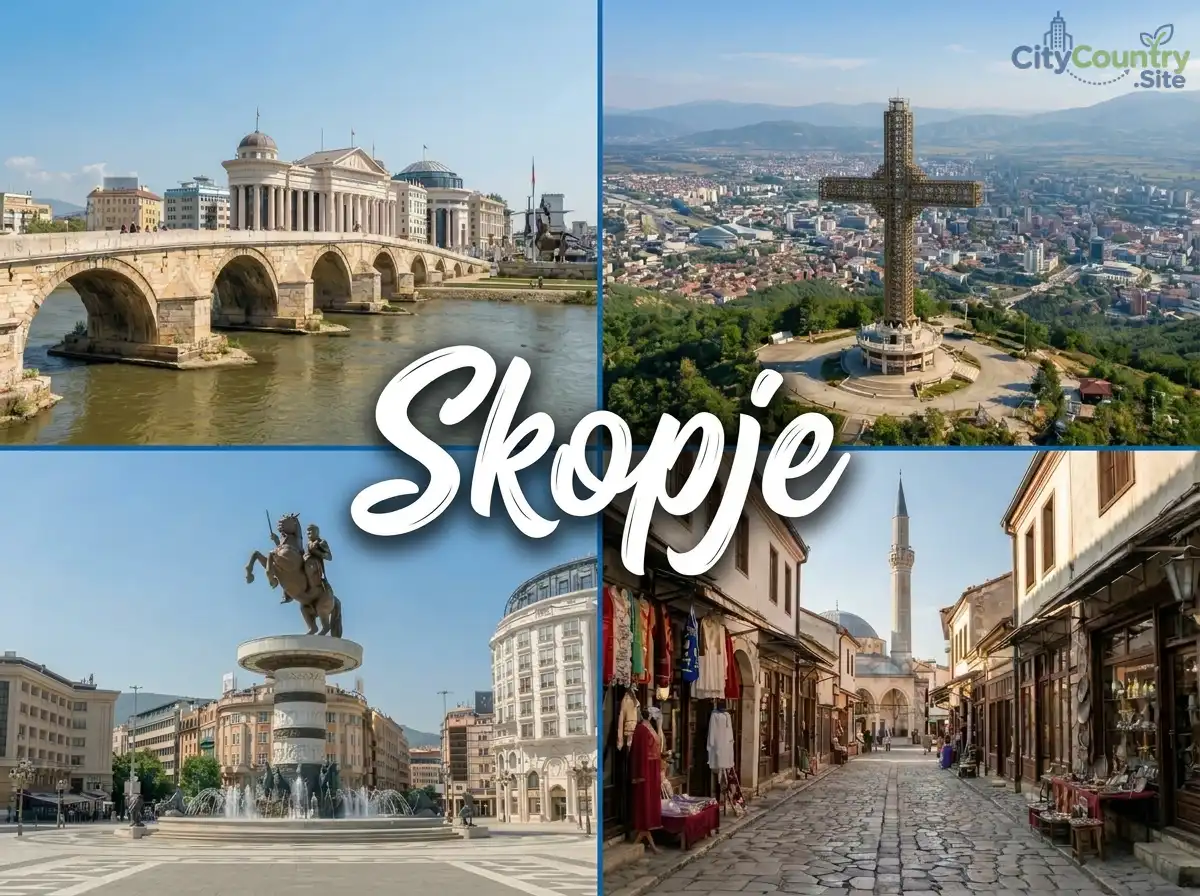
Stand in Macedonia Square and you are surrounded by the most concentrated assemblage of public statuary in Europe — a warrior on horseback of enormous scale (officially “Warrior on a Horse” but unmistakably Alexander the Great), flanked by dozens of other statues, triumphal arches, baroque-inspired fountains, and neoclassical facades that were built between 2010 and 2018 at enormous public expense and to significant international controversy. Cross the Stone Bridge — the genuine 15th-century Ottoman bridge that has connected Skopje’s two banks since the days of the Sultans — and you enter the Old Bazaar (Čaršija): the largest and finest preserved Ottoman market in the Balkans outside Istanbul, a labyrinth of cobbled lanes, mosques, caravanserais, craft workshops, and tea houses that has been functioning continuously since the 14th century.
The contrast — between the manufactured baroque of the 21st-century city center and the genuinely ancient Ottoman quarter across the river — is the defining Skopje experience. It is a city where the authentic and the artificial sit in extraordinary proximity, where a 15th-century stone bridge connects a 14th-century bazaar to a 21st-century theme park of monuments, and where the visitor is required to hold multiple responses simultaneously.
North Macedonia’s capital sits in the Vardar River valley at an elevation of approximately 240 metres — surrounded by mountains that are visible from the city center on clear days and that produce the dramatic landscape that makes Skopje’s setting considerably more attractive than its recent architectural interventions. The Vodno Mountain to the southwest — with its enormous illuminated cross visible from across the city — and the Skopska Crna Gora range to the north provide dramatic frames for an urban landscape that is still, despite everything, possessed of genuine character.
What makes Skopje genuinely interesting — beyond the monuments, beyond the bazaar, beyond the controversy — is the city’s underlying character: a Balkan city at the crossroads of Orthodox Christian, Muslim, Albanian, Macedonian, Roma, and Turkish communities, shaped by Byzantine, Ottoman, Yugoslav, and post-independence layers of history, still working out what it is and what it wants to be, and doing so with a particular combination of political passion, cultural stubbornness, and Balkan warmth that makes human encounters here consistently rewarding.
“Skopje is the most confusing city I have ever visited — I spent three days trying to decide whether I found it ridiculous or magnificent and eventually concluded the answer is both. It is absolutely unlike anywhere else.”
— Anonymous travel journalist, Lonely Planet Balkans, 2025
3. Skopje History Timeline
Prehistoric and Neolithic periods — The Vardar River valley has been inhabited since the Neolithic era — archaeological excavations reveal continuous settlement from approximately 4000 BCE. The earliest organized settlement on the site of modern Skopje is associated with the ancient Paeonian people — a Balkan tribe distinct from both Greeks and Illyrians.
3rd century BCE — The region comes under the influence of the expanding Macedonian Kingdom of Philip II and Alexander the Great — the ancient Macedonian state whose relationship to the modern country of North Macedonia is one of the most fiercely contested historical questions in the Balkans (see Greece-North Macedonia “name dispute”).
148 BCE — Rome incorporates the region into the province of Macedonia. The settlement on the Vardar River develops as a Roman administrative and military center.
1st–4th centuries CE — Under the name Scupi, the Roman city develops significantly — a legionary camp, forum, theater, and aqueduct are documented. Scupi is the capital of the Roman province of Dardania and an important node on the road between the Danube frontier and the Aegean.
518 CE — A devastating earthquake destroys Scupi. The settlement is partially rebuilt but the Roman city never fully recovers.
6th century — Slavic migrations into the Balkans bring the ancestors of the South Slavic peoples into the Vardar valley. Byzantine authority is progressively displaced.
9th–10th centuries — The Vardar valley is contested between the Byzantine Empire and the expanding Bulgarian Empire. The settlement at Skopje grows in strategic importance as a frontier town between competing powers.
1189 — Skopje becomes the capital of the Serbian medieval state under Stefan Nemanja — beginning a period of Serbian rule that leaves significant cultural marks on the region, including the construction of numerous Orthodox monasteries.
1346 — The Serbian Emperor Stefan Dušan is crowned at Skopje, briefly making the city the capital of a Serbian Empire that claims to be the successor of Byzantium. The medieval Serbian state reaches the peak of its territorial extent.
1392 — The Ottoman Empire captures Skopje following the progressive conquest of the Balkans. The city — renamed Üsküp in Turkish — becomes an important Ottoman administrative center for the European Balkans.
15th–19th centuries — Ottoman Üsküp flourishes as one of the most important cities in the Ottoman European domains. The Old Bazaar (Čaršija) develops as a major commercial center; mosques, caravanserais, hans (inns), and hammams (bathhouses) are built throughout the city. The Stone Bridge — built in the 15th century, possibly commissioned by Sultan Murat II — becomes the symbolic connection between the Ottoman administrative city on the left bank and the commercial bazaar on the right bank.
1555 — Another devastating earthquake strikes Skopje — one of a recurring pattern of seismic events that has repeatedly destroyed and rebuilt the city throughout its history.
1689 — Austrian Imperial forces under General Piccolomini briefly occupy Skopje during the Great Turkish War. The Austrians burn much of the city upon retreating — accelerating the decline of Üsküp relative to other Ottoman Balkan centers.
19th century — The Ottoman decline in the Balkans creates a power vacuum that produces intense competition between Serbian, Bulgarian, and Greek national projects for control of Macedonia — the region at the geographic heart of the Balkans whose mixed population made it equally claimed by all three.
1873 — Skopje’s railway connection to Thessaloniki (then Ottoman) and Belgrade creates a significant economic and demographic shift.
1912–1913 — The First Balkan War ends Ottoman rule in Macedonia. Skopje is captured by Serbian forces in October 1912. The subsequent Second Balkan War and the Treaty of Bucharest assign most of Macedonia to Serbia.
1914–1918 — World War I brings Bulgarian and Austro-Hungarian forces to Skopje. The city changes hands multiple times during the conflict.
1918 — Skopje becomes part of the Kingdom of Serbs, Croats and Slovenes (later Yugoslavia) — officially designated as part of the Vardar Banovina administrative unit.
1941–1944 — Bulgarian forces (allied with Nazi Germany) occupy Skopje and much of Macedonia. The city’s Jewish community — the Sephardic Jews who had lived in Skopje since their expulsion from Spain in 1492 — is almost entirely deported and murdered in the Holocaust. Approximately 7,000 Macedonian Jews are transported to the Treblinka extermination camp in March 1943.
1944 — Tito’s Yugoslav Partisans liberate Skopje. The People’s Republic of Macedonia is established as one of the six constituent republics of communist Yugoslavia — a decision that reflects Tito’s strategic calculation about Balkan politics and creates the institutional basis for a distinct Macedonian national identity.
1963 — The most catastrophic event in modern Skopje’s history — a magnitude 6.1 earthquake strikes on July 26, killing over 1,000 people (some estimates are higher), injuring thousands more, and destroying approximately 80% of the city’s buildings. The international response is remarkable — over 78 countries contribute to reconstruction aid. The Yugoslav architect Kenzo Tange (a Japanese architect, reflecting Yugoslavia’s non-aligned status) creates a new master plan for the city. Much of modern Skopje’s brutalist architecture dates from the post-earthquake reconstruction.
1991 — North Macedonia declares independence from Yugoslavia on September 8 — one of the most peaceful dissolutions of any Yugoslav republic, achieved without the armed conflict that devastated Croatia, Bosnia, and Kosovo.
1991–2001 — The new state faces immediate challenges: Greece objects to the use of the name “Macedonia” (claiming it implies territorial claims on the Greek region of the same name) and blocks EU and NATO membership for years. An ethnic Albanian insurgency in 2001 is resolved by the Ohrid Framework Agreement, which grants significant rights to the Albanian minority but leaves underlying tensions unresolved.
2010–2018 — The Skopje 2014 project under Prime Minister Nikola Gruevski’s VMRO-DPMNE government transforms the city center with an estimated €500 million+ investment in neoclassical monuments, fountains, government buildings in baroque style, museums, and the extraordinary “Warrior on a Horse” monument. The project is widely criticized domestically and internationally as a waste of public funds, a distortion of history, and an aesthetically incoherent imposition on the city’s genuine heritage. It is simultaneously unlike anything else in Europe and genuinely fascinating.
2018 — The Prespa Agreement between North Macedonia and Greece resolves the 27-year name dispute — Macedonia officially renames itself North Macedonia, clearing the path for NATO and EU membership. The agreement is politically contested within the country but internationally recognized as a landmark diplomatic achievement.
2020 — North Macedonia joins NATO — a moment of enormous national significance after nearly three decades of frustrated ambition.
2022 — EU accession negotiations officially begin — North Macedonia is on the path toward European Union membership, though the timeline remains uncertain.
2024–2026 — Skopje continues developing — the controversy over the Skopje 2014 monuments persists but the city’s genuine attractions (the Old Bazaar, the canyon day trips, the food scene, the affordability) are attracting growing numbers of international visitors. The city’s political landscape remains dynamic; economic development proceeds alongside ongoing governance challenges.

4. Skopje Geography & Neighborhoods
Skopje occupies the Vardar River valley in north-central North Macedonia — a broad flat basin at approximately 240 metres elevation, surrounded by mountain ranges on three sides. The Vardar River runs through the center of the city from east to west, providing the fundamental geographical division between the northern and southern parts of the city.
Vodno Mountain (1,066 metres) rises dramatically to the southwest of the city, with the enormous Millennium Cross illuminated at night and visible from most of the city. The Skopska Crna Gora (Black Mountain) range lies to the north. The combination of river valley and surrounding mountains creates a dramatic natural setting that is one of the city’s genuine assets.
Neighborhood Comparison Table
| Area | Best For | Vibe | Price Level |
|---|---|---|---|
| Macedonia Square (Ploštad Makedonija) | Skopje 2014 monuments, central orientation | Grand, controversial, tourist-facing | Mid |
| Old Bazaar (Čaršija) | Ottoman heritage, craft shops, mosques, cafés | Ancient, atmospheric, authentic | Budget–Mid |
| Debar Maalo | Independent cafés, restaurants, local life | Bohemian, local, creative | Mid |
| Centar (City Center) | Hotels, shopping, business, central access | Modern, functional, mixed | Mid |
| Karpoš | Residential, parks, upscale local living | Quiet, green, affluent | Mid–High |
| Čair | Albanian community, authentic urban life | Dense, diverse, authentic | Budget–Mid |
| Aerodrom | Modern suburbs, budget accommodation | Functional, residential, expanding | Budget |
| Kisela Voda | Residential, local cafés, authentic neighborhoods | Genuine, unhurried, local | Budget–Mid |
The Old Bazaar (Čaršija) is the most important and most historically significant area — the Ottoman market district across the Stone Bridge from the modern center, its cobbled lanes and ancient buildings constituting the most authentic and most genuinely historical environment in the city. Debar Maalo — the residential neighborhood south of the city center — has emerged as the most creative and most genuinely local café and restaurant district, beloved by Skopje’s young creative class and the best place to find the city’s most interesting independent food and drink establishments. Macedonia Square and the surrounding Skopje 2014 area are tourist-facing and visually extraordinary, if architecturally controversial.

5. Skopje Weather & Temperature Guide
Skopje has a humid continental climate with significant seasonal extremes — hot, dry summers (among the hottest of any Balkan capital) and cold, occasionally snowy winters, with beautiful spring and autumn periods that represent the finest travel windows.
Month-by-Month Weather Table
| Month | Avg Temp (°C) | Rainfall | Crowd Level | Travel Recommendation |
|---|---|---|---|---|
| January | -3–5 | Low–Medium (snow possible) | Very Low | ✅ Good — quiet, affordable, atmospheric |
| February | -1–8 | Low–Medium | Very Low | ✅ Good — spring beginning |
| March | 4–14 | Medium | Low | ✅ Good — warming rapidly |
| April | 9–20 | Medium | Medium | ⭐ Excellent — spring blooms |
| May | 13–25 | Medium–Low | High | ⭐ Excellent — finest spring weather |
| June | 17–30 | Low | High | ⭐ Excellent — warm and lively |
| July | 20–35 | Very Low | High | ⚠️ Very hot — limit midday outdoor time |
| August | 20–37 | Very Low | High | ⚠️ Hottest — early morning outdoor only |
| September | 15–30 | Low | High | ⭐ Excellent — finest autumn month |
| October | 9–21 | Medium | Medium | ⭐ Excellent — golden autumn |
| November | 3–12 | Medium | Low | ✅ Good — quieter, atmospheric |
| December | -1–7 | Low–Medium | Low | ✅ Good — festive season |
April through June is Skopje’s finest season — warm (20–25°C), relatively low rainfall, the surrounding mountains beautifully green, and the city’s outdoor café culture in full operation. May is the single finest month — the mountains are still snow-capped on their higher ridges, the valley wildflowers are extraordinary, and the temperature is perfect for exploring both the city and the magnificent day trip destinations.
September and October are outstanding autumn months — warm but not scorching after the extreme summer heat, the mountain forests beginning their color change, and the city at its most golden and most atmospheric.
July and August are very hot — Skopje regularly records 35–37°C in peak summer and is one of the hottest capitals in Europe. Plan outdoor activities exclusively for early morning and evening; the Old Bazaar’s covered lanes provide welcome shade.
Winter (December–February) is cold but rarely extreme — snow is possible but Skopje winters are generally shorter than those of the Baltic capitals. A quiet, affordable, and entirely authentic winter experience.
💡 Did You Know? The Vardar River valley in which Skopje sits creates a distinctive microclimate — channeling hot, dry air from the south in summer (producing temperatures that regularly exceed 35°C) and cold air from the north in winter. This valley effect makes Skopje one of the hottest cities in Europe in summer — regularly exceeding the temperatures of Athens and Rome despite being significantly further north. In July 2024, Skopje recorded temperatures of 44°C during the extraordinary Balkan heat wave — among the highest reliably recorded temperatures in European capital city history.
6. Skopje Airport & Getting There
Skopje International Airport (SKP)
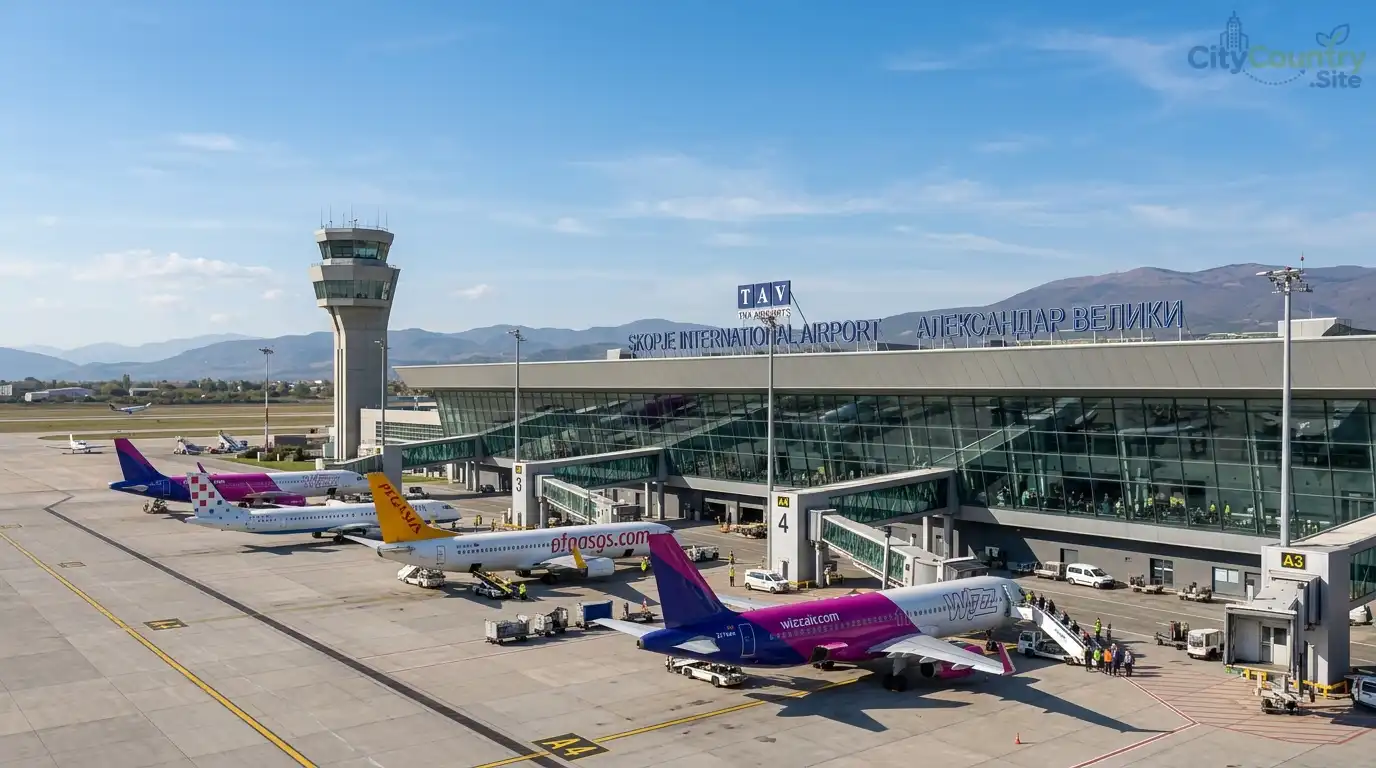
Skopje International Airport (IATA: SKP) — officially Alexander the Great Airport (a name that contributed to the Greek-Macedonian name dispute) — is located approximately 21 km east of the city center near the town of Petrovec. A modest but functional airport that has seen significant traffic growth in recent years as North Macedonia’s tourism profile has grown.
Wizz Air is the dominant carrier at Skopje, connecting the city to numerous European destinations at very low fares. Additional carriers include Turkish Airlines (connecting Skopje to Istanbul and beyond), Pegasus Airlines, airBaltic, Lufthansa (seasonal), Austrian Airlines (seasonal), easyJet (seasonal), and several charter operators. International connections include London, Vienna, Frankfurt, Istanbul, Zurich, Amsterdam, Rome, and many other European cities.
Important note: Many travelers reach Skopje via Pristina International Airport (PRN) in Kosovo — approximately 90 km north and accessible in under 2 hours by road. Pristina is served by a wider range of airlines and routes than Skopje, including British Airways, Lufthansa, Swiss Air, and others. For travelers with flexible routing, Pristina can be a better gateway with more airline options.
Getting from SKP to the City Center:
| Transport Option | Duration | Cost (Approx.) | Notes |
|---|---|---|---|
| Airport Bus | 30–40 min | 200 MKD (~$3.50) | Reliable; runs to city center |
| Taxi (official) | 25–35 min | 1,200–1,800 MKD (~$21–31) | Official taxi rank; agree price |
| Bolt / inDrive | 25–35 min | 800–1,400 MKD (~$14–24) | App-based; cheaper than taxi |
| Hotel shuttle (pre-booked) | 30–40 min | Varies | Some hotels offer transfers |
Getting to Skopje from neighboring countries:
| Origin | Transport | Duration | Cost (Approx.) |
|---|---|---|---|
| Pristina, Kosovo | Bus / Car | 1.5–2 hours | €5–15 |
| Tirana, Albania | Bus | 5–6 hours | €15–25 |
| Thessaloniki, Greece | Bus / Car | 3 hours | €10–20 |
| Sofia, Bulgaria | Bus / Car | 3.5–4 hours | €10–20 |
| Belgrade, Serbia | Bus | 5–6 hours | €15–25 |
| Istanbul, Turkey | Bus / Flight | 12 hrs / 1.5 hrs | €20–40 / €60–150 |
💡 Did You Know? Mother Teresa (Anjezë Gonxhe Bojaxhiu, 1910–1997) was born in Skopje on August 26, 1910 — in a house near what is now the Memorial House of Mother Teresa on Macedonia Square. She was the daughter of an Albanian Catholic family and left Skopje at age 18 to join a religious order in Ireland, eventually founding the Missionaries of Charity in Calcutta. The Mother Teresa Memorial House in Skopje — opened in 2009 on the site of the church where she was baptized — is one of the most visited attractions in the city and a point of considerable local pride, even as both Albania and North Macedonia claim her as their own national figure.
7. Getting Around Skopje
Skopje is a medium-sized city where walking works well for the central areas but where public transport and ride-hailing are useful for reaching outer neighborhoods, Vodno Mountain, and attractions outside the immediate center.
Walking is the primary and recommended mode for the historic center, Macedonia Square, the Stone Bridge, and the Old Bazaar — all connected in a walkable corridor of approximately 15–20 minutes from end to end. The Vardar River promenade provides a pleasant riverside walking route connecting the city center with the Stone Bridge and adjacent areas.
Bolt and inDrive are the primary ride-hailing apps — both operate in Skopje with good availability and transparent pricing. A typical city ride costs 200–600 MKD (~$3.50–10.50). Significantly cheaper than taxis and more transparent in pricing.
City Buses — Skopje’s bus network covers the city comprehensively at very low cost (35 MKD per journey — approximately $0.60). Useful for reaching Vodno Mountain (bus to the cable car station), the Matka Canyon (seasonal bus service), and more distant neighborhoods.
Taxis — white vehicles with meters — are widely available. Agree on the price before departing or ensure the meter is running. A typical city ride costs 200–500 MKD (~$3.50–9). Bolt and inDrive are generally cheaper.
Cable Car (Žičara) to Vodno Mountain — Accessible by city bus to the lower station, providing easy access to the mountain’s hiking trails and the views from the Millennium Cross.

8. Top Attractions & Must-See Places in Skopje
Top Attractions Table
| Attraction | Type | Entry Fee | Best Time | Time Needed |
|---|---|---|---|---|
| Old Bazaar (Čaršija) | Ottoman market district / heritage | Free | Morning | 2–4 hours |
| Skopje Fortress (Kale) | Medieval Byzantine / Ottoman fortress | 100 MKD (~$1.75) | Morning | 1.5 hours |
| Stone Bridge (Kameni Most) | Historic Ottoman bridge | Free | Any time | 20–30 min |
| Macedonia Square and Monuments | Skopje 2014 monuments / fountains | Free | Evening (illuminated) | 1–1.5 hours |
| Mother Teresa Memorial House | Memorial / museum | 100 MKD (~$1.75) | Morning | 45 min |
| Museum of the Macedonian Struggle | National history museum | 100 MKD (~$1.75) | Morning | 1.5 hours |
| Mustafa Pasha Mosque | 15th-century Ottoman mosque | Free | Morning | 30–45 min |
| Old Bazaar Mosques (Daut Pasha, Čifte Amam) | Ottoman architecture | Free–small fee | Morning | 1 hour |
| Vodno Mountain (Millennium Cross) | Nature / views / hiking | Free (cable car: 200 MKD) | Morning | Half–full day |
| Holocaust Memorial Center | Holocaust / Jewish heritage | 100 MKD (~$1.75) | Morning | 1.5 hours |
| National Gallery of Macedonia | Art museum | 100 MKD (~$1.75) | Morning | 1.5 hours |
| Memorial House of Mother Teresa | Catholic heritage / memorial | 100 MKD (~$1.75) | Any time | 45 min |
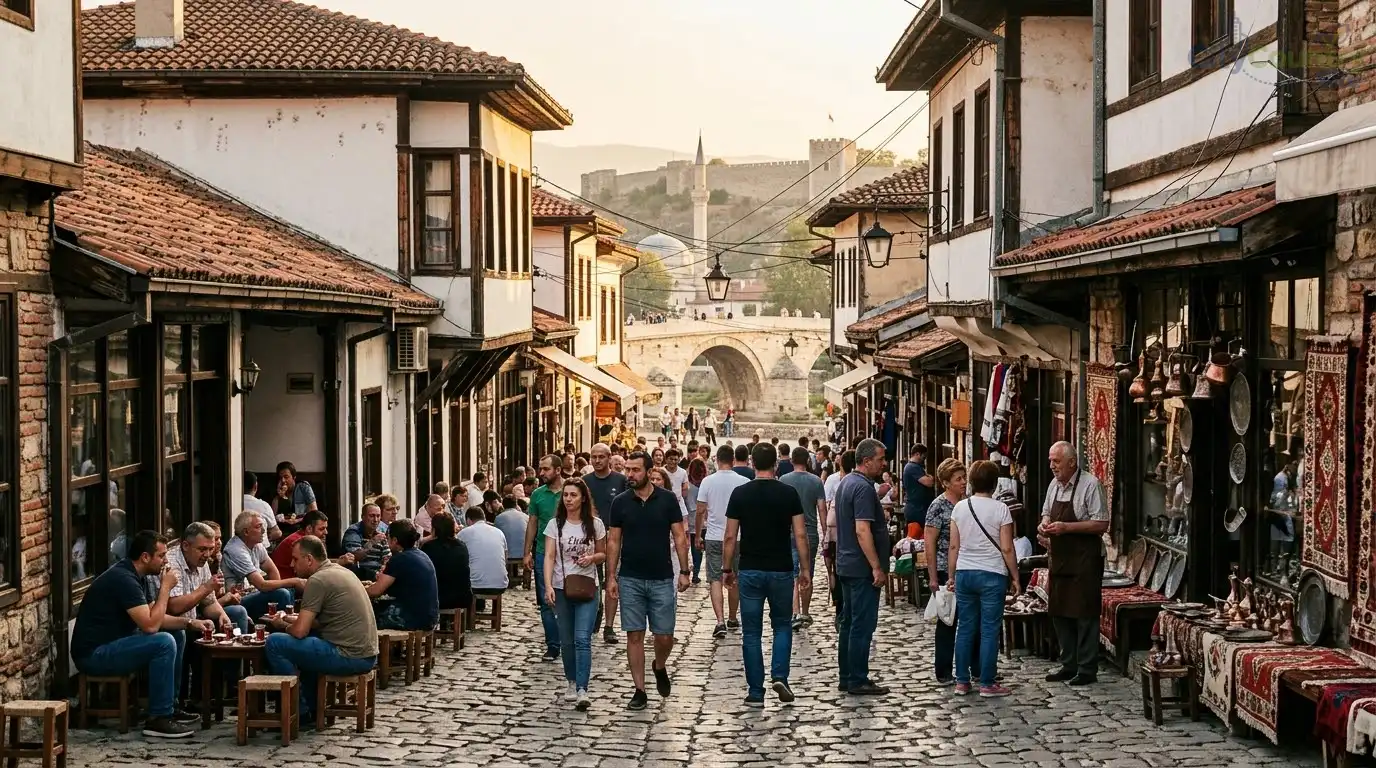
The Old Bazaar (Čaršija) is the soul of Skopje and the most important reason to visit the city. The largest and finest preserved Ottoman market in the Balkans outside Istanbul, covering approximately three square kilometres of cobbled lanes, it has been functioning as a commercial center since the 14th century with remarkable continuity. Unlike the reconstructed or heavily touristed bazaars of Istanbul or Sarajevo, the Skopje Čaršija retains a character of genuine daily life — craftsmen still working in traditional trades (coppersmiths, jewelers, leather workers, textile merchants), neighborhood mosques still serving active communities, tea houses (čajdžinica) where old men play backgammon in the morning light, and a human scale that makes wandering its lanes one of the most authentic historical immersions available in the Balkans. The Daut Pasha Hammam (15th century, one of the largest Ottoman baths in the Balkans, now an art gallery), the Čifte Amam (double hammam, also converted to cultural use), the Mustafa Pasha Mosque (1492 — its interior garden one of the most beautiful Ottoman spaces in North Macedonia), and the Kapan Han (Ottoman caravanserai) are the most important architectural monuments within the bazaar.
Skopje Fortress (Kale) rises on a rocky hill above the junction of the Vardar River and the Stone Bridge — a Byzantine and Ottoman fortress whose current walls date primarily from the 6th century Byzantine reconstruction, with later Ottoman modifications. The fortress is not extensively developed as a museum — much of the interior is an open archaeological site — but the views from the ramparts over the city, the river, the bazaar, and the surrounding mountains are among the finest available in Skopje. The combination of the ancient stone walls and the extraordinary panorama of the city below makes the Kale an essential visit.
The Stone Bridge (Kameni Most) is the symbolic heart of Skopje — a beautifully proportioned 15th-century Ottoman bridge of eleven arches spanning the Vardar River, connecting the Ottoman bazaar on the north bank with the modern city center on the south. The bridge has stood for over 500 years, surviving the 1963 earthquake (one of the very few pre-earthquake structures to survive relatively intact) and the extraordinary transformations that the city has undergone around it. Standing on the Stone Bridge at dusk — with the bazaar’s minarets to the north, the new monuments’ lights coming on to the south, and the Vardar flowing below — is the finest single Skopje moment.
Macedonia Square (Ploštad Makedonija) and the Skopje 2014 monuments are the city’s most controversial and most internationally discussed feature. The “Warrior on a Horse” — a massive equestrian statue officially unnamed but universally understood to represent Alexander the Great — dominates the square, surrounded by dozens of other monumental statues, a neoclassical arch (the Arc de Triomphe of Skopje — the local name used ironically by residents), baroque-inspired government buildings, and multiple fountains. The ensemble is technically extraordinary — the execution is high quality, the materials are expensive, the scale is genuinely impressive — while simultaneously representing a public investment decision of highly questionable wisdom and a historical narrative of considerable controversy. Visit at evening, when the illumination turns the entire square into something genuinely theatrical.
The Holocaust Memorial Center for the Jews of Macedonia — opened in 2011 in a beautifully designed building near the Stone Bridge — documents the destruction of Macedonia’s 7,148 Jewish community members in March 1943, when the entire Skopje Sephardic Jewish community was transported by Bulgarian forces to the Treblinka extermination camp. The museum’s design is outstanding — its exhibitions are moving, precisely documented, and historically essential. One of the finest Holocaust memorial museums in southeastern Europe.
💡 Did You Know? The Skopje 2014 project — the controversial program of neoclassical monuments and baroque government buildings that transformed the city center between 2010 and 2018 — is estimated to have cost between €500 million and €700 million of public funds (exact figures have never been fully disclosed), in a country with a GDP per capita of approximately $7,000–8,000 at the time of construction. The project was officially justified as stimulating tourism and reinforcing national identity; critics argued it was a calculated distraction from governance failures and a waste of funds desperately needed for education, healthcare, and economic development. The irony noted by many observers is that the project succeeded in one of its stated aims — Skopje now attracts more international visitors than at any point in its history, in part because people come to see what this extraordinary, controversial, unique cityscape actually looks like in person.
9. Skopje Food & Cuisine Guide
Macedonian cuisine is a deeply satisfying, Mediterranean and Balkan-influenced cooking tradition — rich in grilled meats, freshwater fish, roasted vegetables, dairy products, and the extraordinary vegetables grown in North Macedonia’s fertile river valleys. The country’s agricultural heritage produces ingredients of exceptional quality; the food culture reflects centuries of Ottoman, Greek, Serbian, and Turkish culinary influence synthesized into something entirely distinctive.
Must-Try Dishes in Skopje
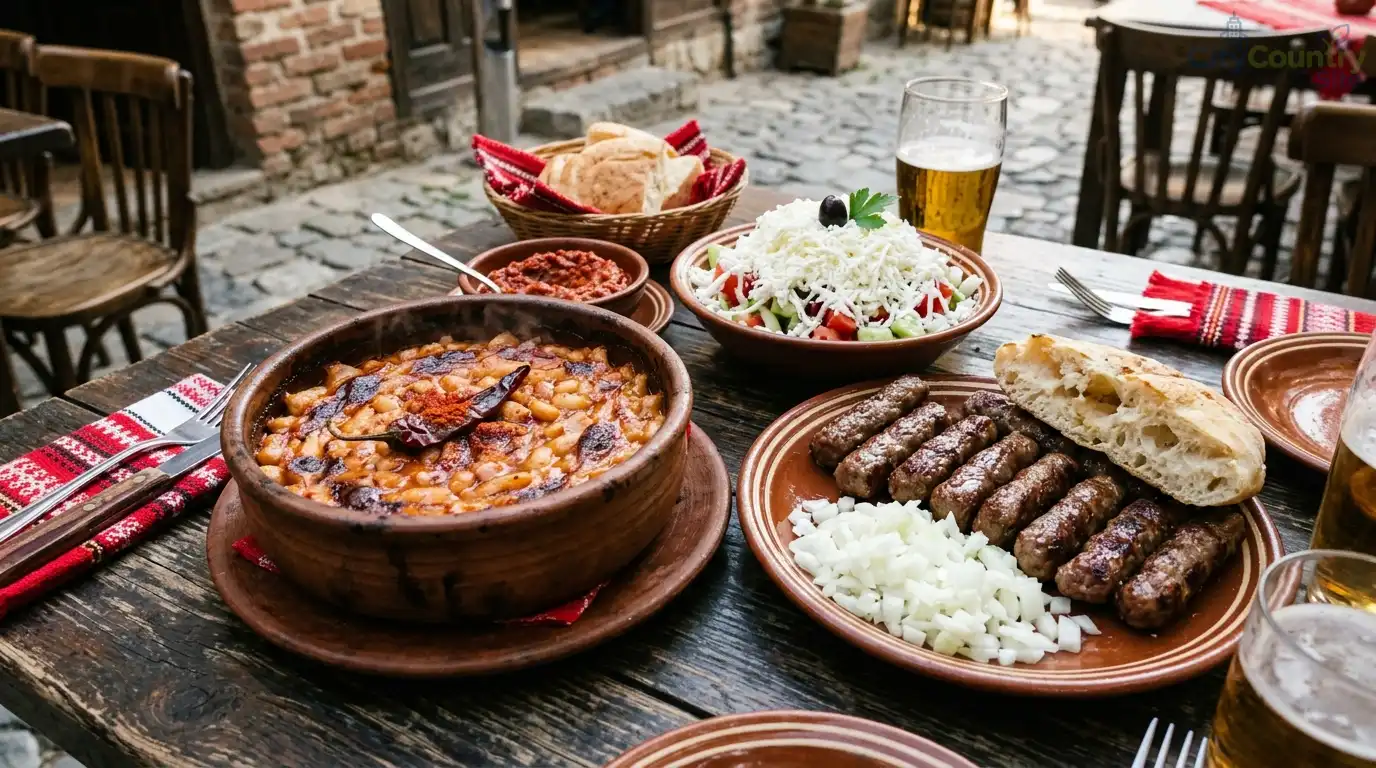
Tavče Gravče — North Macedonia’s undisputed national dish and one of the most satisfying bean preparations in Europe. White beans slow-cooked in a clay pot (tavče) with onions, peppers, tomatoes, and the distinctive Macedonian spice blend of dried paprika and herbs, baked until the beans are creamy and the top is slightly charred. The name literally means “beans in a pan” — an entirely accurate description of something far more extraordinary than its name suggests. Every region and every family has a slightly different version; the finest use Macedonian tetovo beans — a prized local variety with a particular creaminess and flavor. Available at every traditional restaurant; an essential order.
Šopska Salata — The most beloved salad in the Balkans — the Macedonian (or Bulgarian/Serbian) national salad depending on which country you are in — and the subject of good-natured regional rivalry. Fresh tomatoes, cucumbers, onion, peppers, and roasted peppers, topped generously with grated white cheese (sirenje — similar to feta) and dressed with olive oil and a little vinegar. The quality of the Macedonian tomatoes — grown in the warm Vardar valley — makes the Skopje version of šopska particularly outstanding in summer.
Pastrmajlija — North Macedonia’s most famous traditional bread — an oval flatbread topped with cured meat (pastrma), eggs, and sometimes cheese, baked in a wood-fired oven until the bread is crispy at the edges and the topping is caramelized. Pastrmajlija is associated with the city of Štip but available throughout Skopje’s traditional restaurants. Rich, savory, and deeply satisfying.
Ajvar — The great roasted red pepper condiment of the Balkans — North Macedonia’s version is considered by many food authorities to be the finest available. Made in autumn when the long red peppers are at their ripest, roasted over open flames, then slowly cooked with garlic and olive oil into a dense, smoky, sweet-hot relish. Macedonian ajvar is available at every traditional restaurant and is one of the finest food souvenirs available from the country.
Turli Tava — A traditional Macedonian baked casserole of mixed vegetables (peppers, tomatoes, onions, eggplant, green beans) with meat (lamb or pork) — slow-cooked in an earthenware dish until everything merges into a deeply aromatic preparation. A dish of extraordinary everyday Albanian and Macedonian cooking tradition.
Ohrid Trout (Pastrmka) — The freshwater trout of Lake Ohrid — one of the world’s oldest and most biodiverse lakes, just 3 hours from Skopje — is among the finest freshwater fish in Europe. Available in Skopje’s better restaurants; a reminder that North Macedonia’s inland geography produces extraordinary ingredients far from the sea.
Rakija — As throughout the Balkans, grape or plum brandy is the essential social drink. Macedonian rakija — particularly the grape-based lozova rakija and the quince-based dunja rakija — is of excellent quality and very inexpensive. Offered at the beginning of every social meal; refusing is impolite.
Macedonian Wine — North Macedonia has a 4,000-year-old winemaking tradition and produces wines of increasing international recognition. The Tikveš wine region in the south — with its warm continental climate and old-vine Vranec (a powerful indigenous red grape) and Smederevka (white) — produces the country’s finest wines. Stobi, Tikveš, and several boutique producers make wines of genuine quality at prices that are dramatically below comparable European alternatives.
Best Restaurants and Food Spots in Skopje
Destan (Old Bazaar) — The finest traditional Macedonian restaurant in the Old Bazaar — a beautifully designed space serving outstanding tavče gravče, grilled meats, and traditional Macedonian cuisine with genuine care and quality ingredients. 600–1,500 MKD (~$10–26) per person.
Pelisterka (Debar Maalo) — A beloved neighborhood restaurant in Debar Maalo — excellent traditional Macedonian comfort food, outstanding local wines, and the warm, genuinely local atmosphere that distinguishes the best Skopje dining experiences from tourist-facing alternatives. 500–1,200 MKD (~$9–21).
Menada (Čaršija area) — An excellent contemporary Macedonian restaurant near the Old Bazaar — creative preparations of traditional ingredients, outstanding Macedonian wine selection, and a knowledgeable and enthusiastic staff. 700–1,800 MKD (~$12–31).
Old Bazaar Tea Houses (Čajdžinica) — Several traditional tea houses in the Čaršija serve authentic Ottoman-style tea (çay) alongside baklava and traditional sweets. The finest is the atmospheric Čajdžinica Destan near the Mustafa Pasha Mosque — a genuinely historic experience at minimal cost.
Green Market (Zeleni Pazar) — The primary fresh produce market near the Old Bazaar — outstanding Macedonian vegetables, fruit, dairy, and traditional products from surrounding farms. The best place in Skopje to understand the extraordinary quality of Macedonian agricultural produce. Best mornings Tuesday through Sunday.
Pivnica An — One of Skopje’s finest traditional restaurants in a beautifully restored Ottoman-era building — outstanding pastrmajlija, grilled meats, and traditional Macedonian dishes in a setting of genuine historical character. 600–1,400 MKD (~$10–24).
💡 Did You Know? North Macedonia produces approximately 25 million liters of wine per year despite having a population of barely 2 million people — making it one of the highest wine production per capita ratios in Europe. The vast majority of this wine was historically exported in bulk to European wine producers (particularly in Germany and France) who blended it into their own products without identifying the Macedonian origin. The shift toward bottled, branded Macedonian wine of genuine quality — driven by producers like Stobi, Tikveš, and the boutique wineries of the Tikveš region — represents one of the most exciting developments in Balkan viticulture of the past decade.
10. Skopje Accommodation Guide
Skopje offers accommodation across all budget levels at prices that are among the most affordable of any European capital — reflecting North Macedonia’s low cost of living and the still-developing state of the city’s tourism infrastructure.
Best Areas to Stay:
- City Center / Near Macedonia Square: Best for proximity to the Skopje 2014 monuments, the Stone Bridge, and the Old Bazaar
- Debar Maalo: Best for the most interesting and most genuinely local café and restaurant scene
- Near the Old Bazaar: Best for those wanting maximum atmosphere and proximity to the city’s finest historical district
Accommodation Price Ranges (2026)
| Category | Price/Night (USD) | Examples |
|---|---|---|
| Budget Hostel | $10–25 | Shanti Hostel, Art Hostel, Yes Hostel |
| Mid-Range Hotel / Guesthouse | $40–90 | Hotel Solun, Hotel Super 8, Hotel Pelister |
| Upscale Boutique Hotel | $90–180 | Hotel Arka, Boutique Hotel Jadran, Hotel Tim |
| Luxury Hotel | $180–350+ | Marriott Skopje, DoubleTree by Hilton, Hotel Aleksandar Palace |
Marriott Skopje — in a prime position overlooking the Vardar River — is the city’s most reliable luxury address, with outstanding facilities and the international service standards expected of the brand. Rates: approximately $160–300 per night.
Hotel Arka — a beautifully designed boutique property in the city center — offers outstanding character at very accessible prices by Western European standards. Rates: approximately $90–160 per night.
Shanti Hostel — consistently one of the finest-rated budget accommodations in the city — offers excellent facilities, genuine social atmosphere, and superb value. Dorm beds from $10; private rooms from $25.
11. Best Time to Visit Skopje
April through June is the finest travel season — warm temperatures (20–26°C), manageable crowds, the surrounding mountains beautifully green, and the city’s outdoor café culture in full operation. May is the outstanding single month — the mountains still snow-capped, the valley flowers extraordinary, and temperatures perfect for exploring both the city and the day trip destinations.
September and October offer excellent autumn conditions — the summer heat has broken, the landscape is beautiful in the changing light, and the Tikveš wine harvest season creates additional interest for food and wine travelers.
July and August are very hot — 35–37°C is typical and genuinely uncomfortable in the city’s urban environment. Plan outdoor activities exclusively for early morning and late evening; the Old Bazaar’s shaded lanes and the Matka Canyon’s cool gorge provide summer relief.
December and winter are quiet and affordable — Skopje rarely sees deep snow and winters are shorter than the Baltic or Central European capitals. The Christmas and New Year decorations on Macedonia Square are genuinely spectacular given the existing density of monuments and illumination.
Key Festivals and Events in Skopje
- Skopje Jazz Festival (October) — One of the finest and longest-running jazz festivals in southeastern Europe — consistently attracting major international artists to intimate Skopje venues since 1982
- Skopje Summer Festival (July–August) — Annual outdoor performing arts festival — theater, classical music, and dance performances in various outdoor venues
- May Opera Evenings (Majski Operni Večeri) (May) — Annual classical music and opera festival held in various Skopje venues
- Skopje Film Festival (March) — Growing annual film festival with a good selection of European and Balkan cinema
- Ilinden (August 2) — North Macedonia’s most important national holiday — commemorating the 1903 Ilinden Uprising against Ottoman rule; marked with cultural events and national celebrations throughout the country
- Skopje Marathon (April) — Growing annual running event through the city center
12. Skopje Shopping Guide
Skopje’s shopping scene combines the extraordinary Old Bazaar craft tradition with growing contemporary design options and excellent traditional food product purchasing.
What to Buy:
Macedonian Ajvar — The roasted red pepper relish is North Macedonia’s finest food product and its most distinctive culinary souvenir. Available in jars at the Green Market from producers who make it themselves, and at the Old Bazaar shops. Buy the homemade (domaška) version rather than commercial brands for the finest quality.
Macedonian Wine — Excellent Tikveš region wine — particularly Vranec (the powerful indigenous red) — is available at wine shops throughout the city at prices that are among the lowest in Europe for comparable quality.
Filigree Silver Jewelry — The Old Bazaar’s jewelry tradition includes outstanding silver filigree work — intricate wirework in Macedonian folk patterns. Several workshops in the Čaršija produce pieces of genuine artisan quality.
Traditional Macedonian Textiles — Handwoven textiles in traditional Macedonian geometric patterns — table runners, decorative weavings, and clothing items from the folk tradition.
Macedonian Honey and Walnuts — Outstanding mountain honey from Macedonian beekeepers; excellent walnuts from the fertile Vardar valley. Available at the Green Market and Old Bazaar food shops.
Where to Shop:
Old Bazaar (Čaršija) — The finest shopping experience in Skopje — traditional craft shops, jewelry workshops, textile merchants, and food stalls in the most atmospheric market environment in the Balkans. Daily; best in the morning.
Green Market (Zeleni Pazar) — The primary fresh produce and food market near the bazaar — outstanding Macedonian vegetables, dairy, traditional food products, and seasonal produce.
Čaršija Craft Workshops — Several traditional craft workshops in the Čaršija offer directly purchased handmade items — copper work, leather goods, and wood carving from craftspeople who have practiced their trades in the same locations for generations.

13. Skopje Nightlife & Entertainment
Skopje has a nightlife scene that is more developed than many visitors expect — driven by its young university population, its affordability, and the particular Balkan talent for sociality and celebration.
Debar Maalo is the epicenter of Skopje’s genuinely local evening culture — a residential neighborhood south of the city center whose café-lined streets have become the gathering place for the city’s young creative class. Ćušpajz and several other excellent independent bars and restaurants create an evening atmosphere of genuine local warmth that is entirely distinct from the tourist-facing establishments near Macedonia Square.
Live Music and Cultural Venues:
MKC (Macedonian Youth Cultural Centre) — The most important cultural venue in Skopje — a long-running hub for contemporary performing arts, music, and cultural events that has been central to Skopje’s alternative cultural life since the Yugoslav period.
Čair Amphitheatre — An outdoor performance venue near the Old Bazaar hosting summer concerts and cultural events in a dramatic setting.
National Theatre of Macedonia — Regular drama productions in Macedonian; occasional international productions and guest performances.
Macedonian Philharmonic — Regular symphony concerts in the Philharmonic Hall — outstanding quality at prices dramatically lower than Western European equivalents.
Bars and Nightlife:
Tempio (Debar Maalo) — One of Skopje’s most beloved local bars — excellent cocktails, a genuinely creative atmosphere, and the particular warmth of a bar where interesting people gather without pretension.
Urban Bar (City Center) — A lively, central bar popular with both locals and visitors — good drinks, reliable music, and a social atmosphere.
Ćušpajz (Debar Maalo) — A beautifully designed bar and restaurant in Debar Maalo — one of the finest evening destinations for understanding contemporary Skopje’s creative culture.
Old Bazaar Tea Houses (Evening) — Several tea houses in the Čaršija remain open into the evening, offering a completely different and entirely authentic evening experience — glasses of sweet tea, backgammon, and the ambient sounds of a living Ottoman market neighborhood.
Clubs:
Skopje’s club scene is modest but genuine — Colosseum, Cabrio, and several other venues offer DJ events and live music for those seeking a dance floor experience. The city’s affordability makes club nights dramatically cheaper than comparable Western European venues.
14. Hidden Gems & Local Secrets
The Čaršija at Dawn — The Old Bazaar at 7–8 AM — before the tourist day begins — is an entirely different and entirely more authentic experience. The muezzin’s call from the Mustafa Pasha Mosque echoes through the cobbled lanes; shopkeepers set up their displays; the smell of freshly baked bread drifts from bakeries; cats (Skopje’s Čaršija is home to an extraordinary number of resident cats, beloved by the community) emerge for their morning circuits. This is the bazaar as a living neighborhood rather than a tourist attraction.
The Painted Mosque of Tetovo (Day Trip) — The extraordinary Šarena Džamija (Painted Mosque) in Tetovo — just 44 km west of Skopje — is arguably the most beautiful single building in North Macedonia and one of the most extraordinary examples of Ottoman decorative art in the Balkans. Its entire exterior is covered in intricate floral and geometric frescoes in vivid colors — a visual spectacle entirely unlike any other mosque in Europe. Almost entirely unknown internationally and completely deserving a detour.
The Debar Maalo Café Circuit on a Slow Morning — The residential streets of Debar Maalo are lined with independent cafés of considerable quality, each with its own distinct character. Spending a slow morning moving between three or four cafés — reading, watching the neighborhood wake up, drinking Macedonian coffee — is the finest available insight into the daily rhythm of contemporary Skopje life that most tourists entirely miss.
The Matka Canyon Early Morning — Matka Canyon (see Day Trips) is most magical in the early morning, when the canyon walls glow with the first light and the lake surface is perfectly still. Arriving by the first available transport (around 8 AM) before the day visitors arrive provides a quality of experience dramatically superior to visiting later in the day.
The Jewish Quarter History Walk — The area around the Holocaust Memorial Center and the old Jewish quarter of Skopje preserves several traces of the Sephardic Jewish community that lived here for nearly 450 years before their near-total destruction in 1943. Walking with a detailed map and engaging with the Memorial Center’s documentation provides a moving encounter with a vanished civilization that was central to Skopje’s character.
Skopje from Vodno Mountain at Sunset — The cable car to Vodno Mountain operates until evening in summer, and the view from the upper cable car station — over the entire city, the Vardar River valley, and the surrounding mountain ranges at sunset — is genuinely extraordinary. The descending cable car as the city lights come on below is one of the finest free (cable car aside) visual experiences available from Skopje.
15. Day Trips from Skopje
North Macedonia — roughly the size of Wales or Vermont — is small enough that extraordinary day trips are accessible from Skopje within 1–3 hours.
Day Trips Table
| Destination | Distance | Travel Time | Method | Highlights |
|---|---|---|---|---|
| Matka Canyon | 15 km west | 30 min | Bus / Car / Taxi | Extraordinary gorge; lake; cave; boat trips; monastery |
| Ohrid | 170 km southwest | 2.5 hrs | Bus / Car | UNESCO lake and old town; one of Europe’s most beautiful sites |
| Tetovo | 44 km west | 45 min | Bus / Car | Painted Mosque; Arabati Baba Teke; Albanian cultural heritage |
| Vodno Mountain | 7 km southwest | 20 min by cable car | Cable car + bus | Hiking; Millennium Cross views; forests; fresh air |
| Stobi | 80 km south | 1 hour | Car | Ancient Roman and early Christian city ruins; outstanding mosaics |
| Mavrovo National Park | 120 km west | 1.5 hrs | Car | Ski resort; mountain lake; forest; wildlife |
| Kratovo | 70 km northeast | 1 hour | Car | Medieval stone bridges; volcanic rock towers; traditional architecture |
| Tikveš Wine Region | 100 km south | 1.5 hrs | Car | Wine country; Stobi winery; Tikveš lake |
Matka Canyon is the single finest and most immediately accessible day trip from Skopje — and one of the most spectacular natural environments accessible from any European capital within 30 minutes. A limestone gorge cut by the Treska River into the mountains west of the city, Matka Canyon offers: a spectacular lake formed by a dam in the narrowest part of the gorge; boat trips through the canyon to reach otherwise inaccessible cave systems (including Vrelo Cave — one of Europe’s deepest underwater caves); several medieval monasteries clinging to the canyon walls; and walking trails through the gorge of outstanding beauty. The combination of the emerald-green lake, the towering limestone walls, and the medieval monastery reflected in the still water creates an environment of almost surreal beauty. Arrive early; go by boat as well as on foot.
Ohrid — 170 km southwest — is North Macedonia’s greatest treasure and one of the most beautiful destinations in the entire Balkans. The UNESCO-listed lake and old town provide: a medieval old town of extraordinary density (over 365 churches were once said to exist within its walls — “one for every day of the year”); the Church of St. Panteleimon (Byzantine, 9th century) with the finest surviving Byzantine frescoes in the southern Balkans; the Samuel’s Fortress with panoramic views over the lake; and Lake Ohrid itself — one of Europe’s oldest and deepest lakes, its crystal-clear water a UNESCO Natural Heritage site of global significance. Ohrid deserves at least an overnight stay; as a day trip it provides a magnificent if rushed introduction.
Stobi — the remarkably well-preserved ruins of an ancient Roman and early Christian city at the confluence of the Vardar and Crna rivers — contains outstanding mosaic floors, theater ruins, episcopal buildings, and an aqueduct from the 2nd–5th centuries CE. One of the finest and least visited archaeological sites in the Balkans.
16. Skopje Local Culture, Customs & Etiquette
North Macedonia has one of the most complex national identity situations in Europe — a country whose very name was disputed internationally for nearly three decades, whose historical narrative is contested by neighboring states, and whose population is divided between ethnic Macedonians (approximately 64%), ethnic Albanians (approximately 25%), and smaller communities of Turks, Roma, Serbs, and others.
Macedonian Identity: North Macedonians have a strong, fiercely felt national identity rooted in Macedonian language, Orthodox Christian heritage (for the majority), and the history of the medieval Macedonian state. The relationship between ancient Macedonian heritage (Alexander the Great, Philip II) and modern Macedonian identity is politically contested — the Prespa Agreement of 2018 was accepted domestically at significant political cost. Sensitivity around these historical questions is genuine and warranted.
Albanian Community: Approximately 25% of North Macedonia’s population is ethnically Albanian — concentrated in the northwestern parts of the country (Tetovo, Gostivar) and in parts of Skopje (particularly the Čair neighborhood). The Albanian community maintains a distinct cultural and linguistic identity; relations between the Macedonian and Albanian communities have been contentious (the 2001 armed conflict remains in living memory) but the Ohrid Framework Agreement has provided a framework for coexistence. Skopje’s Čaršija area is significantly Albanian in character as well as Ottoman — the two heritages are deeply intertwined.
Religious Coexistence: North Macedonia’s mixed religious landscape — Orthodox Christian majority alongside a substantial Muslim minority — has generally produced a society of relatively peaceful coexistence, albeit with tensions that occasionally surface in political and social conflicts. The Orthodox Cathedral, the mosques of the Čaršija, and the Catholic Memorial House of Mother Teresa all stand within walking distance of each other in central Skopje — a physical expression of the city’s multi-religious character.
Coffee and Hospitality: Macedonian coffee culture follows the Balkan tradition — coffee is drunk slowly, in company, as an occasion for conversation. “Turska kafa” (Turkish coffee) is the traditional preparation; espresso is increasingly available. Accepting coffee from a Macedonian host is expected and socially important.
Tipping:
- Restaurants: 10% tip is standard and appreciated — round up or add explicitly
- Taxis / Bolt: rounding up is appreciated
- Hotel staff: 100–200 MKD (~$1.75–3.50) per service
- Tour guides: 500–1,000 MKD (~$9–17) per day
Dos and Don’ts:
- ✅ Do spend significant time in the Old Bazaar — it is the finest Ottoman heritage experience in the Balkans outside Istanbul and entirely outweighs the Skopje 2014 monuments in historical importance
- ✅ Do visit the Holocaust Memorial Center — an essential act of historical engagement
- ✅ Do try tavče gravče and Macedonian wine — the finest expressions of North Macedonian culinary tradition
- ✅ Do make the day trip to Matka Canyon — it is extraordinary and entirely accessible
- ❌ Don’t introduce the “Macedonian question” (ancient history, name dispute, relations with Greece and Bulgaria) into casual conversation — these are genuinely sensitive topics
- ❌ Don’t assume the Skopje 2014 monuments represent all of Skopje — the city’s genuine historical heritage is in the Čaršija, the Kale, and the Stone Bridge
- ❌ Don’t confuse North Macedonia with other Balkan states — the country’s distinct language, history, and identity deserve genuine engagement
17. Safety & Travel Tips
Skopje is a safe city for tourists by Balkan and European standards. Violent crime against visitors is uncommon. The city center, Old Bazaar, and all tourist areas are safe for walking.
Safe Areas: The entire tourist circuit — Macedonia Square, the Stone Bridge, the Old Bazaar, Debar Maalo, and the Vardar promenade — is completely safe. The Čair neighborhood (primarily Albanian) is equally safe; do not make assumptions based on demographics.
Main Practical Concerns:
- Traffic — Macedonian driving culture can be aggressive; exercise caution as a pedestrian
- Summer heat — July and August temperatures of 35–37°C are genuinely dangerous for extended outdoor activity; plan accordingly
- Uneven surfaces — The Old Bazaar’s cobblestones and some city pavements are uneven; appropriate footwear is important
Emergency Numbers:
- Police: 192
- Ambulance: 194
- Fire: 193
- All emergencies: 112
- Tourist Information: +389 2 3116 854
Health Tips:
- Medical facilities in Skopje are adequate — City General Hospital Skopje provides care for most situations; private clinics provide better service for minor issues
- Tap water in Skopje is safe to drink
- Travel insurance is recommended
- In summer: sunscreen, hat, and significant water intake are essential
18. Skopje Budget Tour
Daily Cost Table
| Category | Budget Traveler | Mid-Range | Luxury |
|---|---|---|---|
| Accommodation | $10–25 (hostel) | $50–110 (hotel) | $160–350+ (luxury hotel) |
| Food | $7–14 (market, local restaurants) | $22–55 (restaurant meals) | $60–150+ (fine dining) |
| Transport | $1–5 (bus, walking, Bolt) | $6–18 (Bolt, taxi) | $25–60 (private car) |
| Activities | $3–10 (fortress, museums, canyon) | $12–30 (guided tours) | $40–110+ (private guide) |
| Total/Day | ~$21–54 | ~$90–213 | ~$285–670+ |
Skopje is among the three most affordable capitals in Europe alongside Tirana and Chisinau — the combination of very low accommodation prices, extraordinarily affordable food and drink, and negligible entry fees for most attractions makes it possible to have a genuinely rich experience for very little money. Even mid-range travel in Skopje costs less than budget travel in most Western European cities.
19. Practical City Information
Visa & Entry: North Macedonia has a relatively open visa policy. Citizens of EU member states, USA, UK, Canada, Australia, Japan, and many others can enter visa-free for stays up to 90 days without prior application. North Macedonia is not yet in the Schengen Area but maintains visa-free agreements with most Western countries. Check the Ministry of Foreign Affairs of North Macedonia for current requirements.
Currency: The Macedonian Denar (MKD) — at approximately 57–58 MKD ≈ 1 USD — is the local currency. The Euro is increasingly accepted in tourist-facing establishments but Denar is required for most everyday transactions. ATMs dispensing Denar are widely available. Credit cards are accepted at hotels and better restaurants.
SIM Cards and Internet: Available at the airport and throughout the city. A1 Macedonia, T-Mobile Macedonia, and ONE.VIP are the main operators. Tourist SIMs with data cost approximately 300–500 MKD (~$5–9) for good data packages. Wi-Fi is available at hotels and most cafés.
Power: North Macedonia uses Type C and F plugs (standard European two-pin round plugs) at 230V, 50Hz.
Drinking Water: Tap water in Skopje is safe to drink.
20. How to Be a Responsible Traveler in Skopje
Engage with the Old Bazaar Authentically: The Čaršija is a living community — craftsmen, merchants, and residents who maintain the oldest continuously functioning commercial district in the Balkans. Buying directly from craftspeople, eating at traditional restaurants rather than tourist-trap establishments, and spending time in tea houses where local life continues regardless of tourist presence all contribute to the bazaar’s continuing vitality.
Visit the Holocaust Memorial Center: The near-total destruction of Skopje’s Sephardic Jewish community — 7,148 people transported to Treblinka in March 1943 — is the most important and most painful chapter in the city’s modern history. Visiting the memorial center with genuine attention honors the memory of a community that lived in Skopje for 450 years.
Support Local Producers at the Green Market: Buying Macedonian ajvar, honey, wine, and vegetables directly from the farmers and producers at the Green Market supports the agricultural communities whose exceptional ingredients define Macedonian cuisine.
Respect the Cultural Complexity: North Macedonia’s multi-ethnic, multi-religious character — the intersecting Macedonian Orthodox, Albanian Muslim, and Turkish Muslim communities — requires genuine sensitivity and genuine curiosity. Engage with the full spectrum of the city’s cultures rather than only the aspects most familiar to your own background.
Environmental Awareness at Matka Canyon: Matka is a protected natural park under increasing tourist pressure. Stay on marked paths, carry out all waste, do not disturb wildlife, and book boat trips with licensed operators who follow the park’s conservation guidelines.
21. Travel Media: Documentaries, Books & Channels
Books:
- Before the Rain (Pred doždot) — Milcho Manchevski’s landmark 1994 film (see below) has an accompanying novel/screenplay that provides insight into the film’s extraordinary meditation on Macedonian identity and the cycle of violence
- The Balkans: A Short History by Mark Mazower — The finest accessible overview of Balkan history, providing essential context for understanding North Macedonia’s complex historical position
- Black Lamb and Grey Falcon by Rebecca West — The classic 1941 account of travel through Yugoslavia; the sections on Macedonia remain among the finest English-language writing about the region
- The Bridge on the Drina by Ivo Andrić — Nobel Prize-winning novel set in the broader region; essential Balkan literary context
Documentaries and Films:
- Before the Rain (Pred doždot) (1994, dir. Milcho Manchevski) — North Macedonia’s greatest film and one of the finest films of the 1990s — nominated for the Academy Award for Best Foreign Language Film, a meditation on the cycle of violence in the Balkans told in three interlocking stories. Required viewing before visiting North Macedonia
- Various Arte and BBC documentaries on the name dispute, the 2001 conflict, and North Macedonia’s path to NATO provide essential political context
YouTube Channels:
- Bald and Bankrupt — Several compelling Skopje and North Macedonia videos
- Mark Wiens — Macedonian food content with genuine local insight
- Lost LeBlancs — Skopje travel content
22. Skopje vs. Similar Cities
| Feature | Skopje | Tirana (Albania) | Sarajevo (Bosnia) |
|---|---|---|---|
| Old Bazaar | ⭐⭐⭐⭐⭐ Largest in Balkans outside Istanbul | ⭐⭐⭐ Good | ⭐⭐⭐⭐ Excellent Baščaršija |
| Controversial monuments | ⭐⭐⭐⭐⭐ Unique globally | ⭐⭐⭐ Communist bunkers | ⭐⭐ Limited |
| Natural day trips | ⭐⭐⭐⭐⭐ Matka Canyon outstanding | ⭐⭐⭐⭐ Dajti Mountain | ⭐⭐⭐⭐ Mountains and Mostar |
| Food scene | ⭐⭐⭐⭐ Very good Macedonian cuisine | ⭐⭐⭐⭐⭐ Outstanding — undiscovered | ⭐⭐⭐⭐⭐ Outstanding Bosnian |
| Affordability | ⭐⭐⭐⭐⭐ Among Europe’s cheapest | ⭐⭐⭐⭐⭐ Most affordable EU area | ⭐⭐⭐⭐⭐ Exceptional |
| Historical depth | ⭐⭐⭐⭐ Byzantine + Ottoman + Yugoslav | ⭐⭐⭐⭐ Ottoman + communist | ⭐⭐⭐⭐⭐ Extraordinary complexity |
| Unique character | ⭐⭐⭐⭐⭐ Entirely unlike anywhere else | ⭐⭐⭐⭐⭐ Entirely unlike anywhere else | ⭐⭐⭐⭐⭐ Entirely unlike anywhere else |
| Wine and food culture | ⭐⭐⭐⭐⭐ Extraordinary wines, ajvar | ⭐⭐⭐⭐ Outstanding olive oil, raki | ⭐⭐⭐⭐ Ćevapi, bosnian coffee |
Choose Skopje if you want the Balkans’ finest Ottoman bazaar experience, the most extraordinary and most controversial urban design experiment in European history, easy access to Matka Canyon’s natural splendor, outstanding Macedonian wine and food at the lowest prices in Europe, and the particular fascination of a city that is genuinely still working out what it is.
23. Skopje City Travel Tips
- Spend at least half your time in the Old Bazaar — it is vastly more historically important and more genuinely beautiful than the Skopje 2014 monuments
- Visit Macedonia Square at night — the illuminated monuments are genuinely theatrical and most photographically spectacular after dark
- Bolt app is essential — download before arriving; significantly cheaper than taxis
- The Macedonian Denar (MKD) — approximately $1 = 57 MKD; divide by roughly 60 for dollar equivalent
- Matka Canyon is accessible in 30 minutes and should not be missed — go early for the finest experience
- Debar Maalo for evening dining — the finest local restaurant and café scene in the city
- Ohrid requires an overnight stay to appreciate fully — consider extending your North Macedonia itinerary to include a night on the lake
- Try tavče gravče at every opportunity — the national dish varies significantly between restaurants and tracking down the finest version is a rewarding pursuit
- The Old Bazaar at dawn (7–8 AM) is the finest single experience available in Skopje
- The Painted Mosque in Tetovo (44 km, 45 minutes) is one of the most beautiful buildings in the Balkans and worth a half-day detour
- Macedonian wine is outstanding and extraordinarily affordable — spend time in a wine bar exploring the Tikveš Vranec before leaving the country
- Summer heat (July–August) is serious — 35–37°C requires early morning outdoor activity and afternoon shelter
💡 Did You Know? The Stone Bridge (Kameni Most) of Skopje — one of the finest surviving Ottoman bridges in the Balkans — was the only major pre-earthquake structure in central Skopje to survive the catastrophic 1963 earthquake largely intact. The earthquake of July 26, 1963 destroyed approximately 80% of Skopje’s buildings and left over 100,000 people homeless. The Stone Bridge’s survival — while the modern city around it crumbled — gave it a particular symbolic weight as a link between Skopje’s ancient and modern identities. The bridge has stood for over 500 years; the city around it has been rebuilt at least four times in the past two centuries, each time creating a new Skopje around this single constant landmark.
24. Is Skopje Worth Visiting?
Yes — with specific qualifications and with a particular kind of traveler in mind. Skopje is not for everyone. Visitors expecting polished heritage tourism, a coherent historical narrative, or the kind of confident architectural beauty that characterizes Prague or Ljubljana will be confused. But for travelers willing to engage with complexity — with a city that is simultaneously ancient and artificial, genuinely historically layered and recently politically manipulated, possessing both the Balkans’ finest Ottoman bazaar and Europe’s most controversial urban redesign project — Skopje is one of the most genuinely interesting cities in southeastern Europe.
The Old Bazaar alone justifies a visit. The Matka Canyon is extraordinary. The food and wine are outstanding at prices that are genuinely embarrassing in their affordability. The Holocaust Memorial Center is an important historical engagement. And the particular human quality of Skopje — the warmth of its people, the pride and frustration of a country working through difficult questions of identity and governance, the Balkan energy that makes ordinary encounters consistently memorable — gives the city a texture that no number of neoclassical monuments can either create or destroy.
Skopje is best suited for:
- History enthusiasts — Byzantine fortress, Ottoman bazaar, Yugoslav legacy, post-independence transformation, and the Holocaust memorial all demand genuine historical engagement
- Architecture and urban design specialists — The Skopje 2014 project is required viewing for anyone interested in the politics of public space, national identity, and monumental architecture
- Food and wine travelers — Macedonian tavče gravče, ajvar, Ohrid trout, and Tikveš Vranec wine represent an extraordinary culinary tradition almost entirely undiscovered internationally
- Budget travelers — Among the three most affordable cities in Europe; outstanding value at every level
- Those doing the Balkans circuit — Skopje as a stop on a Tirana-Pristina-Skopje-Ohrid-Sarajevo or similar itinerary provides an essential piece of Balkan complexity
- Nature enthusiasts — Matka Canyon, Vodno Mountain, Mavrovo National Park, and Lake Ohrid are all accessible as day trips
Less suited for those seeking architectural beauty above complexity, those who find political ambiguity uncomfortable, or those expecting the polish of more developed Western European tourism infrastructure.
The verdict: Give Skopje two full days minimum — three is better. Spend the first morning entirely in the Old Bazaar — from dawn until noon, discovering every lane and every mosque. Cross the Stone Bridge to Macedonia Square in the afternoon and absorb the extraordinary controversy. Visit the Holocaust Memorial Center with full attention. Take a half-day to Matka Canyon. Eat tavče gravče and drink Vranec. And on your last evening — standing on the Stone Bridge as the bazaar’s minarets glow behind you and the illuminated monuments light up the sky ahead — you will have understood something important about the Balkans, about history, about identity, and about the extraordinary human capacity for both genuine achievement and spectacular misjudgment. That understanding, arrived at in a city that makes you work for it, is worth more than a dozen easier journeys.
25. Frequently Asked Questions About Skopje
Q1: Is Skopje safe for tourists?
Yes — Skopje is safe by European and Balkan standards. Violent crime against visitors is uncommon. The historic center, Old Bazaar, Macedonia Square, and all tourist areas are safe at all hours. The main practical concern is traffic — exercise caution as a pedestrian at all road crossings. The Čair neighborhood (predominantly Albanian) is equally safe; do not make assumptions based on the neighborhood’s ethnic character.
Q2: Do I need a visa to visit North Macedonia?
North Macedonia has a liberal visa policy. Citizens of EU member states, USA, UK, Canada, Australia, Japan, and many others can enter visa-free for up to 90 days. North Macedonia is not yet in the Schengen Area. EU citizens can enter with a national ID card (no passport required). Check the North Macedonia Ministry of Foreign Affairs website for current requirements for your specific nationality.
Q3: What is the Skopje 2014 project and why is it controversial?
The Skopje 2014 project was a government-funded urban redesign program between approximately 2010 and 2018 under Prime Minister Nikola Gruevski that covered the city center with dozens of neoclassical monuments, statues, bridges, fountains, and baroque-inspired government buildings at an estimated cost of €500–700 million. The project is controversial for multiple reasons: the enormous public expenditure in a country with significant poverty; the historical narrative embedded in the monuments (particularly the “Warrior on a Horse” — unmistakably Alexander the Great — asserting an ancient Macedonian heritage contested by Greece and scholars); the aesthetic incongruity with the city’s genuine Ottoman and Yugoslav character; and the lack of public consultation. Despite the controversy, it has created one of the most visually distinctive and most genuinely unusual urban environments in Europe.
Q4: What is the Old Bazaar and why is it important?
The Old Bazaar (Čaršija) of Skopje is the largest and finest preserved Ottoman market in the Balkans outside Istanbul — a functioning commercial district of cobbled lanes, mosques, caravanserais, craft workshops, and tea houses that has been continuously operating since the 14th century. It survived the 1963 earthquake (on the north bank of the Vardar, away from the most severely affected areas), communist-era neglect, and the post-independence transformation of the city. Its continuity — craftsmen still working in traditional trades in the same locations for generations — makes it one of the most authentic historical commercial environments in southeastern Europe.
Q5: What should I eat in Skopje?
The essential Macedonian dishes to try in Skopje: Tavče gravče (white beans baked in a clay pot — the national dish, available everywhere), Šopska salata (fresh tomato, cucumber, and white cheese salad — outstanding in summer with Macedonian tomatoes), Pastrmajlija (oval bread topped with cured meat and eggs from a wood-fired oven), Ajvar (roasted red pepper relish — buy homemade from the market), and Macedonian wine (particularly Vranec from the Tikveš region). The finest traditional restaurant in the Old Bazaar is Destan; the finest genuinely local dining is in Debar Maalo.
Q6: Is Matka Canyon worth visiting and how do I get there?
Matka Canyon is absolutely worth visiting and is one of the finest natural environments accessible from any European capital within 30 minutes. A spectacular limestone gorge with a turquoise lake, medieval monasteries, boat trips into cave systems, and walking trails of outstanding beauty. Accessible by city bus (route 60) or taxi/Bolt in approximately 30 minutes from the city center. Go early (8 AM) before day visitors arrive. The boat trip to Vrelo Cave is an additional highlight. Entry to the canyon area is free; boat trips cost approximately 300–400 MKD (~$5–7).
Q7: Why is the airport called “Alexander the Great”?
Skopje International Airport was officially named Alexander the Great Airport as part of the broader assertion of ancient Macedonian heritage that characterized the VMRO-DPMNE government’s Skopje 2014 project. The name was one of the irritants in the long-running dispute between North Macedonia and Greece — Greece objecting to any Macedonian assertion of connection to the ancient Macedonian kingdom. Following the Prespa Agreement of 2018 and the official renaming of the country to North Macedonia, some of the most egregious naming controversies were addressed, but the airport retained its name. It is known to most travelers simply as Skopje Airport (SKP).
Q8: How does Skopje compare to other Balkan capitals?
Skopje is the most affordable Balkan capital alongside Tirana and Pristina; has the finest Ottoman bazaar of any Balkan capital; and has the most architecturally controversial city center in Europe. Compared to Sarajevo — which has deeper historical complexity and more profound war history — Skopje is somewhat lighter in historical weight but compensates with the extraordinary bazaar and better natural day trips. Compared to Tirana — which has more developed nightlife and more internationally celebrated communist heritage — Skopje has superior medieval architecture and better wine. All three share the same extraordinary affordability that makes the western Balkans one of Europe’s finest value travel regions.
Q9: What is the best day trip from Skopje?
Matka Canyon (15 km west, 30 minutes) is the finest and most accessible. Ohrid (170 km southwest, 2.5 hours) is the most beautiful and most important — a UNESCO lake and old town of extraordinary quality that deserves an overnight stay if possible. Tetovo and the Painted Mosque (44 km west, 45 minutes) is the most underrated — the Šarena Džamija is one of the most visually extraordinary buildings in the Balkans and almost entirely unknown internationally. Stobi (80 km south, 1 hour by car) is the finest archaeological day trip — outstanding Roman and early Christian ruins in a beautiful riverside setting.
Q10: How many days should I spend in Skopje?
Two full days covers the essential experiences — the Old Bazaar (full morning), Kale Fortress, Stone Bridge, Macedonia Square (evening), Holocaust Memorial Center, and Debar Maalo for dinner. Three days adds the Matka Canyon day trip, more time in the bazaar, the National Gallery, and a properly unhurried exploration of the city. For those incorporating Ohrid into a North Macedonia itinerary, a minimum of 5 days total (3 in Skopje, 2 in Ohrid) provides an excellent introduction to the country.
26. Sources & References
This article was researched using information from the following trusted sources:
- Lonely Planet North Macedonia — lonelyplanet.com
- TripAdvisor Skopje — tripadvisor.com
- Booking.com Skopje Hotels — booking.com
- Wikipedia — Skopje — en.wikipedia.org
- North Macedonia Tourism — exploringmacedonia.com
- Numbeo — Cost of Living Skopje — numbeo.com
- Google Maps — maps.google.com
- Wikitravel Skopje — wikitravel.org
- Skyscanner Skopje Flights — skyscanner.com
- World Travel Guide — worldtravelguide.net
- Holocaust Memorial Center for the Jews of Macedonia — holocaustmacedonia.org.mk
- Matka Canyon Nature Park — kanjonmatka.mk
- Condé Nast Traveller Balkans — cntraveller.com
- UNESCO North Macedonia — whc.unesco.org
- North Macedonia Ministry of Foreign Affairs — mfa.gov.mk
27. Skopje Travel Guide Images