1. Facts About Siem Reap
| Feature | Details |
|---|---|
| Country | Cambodia (Kingdom of Cambodia) |
| Region / Province | Siem Reap Province, northwestern Cambodia |
| Official Language | Khmer |
| Currency | Cambodian Riel (KHR); US Dollar widely accepted and often preferred |
| Best Time to Visit | November–March (cool dry season) |
| Time Zone | Indochina Time (ICT) — UTC+7 |
| Weather | Tropical monsoon; hot year-round; distinct wet and dry seasons |
| Temperature | 22°C–38°C year-round; avg 28–30°C dry season; hottest April |
| Map | Northwestern Cambodia; ~330 km north of Phnom Penh; adjacent to Tonlé Sap Lake; near Thai border |
| Airport | Siem Reap–Angkor International Airport (SAI) — 45 km from city center (new airport 2023) |
| Tourist Places | Angkor Wat, Angkor Thom, Ta Prohm, Bayon, Banteay Srei, Tonlé Sap Lake, Pub Street |
| Average Trip Cost Per Day | Budget: $25–45 / Mid-range: $70–140 / Luxury: $180–500+ |
| Nearest Major Airport | Siem Reap–Angkor International Airport (SAI) |
| Population | Approx. 250,000 (city); 1.2 million (province) |
| Famous For | Angkor Wat — the world’s largest religious monument; ancient Khmer civilization; temple complex |
2. Siem Reap City Overview & Background
There are a handful of moments in travel that genuinely stop you in your tracks — moments when the scale or beauty or age of what you are looking at exceeds every expectation and photograph and description you have ever encountered. Standing before Angkor Wat at sunrise is one of those moments. Unconditionally, without reservation, one of them.
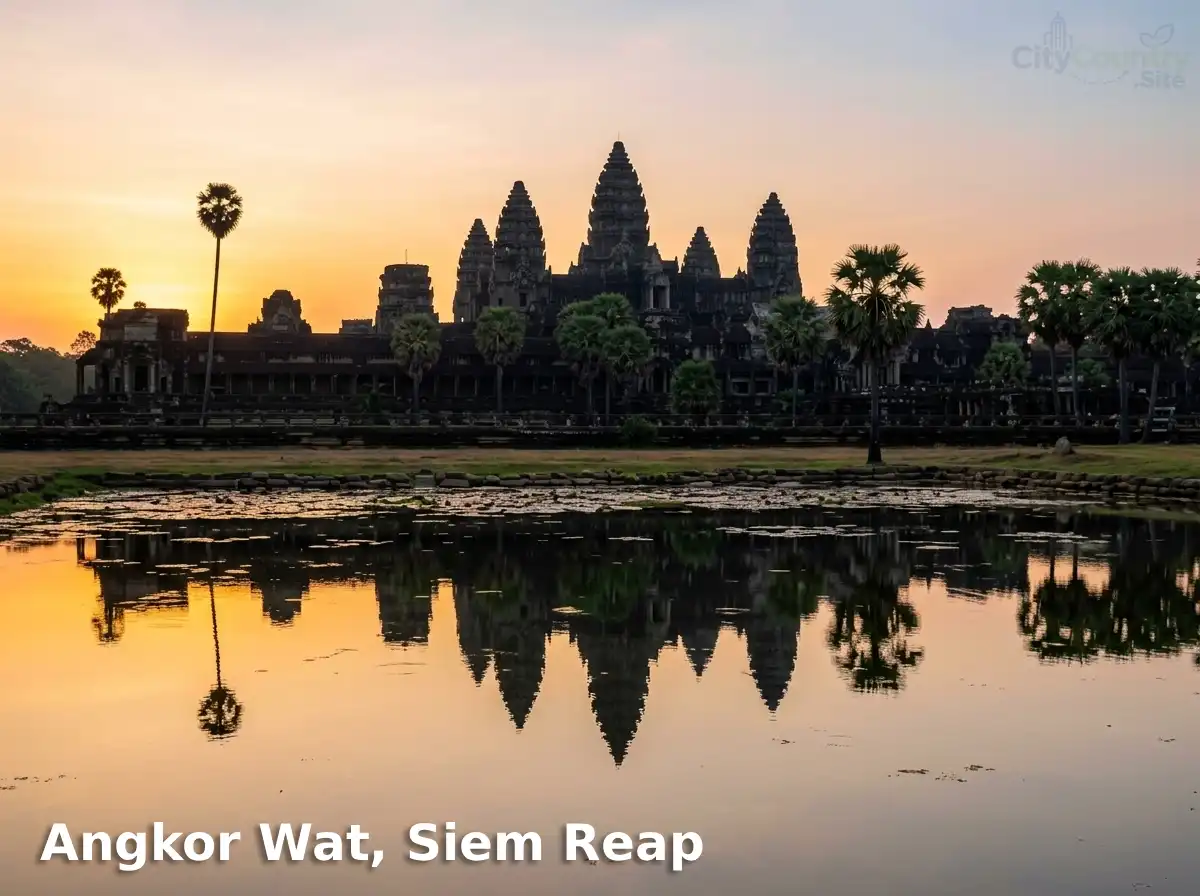
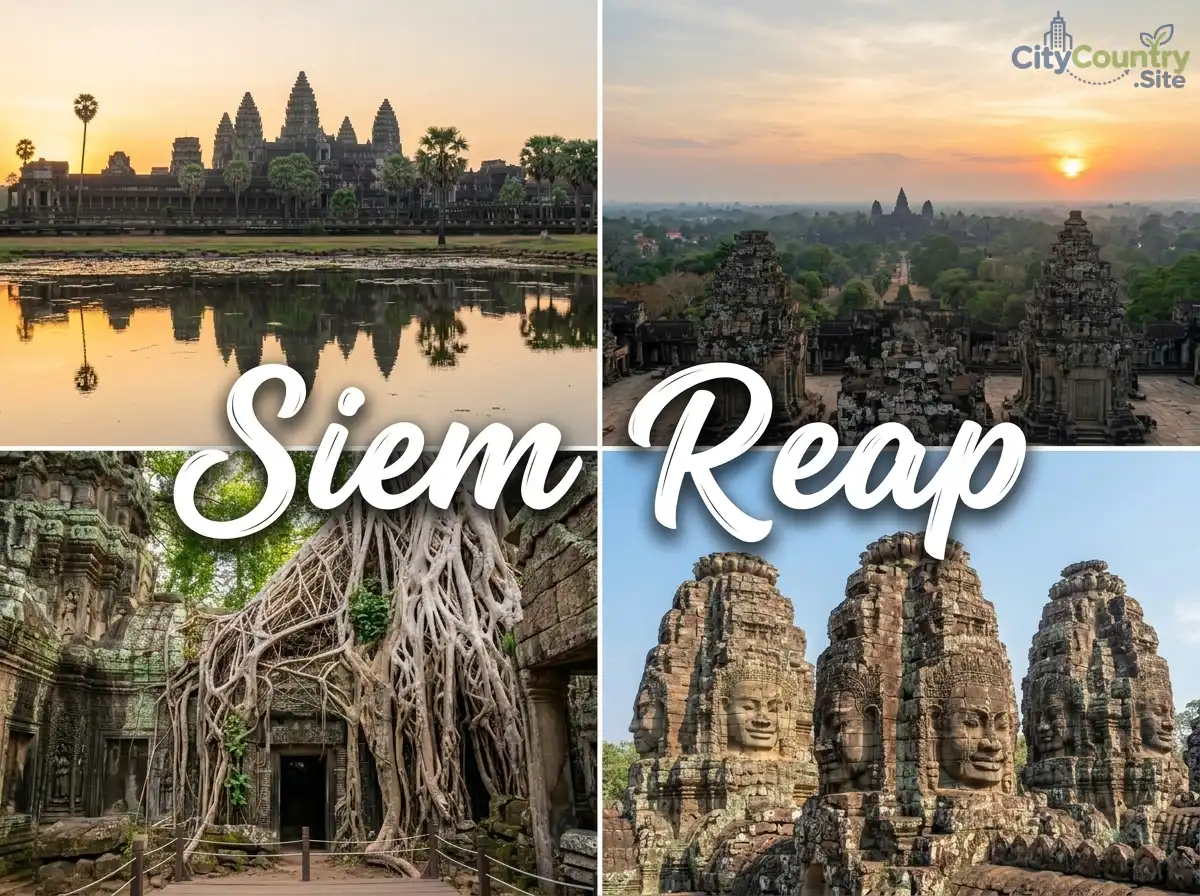
The pink-and-gold light spreads across the reflecting pool. The five lotus-bud towers of the temple emerge from the morning mist. The sound of monks chanting somewhere within the complex drifts across the water. And you suddenly understand why this is not merely one of the world’s great tourist attractions but one of the supreme achievements of human civilization — an architectural, spiritual, and artistic monument of a scale and refinement that has no true parallel anywhere on Earth.
Siem Reap — the small city that serves as the gateway to the Angkor Archaeological Complex — exists largely because of this great temple and its extraordinary siblings. But to describe it only as a gateway would be to significantly underestimate a city that has, over the past two decades, developed into one of Southeast Asia’s most genuinely enjoyable destinations in its own right.
The city’s old French quarter along the Siem Reap River retains beautiful colonial-era shophouses now converted into boutique hotels and design cafés. The famous Pub Street — love it or hate it — delivers the backpacker experience in concentrated form, while the surrounding alleyways and lanes contain remarkable independent restaurants, night markets, art galleries, and social enterprises. A genuinely exciting arts and circus scene has emerged here, particularly around the extraordinary Phare Circus.
And then, of course, there are the temples. Not just Angkor Wat — extraordinary as it is — but an entire archaeological landscape of over 400 km² containing dozens of extraordinary temple complexes, each with its own character, history, and reason to visit. Spending three days exploring this landscape is not too much. A week is insufficient.
A Brief History
802 AD — King Jayavarman II declares himself universal monarch at Phnom Kulen north of modern Siem Reap, founding the Khmer Empire and beginning the era of temple construction that will produce Angkor.
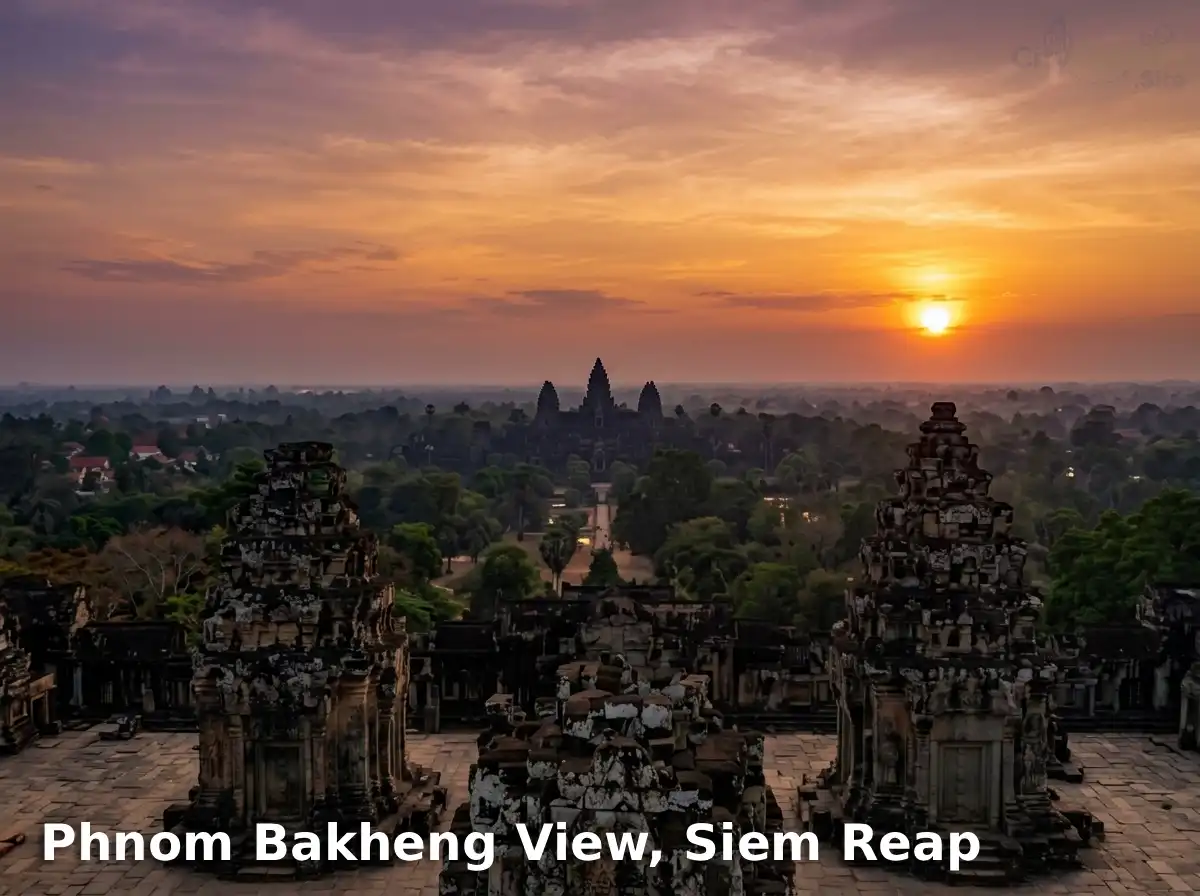
889 AD — King Yasovarman I establishes the first great city at Angkor (then called Yasodharapura) and builds the temple of Phnom Bakheng — the first major monument at Angkor.
1113–1150 — King Suryavarman II constructs Angkor Wat — dedicated to the Hindu god Vishnu; the largest religious monument ever built.
1177 — The Cham people of neighboring Champa sack and briefly occupy Angkor.
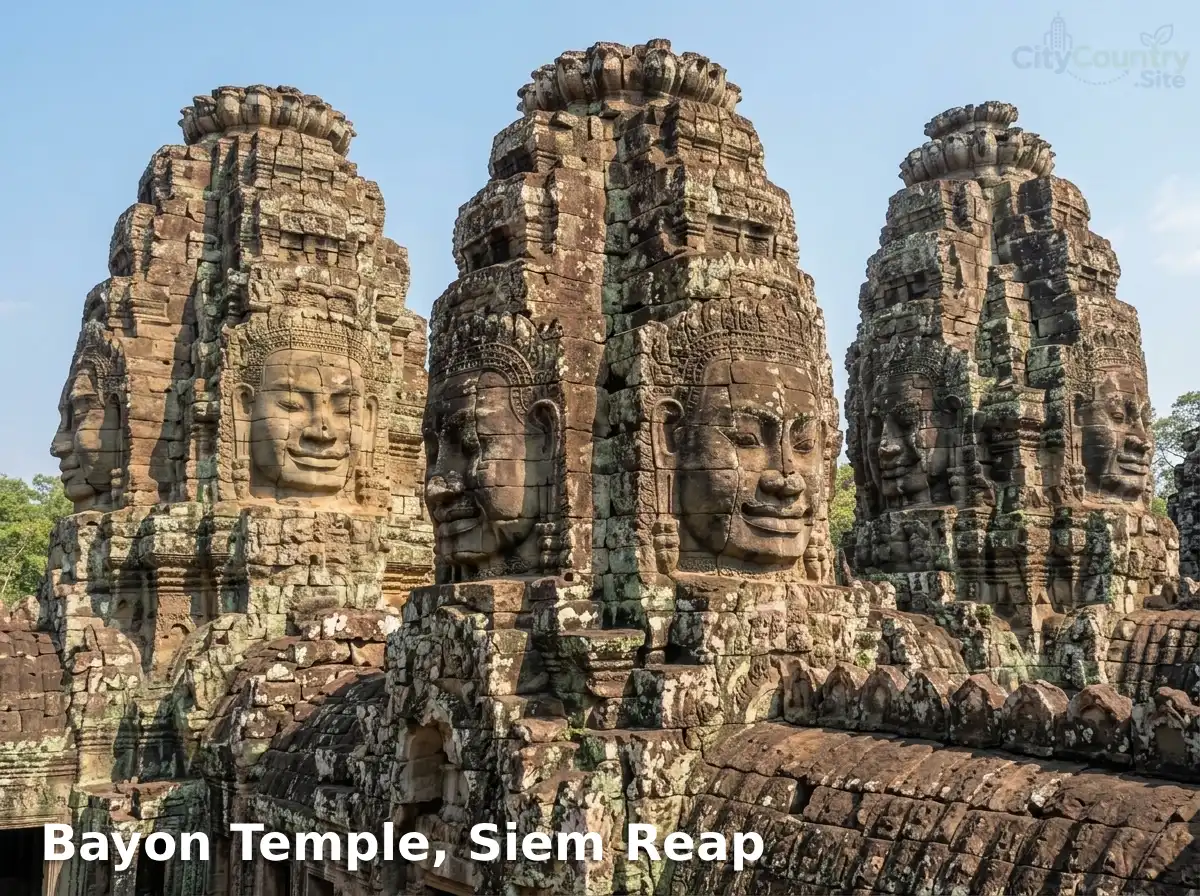
1181–1218 — King Jayavarman VII reconquers Angkor, converts the empire to Buddhism, and constructs Angkor Thom — including the magnificent Bayon temple and Ta Prohm.
13th–15th centuries — The Khmer Empire gradually declines; pressure from Thai kingdoms (Ayutthaya) increases.
1431 — Thai (Siamese) forces sack Angkor; the Khmer capital moves south toward Phnom Penh. Angkor is largely abandoned to the jungle, though never entirely deserted — monks continue to inhabit Angkor Wat.
1860 — French naturalist Henri Mouhot “rediscovers” Angkor for Western audiences; his published accounts spark enormous international interest.
1907 — France transfers control of the Siem Reap region from Siam (Thailand) to French Indochina; the École française d’Extrême-Orient (EFEO) begins systematic documentation and restoration of the Angkor complex.
1970–1991 — The Vietnam War, Khmer Rouge genocide, and civil war severely impact the Siem Reap region; temple restoration ceases and significant looting of statues occurs.
1991 — UNESCO inscribes Angkor as a World Heritage Site; international restoration effort begins with contributions from France, Japan, India, China, USA, and many others.
2000s–2010s — Tourism to Siem Reap explodes; the city transforms from a small provincial town to a major international destination; visitor numbers peak at over 2.6 million annually in 2019.
2020–2022 — COVID-19 devastates Siem Reap tourism; the city’s dependence on international visitors creates acute economic hardship.
2023 — New Siem Reap–Angkor International Airport opens 45 km from the city — dramatically improving capacity but creating transport logistics challenges.
2024–2026 — Tourism recovers strongly; Siem Reap reinvents itself with a more diverse and sophisticated offering; sustainability concerns around Angkor intensify.
“Of all the wonders I have encountered in forty years of travel, nothing has moved me as profoundly as Angkor Wat at sunrise. It is the greatest building I have ever seen, and I do not expect to revise that judgment.” — Jan Morris, Travel Writer and Historian
3. Siem Reap Geography & Neighborhoods
City Layout
Siem Reap is a relatively small, flat city situated on the Siem Reap River — a tributary of the Tonlé Sap Lake, which lies approximately 15 km to the south. The Angkor Archaeological Park begins approximately 5–6 km north of the city center and extends northward for dozens of kilometers.
The city center is compact and walkable — most of the restaurants, guesthouses, markets, and entertainment venues are concentrated within a roughly 2 km radius of the Old Market area.
Neighborhood Comparison Table
| Neighborhood | Best For | Vibe | Price Level |
|---|---|---|---|
| Old Market (Phsar Chas) area | Central location, restaurants, bars, markets | Busy, tourist-friendly, vibrant | Budget–Mid |
| Pub Street & surroundings | Backpacker scene, cheap food, nightlife | Loud, energetic, touristy | Budget |
| Wat Bo area (east of river) | Quieter guesthouses, local restaurants, authentic | Residential, peaceful, charming | Budget–Mid |
| Old French Quarter (along river) | Boutique hotels, upscale dining, beautiful architecture | Elegant, colonial, sophisticated | Mid–Luxury |
| Svay Dangkum (west of center) | Budget guesthouses, local markets, authentic | Working-class, genuine, affordable | Budget |
| Airport Road area | Business hotels, international restaurants | Modern, convenient, less atmospheric | Mid |
| Sala Kamreuk (north toward Angkor) | Luxury resorts, spa retreats, quiet | Serene, upscale, tropical garden | Luxury |
4. Siem Reap Weather & Temperature Guide
Siem Reap’s climate is tropical monsoon — hot throughout the year with a pronounced wet season from May to October and an optimal dry season from November through April.
Temperature Details
- Coolest and most comfortable: December and January — 22–28°C (72–82°F) with low humidity and clear skies
- Hottest months: March–April — temperatures reach 36–38°C (97–100°F); significant heat and humidity; temple visits should be limited to early morning
- Annual average: approximately 28°C (82°F)
- Wet season temperatures: slightly lower (26–32°C) than peak dry season heat, but high humidity makes it feel oppressive
Angkor-Specific Weather Considerations
- Best light for temple photography: October–March mornings (6–10 AM) offer the clearest skies and best photographic light
- Angkor Wat reflecting pool: best filled (reflecting towers clearly) from approximately October–June; can be low in the driest months
- Sunrise at Angkor Wat: spectacular in any month but clearest (no clouds or haze) November–February
- Smoke haze: February–April, agricultural burning across the region creates haze that affects photography and air quality
5. Siem Reap Map & Orientation
Key Landmarks for Navigation
Old Market (Phsar Chas) — the central reference point for all Siem Reap navigation; the covered market building and surrounding streets are the city’s social and commercial heart.
Pub Street — 50 meters west of Old Market; the most recognizable street in the city; loud, tourist-oriented, impossible to miss.
Siem Reap River — flows south through the city center; the Old French Quarter on the eastern bank and the Pub Street area on the western bank are separated by river bridges.
Angkor Wat — approximately 5.5 km north of Old Market via Charles de Gaulle Boulevard; the road is lined with hotels and restaurants leading to the main Angkor complex entrance.
Angkor Complex Orientation
The Angkor Archaeological Park is vast — 400 km² — and requires a tuk-tuk, bicycle, or car to navigate. The main circuit includes:
- Angkor Wat: 5.5 km from city; the anchor point of all temple visits
- Angkor Thom: 7 km north; the ancient fortified city containing Bayon, Baphuon, and other temples
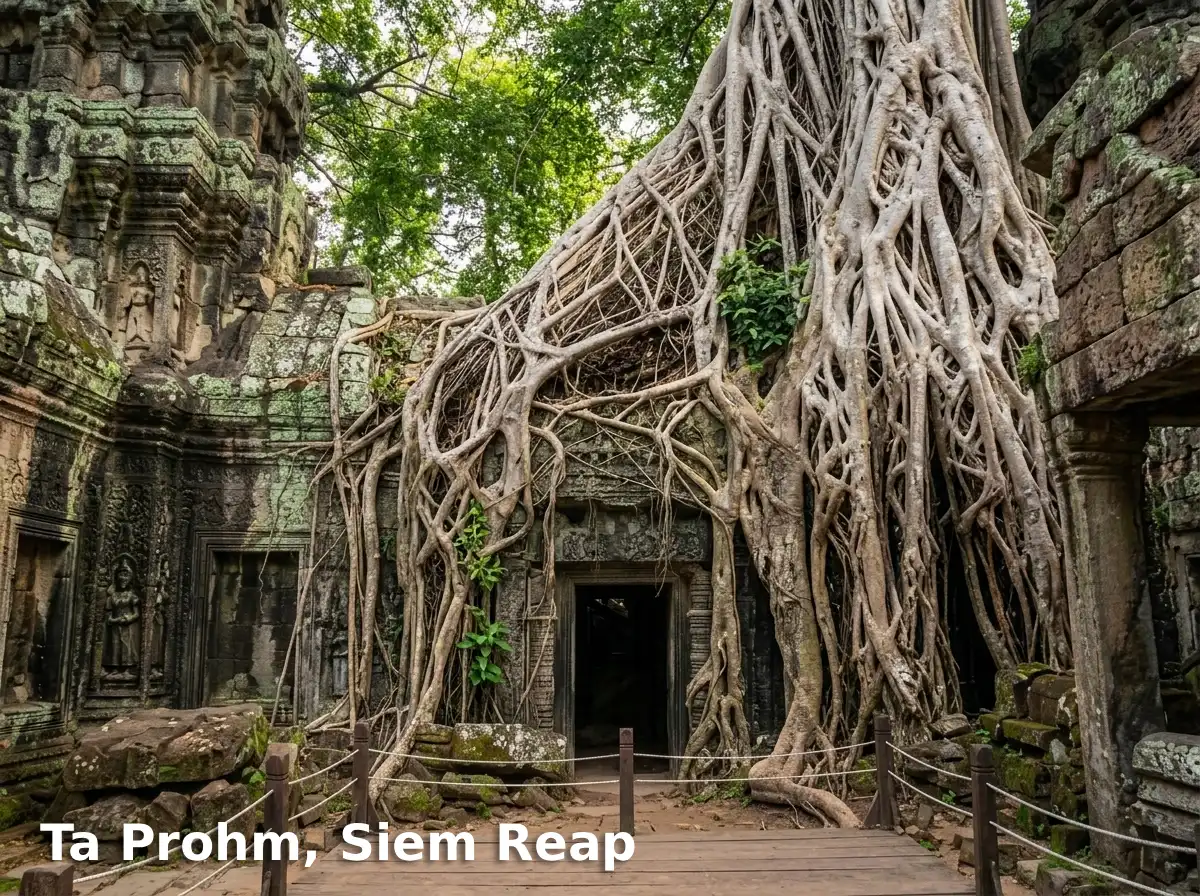
- Ta Prohm: 10 km northeast; the famous “jungle temple” where tree roots engulf the ruins
- Banteay Srei: 32 km northeast; the finest carved sandstone temple
6. Siem Reap Airport
The New Siem Reap–Angkor International Airport (SAI)
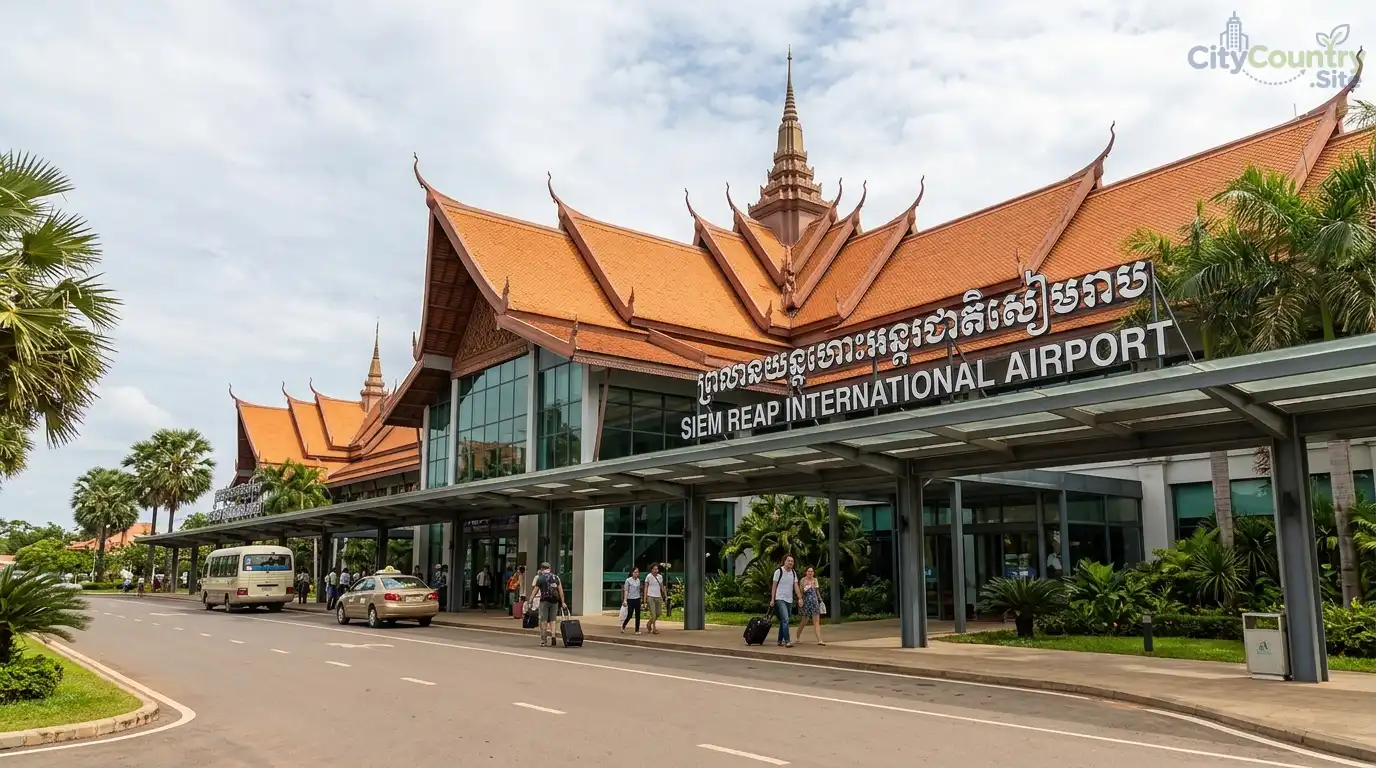
Opened in November 2023, the new Siem Reap–Angkor International Airport (IATA: SAI) is one of the most significant infrastructure developments in Cambodian history. Designed to handle up to 7 million passengers annually (eventually expandable to 20 million), it is a spectacular building whose design incorporates Angkor-inspired architectural motifs.
Critical note for travelers: The new airport is located 45 km southeast of Siem Reap city center — significantly further than the old airport (which was just 3 km from center). This distance has major practical implications:
- Transfer to city center takes 45–60 minutes by car/taxi
- Transfer costs are significantly higher than before
Airport to City Center
- Taxi (official): $20–30 USD to city center; approximately 45–60 minutes
- Grab/PassApp: $15–25 USD with ride-hailing app
- Hotel shuttle: many hotels offer transfers for $25–40 USD; arrange in advance
- Bus service: public bus service available for approximately $3–5 USD but slower and less convenient with luggage
Key International Routes (2026)
- Bangkok (Suvarnabhumi) — Bangkok Airways, Thai AirAsia; 1 hour; most popular connection
- Singapore — Scoot, Singapore Airlines; 2 hours
- Kuala Lumpur — AirAsia; 2 hours
- Ho Chi Minh City — Vietnam Airlines; 1 hour
- Seoul (Incheon) — Korean Air; 5.5 hours
- Guangzhou, Shanghai — China direct connections
✈️ Did You Know? The old Siem Reap International Airport — which closed when the new airport opened in 2023 — was located just 3 km from the city center, making it one of the most conveniently located airports in Southeast Asia. The new airport’s 45 km distance from the city has been a significant adjustment for travelers used to the old airport’s extreme convenience. Always budget for this transfer in both cost and time.
7. Siem Reap Top Attractions & Best Places
Top Attractions Table
| Attraction | Type | Entry Fee (2026) | Best Time to Visit | Time Needed |
|---|---|---|---|---|
| Angkor Wat | UNESCO temple complex | Included in Angkor Pass | Sunrise (5:30–7 AM) + return afternoon | Half–full day |
| Angkor Thom / Bayon | Ancient fortified city / temple | Included in Angkor Pass | Morning (8–11 AM) | 2–3 hours |
| Ta Prohm | Jungle-covered temple | Included in Angkor Pass | Early morning | 1.5–2 hours |
| Banteay Srei | Remote pink sandstone temple | Included in Angkor Pass | Morning | Half day (with transport) |
| Phnom Bakheng | Hilltop sunset temple | Included in Angkor Pass | Sunset | 1.5 hours |
| Pre Rup | Elevated temple / sunset spot | Included in Angkor Pass | Sunset | 1 hour |
| Tonlé Sap Lake | UNESCO biosphere; floating villages | Boat: $15–25 USD | Afternoon | Half day |
| Landmine Museum | Historical education | $5 USD | Morning | 1 hour |
| Old Market (Phsar Chas) | Traditional market | Free | Morning | 1–1.5 hours |
| Phare Circus | Contemporary Cambodian circus | $18–38 USD | Evening (showtime varies) | 1.5 hours |
| Banteay Kdei | Jungle temple | Included in Angkor Pass | Morning | 1 hour |
| Neak Pean | Island temple (seasonal) | Included in Angkor Pass | Dry season morning | 45 min |
Angkor Pass — Essential Information
Entry to virtually all temples within the Angkor Archaeological Park requires an Angkor Archaeological Park Pass, purchased at the official ticket center (2 km north of Siem Reap on the road to Angkor):
- 1-day pass: $37 USD
- 3-day pass: $62 USD (valid for any 3 days within 10 days)
- 7-day pass: $72 USD (valid for any 7 days within 1 month)
Passes are non-transferable and include a biometric photo; passport photos are taken at the ticket center. Keep your pass on you at all times — guards check at every temple entrance.
Angkor Wat — The Essential Experience
Words genuinely struggle with Angkor Wat. Constructed between approximately 1113 and 1150 during the reign of King Suryavarman II, it is the largest religious monument ever built — covering approximately 162 hectares within its outer moat. The temple was originally dedicated to the Hindu god Vishnu before being converted to Buddhist use; it is the best-preserved major temple in the complex precisely because it has been continuously maintained by monks throughout its history.
The outer gallery walls carry the longest continuous bas-relief carving in the world — 800 meters of narrative stone carving depicting scenes from Hindu mythology, historical battles, and the churning of the cosmic ocean. Each panel rewards hours of careful study.
Sunrise at Angkor Wat — standing at the reflecting pool in the darkness before dawn, watching the sky lighten behind the five towers, the colors shifting from black to purple to pink to gold — is genuinely one of the most extraordinary experiences available anywhere in the world.
Ta Prohm — The Jungle Temple
Ta Prohm is many visitors’ favorite temple — not because of architectural perfection but because of its extraordinary romance of ruin. Where most Angkor temples have been cleared and partially restored, Ta Prohm was deliberately left in its discovered state, with enormous Tetrameles and silk-cotton trees growing through and over the walls, their roots cracking stone in slow-motion vegetable embrace. The result is one of the most atmospheric and photogenic sites on Earth.
Ta Prohm was used as a filming location for the 2001 Tomb Raider film starring Angelina Jolie — a fact that significantly boosted global awareness of Angkor and led to a major increase in international tourism to Cambodia in the early 2000s.
Did You Know? The Angkor Wat temple complex is so large that it took approximately 300,000 workers and 6,000 elephants to construct, according to estimates by archaeologists. The stone used in its construction would be enough to build a wall 40 feet high and 8 feet wide stretching from New York to Los Angeles. It was built without mortar — the stones are held in place by their own weight and precision fitting.
8. Siem Reap Food & Cuisine Guide
Siem Reap’s food scene has evolved dramatically from the simple backpacker fare of its early tourism era into one of Southeast Asia’s most genuinely interesting culinary destinations — a mix of traditional Khmer cuisine, innovative fusion restaurants, social enterprise cafés, and excellent street food that rewards serious eating exploration.
Signature Khmer Dishes
Fish Amok — Cambodia’s national dish; steamed fish in coconut milk and kroeung spice paste, wrapped in banana leaves; silky, fragrant, and unmistakably Khmer.
Khmer Red Curry (Samlar Kari) — richer and more coconut-heavy than Thai curry; typically made with chicken or beef; served with rice or bread.
Bai Sach Chrouk — grilled pork over rice with ginger broth; the definitive Cambodian breakfast, available from street vendors until approximately 9 AM for $1–2.
Nom Banh Chok — thin rice noodles with fish-based green curry sauce and fresh vegetables; traditional Cambodian morning noodle dish.
Lap Khmer — Cambodian beef salad with lemongrass, kaffir lime, chili, and fresh herbs; the Cambodian equivalent of Thai larb; fresh and intensely flavored.
Khmer BBQ (Sach Ko Ang) — the Cambodian approach to barbecue; a tabletop grill where guests cook their own marinated meat, seafood, and vegetables; an interactive and excellent evening dining experience.
Fried grasshoppers and tarantulas — genuinely part of local cuisine (not just a tourist challenge); available at Old Market stalls and from street vendors throughout the city.
Best Places to Eat
- Cuisine Wat Damnak — Cambodia’s most internationally celebrated restaurant; innovative contemporary Khmer cuisine using local and seasonal ingredients; essential advance booking; approximately $50–80 per person
- Mahob Restaurant — excellent traditional Khmer cuisine in a beautiful setting; fish amok is outstanding
- Haven Training Restaurant — social enterprise training disadvantaged youth; excellent Khmer and Western food; meaningful dining experience
- Marum Restaurant — social enterprise; excellent Khmer food; beautiful garden setting; highly recommended
- Pub Street food stalls — the most fun and affordable evening eating; BBQ stalls, noodle soup stands, and fresh juice vendors from $1–5 per dish
- Old Market area breakfast stalls — nom banh chok and bai sach chrouk from local vendors; the most authentic breakfast for $1–2
- Blue Pumpkin — Siem Reap institution; excellent sandwiches, pastries, and ice cream; multiple locations
Did You Know? Fried tarantulas are not merely a tourist gimmick in Cambodia — they have been eaten by Cambodians for generations, particularly in the area around Skuon in eastern Cambodia. During the Khmer Rouge famine years, tarantulas were a crucial protein source for starving rural populations. Today they remain a genuine local delicacy eaten with salt and lime.
9. Accommodation Guide for Siem Reap City
Siem Reap offers the widest range of accommodation in Cambodia — from $3-a-night dormitories to some of the most extraordinary luxury resorts in Southeast Asia.
Budget (Under $20/night)
- Mad Monkey Hostel — excellent backpacker hostel with pool; great social atmosphere; popular with solo travelers
- Onederz Hostel — reliable chain hostel; good facilities; central location
- Garden Village Hostel — excellent budget guesthouse with garden; friendly staff
Mid-Range ($35–100/night)
- Shinta Mani Wild (tented camp — see luxury) — Note: also has a mid-range entry point at Shinta Mani Angkor ($80–120/night); colonial-era boutique; beautiful; excellent value
- La Niche d’Angkor Boutique Hotel — excellent boutique; pool; beautiful design; good value
- Viroth’s Hotel — one of the best mid-range hotels in Siem Reap; beautiful pool; great service; excellent design
Luxury ($180–800+/night)
- Amansara — Aman’s legendary Siem Reap property; converted residence of King Sihanouk’s guesthouse; arguably the finest hotel in Cambodia; extraordinary exclusivity and service; private pools; included temple tours
- Shinta Mani Wild — the most extraordinary hotel experience in the region; tented camp accessible only by zipline over a waterfall through the jungle; genuine conservation project; breathtaking
- Raffles Grand Hotel d’Angkor — the grande dame of Siem Reap; opened 1932; iconic colonial architecture; magnificent pool; impeccable service
- Park Hyatt Siem Reap — excellent contemporary luxury in a stunning design building; beautiful pool
10. Getting to Siem Reap
By Air
Siem Reap–Angkor International Airport (SAI) is the current gateway — 45 km from the city center, opened November 2023. Most visitors connect via Bangkok, Singapore, or Ho Chi Minh City as direct long-haul flights remain limited.
Budget tip: Flying via Bangkok (Don Mueang) on AirAsia often provides the most affordable international connections.
By Bus from Phnom Penh
The Phnom Penh–Siem Reap Expressway (opened 2023) has reduced the road journey between Cambodia’s two main cities to approximately 3.5–4 hours (previously 5–6 hours on the old highway). Multiple bus companies operate daily services; Giant Ibis and Mekong Express are the most comfortable and reliable (approximately $12–18 USD).
By Bus from Bangkok (Thailand)
The Bangkok to Siem Reap overland route crosses the Thai-Cambodian border at Aranyaprathet/Poipet — a busy crossing with a reputation for scams; use licensed bus companies that cross the border properly. Journey time approximately 8–10 hours total including border crossing.
By Boat from Phnom Penh (Seasonal)
The Phnom Penh–Siem Reap river and lake boat operates during high-water season (July–November) through the Tonlé Sap — approximately 6 hours including a spectacular section across the vast Tonlé Sap Lake. Not available in dry season when water levels are insufficient.
11. Getting Around the City
Tuk-Tuk
The tuk-tuk is the essential transport mode for Siem Reap — particularly for temple visits. Most temples are too spread out for comfortable cycling and tuk-tuks are the perfect middle ground between independence and guided tours. A full-day tuk-tuk hire for Angkor temple circuits costs approximately $15–25 USD depending on route; city trips cost $2–5.
Find a trustworthy tuk-tuk driver through your guesthouse, hotel, or at the Old Market area — having the same driver across multiple days builds trust and often results in better service and local knowledge.
Bicycle
Bicycle rental ($2–5/day) is excellent for temple visits for physically fit travelers in cool-season months. The roads within the Angkor complex are well-maintained and relatively flat; cycling between temples allows freedom and spontaneity unavailable with tuk-tuks. However, in March–April heat (36°C+), cycling several kilometers between temples becomes genuinely dangerous — reserve cycling for November–February.
E-Bike / Motorbike
E-bikes ($10–15/day) are increasingly popular — offering cycling freedom without the physical exertion in heat. Motorbikes ($10–15/day) are available but independent motorbike riding in the Angkor complex carries risks (road conditions, heat, accident response); most experienced Cambodia travelers use tuk-tuks for temple visits.
Ride-Hailing
PassApp and Grab both operate in Siem Reap for city transportation — useful for getting between guesthouses, restaurants, and the town center, though less relevant for temple visits where pre-arranged tuk-tuks are more practical.
12. Best Time to Visit Siem Reap
Month-by-Month Weather & Travel Table
| Month | Avg Temp (°C) | Rainfall | Crowd Level | Travel Recommendation |
|---|---|---|---|---|
| January | 22–30°C | Very Low | Very High | Peak season; perfect; book well ahead ✅✅✅ |
| February | 23–32°C | Very Low | Very High | Excellent; best weather ✅✅✅ |
| March | 25–35°C | Low | High | Getting hot; still good ✅✅ |
| April | 27–37°C | Low | Medium | Very hot; Khmer New Year Apr 13–16 🔥⚠️ |
| May | 26–34°C | Medium | Low | Monsoon beginning; fewer crowds ✅ |
| June | 25–31°C | High | Very Low | Rainy season; lush; low prices ✅ |
| July | 25–30°C | Very High | Very Low | Peak monsoon; some flooding ⚠️ |
| August | 25–30°C | Very High | Very Low | Heavy rain; challenging ⚠️ |
| September | 24–30°C | High | Low | Rains easing; green; good value ✅ |
| October | 24–29°C | Medium | Low–Med | Beautiful; temples uncrowded ✅✅ |
| November | 23–29°C | Low | Medium–High | Season starting; excellent ✅✅ |
| December | 21–28°C | Very Low | Very High | Perfect; festive; book months ahead ✅✅✅ |
Special considerations for Angkor visits:
- Angkor Wat sunrise: best November–February (clearest skies)
- Angkor reflecting pool: best filled September–February
- Crowds at sunrise: heaviest December–February; arrive before 5:30 AM for best positioning
- Monsoon advantage: temples are dramatically green and empty; some paths may be muddy but the atmosphere is extraordinary
13. Siem Reap Local Culture, Customs & Etiquette
Siem Reap is a deeply Buddhist city and the Angkor temples — though ancient — remain active religious sites. Understanding and respecting the culture that produced Angkor enriches every temple visit immeasurably.
At Angkor Temples — Essential Rules
- Dress modestly — both men and women must cover shoulders and knees at all temple sites; this is strictly enforced at Angkor Wat with guards turning away inappropriately dressed visitors; always carry a scarf
- Never climb on temple walls, towers, or prohibited areas — this causes irreversible damage to ancient stone
- Do not touch the bas-relief carvings — the oils from skin cause long-term damage
- Respect monks — never touch; women must not hand anything directly to monks; always give way on paths
- Photography restrictions: certain inner sanctuaries prohibit photography — observe signs and the behavior of locals
At Angkor Wat Specifically
- Walk clockwise around the temple (as with all Hindu/Buddhist temples)
- The central sanctuary requires climbing steep stairs — accessible from the east; dress and physical fitness considerations apply
- Sunrise positioning: arrive before 5:30 AM for the main reflecting pool position; the best spot is the left-side reflecting pool
General Social Customs
- The sampeah (hands together, slight bow) is the respectful Khmer greeting
- Never point feet toward Buddha images or at people
- Bargaining is appropriate at markets; not in restaurants
- Tipping culture: 10% at restaurants; $1–2 for helpful tuk-tuk drivers; $3–5 for excellent guides
14. Safety & Travel Tips
Siem Reap is one of Southeast Asia’s safest tourist destinations — the city’s entire economy depends on visitors, and the local community has strong incentives to maintain a welcoming and safe environment.
Key Safety Considerations
Scams at the temple complex:
- “Temple is closed today” scam — tuk-tuk drivers telling tourists that their chosen temple is closed for a holiday, then redirecting to shops; temples virtually never close for holidays; verify independently
- “Blind monk” scam — fake monks soliciting money; genuine monks do not approach tourists for donations
- Overpriced temple passes from unofficial sellers — buy only from the official ticket center
- “Special viewing spot” scam — being directed to a “secret” sunrise spot that requires payment
Health:
- Mosquito protection essential — dengue fever is present in the region; wear repellent and light-colored long clothing, particularly at dawn (Angkor sunrise) and dusk
- Heat exhaustion — a serious risk during March–April temple visits; carry at least 2 liters of water, wear a hat, and rest in shade
Mines: The Angkor complex itself is entirely safe, but some rural areas around Siem Reap Province still contain unexploded ordnance from decades of conflict; stay on marked paths when hiking outside temple complexes.
Emergency Numbers:
- Police: 117
- Ambulance: 119
- Tourist Police: 012 402 424
Did You Know? Cambodia has more landmine victims per capita than almost any other country in the world — a tragic legacy of decades of civil conflict. The Cambodian Landmine Museum near Siem Reap, established by former child soldier Aki Ra, is one of the most important and moving educational sites in the region. Visiting and donating is one of the most meaningful things a traveler in Siem Reap can do.
15. Siem Reap Budget Tour
Daily Budget Table
| Category | Budget Traveler | Mid-Range Traveler | Luxury Traveler |
|---|---|---|---|
| Accommodation | $5–15 | $40–100 | $180–800+ |
| Food | $5–10 | $25–55 | $80–200 |
| Transport (tuk-tuk/bike) | $3–8 | $15–30 | $40–100 |
| Attractions (Angkor Pass amortized) | $12–37 | $20–45 | $37–100+ |
| Miscellaneous | $2–5 | $8–20 | $30–80 |
| DAILY TOTAL | $27–75 | $108–250 | $367–1,280+ |
Note: Angkor Pass costs ($37 for 1 day, $62 for 3 days, $72 for 7 days) significantly affect the daily budget; spreading the cost over multiple temple days reduces the per-day impact.
Siem Reap is excellent value — budget travelers who buy a 3-day Angkor pass can cover all major temples and eat well for under $40–50 per day total.
16. Hidden Gems & Local Secrets
Beyond the famous temples and Pub Street, Siem Reap offers extraordinary hidden experiences.
Beng Mealea — a temple approximately 77 km east of Siem Reap that many guides describe as the closest thing to what Angkor Wat looked like when Henri Mouhot first encountered it — completely engulfed by jungle, largely unrestored, with trees growing through rooftops and corridors open to the sky. Far fewer tourists visit than the main Angkor complex and the atmosphere is extraordinary.
Kbal Spean — the “River of a Thousand Lingas” — a jungle river in the Kulen Hills approximately 50 km north of Siem Reap where the riverbed has been carved with hundreds of Hindu symbols and deity carvings by ancient Khmer craftsmen; water flowing over these sacred carvings was believed to be blessed before flowing south to Angkor. A steep 30-minute jungle hike leads to a dramatic waterfall and the carvings; almost entirely off the main tourist circuit.
Early morning at Pre Rup or East Mebon — these elevated temple pyramids near Angkor are magnificent at sunrise and almost completely empty while the crowds are 2 km away at Angkor Wat. Standing atop Pre Rup as the sun rises over the jungle — completely alone — is one of Siem Reap’s greatest secret experiences.
Artisans Angkor workshops — the majority of visitors buy souvenirs at markets without knowing that Artisans Angkor operates free-entry workshops where visitors can watch master craftspeople producing traditional Khmer sculpture, lacquerware, silk, and jewelry using centuries-old techniques. Far more interesting than any market and directly supporting traditional craft preservation.
Phnom Krom at sunset — a small hilltop temple complex approximately 13 km south of Siem Reap overlooking the Tonlé Sap Lake; rarely visited by tourists; the sunset from the hilltop — over the lake, with the Angkor complex visible in the distance — is extraordinary.
Did You Know? The silk-cotton trees (Tetrameles nudiflora) growing over and through the ruins of Ta Prohm are not the original trees that colonized the temple after its abandonment — the original trees were removed during early 20th-century French restoration. The famous trees now enveloping Ta Prohm are relatively recent growth, planted or naturally seeded in the decades since; the temple’s famous jungle atmosphere is partly a managed aesthetic rather than pure historical accident.
17. Day Trips from Siem Reap
Day Trips Table
| Destination | Distance | Travel Time | Travel Method | Highlights |
|---|---|---|---|---|
| Tonlé Sap Lake | 15 km south | 30 min | Tuk-tuk + boat | UNESCO biosphere; floating villages; incredible birdlife |
| Banteay Srei | 32 km northeast | 45 min | Tuk-tuk / taxi | Finest carved sandstone temple; remarkable pink stone |
| Beng Mealea | 77 km east | 1.5 hours | Taxi / tour | Jungle-engulfed unrestored temple; extraordinary atmosphere |
| Kbal Spean | 50 km north | 1 hour | Taxi / tour | Jungle river carvings; waterfall; hiking |
| Phnom Kulen | 48 km north | 1 hour | Taxi / tour | Sacred mountain; waterfall; ancient carvings; pilgrimage site |
| Kompong Phluk | 20 km southeast | 30 min + boat | Tuk-tuk + boat | Flooded forest; stilt house village; unique ecosystem |
| Banteay Samré | 18 km east | 30 min | Bicycle / tuk-tuk | Lesser-visited but beautifully restored Hindu temple |
| Phnom Penh | 330 km south | 3.5h (expressway) / 2h (air) | Bus / flight | Royal Palace; Tuol Sleng; Killing Fields |
Tonlé Sap Lake — The Essential Experience
The Tonlé Sap is the largest freshwater lake in Southeast Asia and one of the world’s most productive freshwater fishing grounds — providing approximately 60% of the protein consumed by Cambodians annually. During the wet season (June–November), the lake swells to approximately 16,000 km² — roughly the size of Connecticut; in dry season it shrinks to approximately 2,500 km².
Most visitors see the Tonlé Sap via a boat trip to one of the floating villages — entire communities of houses, schools, churches, and markets built on stilts or floating on pontoons, rising and falling with the seasonal water level. The villages are extraordinary — genuinely inhabited by thousands of fishing families, not tourist constructions — though the most-visited ones (Chong Kneas) can feel very commercialized. Seek out less-visited alternatives like Kampong Khleang (much larger, more authentic) for a more genuine experience.
18. Shopping Guide
What to Buy in Siem Reap
Cambodian silk — traditional hand-woven silk using natural dyes and Khmer patterns; available at the Old Market, Night Market, and Artisans Angkor shops; quality varies considerably — seek Artisans Angkor for guaranteed quality and ethical production.
Stone carvings — modern reproductions of Angkor bas-relief figures and deities; quality ranges from mass-produced souvenirs to genuine artisan work; Artisans Angkor produces the finest quality pieces.
Kramas — traditional Cambodian checked cotton scarves; essential dual-purpose item (souvenir + useful at temples for modesty covering); from $2–20 depending on quality.
Pepper and spices — Kampot pepper (from southern Cambodia) is available in specialty food shops throughout Siem Reap; an excellent and practical souvenir.
Lacquerware — traditional Khmer lacquer work on boxes, trays, and bowls; beautiful if purchased from quality artisan producers.
Paintings — contemporary Cambodian art, often referencing Angkor themes; quality varies; the Theam’s Gallery and similar spaces stock excellent work from established artists.
Where to Shop
- Old Market (Phsar Chas) — the city’s best and most authentic market; silk, carvings, kramas, silver; best in the morning; gentle bargaining
- Angkor Night Market — pleasant outdoor market off Sivatha Boulevard; good range of handicrafts and textiles; slightly less frenetic than Old Market
- Artisans Angkor (multiple locations) — the gold standard for quality Cambodian handicrafts; fixed prices; ethical production; directly supports artisan communities
- Made in Cambodia Market — dedicated to Cambodian-made products; excellent range; good social enterprise focus
19. Siem Reap Nightlife & Entertainment
Pub Street
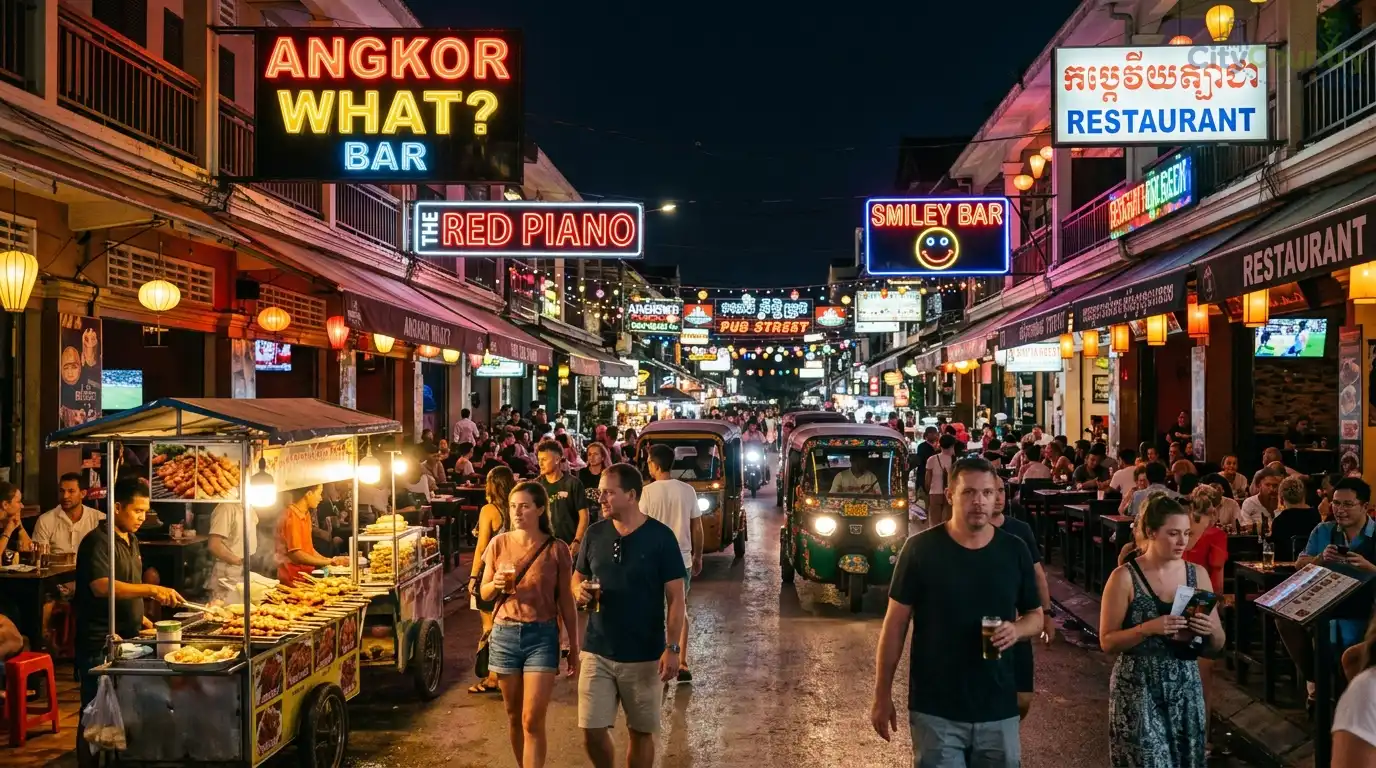
Pub Street (officially Street 8) is Siem Reap’s legendary — and simultaneously beloved and reviled — backpacker nightlife strip. A narrow lane of bars, restaurants, and clubs catering primarily to international visitors, it operates noisily until the early hours and offers everything from $0.50 “happy pizza” (legally ambiguous) to cocktail bars with live music. It is exactly what it appears to be — tourist-oriented, unpretentious, occasionally chaotic — and many visitors find it tremendous fun. Others avoid it entirely. Both responses are valid.
The Alley (adjacent to Pub Street) is a slightly more refined extension — bars with craft beer, small live music venues, and rooftop options that attract a more mixed crowd.
Cultural Entertainment
Phare, the Cambodian Circus — the most significant cultural entertainment venue in Siem Reap and genuinely one of the most extraordinary performance experiences in Southeast Asia. Founded by the same organization as the Battambang circus school, Phare combines Cambodian storytelling with extraordinary contemporary acrobatics, theatre, and music in performances that are simultaneously entertaining and deeply emotional. Each show tells a story about Cambodian history or culture using aerial acrobatics, contortion, and live music. Performances run several evenings per week; tickets approximately $18–38 USD; advance booking strongly recommended.
Traditional Apsara Dance — nightly Apsara dance performances (the ancient Khmer classical dance form revived after the Khmer Rouge destroyed the traditional performance community) are staged at several major hotels and dedicated venues. The most authentic performances are at Angkor Village Theater or the Smile of Angkor show (larger scale, less intimate but spectacular).
Rooftop Bars & Evening Options
- Miss Wong — 1920s Shanghai-inspired cocktail bar; the most atmospheric cocktail venue in the city
- Asana Old Wooden House — beautiful old wooden building converted to a bar; excellent cocktails; regular live music
- Bar Bop — best craft beer selection in Siem Reap; friendly and unpretentious
- Linga Bar — rooftop option near Pub Street; good views and cocktails
20. Practical City Information
Visa & Entry
Cambodia visa information for Siem Reap is identical to Phnom Penh (same country):
- e-Visa: $30 USD; 30 days single entry; apply at evisa.gov.kh; 3 business days processing; strongly recommended
- Visa on Arrival: $30 USD at Siem Reap–Angkor International Airport; requires passport photo
- ASEAN citizens: visa-free
- Passport valid minimum 6 months beyond entry date
Health & Vaccinations
- Hepatitis A and B — recommended
- Typhoid — recommended
- Japanese Encephalitis — recommended for longer stays
- Dengue fever awareness — no vaccine widely available; use repellent; wear long sleeves at dawn/dusk
- Tap water: NOT safe — bottled water essential ($0.50–$1.50 per 1.5L)
Connectivity
- Smart, Metfone, and Cellcard — main operators
- SIM cards at airport and throughout city; 5 GB data: approximately $3–5 USD
- WiFi excellent in virtually all guesthouses, cafés, and restaurants
Power & Plugs
- Types A, C, and G — universal adapter recommended
- Voltage: 230V / 50Hz
21. How to Be a Responsible Traveler in Siem Reap
Protecting Angkor
- Never touch bas-relief carvings — skin oils cause irreversible chemical damage
- Stay on marked paths — off-path walking causes ground subsidence that threatens buried temple foundations
- Never take stone fragments as souvenirs — this is theft from a UNESCO World Heritage Site and a criminal offense
- Buy official Angkor passes only — funds go to APSARA Authority for temple maintenance
Supporting Ethical Businesses
- Eat at social enterprise restaurants — Marum, Haven, and similar organizations train disadvantaged youth
- Shop at Artisans Angkor — ethical wages; traditional craft preservation; genuine community benefit
- Book with responsible tour operators — look for operators that pay fair wages to guides and support temple conservation organizations
Child Welfare
- Never give money or gifts to child beggars — this perpetuates organized systems that keep children out of school
- Never visit “orphanages” as tourist attractions — most are not genuine orphanages; “orphanage tourism” causes documented harm to children
- Donate to legitimate children’s organizations instead — Friends International, LICADHO, and others work to protect Cambodian children
Environmental Responsibility
- Carry reusable water bottles — refill at guesthouses and restaurants
- Dispose of waste carefully — waste management is limited in the temple complex
- Choose responsible wildlife experiences — avoid elephant rides (unsustainable); support wildlife sanctuaries that prioritize animal welfare
22. Comparison Table — Siem Reap vs Similar Cities
| Feature | Siem Reap, Cambodia | Bagan, Myanmar | Ayutthaya, Thailand |
|---|---|---|---|
| Main Monument | Angkor Wat (UNESCO) | 2,000+ Buddhist temples (UNESCO) | Ancient Thai capital (UNESCO) |
| Scale of complex | 400+ km²; world’s largest religious monument | ~40 km²; thousands of pagodas | Compact; easily walkable |
| Access | Easy; international flights | Difficult; limited international access | Easy day trip from Bangkok |
| Cost Level | Low–Medium | Low | Low |
| City Facilities | Excellent tourist infrastructure | Basic | Good |
| Temple Diversity | Extraordinary; Hindu and Buddhist | Primarily Buddhist | Primarily Buddhist |
| Crowds | Very High (peak season) | Low–Medium | High |
| Best For | World heritage; comprehensive experience | Sunset balloon flights; bicycle touring | Day trip; Thai history |
23. Is Siem Reap Worth Visiting?
Yes — emphatically, unequivocally, without reservation. Siem Reap and the Angkor Archaeological Complex represent one of the world’s essential travel experiences.
Angkor Wat is not overhyped. It is not disappointing. It is not just another temple. It is, quite simply, one of the greatest things humanity has ever built — and standing before it, particularly at sunrise, is an experience that permanently expands your understanding of what human beings are capable of creating.
The rest of the Angkor complex — Ta Prohm engulfed by jungle, the extraordinary stone faces of Bayon, the pink sandstone intricacy of Banteay Srei, the flooded forest of Beng Mealea — adds layer after layer of wonder to a visit that could easily fill a week without exhausting its rewards.
And Siem Reap itself — the cafés, the social enterprise restaurants, the Phare Circus, the warmth of the Cambodian people, the extraordinary resilience of a culture that nearly had its arts, history, and identity destroyed within living memory — makes this more than just a temple pilgrimage. It is an encounter with one of the great civilizations in human history, in a place that is rebuilding its connection to that legacy with remarkable energy and grace.
Siem Reap is best suited for:
- ✅ History and architecture lovers — the greatest temple complex on Earth
- ✅ Photography enthusiasts — among the world’s most spectacular subjects
- ✅ Culture seekers — Phare Circus, Apsara dance, Artisans Angkor
- ✅ Budget travelers — extraordinary world heritage at remarkable value
- ✅ Families — Angkor is genuinely awe-inspiring for children
- ✅ Luxury travelers — Amansara and Shinta Mani Wild offer some of Asia’s finest experiences
Our honest verdict: Allow minimum 3 days — for a 3-day Angkor pass covering the main circuit, Ta Prohm, Angkor Thom, and a sunrise. Allow 5–7 days to include Banteay Srei, Beng Mealea, Tonlé Sap, and Phare Circus — and to begin to absorb the magnitude of what you are seeing.
24. City Travel Tips at a Glance
- 🌅 Angkor Wat sunrise: arrive by 5 AM in peak season (December–February) for the best reflecting pool position
- 👗 Always carry a scarf — temple dress code is strictly enforced; guards will turn away bare shoulders and shorts
- 🚲 Hire the same tuk-tuk driver for multiple days — relationships build trust and better local knowledge
- 💧 Carry at least 2 liters of water during temple visits — the heat dehydrates rapidly
- 🎪 Book Phare Circus tickets in advance — shows sell out in peak season
- 🕐 Visit major temples at off-peak times — Ta Prohm and Bayon are most crowded 9 AM–noon; arrive early or after 2 PM
- 💵 USD is standard — carry small bills; $1 and $5 are most useful
- 📸 The best temple photography light is 6–9 AM and 4–6 PM; midday light is harsh and flat
- 🏺 Buy from Artisans Angkor for quality souvenirs — not mass-produced market goods
- 🌧️ Wet season advantage — temples are green, uncrowded, and extraordinarily atmospheric; morning visits between rain showers are magical
25. Recommended Resources
Books:
- “A Dragon Apparent” by Norman Lewis — the finest literary account of Indochina before independence; essential context
- “River of Time” by Jon Swain — moving account of Cambodia during the Khmer Rouge era
- “Angkor: An Introduction to the Temples” by Dawn Rooney — the best practical guide to the temple complex itself
Films:
- “Tomb Raider” (2001) — partly filmed at Ta Prohm; directly responsible for a major surge in Angkor tourism
- “In the Mood for Love” (2000) — director Wong Kar-Wai incorporated an Angkor Wat sequence into his masterpiece
YouTube Channels:
- Mark Wiens — excellent Siem Reap food content
- Lost LeBlancs — quality Siem Reap and Angkor travel vlogs
- Wolters World — honest and practical Siem Reap travel advice
26. Frequently Asked Questions About Siem Reap
Q1: How much does the Angkor Archaeological Pass cost and which pass should I buy?
As of 2026: 1-day pass: $37 USD, 3-day pass: $62 USD (valid for any 3 days within 10 days), 7-day pass: $72 USD (valid for any 7 days within 1 month). For most visitors, the 3-day pass is the best value — sufficient for the main Angkor circuit, Ta Prohm, Angkor Thom/Bayon, and Banteay Srei. Serious temple enthusiasts should buy the 7-day pass. Passes are purchased at the official ticket center on the road to Angkor; bring your passport for the biometric photo.
Q2: When is the best time to visit Angkor Wat at sunrise?
The most spectacular sunrises occur November through February when skies are clearest. For the famous reflecting pool shot (with Angkor Wat reflected in the water), arrive by 5:00–5:15 AM in peak season (December–January) — crowds gather from 5:30 AM onward. During shoulder season (March, October, November), arriving by 5:30 AM is usually sufficient. The sunrise itself occurs approximately 6:00–6:30 AM depending on the month.
Q3: How do I get from the new Siem Reap airport to the city?
The new Siem Reap–Angkor International Airport (SAI) is 45 km from the city center — a significant distance. Options are: official airport taxi ($20–30 USD, 45–60 minutes), Grab/PassApp ride-hailing ($15–25 USD with a local SIM card), or hotel shuttle (arrange in advance, $25–40 USD). The airport bus is cheapest ($3–5 USD) but slowest with luggage. Always factor this transfer time and cost into your arrival plans.
Q4: What should I wear when visiting the Angkor temples?
Both men and women must cover shoulders and knees at all Angkor temples — this is strictly enforced, particularly at Angkor Wat where guards stationed at the entrance will turn away visitors who are not appropriately dressed. Pack light cotton trousers or a long skirt, and a lightweight shirt or cover-up that covers the shoulders. Sarongs are sometimes available for rent at the entrance but having your own is more practical. Comfortable walking shoes (not sandals) are strongly recommended for uneven temple surfaces.
Q5: Is it safe to visit Siem Reap?
Siem Reap is one of Southeast Asia’s safest tourist destinations — the entire economy depends on visitors and the community strongly supports a welcoming environment. The main concerns are: temple-specific scams (fake closure notices, unofficial sellers), heat exhaustion during March–April visits, and mosquito-borne diseases (use repellent). Violent crime against tourists is extremely rare. Solo female travelers generally feel comfortable and safe, particularly in the tourist areas around Old Market and at temple sites.
Q6: How many days should I spend in Siem Reap?
A minimum of 3 full days is required to do justice to the main Angkor complex — one day for Angkor Wat (sunrise + exploration), one day for Angkor Thom (Bayon, Baphuon, Ta Prohm), and one day for Banteay Srei and the Tonlé Sap. Most travelers who come with 3 days wish they had more. 5–7 days allows for more leisurely temple exploration, less-visited sites (Beng Mealea, Kbal Spean), a Phare Circus performance, and genuine immersion in the city.
Q7: What are the must-see temples beyond Angkor Wat?
The essential temples beyond Angkor Wat are: Bayon (the forest of stone faces within Angkor Thom — equally extraordinary to Angkor Wat), Ta Prohm (jungle-engulfed temple; the most atmospheric site in the complex), Banteay Srei (32 km out; the most intricately carved temple in the complex; pink sandstone; extraordinary), and Pre Rup (elevated temple pyramid; best at sunset; uncrowded). For those with more time: Beng Mealea (77 km; unrestored jungle temple; extraordinary), Phnom Bakheng (hilltop sunset viewpoint), and the outer temples of the Grand Circuit.
Q8: What is the Phare Cambodian Circus and should I attend?
Phare, the Cambodian Circus is not a traditional circus — it is a company of performers trained at the Phare Ponleu Selpak arts school in Battambang, combining acrobatics, contemporary circus arts, theatre, live music, and Cambodian storytelling into performances of extraordinary power and beauty. Shows tell stories of Cambodian history and culture — including the Khmer Rouge experience — through physical performance that is simultaneously technically brilliant and deeply moving. It is the single most culturally significant entertainment experience in Siem Reap and is strongly recommended for all visitors. Performances several evenings per week; tickets $18–38 USD; advance booking required in peak season.
23. Sources & References
- Lonely Planet Cambodia (lonelyplanet.com/cambodia)
- TripAdvisor Siem Reap (tripadvisor.com)
- Booking.com Siem Reap (booking.com)
- Wikipedia — Siem Reap, Angkor Wat, Angkor (en.wikipedia.org)
- APSARA National Authority (apsara.gov.kh) — Angkor archaeological management
- Cambodia Tourism Official (tourismcambodia.com)
- UNESCO World Heritage — Angkor (whc.unesco.org)
- Numbeo — Cost of Living Cambodia (numbeo.com)
- Wikitravel Siem Reap (wikitravel.org/en/Siem_Reap)
- World Travel Guide — Cambodia (worldtravelguide.net)
- Skyscanner Cambodia flights (skyscanner.net)
- Cambodia e-Visa Portal (evisa.gov.kh)
- Phare Cambodian Circus (pharecircus.org)
- Artisans Angkor (artisansangkor.com)
- Giant Ibis Transport (giantibis.com)
25. Siem Reap Travel Guide Images