1. Facts About Mandalay
| Category | Details |
|---|---|
| Country | Myanmar (formerly Burma) |
| Region / Province | Mandalay Region |
| Official Language | Burmese (Myanmar language); some English in tourist areas |
| Currency | Myanmar Kyat (MMK) — approx. 1 USD ≈ 2,100 MMK (2026, varies significantly) |
| Best Time to Visit | November to February (cool dry season) |
| Time Zone | Myanmar Standard Time (MST) — UTC+6:30 |
| Weather | Tropical savanna climate — hot and dry most of year; monsoon June–October |
| Temperature | 16°C – 40°C (61°F – 104°F) depending on season |
| Map | Located in central Myanmar on the eastern bank of the Irrawaddy River, 716 km north of Yangon |
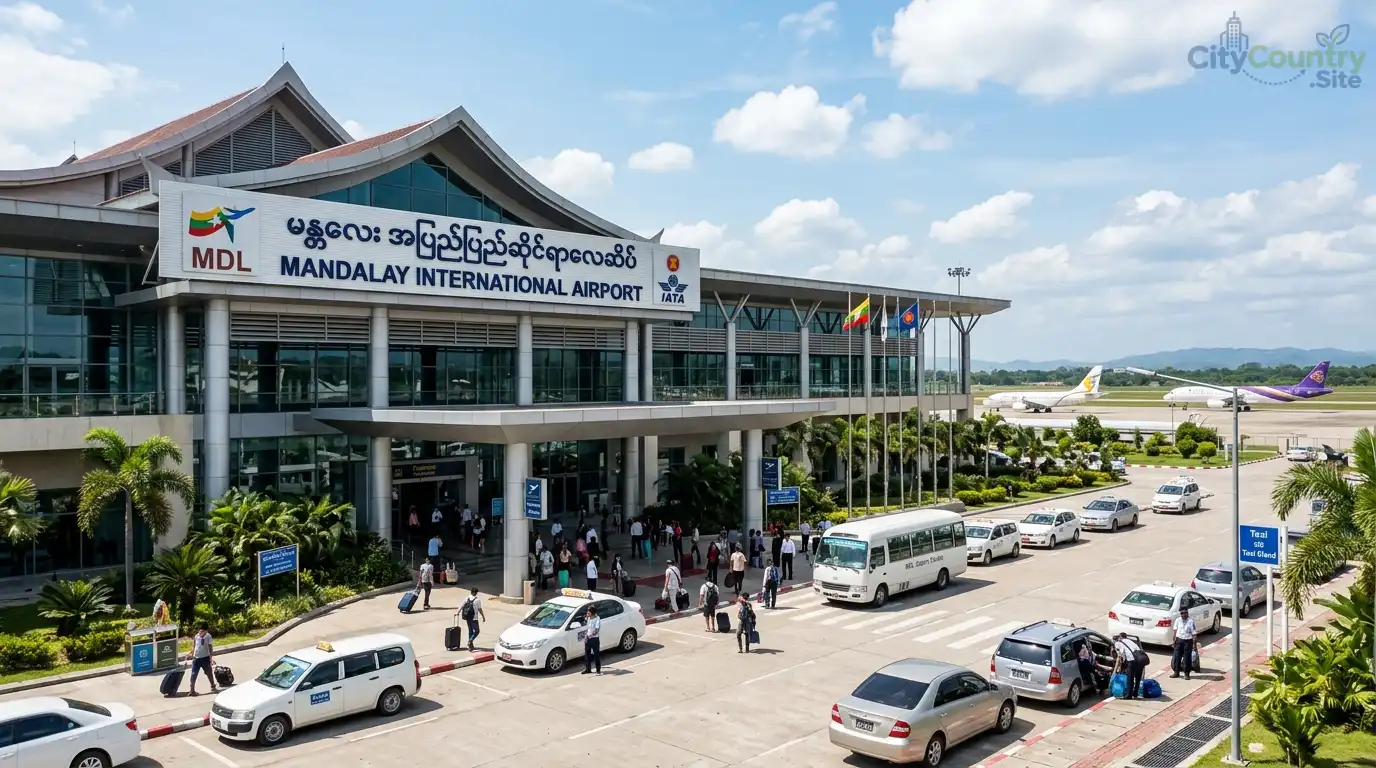
| Airport | Mandalay International Airport (MDL) — 45 km south of the city center |
| Top Tourist Places | Mandalay Hill, Kuthodaw Pagoda, U Bein Bridge, Mahamuni Pagoda, Shwenandaw Monastery, Mingun, Inwa |
| Avg. Trip Cost/Day | Budget: $20–35 / Mid-range: $50–90 / Luxury: $100–200+ |
| Nearest Major Airport | Mandalay International Airport (MDL) — serves domestic and some international routes |
| Population | Approx. 1.3 million (city); 1.8 million (metro area) |
| Famous For | The last royal capital of Burma, ancient Buddhist pagodas, traditional crafts, the legendary U Bein teak bridge, and breathtaking Irrawaddy River sunsets |
2. Mandalay City Overview & Background
The name alone carries a certain magic. Mandalay. It rolls off the tongue like a poem, which is perhaps why Rudyard Kipling immortalized it in verse — though famously he never actually visited. Those who do visit discover something that lives up entirely to the romance of its name: a city of gilded pagodas rising against a backdrop of green hills, of golden Buddhist monks moving through misty morning markets, of ancient teak monasteries carved with extraordinary artistry, and of a wide, slow river that has carried the dreams and commerce of a civilization for thousands of years.
Mandalay is Myanmar’s second-largest city and its undisputed cultural capital. Sitting at the heart of the country on the eastern bank of the magnificent Irrawaddy River, it was the last royal capital of the Burmese kings before British colonization in 1885. That royal heritage saturates every aspect of the city — in its magnificent pagodas, its living traditions of classical music, dance, puppetry, and crafts, and in the fierce pride of its people in their Burmese identity.
What makes Mandalay extraordinary is precisely this quality of living tradition. This is not a city where culture is performed for tourists in sanitized heritage centers. In Mandalay, you can watch a master goldbeater hammering gold leaf with centuries-old techniques in a workshop open to the street. You can observe a jade carver at work in the market district, a puppet maker in a traditional workshop, a silk weaver at a hand loom. The city’s crafts have been passed from parent to child for generations and continue today — a remarkable and moving continuity.
For travelers with an appetite for authentic cultural immersion, historic architecture, and the kind of slow, contemplative exploration that reveals a place’s true soul, Mandalay is one of the most rewarding cities in Southeast Asia.
“On the road to Mandalay, where the flyin’ fishes play, an’ the dawn comes up like thunder outer China ‘crost the Bay!” — Rudyard Kipling, from the poem Mandalay (1890) — written, famously, without ever having visited
3. Mandalay History Timeline
~850 CE — The area around modern Mandalay has been settled for centuries. The ancient city of Innwa (Ava), just south of present-day Mandalay, serves as the Burmese royal capital for much of the medieval period.
1365 — Innwa (Ava) is established as the capital of the Ava Kingdom, beginning centuries of political and cultural dominance in upper Burma. The city becomes a major center of Burmese Buddhism, literature, and the arts.
1555 — Bagan emerges as a consolidated center of Burmese power under the Taungoo Dynasty. Upper Burma — the Mandalay region — remains central to the country’s Buddhist and cultural life.
1783 — King Bodawpaya establishes a new royal capital at Amarapura, just south of modern Mandalay, and begins construction of the Mahamuni Pagoda — one of the most sacred Buddhist sites in Myanmar, which still draws millions of pilgrims today.
1823 — The royal capital moves back to Innwa under King Bagyidaw, continuing the pattern of shifting capitals that characterizes Burmese royal history.
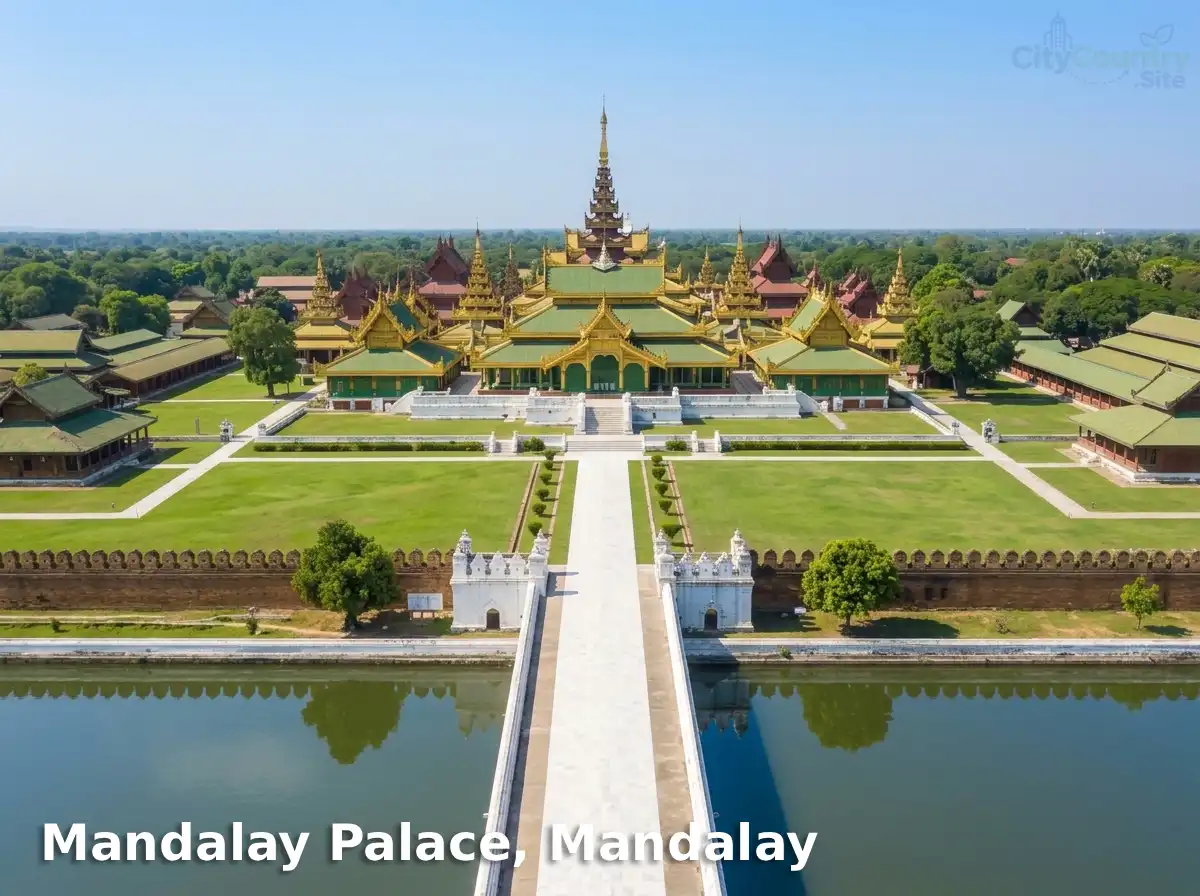
1857 — King Mindon Min makes the most consequential decision in Mandalay’s history: he founds a new royal capital on the slopes of Mandalay Hill, fulfilling what is claimed to be a 2,400-year-old prophecy by the Buddha. The new city is called Yadanabon — the “City of Gems” — though the world knows it as Mandalay. The Mandalay Palace and its surrounding fortified walls are constructed over the next several years, becoming one of the finest examples of traditional Burmese royal architecture ever built.
1871 — King Mindon hosts the Fifth Buddhist Synod at Mandalay — a landmark event in Buddhist history at which the entire Pali Canon (the scriptural foundation of Theravada Buddhism) is reviewed and inscribed on 729 marble slabs housed at the Kuthodaw Pagoda. The collection is known as the “World’s Largest Book.”
1878 — King Thibaw ascends the Mandalay throne in a bloody palace coup, massacring dozens of rival claimants. His reign is marked by increasing British pressure and internal disorder.
1885 — After a brief military campaign, British forces capture Mandalay and King Thibaw is sent into exile in India. The Third Anglo-Burmese War ends the Burmese monarchy and Mandalay becomes part of British India. The royal palace is converted into a British military garrison. The fall of Mandalay is mourned across Burma as a national humiliation.
1900s–1930s — Under British rule, Mandalay grows as a commercial city with significant Chinese and Indian immigrant communities. The city becomes an important trade hub on the Burma Road.
1942 — Japanese forces capture Mandalay during World War II. The city suffers devastating bombing — fires break out and much of the historic city, including many pagodas and the royal palace, is destroyed or severely damaged.
1945 — Allied forces recapture Mandalay after intense fighting. The city is in ruins. Reconstruction begins slowly.
1948 — Burma gains independence from Britain. Mandalay begins the long process of cultural and physical restoration.
1989 — Burma’s ruling military junta renames the country Myanmar and Rangoon becomes Yangon. Mandalay’s cultural institutions are brought under state control.
1990s–2000s — The military government undertakes extensive reconstruction of the Mandalay Palace complex, though critics argue the reconstruction uses modern materials that lack historical authenticity.
2011 — Myanmar begins a tentative democratic transition. Economic reforms and tourism growth begin transforming Mandalay’s economy and infrastructure.
2015 — Aung San Suu Kyi’s NLD party wins a landslide election. Mandalay experiences a surge in international tourism and foreign investment.
2021 — The military seizes power in a coup on February 1, overthrowing the elected government. Nationwide protests and civil disobedience movements are met with violent suppression. Armed resistance emerges across the country. Mandalay experiences significant civil unrest.
2022–2026 — Myanmar’s conflict continues. Mandalay remains relatively more stable than some conflict-affected regions, but the tourism industry has contracted dramatically. International visitor numbers remain a fraction of pre-coup levels. The city’s cultural heritage endures.
4. Geography & Neighborhoods
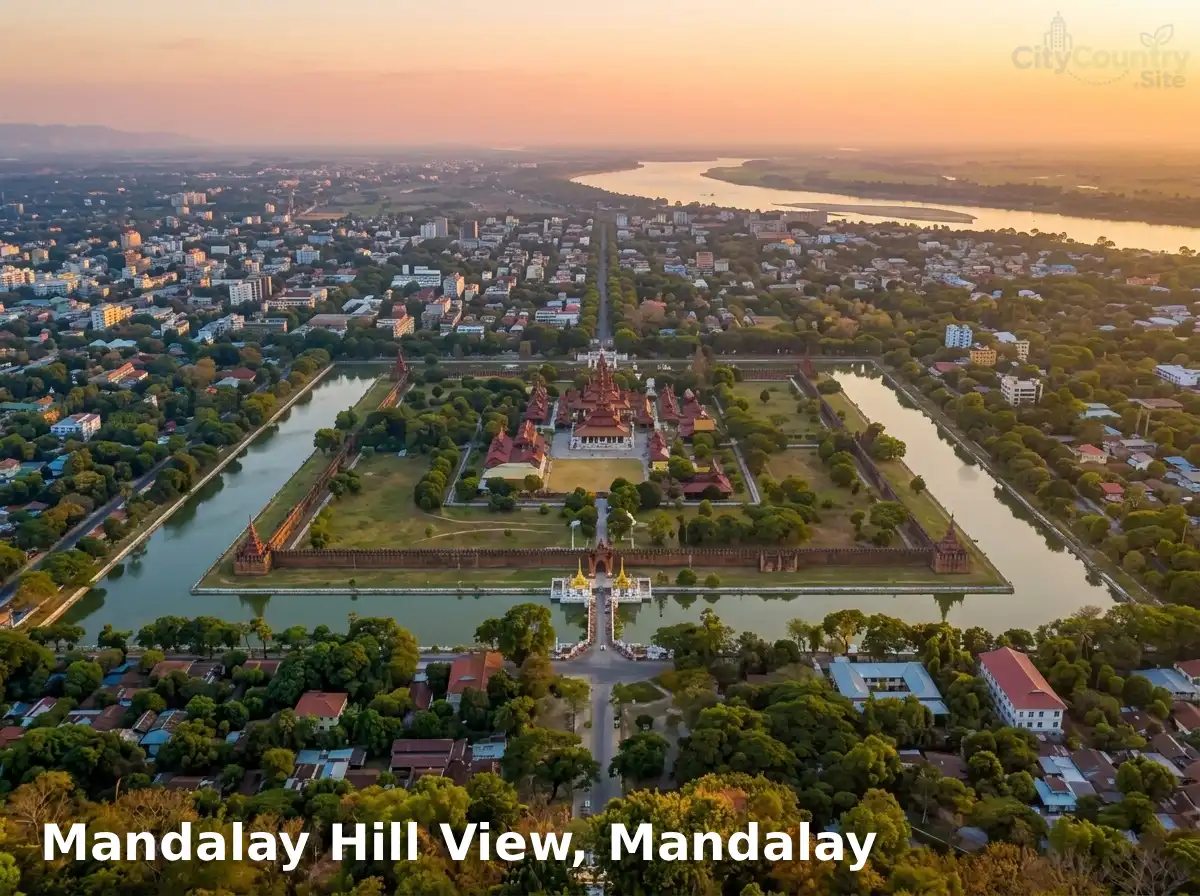
Mandalay occupies a broad, flat plain in central Myanmar, on the eastern bank of the Irrawaddy River. The city is dominated on its northeastern edge by Mandalay Hill — a 236-metre (774-foot) rise that provides panoramic views over the entire city, the river, and the surrounding plains. The ancient capital sites of Innwa, Amarapura, Sagaing, and Mingun are all within easy reach, forming a “quadrangle of ancient capitals” that makes the Mandalay region one of the richest archaeological zones in Southeast Asia.
The city is laid out on a rough grid system, with numbered streets running in both directions — numbered streets (running north-south) and numbered roads (running east-west). The royal palace and its moat sit at the geographic heart of the old city.
Neighborhood Comparison Table
| Area | Best For | Vibe | Price Level |
|---|---|---|---|
| City Center / Palace Area | Sightseeing, history, palace complex | Grand, historic, dusty, commercial | Mid |
| 26th–28th Street Area | Restaurants, budget accommodation, nightlife | Lively, touristy, convenient | Budget–Mid |
| Zegyo Market District | Shopping, local life, street food | Bustling, authentic, commercial | Budget |
| Chan Aye Thar Zan Township | Mid-range hotels, restaurants | Modern, comfortable, accessible | Mid |
| Amarapura (south suburb) | U Bein Bridge, day trip base | Quiet, village-like, scenic | Budget–Mid |
| Sagaing Hills (west of city) | Monastery retreats, hillside temples | Spiritual, peaceful, rural | Budget |
| Along the Irrawaddy | River views, boat trips, sunset watching | Open, atmospheric, scenic | Budget–Mid |
5. Mandalay Weather & Temperature Guide
Mandalay has one of the hottest and driest climates in Southeast Asia. Located in the rain shadow of mountains to the west, it receives significantly less rainfall than Yangon and most of Myanmar — but compensates with intense heat for much of the year. The cool season is genuinely pleasant; the hot season is brutal.
Month-by-Month Weather Table
| Month | Avg Temp (°C) | Rainfall | Crowd Level | Travel Recommendation |
|---|---|---|---|---|
| January | 16–28 | Very Low | High | ⭐ Excellent — cool and dry |
| February | 18–32 | Very Low | High | ⭐ Excellent |
| March | 22–37 | Very Low | Medium | ✅ Good — getting hot |
| April | 27–40 | Low | Medium | ⚠️ Very hot — avoid midday |
| May | 27–38 | Medium | Low | ⚠️ Heat plus early rains |
| June | 26–34 | High (Monsoon) | Low | ⚠️ Wet season begins |
| July | 25–32 | Very High | Very Low | ⚠️ Heaviest rain |
| August | 25–32 | Very High | Very Low | ⚠️ Monsoon peak |
| September | 25–33 | High | Low | ⚠️ Still wet |
| October | 23–33 | Medium | Medium | ✅ Improving — good |
| November | 18–30 | Low | High | ⭐ Excellent |
| December | 16–27 | Very Low | High | ⭐ Excellent — peak season |
November through February is universally the best time to visit Mandalay. Days are warm but manageable (mid-20s to low 30s°C), evenings are pleasantly cool, and rainfall is minimal. March is still acceptable but heat is building. April is extremely hot — temperatures can reach 40°C (104°F) and feel significantly hotter due to dust and sun. The monsoon (June–October) brings heavy rain and occasional flooding, though Mandalay receives less rain than southern Myanmar.
💡 Did You Know? Mandalay is officially one of the hottest cities in Southeast Asia during the pre-monsoon season. April temperatures regularly touch 40°C (104°F), and the flat, dry terrain of central Myanmar provides no relief from the relentless sun. The Burmese call this period the “Thingyan” season — the time of the Water Festival, when the entire nation celebrates the New Year by throwing water at everyone in sight. It is, in context, entirely understandable.
6. Mandalay Airport & Getting There
Mandalay International Airport (MDL)
Mandalay International Airport is located approximately 45 km south of the city center in the township of Tada-U — making it one of the more distant airports from a city center in Southeast Asia. Allow a minimum of 1 hour for the journey under normal traffic conditions; longer during peak hours.
The airport handles both domestic routes (connections to Yangon, Bagan, Heho/Inle Lake, and other Myanmar cities) and a limited number of international routes (historically to Bangkok, Singapore, Kunming, and Chiang Mai — though service fluctuates significantly due to the political situation).
Getting from Mandalay Airport to the City Center:
| Transport Option | Duration | Cost (Approx.) | Notes |
|---|---|---|---|
| Pre-booked hotel taxi | 60–75 min | $15–20 (USD) | Most reliable; arrange through hotel |
| Airport taxi | 60–75 min | $12–18 | Available at taxi counter in arrivals |
| Shared taxi / car | 75–90 min | $5–8 per seat | Slower, stops for other passengers |
| Local bus / songthaew | 90–120 min | $0.50–1 | Very cheap, very slow, limited luggage |
Getting to Mandalay from Yangon:
| Transport Option | Duration | Cost (Approx.) | Notes |
|---|---|---|---|
| Domestic flight (RGN → MDL) | 1 hour 20 min | $40–100 | Multiple airlines, multiple daily flights |
| Overnight train | 14–16 hours | $20–50 (sleeper) | Classic experience; comfortable sleeper berths |
| VIP Bus (overnight) | 8–10 hours | $10–20 | Reclining seats, air-conditioned |
| Private car / driver | 8–10 hours | $80–150 | Best for groups; direct and flexible |
The overnight train from Yangon to Mandalay is one of Southeast Asia’s great railway journeys — an experience in itself, slowly crossing the Burmese heartland through the night in a comfortable sleeper berth, arriving in Mandalay in the morning. Book upper-class sleeper berths for maximum comfort.
💡 Did You Know? Myanmar has its own unique time zone — UTC+6:30 — sharing with no other country in the world. Like Nepal’s UTC+5:45, it was set to precisely the geographic midpoint of the country. This means travelers arriving from Thailand (UTC+7) and India (UTC+5:30) both need to adjust their clocks by exactly 30 minutes.
7. Getting Around Mandalay
Mandalay is a large, sprawling city and not particularly walkable beyond specific neighborhoods. However, it is easy and inexpensive to get around with the right transport options.
Trishaws (Bicycle Rickshaws) — The traditional and iconic way to get around central Mandalay. Comfortable, slow, and wonderfully atmospheric for short hops through the city. Negotiate the fare before boarding — typically MMK 1,000–3,000 (~$0.50–1.50) for short rides.
Taxis — Widely available throughout the city. A typical city ride costs MMK 3,000–8,000 (~$1.50–4). For a half-day or full-day hire — essential for visiting the ancient capitals and multiple pagodas — negotiate a rate of approximately $15–25 for a full day with a driver.
Motorcycles / Motor Taxis — Cheap and fast for short distances. Drivers congregate at major intersections and pagoda entrances. Fare: MMK 500–2,000 for short hops.
Bicycle Rental — Several guesthouses and shops in the tourist district rent bicycles for $2–4 per day. Excellent for exploring the flat city center and riding to the riverfront. Less practical in intense heat.
E-bikes / Scooter Rental — Electric scooters are available for $5–10 per day and are the best way to independently explore the city and surrounding areas at your own pace.
Grab / Ride-hailing — As of 2026, app-based ride-hailing services have had interrupted operations in Myanmar due to the political situation. Availability varies — check current status on arrival.
8. Mandalay Top Attractions & Must-See Places in Mandalay
Top Attractions Table
| Attraction | Type | Entry Fee | Best Time | Time Needed |
|---|---|---|---|---|
| Mandalay Hill | Sacred hill / viewpoint / temple | Free (donation welcome) | Sunrise or Sunset | 2–3 hours |
| Kuthodaw Pagoda | UNESCO site / “World’s Largest Book” | $3 (combined ticket) | Morning | 1–2 hours |
| Shwenandaw Monastery | Teak monastery / historic architecture | $3 (combined ticket) | Morning | 1–1.5 hours |
| Mandalay Palace | Royal palace complex | $10 (combined zone ticket) | Morning | 2–3 hours |
| Mahamuni Pagoda | Sacred Buddhist temple / pilgrimage site | Free | Early morning (5–8 AM) | 1–2 hours |
| U Bein Bridge, Amarapura | World’s longest teak bridge | Free | Sunrise or Sunset | 2–3 hours |
| Mingun (day trip) | Ancient pagoda ruins / river trip | $5 | Morning | Half–Full day |
| Inwa (Ava) (day trip) | Ancient capital ruins | $5 | Morning | Half day |
| Sagaing Hill | Hillside temples / monasteries | Free | Morning | 2–3 hours |
| Jade Market (Kyauk Thara) | Gem trading market | Free | Morning (7–11 AM) | 1–2 hours |
| Gold Leaf Workshops | Traditional craft workshop | Free | Morning | 45 min |
| Silk & Tapestry Weaving Workshops | Traditional craft | Free | Morning | 1 hour |
Mandalay Hill is the spiritual and geographical heart of the city. According to Buddhist legend, the Buddha himself stood on this hill and prophesied that a great city would be built at its foot 2,400 years after his death — which it was, by King Mindon, in 1857. A covered stairway winds 1,729 steps to the summit, lined with shrines, vendors, and pilgrims. Arrive before dawn to watch the sun rise over a city of pagodas and the silver ribbon of the Irrawaddy far below. The view at sunrise — golden spires glinting into life one by one as the light intensifies — is one of the most beautiful sights in Southeast Asia.
Kuthodaw Pagoda houses the astonishing collection of 729 white marble slabs, each inscribed with pages of the Pali Canon — the complete scripture of Theravada Buddhism — and housed in individual mini-stupas arranged around a central golden pagoda. The collection was inscribed at the Fifth Buddhist Synod in 1871 under King Mindon. Walking among the white stone stupas in the early morning silence, with monks moving quietly between them, is genuinely moving.
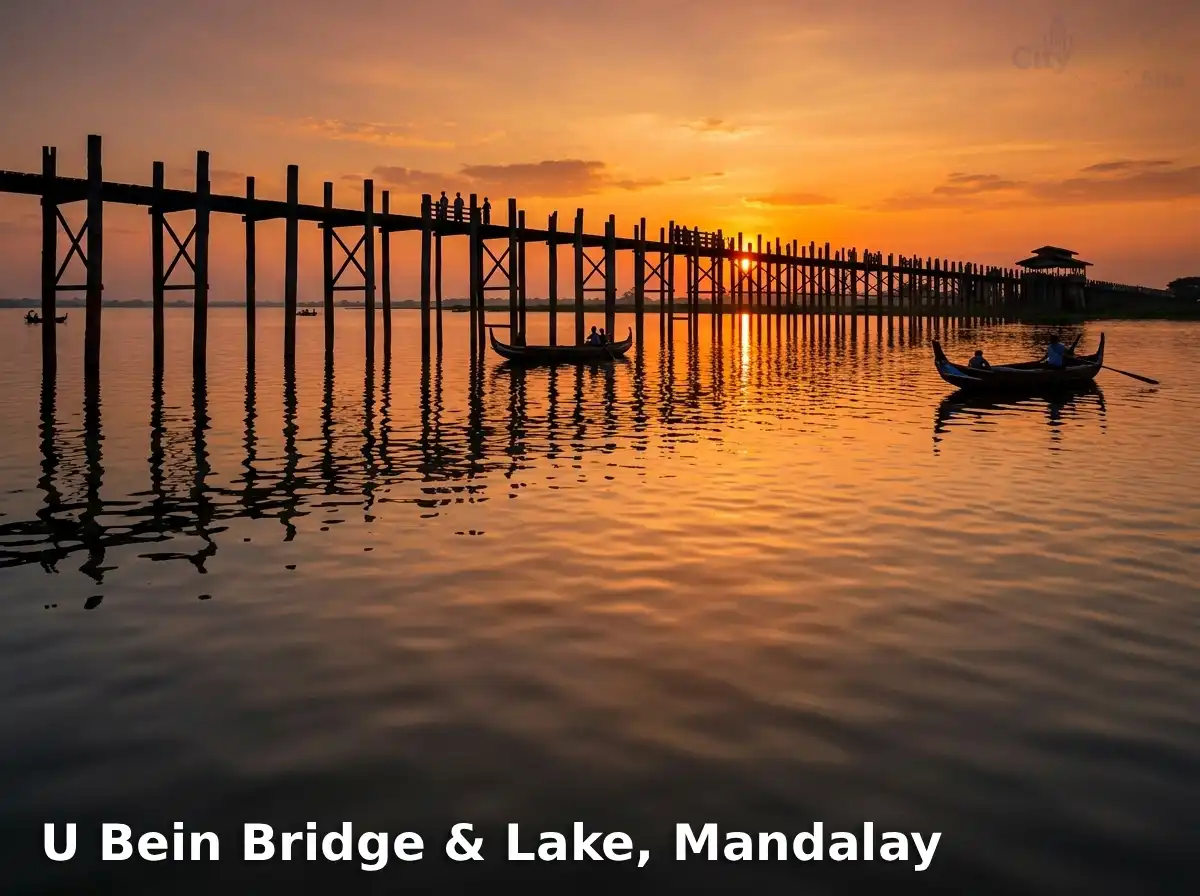
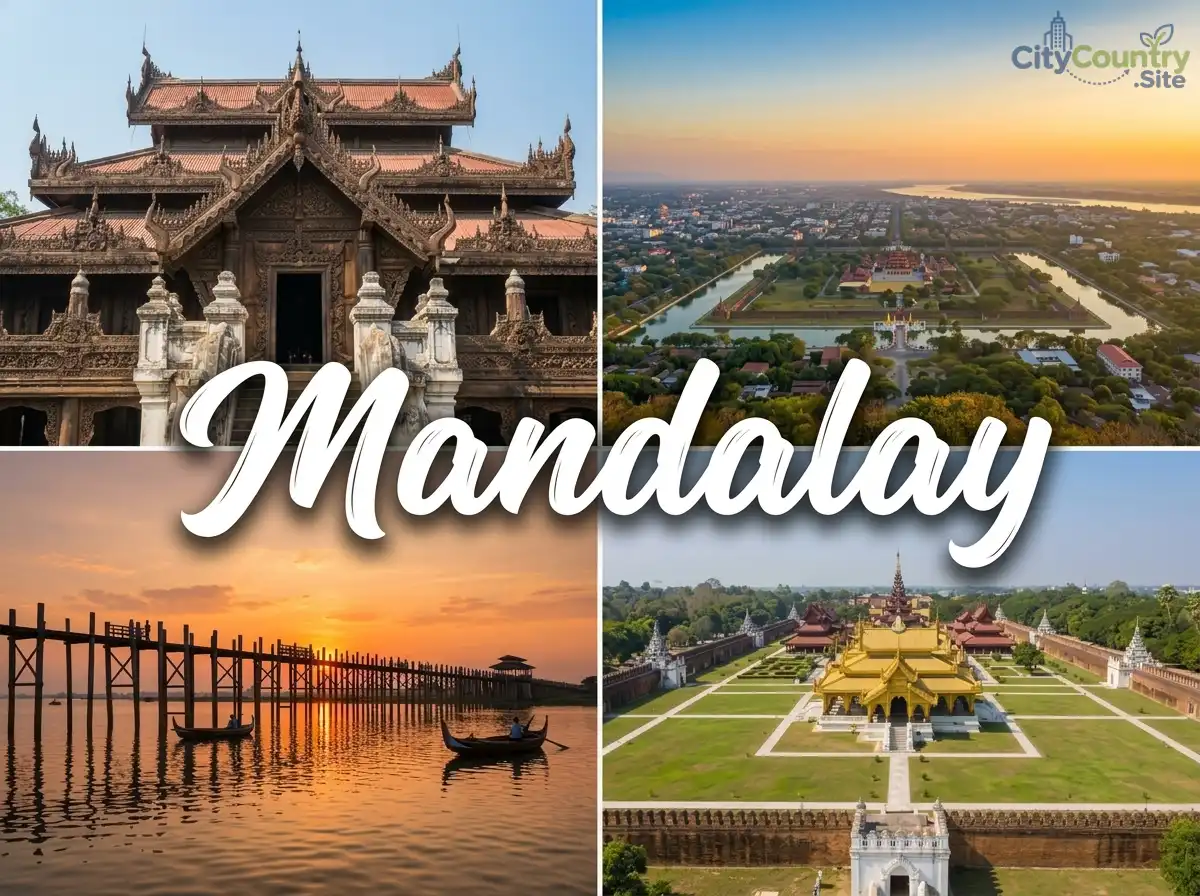
The U Bein Bridge at Amarapura, 11 km south of Mandalay, is one of the most photographed sights in Myanmar — a 1.2 km teak bridge stretching across the shallow Taungthaman Lake, built in 1849 from the salvaged teak timbers of the old Inwa royal palace. At sunset, monks in saffron robes and locals on bicycles cross the bridge in silhouette against a sky that turns every shade of orange, pink, and crimson. The beauty is extraordinary and completely real — this is not a constructed tourist spectacle but a living bridge still used daily by the local community.
Mahamuni Pagoda is Mandalay’s most important pilgrimage site — one of only five original likenesses of the Buddha said to have been made during his lifetime. The sacred image is covered in 15 cm of gold leaf applied layer by layer by male devotees over centuries, giving it a uniquely lumpy, organic silhouette quite unlike conventional Buddha images. Arrive at 5 AM for the daily face-washing ceremony, when monks ritually bathe the Buddha’s face — one of the most intimate and moving religious ceremonies in Myanmar.
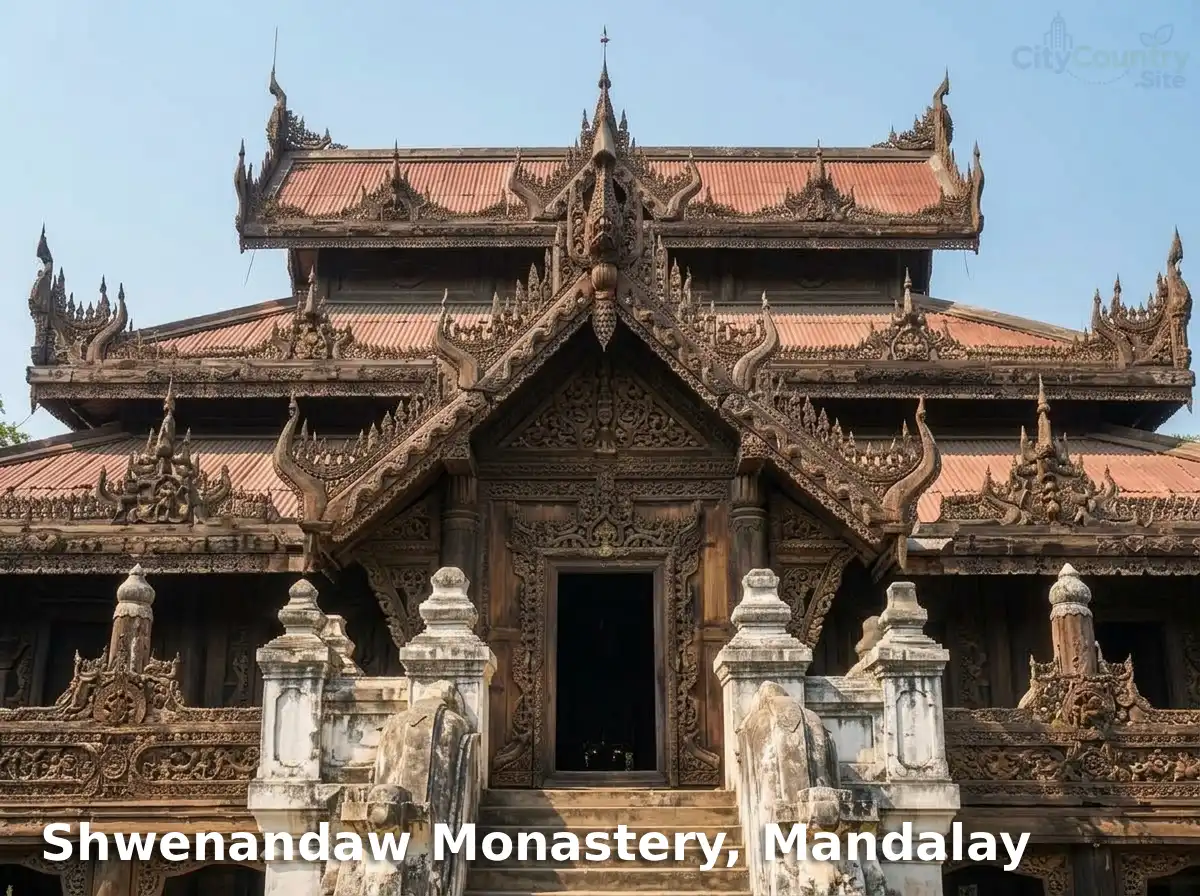
Shwenandaw Monastery is the sole surviving wooden structure of the original Mandalay Palace complex. Built entirely of teak and covered in extraordinarily intricate carved scenes from Buddhist mythology and royal life, it is regarded as one of the finest examples of traditional Burmese wooden architecture in existence. The detail of the carvings — visible even in the high interior panels — is breathtaking.
💡 Did You Know? The gold leaf applied to the Mahamuni Buddha statue has accumulated to a thickness of approximately 15 centimetres (6 inches) over centuries of continuous application by male pilgrims. Women are not permitted to touch or apply gold leaf to the image, though they may pray nearby. The statue’s body has taken on a completely organic, almost sculptural quality entirely different from its original form.
9. Mandalay Food & Cuisine Guide
Mandalay has a rich and distinctive food culture that reflects its position as the cultural capital of upper Burma and its history as a meeting point for Burmese, Shan, Chinese, and Indian culinary traditions.
Must-Try Dishes in Mandalay
Mohinga — Myanmar’s national dish and the most beloved breakfast food in the country. A rich, aromatic fish-broth noodle soup made with rice vermicelli, fish sauce, lemongrass, banana stem, and crispy fritters. Warming, complex, and deeply satisfying. Available at street stalls throughout the city from early morning. Cost: MMK 500–1,500 (~$0.25–0.75).
Mandalay Mee Shay — Mandalay’s most distinctive local dish — flat rice noodles served with a savory pork or chicken sauce, pickled mustard greens, crispy garlic, and a light broth on the side. This is the dish that Mandalay people eat for breakfast that all others envy. Extraordinary flavor for almost no cost.
Shan Noodles (Shan Khao Swe) — Flat rice noodles served with a mild, tomato-based pork or chicken sauce and garnished with sesame seeds, spring onions, and crispy garlic. Brought to Mandalay from the Shan State to the east, this dish is ubiquitous and utterly delicious.
Laphet Thohk (Tea Leaf Salad) — Myanmar’s most iconic salad — fermented tea leaves tossed with crunchy garlic, sesame seeds, peanuts, dried shrimp, tomatoes, and lime. The flavors are complex and unlike anything in the wider culinary world: earthy, sour, crunchy, savory, and faintly caffeinated. A defining Burmese taste experience.
Nan Gyi Thohk — Thick rice noodles in a rich chicken curry sauce with crushed chickpea fritters, fresh herbs, and boiled egg. A complete, satisfying meal in one bowl.
Mont Di — Another iconic Mandalay breakfast dish — rice noodles in a light fish broth with a garnish of soft fish, fresh herbs, and fried onions. Similar to Mohinga but distinctly Mandalay in character.
Burmese Curry (Hin) — Rich, oil-topped curries of pork, chicken, fish, or mutton, slow-cooked with onions, garlic, ginger, and dried chilies. Served with rice, pickled vegetables, and a thin clear soup. The “oil on top” is a traditional indicator of quality — the oil forms a seal that preserves the curry and indicates generous cooking.
Mont Lone Yay Paw — Small, round, sticky rice balls filled with jaggery (palm sugar) and served in a light ginger broth. A traditional festive sweet, available year-round at street stalls.
Best Restaurants & Food Spots
Nylon Ice Cream Bar — A Mandalay institution since 1956. This legendary ice cream shop on 83rd Street serves extraordinary Burmese-style ice cream — avocado, coconut, durian, rose syrup — in a time-warp setting of wooden benches and ceiling fans. MMK 500–1,500 per serving. Every Mandalay visitor must come here.
Marie Min Restaurant — One of Mandalay’s finest traditional Burmese restaurants, serving elaborate multi-dish Burmese set meals with exceptional laphet thohk, curries, and seasonal vegetable dishes. Local institution. MMK 4,000–10,000 per person.
Mingalar Restaurant — Excellent Shan cuisine in a relaxed setting near the city center. The Shan noodles and tofu dishes are exceptional. MMK 3,000–8,000.
Win Win Teashop — Breakfast in a Burmese teashop is one of the great cultural rituals of Myanmar. Win Win is one of Mandalay’s most atmospheric — arrive early for mee shay, Shan noodles, and strong, sweet Burmese milk tea. MMK 500–2,500.
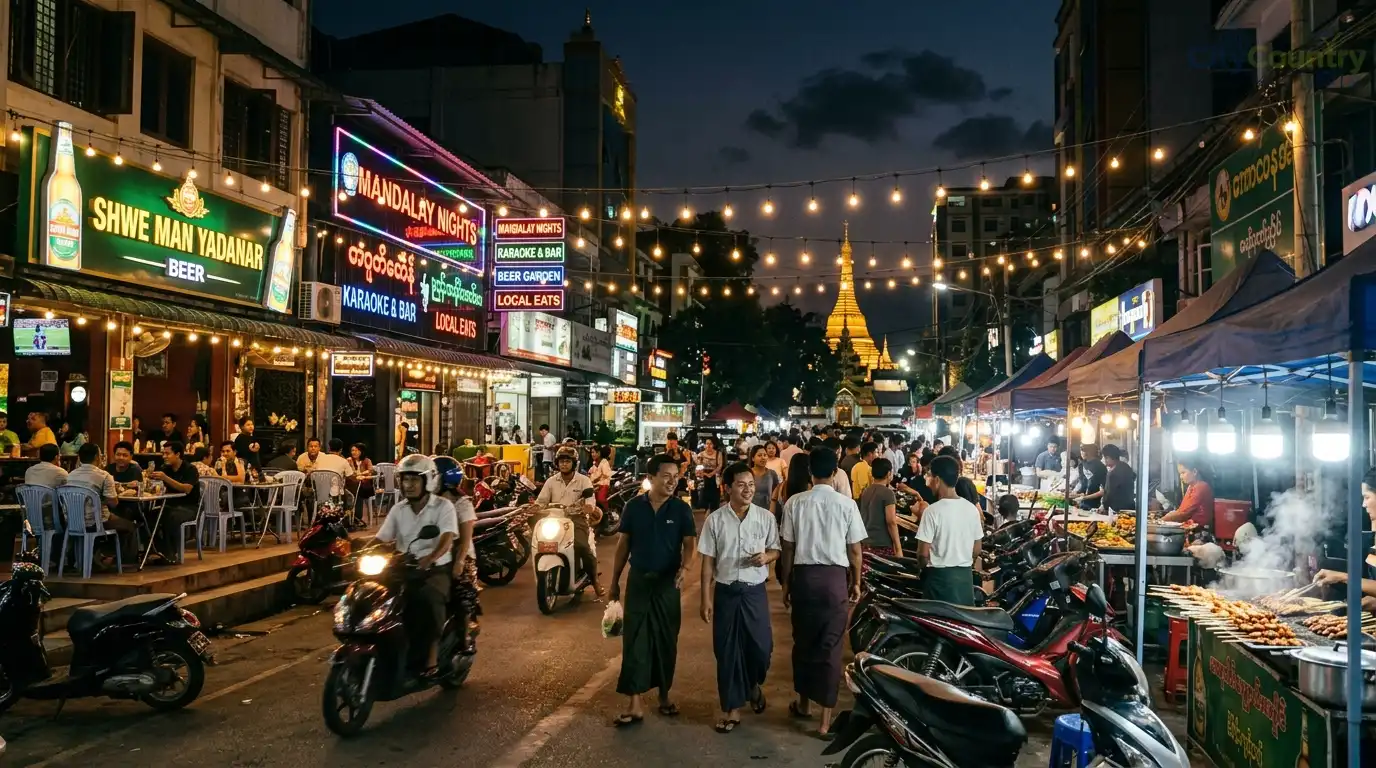
Night Market (Near 84th Street) — Mandalay’s evening food market is one of the best street food experiences in the city. Rows of stalls serving grilled skewers, noodle soups, stir-fries, fresh juices, and sweet snacks. Best visited after 6 PM. Budget MMK 2,000–5,000 for a full evening’s eating.
Mandalay Beer Station — Popular local gathering place serving cold Mandalay beer alongside grilled skewers, noodle dishes, and Burmese-Chinese appetizers. Great atmosphere, extremely cheap.
💡 Did You Know? Myanmar is one of the few countries in the world where tea is eaten as food rather than just drunk as a beverage. Fermented tea leaves (laphet) are considered a national delicacy and are traditionally served at significant social occasions including weddings and peace negotiations. The expression “eating laphet together” is synonymous with settling a dispute amicably.
10. Mandalay Accommodation Guide
Mandalay’s accommodation scene is concentrated in the city center and tourist district, with options ranging from basic guesthouses to genuinely comfortable hotels. True luxury options are limited compared to Yangon or Bagan, but mid-range comfort is widely available.
Best Areas to Stay:
- 26th–28th Street area (tourist zone): Best for budget and mid-range travelers — central, restaurant-rich, convenient for sightseeing
- Near the Palace Moat: Most atmospheric location — views of the moat and walls
- Chan Aye Thar Zan: Best for mid-range hotels in a slightly quieter setting
- Near Mandalay Hill: Good for morning temple access; quieter than the city center
Accommodation Price Ranges (2026)
| Category | Price/Night (USD) | Examples |
|---|---|---|
| Budget Guesthouse / Hostel | $8–20 | ET Hotel, Garden Guesthouse, various family guesthouses |
| Mid-Range Hotel | $25–70 | Hotel by the Red Canal, Rupar Mandalar, Yadanarbon Hotel |
| Upscale / Boutique Hotel | $70–130 | Hotel Mandalay, Sedona Hotel Mandalay |
| Luxury | $120–220+ | Mandalay Hill Resort, Bagan Thande-style properties on outskirts |
Hotel by the Red Canal is consistently the most recommended mid-range property in Mandalay among independent travelers — a beautifully maintained boutique hotel with excellent service, a lovely pool, good breakfast, and warm, helpful staff. Rates: approximately $55–100 per night.
Mandalay Hill Resort is the city’s most prestigious address — a large resort hotel directly at the base of Mandalay Hill with commanding views, a swimming pool, and the best breakfast spread in the city. Rates: approximately $120–200 per night.
11. Best Time to Visit Mandalay
November through February is the undisputed best time to visit Mandalay. Cool evenings (dropping to 15–16°C in December and January), warm but manageable days, clear blue skies, and virtually no rainfall create near-perfect conditions for sightseeing, temple-hopping, and river excursions.
December and January are peak months — slightly more visitors, slightly higher hotel rates, but genuinely excellent weather.
February and early March remain excellent — warming up slightly but still very pleasant. The Shwedagon Pagoda Festival and various local pagoda festivals bring color and cultural vibrancy to the city.
March is acceptable but heat is beginning to build. By late March, midday temperatures are uncomfortably high. Morning and late afternoon sightseeing is strongly recommended.
April is the hottest month — temperatures can hit 40°C or above. The Thingyan Water Festival (Myanmar New Year, mid-April) is a spectacular event nationwide, but the heat is intense. If visiting for Thingyan, prepare for soaking and celebrate enthusiastically.
May through September is the monsoon season. Rain comes in heavy daily downpours, though Mandalay is drier than most of Myanmar due to its position in the rain shadow. Accommodation is cheap, crowds are minimal, and the landscape is lush and green. Not ideal but manageable for determined travelers.
October sees the monsoon ending and is a transitional month — improving weather, moderate crowds, and a sense of the city returning to itself after the rains.
Key Festivals & Events in Mandalay
- Thingyan Water Festival (April, 3–5 days before New Year) — The entire nation celebrates by dousing everyone in sight with water. In Mandalay, stages are set up throughout the city and the celebrations are spectacular
- Myanmar New Year (April 17) — The day after Thingyan ends; a day of quiet after the chaos
- Thadingyut (Festival of Lights) (October) — Buddhist observance marking the end of the monk’s rains retreat. The city is illuminated with candles and lanterns
- Tazaungdaing (November) — A second festival of lights held one month after Thadingyut
- Mandalay’s Many Pagoda Festivals — Major pagodas including Mahamuni and Kuthodaw hold annual festivals with traditional music, drama, and huge pilgrim crowds. Dates follow the lunar calendar
12. Shopping Guide for Mandalay tour
Mandalay is the craft capital of Myanmar — arguably the best city in the country for buying traditional handmade goods directly from the artisans who make them.
What to Buy:
Gold Leaf — Mandalay’s gold-beaters (almost all in a specific workshop district south of Mandalay Hill) hammer gold into gossamer-thin sheets using traditional techniques unchanged for centuries. Watching the process is extraordinary; buying a packet of gold leaf to apply yourself to a pagoda statue is a uniquely Burmese experience. Very inexpensive.
Marionettes (Yama Zatgyi Puppets) — Traditional Burmese puppet theater characters, intricately costumed and expertly crafted. Among the most beautiful and unique crafts in all of Myanmar. Prices range from $10 for small decorative pieces to $100+ for master-quality performance puppets.
Longyi (Traditional Wraparound Cloth) — The ubiquitous Burmese garment worn by men and women. Mandalay produces some of the finest silk and cotton longyi in the country. A beautiful souvenir and genuinely practical garment.
Silk and Cotton Tapestries (Kalaga) — Embroidered and sequined wall hangings depicting scenes from Burmese mythology and the Jataka tales. Traditional art form, visually stunning, and unique to Myanmar.
Jade and Gems — Mandalay’s Jade Market is one of the most fascinating in Asia — a chaotic, expert-dominated trading floor where buyers and sellers examine rough and polished jade under bright lights, haggling in whispers. Most jade trading here is wholesale and professional, but tourist-quality jade jewelry and carvings are available at surrounding shops.
Lacquerware — Beautiful black and gold lacquered boxes, bowls, and trays made using traditional techniques. Buy from reputable craft shops for quality pieces.
Where to Shop:
Jade Market (Kyauk Thara Street) — Open primarily in the morning. Fascinating to observe even if not buying; surrounding streets have retail jade shops.
Zegyo Market (Bogyoke Market) — Mandalay’s main covered market — an enormous, labyrinthine complex selling everything from longyi and lacquerware to electronics, food, and gold. The authentic Mandalay shopping experience.
Gold Leaf Workshop District (36th–38th Streets) — A cluster of workshops where you can watch gold leaf being beaten and purchase the finished product directly.
Puppet and Craft Shops (near 39th Street) — Several workshops and showrooms selling traditional Burmese puppets, tapestries, and decorative arts.
Amarapura Silk Weaving Workshops — Silk longyi and tapestries woven on hand-looms by expert weavers in workshops open to visitors. Buy direct and watch your souvenir being made.
13. Mandalay Nightlife & Entertainment
Mandalay’s nightlife is quieter and more culturally oriented than Yangon’s. The city goes to bed relatively early by Southeast Asian capital standards, but there are good options for evening entertainment.
Traditional Cultural Performances:
Mandalay Marionette Theater — Traditional Burmese puppet theater (yama zatgyi) performed with extraordinary skill by master puppeteers. The elaborate costumed puppets can recreate every human movement and expression. Performances are held nightly at several venues near the tourist district. A genuinely world-class art form. Tickets: $8–15.
Moustache Brothers — Mandalay’s most internationally famous entertainers — a comedy troupe known for merging traditional Burmese a-nyein performance with political satire during the military dictatorship era. Their performances during the protest years made them legendary; they were imprisoned for their humor. Performances continue today, though the original troupe’s situation has evolved with the changing political landscape.
Classical Burmese Music — Several restaurants and cultural centers offer evening performances of traditional Burmese music featuring the saung gauk (harp), patala (xylophone), and hsaing waing (percussion ensemble). Hauntingly beautiful.
Bars & Evening Spots:
Mandalay Beer Station — The most popular local gathering place, with cold Mandalay beer, grilled food, and the relaxed conviviality of Burmese evenings.
The Pub (Hotel Mandalay) — A reliable hotel bar option for those wanting a quiet drink in comfortable surroundings.
Rooftop Bars — Several mid-range hotels offer rooftop spaces with views over the city lights at night. The Mandalay Hill Resort rooftop offers the finest panoramic evening view.
Evening Walks:
The Palace Moat at night — when the walls and corner pagodas are lit and reflected in the dark water — is one of Mandalay’s most beautiful after-dark experiences. The evening promenade along the moat is peaceful and atmospheric.
14. Hidden Gems & Local Secrets
Eindawya Pagoda — A beautiful, lesser-visited golden pagoda in the heart of the city, enshrining a Buddha image supposedly brought from the holy city of Bodhgaya, India. Almost entirely free of tourists, it maintains an authentic atmosphere of devotion that the major pilgrimage sites sometimes lack.
Yankin Hill — A small, forested hill northeast of the city center with several quiet temple complexes, panoramic views over the urban sprawl, and almost no tourists. Local families picnic here on weekends. A lovely, unhurried alternative to the crowds of Mandalay Hill.
Potter’s Village, Yandabo — About 15 km south of the city, the village of Yandabo has produced pottery for centuries using river clay from the Irrawaddy. Traditional pottery wheels, open-air kilns, and finished ceramic pots drying in long rows present a scene of craft production almost unchanged for a thousand years.
Chan Thar Village Boat Sunset — Rather than the standard U Bein Bridge sunset experience (crowded with photographers on rickety viewing platforms), hire a small wooden boat to drift on Taungthaman Lake as the sun sets. From the water, the bridge, the reflections, the silhouetted monks, and the golden sky create a more intimate and less photographically competitive version of the same magnificent scene.
The Irrawaddy River at Dawn — Walking to the riverbank in the early morning — before the heat intensifies — to watch flat-bottomed wooden boats moving through golden mist, fishermen casting nets, and the far shore’s low hills catching the first light, is a profoundly serene experience that most tourists completely miss.
Traditional Teashop Breakfast Circuit — Rather than eating at tourist restaurants, spend a morning doing what Mandalay people do: walking between two or three traditional teashops, eating a different noodle dish at each, watching the city wake up over a succession of sweet milk teas. Cost: barely $2 total.
15. Day Trips from Mandalay
Mandalay is the gateway to one of the most historically and architecturally rich regions in Southeast Asia — the ancient cities of upper Burma that formed the successive royal capitals of the Burmese kingdoms.
Day Trips Table
| Destination | Distance | Travel Time | Method | Highlights |
|---|---|---|---|---|
| Amarapura | 11 km south | 20–30 min | Taxi / E-bike | U Bein Bridge, silk weaving, Pahtodawgyi Pagoda |
| Inwa (Ava) | 22 km south | 40–50 min | Taxi + ferry + horse cart | Ancient capital ruins, Bagaya Monastery, leaning watchtower |
| Sagaing | 21 km southwest | 40 min | Taxi / Motorbike | Hillside stupas, 600+ monasteries, panoramic river views |
| Mingun | 11 km north (by river) | 1 hour by boat | Morning river boat | Unfinished world’s largest pagoda, Mingun Bell, Hsinbyume Pagoda |
| Paleik (Snake Temple) | 35 km south | 1 hour | Taxi | Famous temple housing live pythons revered as sacred |
| Monywa | 136 km west | 3 hours | Bus / Taxi | World’s largest reclining Buddha, Thanboddhay Pagoda, cave temples |
| Pyin Oo Lwin (Maymyo) | 70 km east | 1.5 hrs | Bus / Taxi | Hill station, Botanical Gardens, waterfalls, colonial architecture |
The Ancient Capitals Loop — Amarapura, Inwa, and Sagaing — can be combined in a single full-day excursion and represents the single best day trip in the Mandalay region. Hire a driver for the day ($15–25), begin with the U Bein Bridge at sunrise, cross by ferry to Inwa for a horse-cart tour of the ruins, continue to Sagaing for the hillside temple panoramas, and end back at U Bein for the sunset. One of the great cultural day trips in Southeast Asia.
Mingun is reached by a 1-hour boat journey north along the Irrawaddy — itself a beautiful experience. The destination is dominated by the Mingun Pahtodawgyi — an enormous unfinished pagoda begun by King Bodawpaya in 1790 that, if completed, would have been the largest Buddhist stupa on earth. Beside it stands the Mingun Bell — at 90 tonnes, the largest uncracked ringing bell in the world — and the fairytale-white Hsinbyume Pagoda, modeled on the mythological Mount Meru. The entire site is extraordinary.
Pyin Oo Lwin (Maymyo) is a British colonial hill station at 1,070 metres elevation — a completely different world from hot, dusty Mandalay. Former British bungalows, horse-drawn carriages (still used locally), a magnificent botanical garden, and the dramatically beautiful Anisakan Falls combine to make it one of the most charming day trips in Myanmar.
💡 Did You Know? The Mingun Bell — cast in 1808 under King Bodawpaya — weighs 90,718 kg (90 tonnes) and is the largest ringing bell in the world. The runner-up, the Tsar Bell in Moscow, is actually larger but has been cracked and cannot ring. The Mingun Bell hangs in a simple wooden shelter near the river and visitors are welcome to strike it — the resonance is felt as much as heard.
16. Local Culture, Customs & Etiquette
Mandalay is the cultural and spiritual heart of Burmese Buddhism. Its people are deeply religious, warmly hospitable to respectful visitors, and justifiably proud of their cultural heritage.
Religion: Theravada Buddhism is the foundation of Burmese life. Temples, pagodas, and monasteries are living places of worship — not tourist attractions — and should be treated as such. Remove shoes and socks before entering any temple or pagoda precinct. Dress modestly — cover shoulders and knees. Women should not touch or hand anything directly to monks.
Thilashin (Nuns) and Monks: Myanmar has the highest proportion of ordained monks relative to population of any country on earth. Monks follow strict codes of conduct — they cannot accept food after midday, cannot touch women, and observe specific rules about interaction with laypeople. Respect these norms: do not touch a monk, do not offer anything to a monk with your left hand, and stand or move aside to let monks pass.
Thanaka — The distinctive yellowish paste worn on the faces of many Burmese women and children is thanaka — ground from the bark of the thanaka tree and applied as both sunscreen and cosmetic. It is a beloved traditional practice and a symbol of Burmese identity. Never mock it; many travelers find it beautiful, as it is.
The Pointing of Feet: As throughout Buddhist Southeast Asia, feet are considered the spiritually lowest part of the body. Never point your feet toward a Buddha image, altar, or elder person. Sit cross-legged or with feet tucked to the side in temple settings.
Photography: Ask before photographing people. Most Burmese are happy to be photographed, but always ask first and respect a “no.” Never photograph military installations, personnel, or checkpoints — this remains sensitive and potentially dangerous.
Tipping:
- Restaurants: Not traditionally expected in local eateries; $1–2 tip at tourist restaurants is appreciated
- Guides: $5–10 per day for a good guide is appropriate and genuinely meaningful in the current economic context
- Drivers: $3–5 per day tip on top of agreed hire rates
- Guesthouse staff: $1 per day at budget places; proportionally more at upscale hotels
Dos and Don’ts:
- ✅ Do remove footwear at all temple and pagoda entrances — without exception
- ✅ Do dress modestly throughout the city, not just at religious sites
- ✅ Do accept food or drink offered by a local host — refusal is genuinely rude
- ✅ Do use both hands when giving or receiving anything of significance
- ❌ Don’t pat children on the head — the head is sacred
- ❌ Don’t photograph monks without permission
- ❌ Don’t display physical affection in public
- ❌ Don’t discuss politics openly — particularly sensitive given the current situation
17. Safety & Travel Tips
Important Safety Context (2026): Myanmar has been experiencing significant internal conflict since the 2021 military coup. The situation varies dramatically by region. Mandalay city itself has been relatively more stable than many conflict-affected regions, but the overall security situation in Myanmar is unpredictable and visitors should remain alert to changing conditions.
Always check your government’s travel advisory before visiting Myanmar. The UK FCO, US State Department, Australian DFAT, and Canadian DFAT all maintain regularly updated Myanmar advisories.
Areas of Caution in Mandalay: The city center and main tourist areas are generally calm. Avoid any areas where protests or civil unrest have recently occurred. Keep a low profile.
Tourist Scams:
- Overpriced trishaws and taxis for tourists — always agree on fare before boarding
- Gem shops with exaggerated quality claims — buy only from reputable, established dealers
- “Friendly strangers” who offer to guide you to specific shops — commission-based
- Fake “closed today” claims about attractions designed to redirect you to partner shops
Emergency Contacts:
- Police: 199
- Ambulance: 192
- Fire: 191
Health Tips:
- Never drink tap water — use bottled water throughout Myanmar
- Food hygiene standards vary widely — stick to busy, popular stalls where food turns over quickly
- Malaria is not a significant risk in Mandalay city itself but is present in rural and border areas; consult your doctor about prophylaxis if traveling beyond the city
- Dengue fever is present in Myanmar; use mosquito repellent, particularly at dawn and dusk
- Medical facilities in Mandalay are limited compared to Western standards — consider comprehensive travel insurance with medical evacuation coverage
18. Budget Breakdown
Daily Cost Table
| Category | Budget Traveler | Mid-Range | Luxury |
|---|---|---|---|
| Accommodation | $8–18 (guesthouse / hostel) | $30–70 (hotel) | $100–200+ (top hotel) |
| Food | $3–8 (local noodle shops, teashops) | $15–30 (restaurant meals) | $35–70+ (upscale dining) |
| Transport | $2–6 (trishaw, motorbike taxi) | $10–20 (taxi, hired driver) | $25–50 (private car) |
| Activities | $5–15 (temples, pagodas, museums) | $15–35 (guided tours, puppet show) | $40–100 (private guides, experiences) |
| Total/Day | ~$18–47 | ~$70–155 | ~$200–420+ |
Mandalay is an exceptionally affordable destination even by Southeast Asian standards. A careful budget traveler eating street food and staying in guesthouses can have a rich and deeply satisfying experience for well under $30 per day.
19. Practical City Information
Visa & Entry: Most nationalities previously could obtain a visa on arrival or e-visa for Myanmar. However, entry requirements and visa processing have changed significantly since the 2021 coup and continue to evolve. As of 2026, check the current visa situation with your country’s Myanmar embassy or consulate and review official Myanmar government announcements, as policies have been inconsistent.
Vaccinations: The following are recommended for Myanmar: Hepatitis A, Typhoid, Tetanus, Rabies (for extended stays or rural areas), and Japanese Encephalitis (for rural areas during monsoon). Malaria prophylaxis is recommended for travel outside major cities. Consult a travel medicine specialist before visiting.
Emergency Contacts:
- Police: 199
- Ambulance / Fire: 192 / 191
- Note: Emergency services may be unreliable given the current political situation. Your hotel reception is often the most practical first point of contact in an emergency.
SIM Cards & Internet: Myanmar has domestic SIM card providers (Ooredoo Myanmar, previously MPT). SIM availability and registration requirements for foreigners have changed since the coup — verify current rules on arrival. Internet access and certain websites may be subject to restriction. A VPN is recommended; note that VPN use may be technically restricted. Many hotels provide Wi-Fi.
Power: Myanmar uses Type C, D, F, and G plugs, voltage 230V, 50Hz. Power cuts occur — particularly during the hot season when demand peaks. Carry a portable power bank.
Drinking Water: Tap water is not safe to drink anywhere in Myanmar. Bottled water is inexpensive and widely available. At upscale hotels, filtered water is often provided in rooms.
Currency Note: Myanmar’s currency situation has been volatile since the coup. The official exchange rate and black-market rate have diverged significantly. USD cash in new, pristine condition is essential — torn, written-upon, or old-design notes may be refused. ATMs have had limited reliability. Carry sufficient USD cash for your entire stay.
20. How to Be a Responsible Traveler in Mandalay
The Ethics of Visiting Myanmar (2026): Tourism in Myanmar carries complex ethical dimensions given the military coup of 2021 and ongoing human rights concerns. Some argue that visiting supports the military regime through taxation and business; others argue that tourism supports local communities and cultural workers who depend on it. This is a genuine ethical question that each traveler must consider for themselves, ideally after reading reporting by organizations such as the Myanmar Tourism Monitor, Human Rights Watch, and Fortify Rights.
If You Choose to Visit:
Support Local, Civilian-Owned Businesses: Eat at family-run teashops and restaurants, stay at privately owned guesthouses, and buy crafts directly from artisans. Avoid businesses with obvious military-affiliated ownership.
Hire Independent Local Guides: Local guides — particularly those who have maintained independent operations — depend on tourism income and provide immeasurably better experiences than package tour companies. Ask your guesthouse for recommendations of trusted guides.
Buy Crafts Directly from Artisans: Mandalay’s gold beaters, puppet makers, silk weavers, and lacquerware craftspeople work in small family workshops. Buying directly puts the full value of your purchase into their hands.
Reduce Plastic Waste: Myanmar’s waste management infrastructure is limited. Use a refillable water bottle with a filter, refuse plastic bags, and carry rubbish out of natural sites.
Respect Religious Sites Absolutely: Behaving respectfully at temples and pagodas — appropriate dress, footwear removal, quiet demeanor — is both culturally correct and a powerful signal of respect to the people for whom these places are sacred.
Photography with Dignity: Never photograph people in moments of poverty, vulnerability, or religious devotion for social media engagement without genuine consideration of their dignity.
Stay Informed: Follow developments through credible sources (Irrawaddy, Myanmar Now, Reuters, BBC) before and during your visit.
21. Travel Media: Documentaries, Books & Channels
Books:
- Burmese Days by George Orwell — Orwell’s first novel, set in colonial Burma. Essential reading for any visitor — a brilliant and disturbing portrait of colonialism
- The Glass Palace by Amitav Ghosh — A sweeping historical novel beginning with the fall of Mandalay in 1885 and spanning a century of Burmese history. Perhaps the finest novel written about Myanmar
- Finding George Orwell in Burma by Emma Larkin — A profound and beautifully written account of traveling through Myanmar in the footsteps of Orwell, exploring the country’s political psychology
- From the Land of Green Ghosts by Pascal Khoo Thwe — A remarkable memoir by a Padaung tribesman from Myanmar who escaped to Cambridge University
- Lonely Planet Myanmar — The standard practical guidebook
Documentaries & Films:
- The Lady (2011) — Luc Besson’s biopic of Aung San Suu Kyi, providing essential political context for modern Myanmar
- Burma VJ (2008) — Oscar-nominated documentary about the 2007 Saffron Revolution, filmed covertly by local video journalists
- Yangon Calling and various VICE documentaries provide accessible introductions to modern Myanmar
YouTube Channels:
- Indochina Tours / Drew Binsky Myanmar content — Accessible travel vlogs from pre-coup Mandalay
- Touropia — Documentary-style Myanmar content
- Various backpacker travel channels with Mandalay content, though most current content reflects pre-2021 conditions
22. Mandalay vs. Similar Cities
| Feature | Mandalay | Chiang Mai (Thailand) | Luang Prabang (Laos) |
|---|---|---|---|
| Historical depth | ⭐⭐⭐⭐⭐ Extraordinary — last royal capital | ⭐⭐⭐⭐ Very rich | ⭐⭐⭐⭐⭐ UNESCO heritage |
| Authentic crafts | ⭐⭐⭐⭐⭐ Best in SE Asia | ⭐⭐⭐⭐ Very good | ⭐⭐⭐ Good |
| Affordability | ⭐⭐⭐⭐⭐ Exceptional | ⭐⭐⭐ Moderate | ⭐⭐⭐ Moderate |
| Tourist infrastructure | ⭐⭐ Limited (current situation) | ⭐⭐⭐⭐⭐ Excellent | ⭐⭐⭐⭐ Very good |
| Safety / stability | ⭐⭐ Complex (see note) | ⭐⭐⭐⭐⭐ Very safe | ⭐⭐⭐⭐⭐ Very safe |
| Food scene | ⭐⭐⭐⭐ Excellent | ⭐⭐⭐⭐⭐ Outstanding | ⭐⭐⭐⭐ Very good |
| Authentic atmosphere | ⭐⭐⭐⭐⭐ Exceptional | ⭐⭐⭐ Moderate (touristy) | ⭐⭐⭐⭐ High |
| Crowd levels | ⭐⭐⭐⭐⭐ Very low (current) | ⭐⭐ Very crowded | ⭐⭐⭐ Moderate |
Choose Mandalay if you are an experienced Southeast Asian traveler seeking an extraordinarily deep cultural experience off the heavily trodden tourist trail, are comfortable navigating complex travel environments, have researched the ethical dimensions of visiting Myanmar, and prioritize authentic, uncrowded encounters with one of Asia’s most remarkable cultural traditions. Mandalay offers things unavailable anywhere else — but it demands more of its visitors than Chiang Mai or Luang Prabang.
City Travel Tips at a Glance
- Arrive between November and February for the best weather — April heat is genuinely extreme
- Always remove footwear before entering temple precincts — without exception and without being asked
- Hire a driver or e-bike for the Ancient Capitals day trip — Amarapura, Inwa, and Sagaing in a single day is the best cultural experience in the region
- Arrive at Mahamuni Pagoda before 5:30 AM for the face-washing ceremony — one of Myanmar’s most moving religious rituals
- Eat breakfast at traditional teashops rather than tourist restaurants — mee shay and Shan noodles for under $1
- Visit the Jade Market before 10 AM when trading is most active
- Carry only pristine, new-issue USD banknotes — torn or marked notes may be refused everywhere
- Never photograph military installations or personnel
- U Bein Bridge at sunrise is less crowded than sunset — and equally beautiful
- The stairway up Mandalay Hill has covered escalators partway up — useful in extreme heat
- Stock up on cash before arriving — ATM reliability has been inconsistent since 2021
- A packet of Mandalay gold leaf costs barely $1 and makes the most meaningful, unique souvenir from Myanmar
23. Is Mandalay Worth Visiting? — Final Verdict
For the right traveler, in the right circumstances, Mandalay is one of the most extraordinary cities in Asia. Its cultural depth, historical grandeur, living craft traditions, and atmospheric beauty are virtually unmatched in Southeast Asia. The U Bein Bridge at sunrise, the Kuthodaw’s forest of white stupas, the Mahamuni face-washing ceremony, a puppet show in a lamplit theater, the ancient capitals of Inwa and Sagaing — these are experiences that mark you permanently, that you carry home in a way that slick, tourist-polished cities simply do not.
However, the decision to visit Myanmar in 2026 is not straightforward. The country has been under military rule since 2021. Armed conflict continues in multiple regions. International travel advisories range from “exercise high caution” to “do not travel” depending on your country. The ethical dimensions of tourism under these circumstances are real and deserve honest consideration.
Mandalay is best suited for:
- Experienced Southeast Asian travelers who understand how to navigate complex, less-structured travel environments
- Cultural and historical enthusiasts who prioritize depth of experience over comfort and convenience
- Photographers and visual artists for whom the combination of pagodas, river light, crafts, and human subjects is extraordinary
- Buddhist practitioners and scholars for whom the city’s religious heritage has profound personal significance
- Adventurous independent travelers who research thoroughly, travel flexibly, and handle uncertainty with equanimity
Not recommended for first-time Southeast Asian visitors, those uncomfortable with political complexity, families with young children (given infrastructure and safety uncertainties), or anyone unwilling to engage seriously with the ethical questions involved.
The honest verdict: Mandalay is one of the world’s great cultural destinations — and one of its most complicated to visit right now. Research carefully, decide with full information, and if you go, travel with humility, respect, and a genuine desire to understand rather than simply consume what you see. Mandalay will reward that approach with experiences you will never forget.
24. Frequently Asked Questions About Mandalay
Q1: Is it safe to travel to Mandalay in 2026?
Mandalay city has been relatively more stable than many conflict-affected regions of Myanmar, but the overall security situation in the country is unpredictable following the 2021 military coup. Check your government’s current travel advisory before making any plans. The UK FCO, US State Department, and Australian DFAT publish regularly updated advisories. Many governments currently advise against non-essential travel to Myanmar. If you choose to visit, register with your country’s embassy, stay informed about local developments, and have a clear emergency exit plan.
Q2: What visa do I need to visit Mandalay / Myanmar?
Visa requirements for Myanmar have been subject to change since the coup. Previously, many nationalities could obtain a tourist visa on arrival or through the e-visa system. As of 2026, visa processing and availability are unpredictable — check the current situation with your country’s Myanmar embassy or consulate well in advance of any planned travel. Do not rely on pre-coup information.
Q3: What currency should I bring to Mandalay?
US dollars in pristine, new condition are essential. Myanmar’s economy has been significantly disrupted since 2021, with exchange rate volatility and ATM unreliability. Carry sufficient USD cash for your entire stay, in small denominations ($1, $5, $10, $20 bills) as well as larger notes. Torn, marked, or older-design notes will often be refused. Exchange USD to Myanmar Kyat (MMK) at licensed money changers or hotels.
Q4: What is the best way to get from Yangon to Mandalay?
The domestic flight (approximately 1 hour 20 minutes, $40–100) is the fastest option. The overnight train (14–16 hours) is a classic travel experience with comfortable sleeper berths and the opportunity to see the Burmese countryside. The VIP overnight bus (8–10 hours, $10–20) is the most popular budget option. The private car is best for groups wanting flexibility.
Q5: What are the must-see attractions in Mandalay?
The essential Mandalay experiences are: Mandalay Hill at sunrise, the Kuthodaw Pagoda (world’s largest book), Shwenandaw Monastery (extraordinary teak carving), the Mahamuni Pagoda (early morning face-washing ceremony), U Bein Bridge at sunrise or sunset (world’s longest teak bridge), and the Ancient Capitals day trip combining Amarapura, Inwa, and Sagaing.
Q6: Is Mandalay worth visiting over Bagan or Yangon?
Each of Myanmar’s three main tourist cities offers a completely different experience. Bagan is the country’s most visually spectacular destination — a plain of 2,000 ancient pagodas that is unique in the world. Yangon is the largest city with the most sophisticated infrastructure, the finest food scene, and the greatest contemporary energy. Mandalay is the cultural and craft capital — deeper in living tradition than either. Ideally, visit all three; if choosing one, Mandalay offers the most immersive, authentic engagement with Burmese culture.
Q7: Can women travel safely solo in Mandalay?
Pre-coup, Mandalay was considered relatively safe for solo female travelers within the tourist areas. The general hospitality of Burmese people toward visitors was well-documented. The current political situation introduces additional unpredictability. Solo female travelers considering a visit in 2026 should consult current firsthand accounts from travelers (travel forums, recent blogs), check government advisories, connect with the guesthouse community for current ground-level information, and make their decision with current information rather than pre-2021 assessments.
Q8: How much does it cost to visit Mandalay per day?
Mandalay is extremely affordable by global standards. A budget traveler eating at street stalls and local teashops, staying in a guesthouse, and traveling by trishaw or motorbike taxi can manage comfortably on $20–35 per day. A mid-range traveler with a comfortable hotel, restaurant meals, and guided excursions would spend $60–100 per day. The main expense is often the full-day driver hire for the Ancient Capitals circuit ($15–25) and any cultural performance tickets ($8–15).
Q9: What is the best single day trip from Mandalay?
The Ancient Capitals circuit — combining Amarapura (U Bein Bridge), Inwa (horse-cart temple tour), and Sagaing (hillside monastery panorama) — is the best single day trip in the Mandalay region and one of the finest cultural day trips in Southeast Asia. Alternatively, the Mingun boat trip (river journey plus the world’s largest uncracked bell and unfinished pagoda) is spectacular. Both can be done in a single day; combining both requires a very early start.
25. Sources & References
This article was researched using information from the following trusted sources:
- Lonely Planet Myanmar — lonelyplanet.com
- TripAdvisor Mandalay — tripadvisor.com
- Booking.com Mandalay Hotels — booking.com
- Wikipedia — Mandalay — en.wikipedia.org
- Numbeo — Cost of Living Mandalay — numbeo.com
- Google Maps — maps.google.com
- Wikitravel Mandalay — wikitravel.org
- Skyscanner Myanmar Flights — skyscanner.com
- World Travel Guide — worldtravelguide.net
- Human Rights Watch Myanmar — hrw.org
- The Irrawaddy (Myanmar independent news) — irrawaddy.com
- Myanmar Now (independent media) — myanmar-now.org
- UK Foreign Commonwealth & Development Office Myanmar Travel Advisory — gov.uk/foreign-travel-advice/myanmar
- Condé Nast Traveller Myanmar — cntraveller.com
- UNESCO World Heritage — Mandalay — whc.unesco.org
26. Mandalay Travel Guide Images