
1. Facts About Ulaanbaatar
| Feature | Details |
|---|---|
| Country | Mongolia |
| Region / Province | Ulaanbaatar Municipality (self-governing capital) |
| Official Language | Mongolian |
| Currency | Mongolian Tögrög (MNT) |
| Best Time to Visit | June–August (summer) & July for Naadam Festival |
| Time Zone | Ulaanbaatar Time (UTC+8) |
| Average Trip Cost Per Day | Budget: $25–45 / Mid-range: $70–130 / Luxury: $180–400+ |
| Nearest Major Airport | Chinggis Khaan International Airport (UBN) — 52 km from city center |
| Population | Approx. 1.6 million (city); nearly 50% of Mongolia’s entire population |
| Famous For | Gateway to the Mongolian steppe, Naadam Festival, nomadic culture, Genghis Khan heritage, world’s coldest capital |
2. Ulaanbaatar City Overview & Background
Most capital cities announce themselves gradually — suburban sprawl giving way to urban density, familiar signs of metropolitan life accumulating as you approach the center. Ulaanbaatar does none of this. You fly in over an ocean of steppe — flat, tawny, seemingly infinite grassland stretching to every horizon — and then, suddenly, without warning, a city appears. Tower blocks rising from the valley floor. A ring of ger districts (traditional felt tent settlements) surrounding the urban core like a nomadic embrace. The Bogd Khan Mountain watching over everything from the south with permanent, snow-dusted authority.
Ulaanbaatar — called simply “UB” by virtually everyone who lives there or passes through — is one of the world’s most genuinely extraordinary capital cities. It is the world’s coldest national capital, experiencing winter temperatures that regularly plunge to -40°C (-40°F). It is one of the most rapidly growing cities in Asia, having expanded from a modest Soviet-era administrative center to a metropolis of 1.6 million people — nearly half of Mongolia’s entire population — in just three decades of post-communist development. And it is the essential gateway to one of the world’s last great wilderness landscapes: the Mongolian steppe, where nomadic herding families still live in gers, move with their animals through the seasons, and maintain a way of life that has characterized this landscape for millennia.
UB itself is a city of fascinating contradictions. Buddhist monasteries that survived Soviet-era repression sit between Soviet constructivist apartment blocks and gleaming glass towers funded by Mongolia’s mining boom. Traditional ger settlements with no running water or sewage exist within sight of luxury hotels serving international cuisine. World-class contemporary art galleries open in buildings that still bear the architectural scars of hasty Soviet construction. And through it all, Mongolian identity — fierce, proud, rooted in the nomadic heritage of Genghis Khan’s empire — asserts itself in ways that make Ulaanbaatar unlike any other capital city on Earth.
For most travelers, Ulaanbaatar serves as the base and launching point for Mongolia’s extraordinary wilderness experiences — the Gobi Desert, the steppe, the Orkhon Valley, the Khövsgöl Lake. But the city itself rewards a few days of careful exploration before and after those adventures. Its museums are excellent, its food scene is improving rapidly, its nightlife is lively and genuine, and its unique position at the intersection of nomadic tradition and explosive modernity creates a social and cultural atmosphere found nowhere else.
A Brief History
1639 — A nomadic Buddhist monastery — Örgöö — is established, moving location repeatedly in accordance with the nomadic tradition. This is the foundation of what will become Ulaanbaatar.
1778 — The monastery permanently settles at its current location in the Tuul River valley; the settlement that grows around it eventually becomes the city.
1911 — Mongolian independence from the Qing dynasty of China; the settlement is named Niislel Khüree and becomes the capital of autonomous Mongolia.
1921 — The Mongolian People’s Revolution establishes a communist government with Soviet backing; Mongolia becomes the world’s second communist state.
1924 — Renamed Ulaanbaatar (“Red Hero” in Mongolian) after the revolutionary leader Damdin Sükhbaatar.
1932 — Soviet-directed modernization begins; traditional nomadic Mongolian infrastructure is gradually replaced with Soviet-style urban planning.
1937–1939 — Stalinist purges devastate Mongolia’s Buddhist establishment — over 700 monasteries are destroyed and approximately 17,000 monks are killed or imprisoned. The Gandantegchinlen Monastery (Gandan) survives as the sole functioning monastery.
1990 — Peaceful democratic revolution; Mongolia abandons communism and transitions to a market economy and parliamentary democracy.
1990s — Difficult economic transition; significant rural-to-urban migration begins, creating the ger districts that now surround the city.
2000s — Mongolia’s mining boom (coal, copper, gold) brings significant economic growth; Ulaanbaatar expands rapidly and investment in urban infrastructure increases.
2013 — New Chinggis Khaan International Airport begins construction to replace the outdated Buyant-Ukhaa Airport, opening in 2021.
2021 — New airport opens 52 km from the city at Khushigt Valley — significantly improving international connectivity.
2022–2026 — Continued rapid urban development; growing international tourism; significant investment in cultural and tourism infrastructure.
“Ulaanbaatar is the strangest capital city I have ever visited — half Soviet city, half nomad camp, entirely Mongolian. And the steppe begins, quite literally, at the city’s edge.” — Tim Cope, Author, On the Trail of Genghis Khan
3. Geography & Neighborhoods of Ulaanbaatar
City Layout
Ulaanbaatar occupies the Tuul River valley in north-central Mongolia, at an elevation of approximately 1,350 meters (4,430 feet) above sea level — a significant altitude that contributes to the city’s extreme cold. The valley is oriented roughly east-west, with the city spreading across the valley floor and up the surrounding hillsides.
The Bogd Khan Uul mountain (2,268 m) forms a dramatic southern boundary — it is a strictly protected area and one of the world’s oldest nature reserves (protected since 1778). Northern, eastern, and western hillsides are covered in ger districts — the traditional tent-based informal settlements that house approximately 60% of the city’s population.
The urban core — containing most hotels, restaurants, museums, and government buildings — is concentrated in the central district (Sükhbaatar District) and the immediately adjacent areas.
Neighborhood Comparison Table
| Neighborhood | Best For | Vibe | Price Level |
|---|---|---|---|
| Sükhbaatar Square area | Hotels, museums, restaurants, nightlife | Central, cosmopolitan, tourist-friendly | Mid–Luxury |
| Peace Avenue (Enkh Taivny Örgön Chölöö) | Shopping, cafés, daily life | Main boulevard, busy, commercial | Mid |
| Zaisan Memorial area (south) | Hilltop views, quieter hotels | Scenic, residential, peaceful | Mid–Luxury |
| Gandan Monastery area | Buddhist culture, local restaurants | Traditional, spiritual, authentic | Budget–Mid |
| Narantuul Market area | Shopping, local markets | Bustling, market-district, authentic | Budget |
| Nalaikh / outer districts | Local authentic life | Working-class, very local | Budget |
| Ger Districts (all surrounding) | Genuine nomadic urban culture | Traditional, raw, fascinating | Budget |
4. Ulaanbaatar Top Attractions & Must-See Places
Top Attractions Table
| Attraction | Type | Entry Fee (2026) | Best Time to Visit | Time Needed |
|---|---|---|---|---|
| Sükhbaatar Square | Central plaza / monument | Free | Morning or evening | 1 hour |
| Gandantegchinlen Monastery (Gandan) | Active Buddhist monastery | MNT 5,000 | Morning (prayer time) | 1.5–2 hours |
| National Museum of Mongolia | History and culture | MNT 10,000 | Morning | 2–3 hours |
| Mongolian National Modern Art Gallery | Contemporary art | MNT 8,000 | Morning | 1.5 hours |
| Zaisan Memorial | Soviet-era hilltop memorial | Free | Sunset | 1.5 hours |
| Bogd Khan Palace Museum | Last Khan’s winter palace | MNT 10,000 | Morning | 1.5–2 hours |
| Narantuul Market (“Black Market”) | Traditional market | Free | Morning (9 AM–1 PM) | 2 hours |
| Naadam Festival | National festival | Stadium ticket required | July 11–13 | Full day |
| Museum of Natural History | Natural history | MNT 8,000 | Morning | 1.5 hours |
| Mongolian Circus | Traditional performance | MNT 15,000–30,000 | Evening | 2 hours |
| Winter Palace of Bogd Khan | Historic palace | MNT 10,000 | Morning | 1.5 hours |
Gandantegchinlen Monastery — The Spiritual Heart
Gandan Monastery — to use its popular short name — is the most important Buddhist monastery in Mongolia and one of the most significant active monasteries in the world. It survived the Soviet purges that destroyed over 700 other Mongolian monasteries through a combination of political maneuvering and the fact that the Soviet authorities kept it functioning as a carefully controlled showpiece for Western visitors. Since the democratic revolution of 1990, Gandan has experienced a genuine religious renaissance — today over 150 monks reside and practice here, and the morning prayer ceremonies are open to respectful visitors.
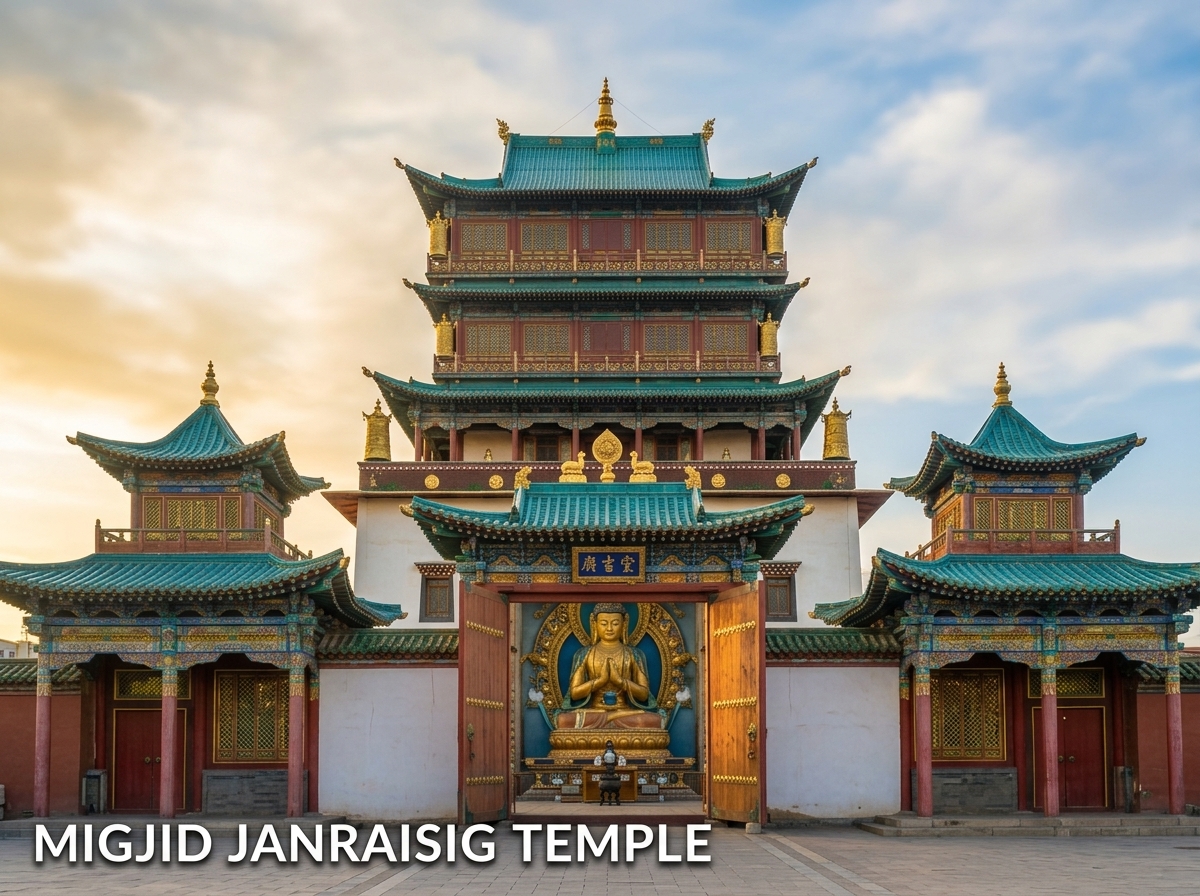
The monastery’s most extraordinary object is a 26.5-meter-tall gilded statue of Megjid Janraisig (Avalokitesvara, the Buddha of Compassion) — one of the tallest indoor Buddha statues in the world. The original statue was melted down by Soviet authorities for its gold and bronze; the current statue was completed in 1996 using donations from Mongolian Buddhists worldwide. Standing before it in the vast prayer hall while monks chant their morning prayers is a genuinely moving experience.
Sükhbaatar Square
The enormous central plaza of Ulaanbaatar — dominated by a massive equestrian statue of Damdin Sükhbaatar (the revolutionary hero) and flanked by the Government Palace (featuring a colossal Genghis Khan statue on its steps) — is the city’s geographical and symbolic heart. The square hosts political demonstrations, national celebrations, and the elaborate opening ceremony of the Naadam Festival each July. In summer, it is a social gathering point; in winter, ice sculptures appear and Mongolians bundle up in traditional deel robes to cross its frozen expanse.
Naadam Festival — The Essential Experience
If you time your Ulaanbaatar visit for a single event, make it Naadam — held annually on July 11–13 to celebrate Mongolian independence and featuring the “Three Games of Men”: wrestling (bökh), archery (sur-kharbaa), and horse racing (urtiin duu). This is not a tourist performance — it is Mongolia’s most important national celebration, a living cultural tradition of extraordinary vitality. The opening ceremony alone — held in the national stadium — features dozens of traditional performers, horsemen in full traditional dress, and an atmosphere of genuine national pride that is deeply moving.
Did You Know? The Naadam horse races are not run by adult jockeys but by children aged 5–13 — a tradition reflecting the fact that Mongolian children learn to ride almost before they learn to walk. The horses race over distances of 15–30 km across open steppe outside the city, ridden by tiny jockeys singing traditional songs to urge their horses on. It is one of the most extraordinary sporting spectacles on Earth.
5. Ulaanbaatar Food & Cuisine Guide
Mongolian cuisine is built on the realities of nomadic life on the cold steppe — a tradition of meat and dairy so embedded that vegetables are still sometimes viewed with mild suspicion by traditional Mongolians. But Ulaanbaatar’s rapid internationalization has created a food scene that offers everything from traditional herder cooking to excellent Korean, Chinese, Japanese, and Western cuisine.
Signature Mongolian Dishes
Buuz are Mongolia’s most beloved food — steamed dumplings filled with minced mutton (or beef) and onion, eaten with the hands and dipped in soy sauce or hot sauce. They are consumed in enormous quantities at Tsagaan Sar (Mongolian New Year) and available year-round at restaurants and canteens across Ulaanbaatar.
Khuushuur are deep-fried meat pastries — flatter, crispier, and oilier than buuz — the quintessential Naadam festival food; the smell of khuushuur frying in oil is inseparable from the memory of July in Ulaanbaatar.
Tsuivan is a fried noodle dish with mutton and vegetables — one of the most common everyday Mongolian meals and deeply comforting on a cold day.
Boodog is a dramatic traditional dish — an entire marmot or goat cooked from the inside using hot stones placed inside the carcass; the outside is then torched. It is as theatrical as it sounds and typically eaten at celebratory outdoor gatherings rather than in restaurants.
Aaruul — dried hard curd made from fermented milk — is the traditional nomadic travel food; intensely sour, extremely dense, and an acquired taste that most visitors either love or profoundly dislike.
Airag (Kumiss) — fermented mare’s milk — is Mongolia’s national drink; slightly alcoholic (1–3%), intensely sour, and deeply embedded in cultural practice. Available at restaurants during summer and at Naadam.
Mongolian Barbecue (khorkhog) — lamb or goat cooked with hot stones in a sealed metal container until magnificently tender — is one of Mongolia’s finest dishes; typically made outdoors and shared communally.
Where to Eat in Ulaanbaatar
- Hazara Afghan Restaurant — Ulaanbaatar’s most famous restaurant; excellent lamb-centered cuisine with Afghan influences; the most celebrated dining experience in the city
- Modern Nomads — excellent contemporary Mongolian cuisine in a beautiful setting; the best place for first-time visitors to experience traditional dishes in an accessible context
- Bull Restaurant — very good traditional Mongolian food at fair prices; reliable and popular with both locals and visitors
- Los Bandidos — surprising but excellent Mexican food; popular with expats and travelers
- Millie’s Espresso — the city’s best café; excellent coffee; popular with digital nomads and expats
Did You Know? Traditional Mongolian nomads consume dairy products primarily in summer and meat primarily in winter — a seasonally adapted diet that evolved over thousands of years on the steppe. This means that the best time to try traditional Mongolian dairy products — airag (fermented mare’s milk), tarag (yogurt), and aaruul (dried curd) — is during a summer visit, when herder families are in full dairy production mode.
6. Ulaanbaatar Accommodation Guide
Ulaanbaatar’s accommodation scene has improved enormously since 2010 and now offers a genuine range at every price level — from very basic budget guesthouses to genuinely international-standard luxury hotels.
Budget (Under $25/night)
- Ulaanbaatar Guesthouse — the city’s longest-established backpacker institution; helpful staff; excellent local knowledge; popular with Trans-Siberian Railway travelers
- LG Guesthouse — clean, central, good value; helpful with organizing day trips and steppe tours
- Oasis Guesthouse — popular budget option; good facilities for the price
Mid-Range ($45–120/night)
- Hotel Bayangol — long-established mid-range landmark; central location; reliable facilities; good restaurant
- Ramada Ulaanbaatar Citycenter — reliable international standard; good central location; consistent quality
- Corporate Hotel & Spa — excellent mid-range option; good facilities including spa; popular with business travelers
Luxury ($150–400+/night)
- The Blue Sky Hotel & Tower — Ulaanbaatar’s most visually striking building; a gleaming glass tower with a distinctive diamond-shaped top; excellent facilities; panoramic city views
- Shangri-La Hotel Ulaanbaatar — the city’s definitive luxury address; world-class service; extraordinary facilities; connected to the Shangri-La Mall
- Kempinski Hotel Khan Palace — sophisticated luxury with traditional Mongolian design influences; excellent service; rooftop restaurant
7. Getting to Ulaanbaatar
By Air
Chinggis Khaan International Airport (UBN) — opened in 2021 to replace the outdated city-center Buyant-Ukhaa Airport — is located 52 km southwest of the city in the Khushigt Valley. It is a modern, well-equipped facility with significantly better capacity than its predecessor.
Key connections:
- Beijing (Air China, MIAT Mongolian Airlines) — 2 hours; the most frequent international connection
- Seoul (Incheon) (Korean Air, MIAT) — 3.5 hours; heavily used by business travelers and Korean tourists
- Tokyo (Narita/Haneda) (MIAT, Japan Airlines) — 4 hours; popular connection
- Moscow — 4 hours (check current availability)
- Istanbul — MIAT operates seasonal service; approximately 8 hours
- Frankfurt — MIAT operates seasonal European service
Airport to city center:
- Express bus: MNT 10,000 (~$3) — runs to Dragon Center; takes approximately 60–90 minutes
- Taxi (app or negotiated): MNT 60,000–100,000 (~$18–30) — 45–75 minutes depending on traffic; negotiate firmly before entering a street taxi
- Hotel transfer: pre-booked transfers from major hotels cost approximately $30–50 USD
The 52 km distance from the new airport makes transfers significantly more expensive and time-consuming than the old airport — factor this into your planning.
By Train
The Trans-Siberian / Trans-Mongolian Railway passes through Ulaanbaatar — one of the world’s great rail journeys:
- Beijing to Ulaanbaatar: approximately 27–30 hours by Trans-Mongolian train; one of travel’s great experiences
- Moscow to Ulaanbaatar: approximately 96 hours (4 days); the classic Trans-Siberian adventure
The main railway station is located approximately 2 km west of Sükhbaatar Square — a taxi costs MNT 5,000–10,000.
8. Getting Around the City
Taxis & Ride-Hailing
Ulaanbaatar has no metro system. The primary urban transport options are:
UBCab — the local ride-hailing app; the recommended option for transparent pricing and safety. Download before arriving; requires a local SIM or roaming data.
Street taxis — ubiquitous but require price negotiation. Short city-center journeys typically cost MNT 5,000–10,000; longer journeys proportionally more. Always agree on price before entering — foreigners are commonly quoted elevated rates.
Informal taxis — in Mongolia, virtually any private car can function as a taxi by simply waving at passing vehicles. This system works but carries greater risk for travelers unfamiliar with local pricing norms.
Buses
Ulaanbaatar’s public bus network is extensive, cheap (MNT 500–1,000 per journey), and covers the entire city — but routes are primarily labeled in Mongolian and navigation without local knowledge or a Mongolian-speaking companion is challenging. The No. 11 bus is useful for reaching the Gandan Monastery area.
Walking
The central district around Sükhbaatar Square is walkable — the distance from the square to Gandan Monastery (north), the Bogd Khan Palace Museum (south), or the Zaisan Memorial (southeast) is all manageable on foot in good weather. In winter, heavy snow, ice, and extreme cold (-20 to -40°C) make extended outdoor walking dangerous — taxis become essential.
9. Best Time to Visit
Month-by-Month Weather & Travel Table
| Month | Avg Temp (°C) | Conditions | Crowd Level | Travel Recommendation |
|---|---|---|---|---|
| January | -25–-15°C | Extreme cold; snow | Very Low | Dangerously cold; not recommended for most ❌ |
| February | -22–-10°C | Extreme cold; Tsagaan Sar (New Year) | Very Low | Extreme cold; Tsagaan Sar interesting but brutal ⚠️ |
| March | -12–0°C | Cold; beginning to warm | Very Low | Still very cold; avoid for sightseeing ⚠️ |
| April | -2–10°C | Transitional; dusty winds | Low | Improving; spring dust storms possible ⚠️ |
| May | 5–18°C | Pleasant; steppe greening | Low–Med | Good for city; steppe still brown ✅ |
| June | 10–24°C | Warm; steppe beautiful | Medium | Excellent; pre-Naadam buildup ✅✅ |
| July | 14–27°C | Peak summer; Naadam Festival | Very High | BEST MONTH — Naadam July 11-13 ✅✅✅ |
| August | 12–25°C | Warm; steppe at its lushest | High | Excellent; green steppe; post-Naadam calmer ✅✅ |
| September | 5–18°C | Cooling; autumn colors | Medium | Good; steppe turning gold; pleasant ✅✅ |
| October | -4–8°C | Cold arriving; first snow | Low | Cold; less comfortable; possible ✅ |
| November | -14–-4°C | Cold and worsening | Very Low | Cold; avoid ⚠️ |
| December | -22–-10°C | Extreme cold | Very Low | Extremely cold; not recommended ❌ |
Best months overall: July (Naadam), August, June, September — summer is emphatically the season for Ulaanbaatar
10. Local Culture, Customs & Etiquette
Mongolian culture is rooted in nomadic steppe tradition — a way of life shaped by the vast landscape, extreme climate, and the necessity of communal cooperation for survival. Understanding this cultural context makes every interaction in Ulaanbaatar richer and more meaningful.
The Nomadic Code of Hospitality
Mongolian hospitality is among the most genuine and structured in the world — rooted in the ancient tradition that the steppe’s distances and dangers made welcoming travelers not merely polite but morally obligatory. When visiting a ger (traditional tent) or a Mongolian home:
- Accept all food and drink offered — refusing is impolite; you may taste rather than consume fully
- Take offered items with both hands or with the right hand supported at the elbow
- Never step on the threshold of a ger — step over it
- Move clockwise within a ger
- Sit in the designated areas — the right side (west) is for men and guests; the left side (east) is for women and household items; the honored guest position is at the back (north) facing the door
Buddhism
Tibetan Buddhism is the dominant religion of Mongolia — reintroduced after the Soviet repression and now practiced with great vitality across the country. When visiting Gandan or other monasteries:
- Walk clockwise around temples and stupas
- Do not point your feet toward religious objects or shrines
- Photography during prayer ceremonies requires sensitivity; ask or observe what other visitors are doing
General Customs
- The blue silk scarf (khadag) is Mongolia’s most important ceremonial gift — presented at greetings, celebrations, and religious contexts; receiving one is an honor
- Never whistle indoors — considered to attract evil spirits in Mongolian tradition
- Mongolians are generally reserved in initial encounters but become warm and generous once rapport is established; patience is rewarded
Tipping
- Restaurants: 10% is appreciated in tourist-oriented restaurants; not always expected in local canteens
- Taxis: Rounding up is courteous
- Tour guides: MNT 30,000–80,000 per day for good service
- Hotel staff: MNT 10,000–20,000 for helpful service
11. Safety & Travel Tips
Ulaanbaatar is generally safe for travelers during daylight hours in the city center, but requires more alertness than many Asian capitals — particularly after dark and in certain districts.
Key Safety Considerations
Pickpocketing and petty theft: More prevalent in Ulaanbaatar than in most Central Asian capitals. The Narantuul Market (“Black Market”) and crowded public transport are the most common locations. Keep valuables secured and be particularly alert in crowds.
Alcohol-related incidents: Mongolia has a significant alcohol consumption culture and incidents related to intoxication — including occasional aggression — can occur, particularly on weekends and around Naadam. Avoid confrontations and leave situations that feel uncomfortable.
Winter cold: From November through March, temperatures can drop to -35°C to -40°C — genuinely life-threatening for the unprepared. Proper cold-weather clothing is absolutely essential for any winter visit.
Air pollution: Ulaanbaatar has among the worst urban air pollution in the world during winter months — caused by the burning of coal and wood in ger district households for heating. Air quality can reach hazardous levels (AQI 500+). Visitors with respiratory conditions should carry N95 masks and monitor the AQI.
Traffic: Ulaanbaatar’s traffic is chaotic and pedestrian safety is poor. Use underground crossings where available and be extremely cautious at intersections.
Emergency Numbers:
- Police: 102
- Ambulance: 103
- Fire: 101
- Emergency: 105
Did You Know? Ulaanbaatar regularly ranks as having the worst air quality of any capital city in the world during winter months — a consequence of approximately 180,000 ger district households burning coal and wood for heating in an enclosed valley with minimal wind. The PM2.5 particulate levels can reach 75 times the WHO safe limit on the worst winter days. Summer air quality is dramatically better.
12. Budget Breakdown
Daily Budget Table
| Category | Budget Traveler | Mid-Range Traveler | Luxury Traveler |
|---|---|---|---|
| Accommodation | MNT 35,000–70,000 ($10–20) | MNT 140,000–350,000 ($41–102) | MNT 500,000–1,200,000+ ($145–349+) |
| Food | MNT 15,000–30,000 ($4–9) | MNT 50,000–120,000 ($15–35) | MNT 200,000–500,000 ($58–145) |
| Transport | MNT 5,000–15,000 ($1–4) | MNT 20,000–60,000 ($6–17) | MNT 80,000–200,000 ($23–58) |
| Attractions | MNT 10,000–30,000 ($3–9) | MNT 40,000–100,000 ($12–29) | MNT 150,000–400,000 ($44–116) |
| Miscellaneous | MNT 10,000–20,000 ($3–6) | MNT 30,000–80,000 ($9–23) | MNT 100,000–300,000 ($29–87) |
| DAILY TOTAL | MNT 75,000–165,000 ($22–48) | MNT 280,000–710,000 ($81–207) | MNT 1,030,000–2,600,000+ ($300–756+) |
Exchange rate approximate: 1 USD ≈ 3,440 MNT (2026)
13. Hidden Gems & Local Secrets
Beyond Ulaanbaatar’s well-known attractions, extraordinary hidden experiences await.
Zaisan Memorial at sunset — the hilltop Soviet-era memorial in the southern part of the city is well-known, but most visitors make the mistake of going in the afternoon and missing the extraordinary moment at sunset when the entire city — apartment blocks, ger districts, mountains — turns golden below. The Soviet-era circular mosaic panoramic mural (depicting Soviet-Mongolian friendship in typical socialist realist style) becomes weirdly beautiful in this light.
Ger district walk at dawn — the ger districts that ring Ulaanbaatar — where roughly 60% of the city’s population live in traditional felt tents surrounded by wooden fences — are one of the most extraordinary urban landscapes on Earth. Walking the fringes of the nearest ger district at dawn, watching smoke rising from cooking fires, children heading to school, and the city waking up in its most traditional form, is completely free and completely unforgettable.
Central Post Office Café — on the top floor of Ulaanbaatar’s central post office building, a tiny café serves excellent coffee to a clientele of Mongolian office workers, students, and the occasional travel writer. Virtually unknown to tourists, it offers a window into everyday Ulaanbaatar intellectual life at prices that make even the budget guesthouses look expensive.
Bogd Khan Uul Mountain hike — the strictly protected mountain directly south of the city can be hiked with a permit (obtainable at the park entrance for a small fee). The trails offer extraordinary panoramic views across the entire city and the steppe beyond — and the complete absence of city noise at the summit, replaced by wind and birdsong, is a profound contrast to the urban density below.
Museum of Mongolian Costumes — a small, specialized museum displaying traditional Mongolian deel robes from different ethnic groups and historical periods; extraordinarily beautiful and visited almost exclusively by researchers and dedicated costume enthusiasts. The collection is one of the finest traditional textile archives in Central Asia.
Did You Know? Ulaanbaatar is officially the world’s coldest capital city — colder than Ottawa, Helsinki, Reykjavik, or Moscow on average. The city’s extreme continental climate produces temperature ranges of up to 90°C between summer and winter — from -40°C in January to +35°C in July — one of the largest annual temperature ranges of any major city on Earth.
14. Day Trips from Ulaanbaatar
Day Trips Table
| Destination | Distance | Travel Time | Travel Method | Highlights |
|---|---|---|---|---|
| Terelj National Park | 80 km east | 1.5 hours | Taxi / tour | Stunning rock formations; ger camp stays; Turtle Rock |
| Genghis Khan Equestrian Statue | 54 km east | 1 hour | Taxi / tour | World’s largest equestrian statue; museum inside |
| Manzushir Monastery | 50 km south | 1 hour | Taxi / tour | Ruined monastery; Bogd Khan Mountain; hiking |
| Hustai National Park | 100 km west | 2 hours | Tour | Przewalski’s wild horses (takhi); steppe wildlife |
| Orkhon Valley | 380 km west | 6–7 hours | Tour / car | UNESCO World Heritage; ancient Mongolian heartland |
| Karakorum (Kharkhorin) | 360 km west | 5–6 hours | Tour / car | Ancient Mongol Empire capital; Erdene Zuu monastery |
| Gun-Galuut Nature Reserve | 130 km east | 2 hours | Tour | Cranes; eagles; wetlands; diverse birdlife |
| Chinggis Khaan Statue | 54 km | 1 hour | Taxi / tour | 40-meter stainless steel statue; panoramic platform |
Terelj National Park — The Essential Day Trip
80 km east of Ulaanbaatar, Gorkhi-Terelj National Park is the most popular day trip from the capital — a stunning mountain valley of dramatic granite formations, pine forests, and pristine steppe rivers that provides the closest accessible taste of Mongolia’s extraordinary natural landscapes. The most famous formation is Turtle Rock (Melkhii Khad) — an enormous granite boulder that genuinely resembles a turtle from the correct angle.
The park is home to multiple ger camps where visitors can stay overnight and experience traditional nomadic hospitality — eating with herder families, riding horses, and sleeping in authentic gers under Mongolia’s extraordinary star-filled sky. Day trips are excellent; overnight stays are transformative.
Genghis Khan Equestrian Statue
54 km east of Ulaanbaatar at the Tsonjin Boldog site — where, according to legend, Genghis Khan found a golden whip on the steppe — stands one of the world’s most spectacular monuments: a 40-meter-tall stainless steel equestrian statue of Genghis Khan on horseback, gleaming on a hilltop above the steppe. Visitors take an elevator up through the horse’s chest to the head, then climb stairs to the horse’s mane — a viewing platform with panoramic steppe views. Inside the base, a museum covers Mongolian history and the Mongol Empire.
15. Shopping Guide
What to Buy in Ulaanbaatar
Cashmere — Mongolia produces approximately 40% of the world’s cashmere, and Ulaanbaatar is the best place on Earth to buy genuine, high-quality cashmere at competitive prices. The famous Gobi Cashmere brand has stores throughout the city; items available include scarves, jumpers, robes, and accessories. Quality is consistently superior to cashmere available at similar prices in Western markets.
Mongolian deel (traditional robe) — the long, wrap-around traditional robe worn by both men and women; beautifully decorated examples can be purchased as both functional clothing and extraordinary decorative pieces.
Mongolian felt products — traditional felt (made from sheep wool) is worked into extraordinary decorative items: wall hangings, floor coverings, slippers, and bags, all featuring traditional geometric patterns.
Mongolian paintings — contemporary Mongolian artists produce beautiful work drawing on both traditional nomadic aesthetic traditions and contemporary influences; galleries throughout the center stock excellent pieces.
Suutei tsai (milk tea) products — Mongolian milk tea (strong black tea mixed with salt and milk) is an acquired taste but dried tea bricks and tea-making sets make unique souvenirs.
Where to Shop
- Narantuul Market (“Black Market”) — Ulaanbaatar’s massive informal market; everything from cashmere to horse tack to electronics; bargaining essential; watch for pickpockets
- State Department Store (Ikh Delguur) — centrally located; good range of cashmere, traditional crafts, and souvenirs at fixed prices; the safest and most comfortable shopping experience
- Shangri-La Mall — modern international mall connected to the Shangri-La Hotel; luxury brands alongside Mongolian cashmere shops
- Gobi Cashmere flagship store — the most reliable source for quality cashmere at transparent prices

16. Nightlife & Entertainment
Ulaanbaatar has a nightlife scene of surprising vitality — a young, energetic population combined with Mongolia’s tradition of celebration creates a lively after-dark atmosphere that has genuinely improved in quality and diversity over the past decade.
Cultural Entertainment
Tumen Ekh National Song and Dance Ensemble — the premier traditional performing arts company in Mongolia, offering nightly shows of Mongolian music, throat singing (khoomei), contortion, and traditional dance. Performances are held in a dedicated theater and are the single best cultural evening available in the city. Tickets approximately $15–25 USD.
Mongolian circus — Mongolia has an extraordinary circus tradition; the State Circus performs traditional Mongolian contortion, acrobatics, and equestrian arts in a dedicated venue; highly recommended for families and anyone interested in traditional performing arts.
Khoomei (throat singing) performances — Mongolia’s extraordinary vocal tradition — producing multiple pitches simultaneously from a single voice — can be heard at the Tumen Ekh shows and in several specialist venues; an uncanny and unforgettable sound.
Bars & Nightlife
- Grand Khaan Irish Pub — despite the name, a genuinely popular and lively bar; the city’s most consistently busy nightlife venue; good mix of expats and locals; live music some nights
- Paddy’s Irish Pub — another popular expat-friendly bar; good draft beer; sports on screens
- Club XS — one of the city’s most popular nightclubs; Mongolian pop and international music; busy on weekends
- Vibe Lounge — upscale cocktail bar popular with the city’s young professional class
- Blue Sky Bar (top floor, Blue Sky Hotel) — panoramic city views; excellent cocktails; Ulaanbaatar’s finest elevated drinking experience
Did You Know? Mongolia has a remarkable tradition of throat singing (khoomei) — a vocal technique in which a single singer produces multiple pitches simultaneously, creating a haunting harmonic sound unlike anything else in world music. The tradition is inscribed on UNESCO’s Intangible Cultural Heritage list and is believed to be one of the oldest vocal techniques in human musical history, developed by the nomads of the steppe in ancient times.
17. Practical City Information
Visa & Entry
Mongolia’s visa policy varies considerably by nationality:
- Visa-free access is available for citizens of approximately 60 countries — including USA (90 days), EU nations (30–90 days), Japan (30 days), South Korea (30 days), and others
- Citizens of most other countries require a visa — available as an e-visa at evisa.immigration.gov.mn or at Mongolian embassies
- Check current requirements carefully as policies have changed periodically — the mongolian immigration website has current information
Health & Vaccinations
No mandatory vaccinations required for Mongolia. Recommended:
- Hepatitis A and B
- Typhoid
- Rabies — Mongolia has a significant stray dog population in ger districts; recommended for extended stays or rural travel
- Japanese Encephalitis — for rural summer travel
Tap water in Ulaanbaatar is NOT safe to drink — use bottled water; widely available and inexpensive (MNT 1,000–2,000 per 1.5L).
Connectivity
- MobiCom, Unitel, Mobicom (G-Mobile), and Skytel are the main operators
- Tourist SIM cards available at the airport and city center; 3–5 GB data package approximately MNT 15,000–25,000 ($4–7)
- WiFi available in most hotels and international restaurants; less reliable in local establishments
Power & Plugs
- Plug type: Types C and E (European round pins)
- Voltage: 220V / 50Hz
- Standard European adapters work throughout Mongolia
18. How to Be a Responsible Traveler in Ulaanbaatar
Sustainable Tourism
- Book tours with responsible local operators — look for companies that demonstrate genuine support for nomadic communities and share revenue with herder families rather than simply using ger camps as tourist props
- Stay in Mongolian-owned guesthouses — locally-owned accommodation keeps tourism revenue within the Mongolian economy rather than international hotel chains
- Eat at local restaurants and canteens — the city’s many small traditional restaurants support local food producers and cook authentic Mongolian food at very fair prices
Cultural Sensitivity
- The Genghis Khan name is sacred to Mongolians — he is not simply a historical conqueror to his descendants but a founding father and cultural hero of profound importance; approach his legacy with respect
- Buddhist practices at Gandan — morning prayer ceremonies are open to visitors but must be observed with complete silence and no flash photography; monks are at genuine prayer, not performing for tourists
- Photography in ger districts — always ask before photographing people’s homes and daily life; most people are happy to be photographed but the act of asking shows respect
Environmental Responsibility
- The winter air pollution crisis — if visiting in winter, use taxis rather than adding to traffic emissions; support organizations working on clean heating solutions for ger districts
- Do not litter — Ulaanbaatar and surrounding steppe face significant litter challenges; pack your rubbish to proper disposal points
- Wildlife watching in national parks — maintain distance from wildlife (particularly the Przewalski’s horses at Hustai), stay on marked trails, and never feed wild animals
19. Comparison Table — Ulaanbaatar vs Similar Cities
| Feature | Ulaanbaatar, Mongolia | Bishkek, Kyrgyzstan | Ulaan-Ude, Russia |
|---|---|---|---|
| Unique Appeal | Nomadic culture; steppe gateway; Naadam | Mountain trekking base; Soviet city | Trans-Siberian hub; Buryat Buddhist culture |
| Cost Level | Medium | Very Low | Low–Medium |
| International Flights | Good hub (Beijing, Seoul, Tokyo) | Limited | Very limited |
| Cultural Heritage | Exceptional (Genghis Khan, Buddhism) | Good (Kyrgyz nomadic) | Good (Buryat Buddhist) |
| Nature Access | Exceptional (steppe, Gobi) | Excellent (Tian Shan) | Good (Baikal region) |
| Visa Ease | Free ~60 countries | Free ~60 countries | Russian visa required for most |
| Winter | Extreme (-40°C); not recommended | Very cold; limited | Very cold; limited |
| Best For | Nomadic culture, Naadam, steppe | Trekking, budget, mountains | Trans-Siberian journey |
20. Is Ulaanbaatar Worth Visiting?
Yes — but with the clear understanding of what Ulaanbaatar is and is not.
Ulaanbaatar is not, primarily, a city sightseeing destination in the way that Samarkand, Yerevan, or Tbilisi are. Its historic monuments are interesting but not world-class; its urban fabric is Soviet-functional rather than architecturally beautiful. What Ulaanbaatar is, however, is the most extraordinary gateway city in the world — the portal to one of Earth’s last great wilderness landscapes, a living culture of nomadic tradition that has survived Soviet repression and rapid modernization with remarkable vitality, and the host of the Naadam Festival, which is among the most authentic and moving national celebrations available to any traveler anywhere.
Visit Ulaanbaatar not just for the city but for what the city gives you access to: the steppe, the gers, the horses, the throat singing, the vast sky, and the humbling experience of encountering a culture that has maintained its essential character across millennia of change.
Ulaanbaatar is best suited for:
- ✅ Adventure travelers — the essential base for Mongolia’s extraordinary wilderness experiences
- ✅ Cultural enthusiasts — Mongolian nomadic culture is genuinely unique in the world
- ✅ Naadam Festival visitors — one of the world’s greatest national celebrations; July 11–13 annually
- ✅ Trans-Siberian Railway travelers — a genuinely fascinating stop on the world’s greatest rail journey
- ✅ Photography enthusiasts — the landscapes, people, and cultural events are extraordinarily photogenic
- ✅ Off-the-beaten-path seekers — Mongolia remains genuinely undiscovered by mass tourism
Our honest verdict: Spend 3–4 days in Ulaanbaatar — sufficient for the main city attractions, at least one day trip (Terelj and/or the Genghis Khan Statue), and the Gandan morning prayers. Use the city as the base for whatever Mongolia wilderness experience has drawn you here — and let the city’s unique character surprise you in the meantime.
21. City Travel Tips at a Glance
- 🎪 Book Naadam Festival stadium tickets well in advance — the opening ceremony fills quickly; book through reputable tour operators
- 🧥 Pack layers for any visit — even summer evenings in Ulaanbaatar can be cold; July days can hit 30°C, nights drop to 10°C
- 📱 Download UBCab before arriving — the local ride-hailing app; avoid unmetered street taxis
- 💰 Carry MNT cash — the Black Market and most local restaurants and canteens are cash only
- 🛬 Factor airport transfer time — the new airport is 52 km from the city; allow 60–90 minutes minimum
- 🧘 Visit Gandan Monastery at 9–10 AM — morning prayer ceremonies are the most atmospheric experience at the monastery
- 🌿 Book Terelj ger overnight in advance for summer visits — the most popular camps fill up quickly
- ☁️ Check AQI before winter visits — air quality can be hazardous; carry N95 masks
- 🦷 Get quality cashmere at Gobi or State Department Store — not from street vendors where quality is unreliable
- 🥟 Eat buuz everywhere — these steamed dumplings are Mongolia’s finest food and cost almost nothing at local canteens
22. Recommended Resources
Books:
- “On the Trail of Genghis Khan” by Tim Cope — the finest contemporary travel book about Mongolia; the author rode on horseback from Mongolia to Hungary following the ancient Mongol route; essential pre-trip reading
- “The Secret History of the Mongols” — the 13th-century primary source on Genghis Khan’s life; available in good English translation; essential context
- “Mongolia” by Michael Kohn (Lonely Planet) — the definitive practical guidebook
YouTube Channels:
- Kara and Nate — excellent Mongolia travel content
- Lost LeBlancs — quality Ulaanbaatar and Mongolia vlog content
- Fearless and Far — adventure travel content from Mongolia
Documentaries:
- “The Story of China” (BBC) — includes significant Mongol Empire context
- “Genghis Khan” (various) — multiple documentary treatments of Mongolia’s founding figure
23. Frequently Asked Questions About Ulaanbaatar
Q1: Do I need a visa to visit Ulaanbaatar, Mongolia?
It depends on your nationality. Citizens of approximately 60 countries — including USA (90 days), EU nations (30–90 days), Japan, South Korea, Singapore, and others — can enter Mongolia visa-free. Citizens of most other countries require a visa, available as an e-visa at evisa.immigration.gov.mn. Processing takes approximately 2–3 business days and costs approximately $50–60 USD. Always check current requirements at the Mongolian Immigration Agency website before travel, as policies change periodically.
Q2: What is the Naadam Festival and should I visit during it?
Naadam is Mongolia’s most important national celebration — held annually on July 11–13 in Ulaanbaatar to celebrate Mongolian independence. The festival features the “Three Games of Men”: wrestling, archery, and horse racing. The opening ceremony at the national stadium is spectacular. This is absolutely the best time to visit Ulaanbaatar — but book flights and accommodation 3–6 months in advance as everything sells out. Hotel prices during Naadam can be 2–3 times normal rates.
Q3: How cold does Ulaanbaatar get in winter?
Ulaanbaatar is the world’s coldest capital city — January temperatures average around -20 to -25°C (-4 to -13°F) and can drop to -40°C (-40°F) during cold snaps. This is genuinely dangerous cold that requires proper equipment (insulated boots, layered wool and down clothing, face covering). Most leisure travelers should avoid November through March unless specifically interested in winter cultural experiences like Tsagaan Sar (Mongolian New Year). The cold is not a reason to avoid Mongolia — it is a reason to visit in summer.
Q4: How far is the airport from Ulaanbaatar city center?
The new Chinggis Khaan International Airport (opened 2021) is 52 km from the city center — significantly further than the old airport that it replaced. The journey by taxi or airport bus takes 45–90 minutes depending on traffic. The express bus costs approximately MNT 10,000 (~$3); a taxi costs MNT 60,000–100,000 (~$18–30). Factor this travel time into your planning — early-morning flights or late arrivals combined with the long transfer can be challenging.
Q5: What is the best day trip from Ulaanbaatar?
Terelj National Park (80 km east, 1.5 hours) is the most popular and accessible — beautiful mountain valley scenery, the famous Turtle Rock formation, and multiple ger camps where overnight stays provide the most immersive Mongolia experience available near the capital. Hustai National Park (100 km west, 2 hours) is essential for wildlife lovers — it is the only place in Mongolia where you can see the Przewalski’s horse (takhi), the world’s last genuinely wild horse species, in its natural steppe habitat. The Genghis Khan Equestrian Statue (54 km east, 1 hour) combines the spectacular monument with beautiful steppe scenery.
Q6: Is Ulaanbaatar safe for travelers?
Generally yes, with caveats. During daylight hours in the city center, Ulaanbaatar is reasonably safe. The main concerns are pickpocketing (particularly at the Narantuul Market and on crowded transport), alcohol-related incidents on weekend nights, and the extreme cold in winter (which is a genuine physical safety concern). After dark, take taxis rather than walking. Solo female travelers should exercise standard precautions, particularly at night. Overall, it is safer than its reputation sometimes suggests, but requires more alertness than many other Asian capitals.
Q7: What should I absolutely not miss in Ulaanbaatar?
The Gandantegchinlen Monastery morning prayers (arrive by 9 AM to see monks chanting in the main temple) are the most authentically moving experience in the city. The National Museum of Mongolia provides essential context for everything you will see in the city and country. A traditional performing arts show (Tumen Ekh ensemble) featuring throat singing, contortion, and traditional music is unlike anything available elsewhere. And if you can possibly arrange it, at least one overnight in a ger camp in Terelj National Park — sleeping under Mongolia’s extraordinary star-filled sky — will be the memory you carry home for the rest of your life.
Q8: What is Mongolian cashmere and is it good to buy in Ulaanbaatar?
Mongolia produces approximately 40% of the world’s cashmere — the finest grade of wool, combed from the undercoat of Mongolian goats. Ulaanbaatar is genuinely one of the best places in the world to buy high-quality cashmere, as you are buying at or near the source without the markup of Western retail. The Gobi Cashmere brand is the most famous and reliable; their products are consistently excellent. The State Department Store also has a good cashmere section. Prices for a good cashmere scarf start around $25–40 USD — dramatically less than equivalent quality in Western stores.
24. Sources & References
- Lonely Planet Mongolia (lonelyplanet.com/mongolia)
- TripAdvisor Ulaanbaatar (tripadvisor.com)
- Booking.com Ulaanbaatar (booking.com)
- Wikipedia — Ulaanbaatar (en.wikipedia.org/wiki/Ulaanbaatar)
- Mongolia Tourism Official (tourism.mn)
- Numbeo — Cost of Living Ulaanbaatar (numbeo.com)
- Wikitravel Ulaanbaatar (wikitravel.org/en/Ulaanbaatar)
- World Travel Guide — Mongolia (worldtravelguide.net)
- Skyscanner Mongolia flights (skyscanner.net)
- Mongolia Immigration Agency — Visa (evisa.immigration.gov.mn)
- IQAir — Ulaanbaatar Air Quality (iqair.com)
- Gandantegchinlen Monastery Official (gandan.mn)
- UBCab — Ride Hailing (ubcab.mn)
- CIA World Factbook — Mongolia (cia.gov/the-world-factbook/countries/mongolia)
- Google Maps (maps.google.com)
25. Ulaanbaatar Travel Guide Images