1. Facts About Amman
| Category | Details |
|---|---|
| Country | Jordan |
| Region / Province | Amman Governorate |
| Official Language | Arabic; English very widely spoken |
| Currency | Jordanian Dinar (JOD) — 1 JOD ≈ 1.41 USD (one of the Arab world’s strongest currencies) |
| Best Time to Visit | March to May; September to November |
| Time Zone | Arabia Standard Time (AST) — UTC+3 (UTC+3 year-round since 2022) |
| Weather | Mediterranean highland climate — warm dry summers, cool wet winters |
| Temperature | 4°C – 33°C (39°F – 91°F) depending on season |
| Map | Located in northwestern Jordan on a high plateau, approximately 50 km east of the Jordan River and the Dead Sea |
| Airport | Queen Alia International Airport (AMM) — 35 km south of the city center |
| Top Tourist Places | The Citadel (Jabal Al Qal’a), Roman Theater, Rainbow Street, Jordan Museum, Al Husseini Mosque, Darat Al Funun, Souq Jara |
| Avg. Trip Cost/Day | Budget: $40–70 / Mid-range: $100–200 / Luxury: $250–600+ |
| Nearest Major Airport | Queen Alia International Airport (AMM) — Jordan’s primary international gateway |
| Population | Approx. 4.5 million (greater Amman, 2026) — over 40% of Jordan’s entire population |
| Famous For | One of the world’s oldest continuously inhabited cities, the extraordinary Citadel overlooking a Roman theater still used for concerts, the finest hummus in the Arab world, Rainbow Street’s café culture, and being the gateway to Petra, Wadi Rum, and the Dead Sea |
2. Amman City Overview & Background
Amman does not announce itself the way that Doha or Dubai does. There are no record-breaking towers, no artificial islands, no single defining architectural gesture visible from thirty kilometers. Instead, Amman reveals itself gradually — a city of hills and valleys in warm limestone white, spreading across the ancient Jordanian plateau in every direction, its neighborhoods stacked up hillsides in dense terraces of apartment buildings and olive trees, punctuated by minarets and church towers and the occasional Roman column rising from the urban fabric like a reminder that all of this was here long before concrete was invented.
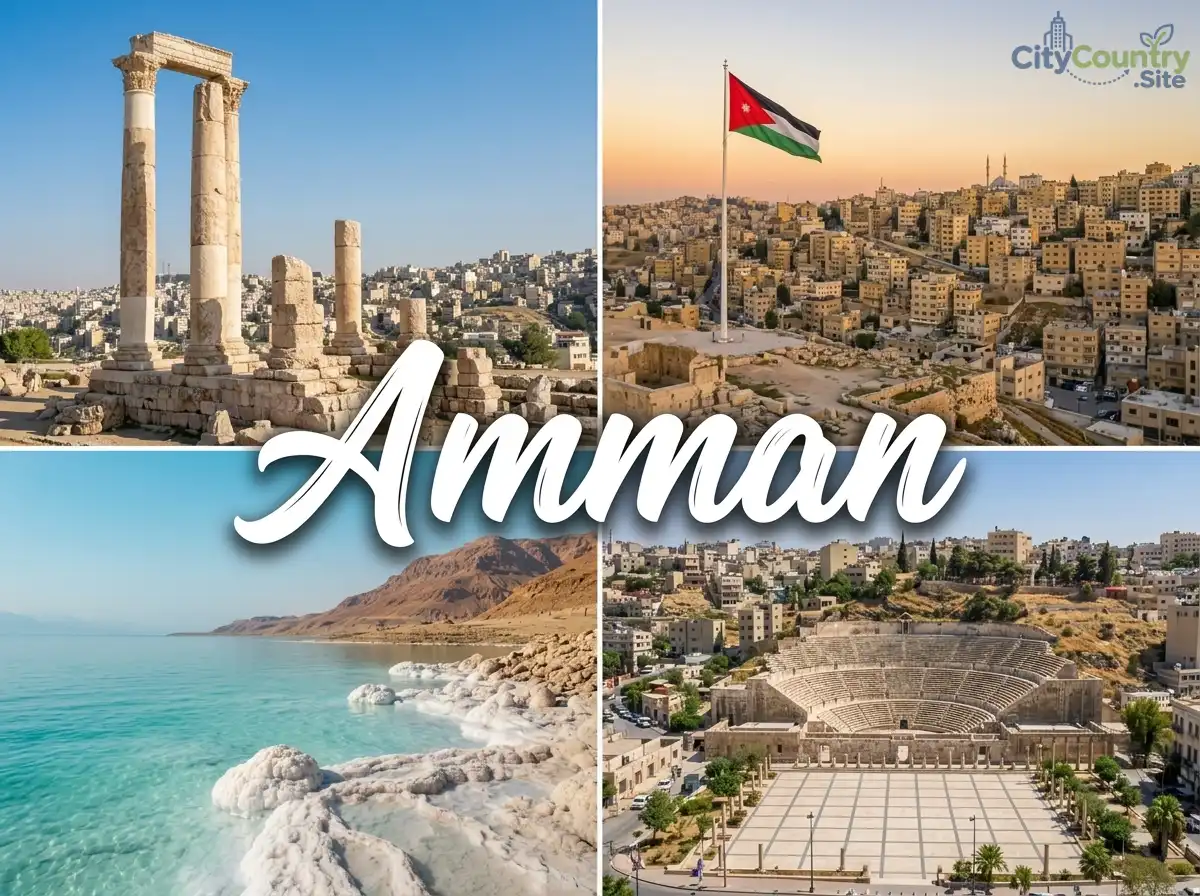
Stand at the Citadel on a clear morning and look out over what you are seeing. The Roman Theater sits in the valley below, still used for concerts on warm evenings, its 6,000-year-old stone seating worn smooth by countless generations of inhabitants. The Temple of Hercules rises behind you on the hilltop, its columns framing a view across the entire city. And in every direction, Amman’s hills — traditionally seven, now spread across more than twenty — support a city of 4.5 million people that is simultaneously one of the oldest urban settlements on earth and one of the Middle East’s most cosmopolitan, creative, and culturally alive capitals.
Jordan’s capital is a city of layers — historical, cultural, and human. The Bronze Age settlement of Rabbath Ammon became the Greek Philadelphia, which became the Roman Decapolis city of Philadelphia, which became the Byzantine and then Islamic city of Amman. Every era has left its mark, and the extraordinary thing is that all of those marks are visible simultaneously — Roman columns in the middle of a functioning urban neighborhood, Byzantine mosaics under a shopping district, Umayyad Islamic structures beside Roman temples on a hilltop that people have climbed for worship for six thousand years.
What makes Amman exceptional for the contemporary traveler is not just its ancient layers but its living present. The city has absorbed enormous waves of refugees — from Palestine in 1948 and 1967, from Iraq in 2003 and after, from Syria since 2011 — each bringing their own culinary traditions, cultural influences, and human energy. This successive absorption has created one of the most culturally diverse and intellectually vibrant cities in the Arab world. Amman’s restaurants, galleries, bookshops, and cafés reflect a creative energy that consistently surprises visitors expecting a conservative, quiet Middle Eastern capital.
And then there is the food. Amman is widely regarded as the culinary capital of the Arab world — the place where the finest mansaf, the creamiest hummus, the most perfectly spiced maqluba, and the most extraordinary kunafa are found. Eating in Amman is one of the great pleasures of traveling in the Middle East.
“Of all the Arab cities I have visited in forty years of travel, Amman is the one I return to most willingly. It has a humanity, a warmth, and a cultural richness that I find nowhere else in the region.”
— Anonymous travel writer, The Guardian Travel, 2024
3. Amman History Timeline
8500 BCE — Archaeological evidence from ‘Ain Ghazal — a site now within the northeastern suburbs of modern Amman — reveals one of the oldest and largest Neolithic settlements ever discovered. The site produced extraordinary plaster statues dated to approximately 7000 BCE — among the oldest large-scale human sculptures on earth. They are housed in the Jordan Museum today.
2000–1200 BCE — The area of modern Amman is known as Rabbath Ammon — capital of the Ammonite kingdom mentioned throughout the Hebrew Bible as both ally and adversary of ancient Israel. The Ammonites build a significant Bronze Age city on the hilltop that will become the Citadel.
332 BCE — Alexander the Great conquers the region during his sweep through the Persian Empire. The city is refounded as a Hellenistic settlement.
285–246 BCE — Ptolemy II Philadelphus — ruler of the Greek Egyptian kingdom — rebuilds and renames the city Philadelphia after himself, beginning a period of significant Hellenistic urban development.
63 BCE — The Roman general Pompey incorporates Philadelphia into the Roman province of Syria. Philadelphia becomes one of the ten cities of the Decapolis — a league of Greco-Roman cities in the region — and enters its most prosperous and architecturally ambitious period.
1st–3rd centuries CE — Roman Philadelphia reaches its height. The Roman Theater (seating approximately 6,000), the Nymphaeum (an ornamental fountain), the Colonnaded Street (Cardo), and the Temple of Hercules on the Citadel are all built during this extraordinary period of Roman urban investment. Philadelphia is one of the most prosperous cities in the eastern Roman Empire.
4th century CE — Christianity becomes the official religion of the Roman Empire. Philadelphia develops a significant Byzantine Christian community; churches are built throughout the city.
635 CE — Arab Muslim forces under Yazid ibn Abi Sufyan capture Philadelphia during the rapid Islamic expansion following the death of the Prophet Muhammad. The city reverts to its ancient name — Amman — derived from the Ammonite original. The city is incorporated into the Umayyad Caliphate.
8th century CE — The Umayyad Caliphate constructs a significant palace complex on the Citadel — the Umayyad Palace — making Amman an important administrative center of the Islamic empire. Amman grows as a significant commercial and administrative hub.
11th–13th centuries — The Crusaders and various Islamic powers compete for control of the Levant. Amman is bypassed by the main Crusader fortifications but affected by the regional instability. The city gradually declines in importance relative to Cairo and Damascus.
15th–19th centuries — Amman enters a long period of reduced significance. The once-great Roman and Byzantine city is reduced to a small village of barely a few hundred inhabitants by the time of the Ottoman Empire. The ruins of the Roman Theater serve as a quarry and dwelling place for local inhabitants.
1878 — The Ottoman authorities encourage Circassian refugees — expelled from the Caucasus by Russian imperial expansion — to settle in Amman. The Circassian community rebuilds the ancient city, constructing Amman’s first modern buildings using materials from the Roman ruins. The modern city of Amman is essentially founded by these Circassian settlers.
1921 — Abdullah I bin Al Hussein — great-grandfather of the current king — establishes the Emirate of Transjordan with Amman as its capital. Amman begins developing as a modern administrative city under British Mandate oversight.
1946 — The Hashemite Kingdom of Jordan achieves full independence from Britain. Amman becomes the capital of an independent nation. The city’s population is still relatively small — approximately 30,000 people.
1948 — The first Arab-Israeli war creates hundreds of thousands of Palestinian refugees who flee or are expelled from their homes. Many settle in Amman, transforming the city’s size and character dramatically. The Palestinian refugee camps established around Amman become permanent communities that shape the city’s culture and politics for generations.
1967 — The Six-Day War produces another massive wave of Palestinian refugees. Amman’s population grows rapidly. Palestinian cultural influence — particularly in food, commerce, and intellectual life — becomes deeply embedded in the city’s identity.
1994 — Jordan signs the Wadi Araba Peace Treaty with Israel — one of only two Arab countries to do so. The treaty normalizes Jordan’s international position and opens the country to tourism investment.
1999 — King Hussein I dies. His son Abdullah II ascends to the throne. The new king pursues economic modernization and tourism development throughout Jordan, including significant investment in Amman’s cultural infrastructure.
2003 — The US invasion of Iraq produces a new wave of refugees — primarily middle-class and professional Iraqis — who settle in Amman, significantly enriching the city’s restaurant, arts, and business culture.
2005 — Coordinated bomb attacks on three Amman hotels kill 60 people. The attacks shock Jordan and temporarily affect tourism. Security measures are strengthened throughout the city.
2011 — Arab Spring demonstrations in Amman are peaceful and result in some political reforms by King Abdullah II. Jordan avoids the violent instability that transforms Syria, Libya, Egypt, and elsewhere.
2011–2019 — The Syrian civil war sends over 1.3 million Syrian refugees into Jordan — one of the world’s largest refugee populations per capita. Many settle in Amman and surrounding areas. Syrian culture — particularly cuisine, music, and crafts — becomes increasingly woven into Amman’s urban fabric.
2024–2026 — Amman continues growing as the Middle East’s most stable and livable capital. Tourism to Jordan grows significantly year on year as travelers discover the extraordinary combination of ancient history, modern culture, and Jordanian hospitality. Petra, Wadi Rum, and the Dead Sea consistently rank among the world’s top travel experiences.
4. Amman Geography & Neighborhoods
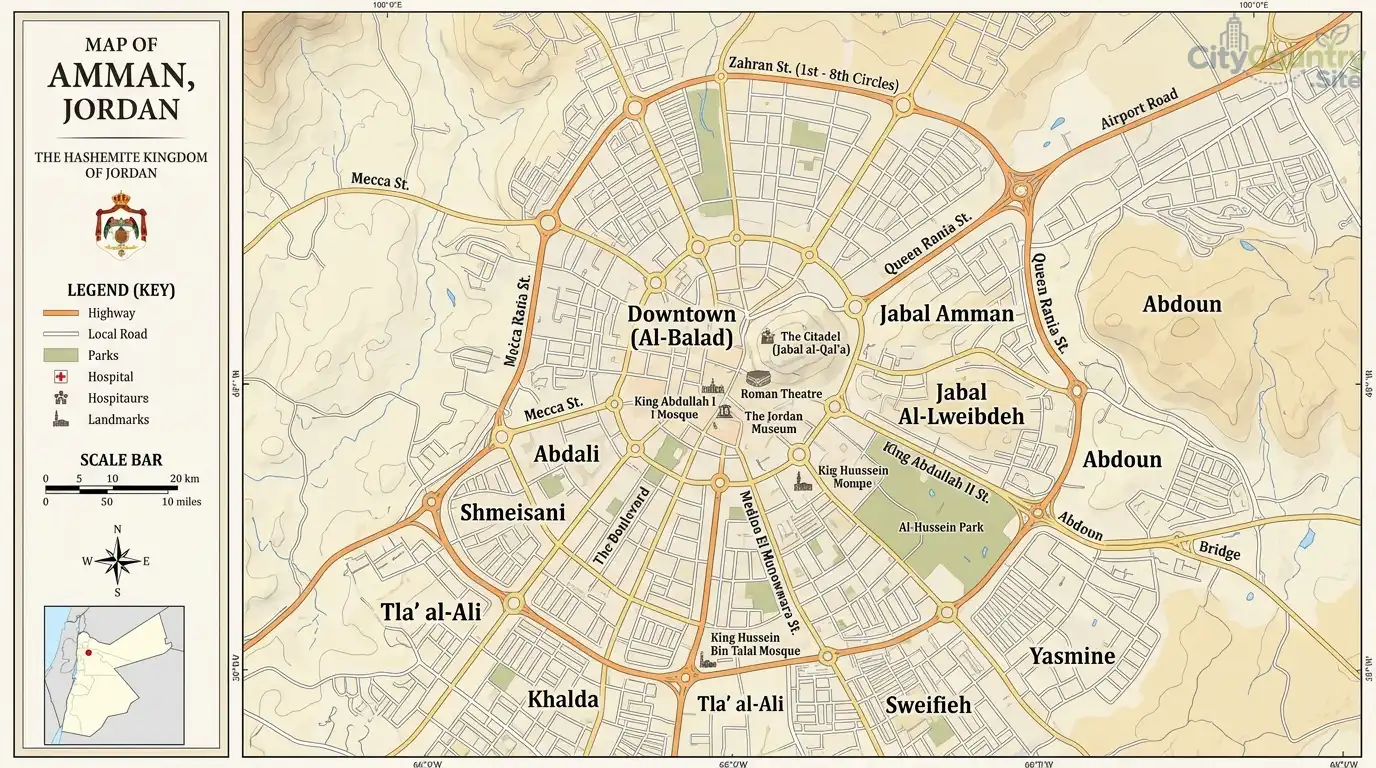
Amman is built across a dramatic landscape of hills and valleys on the Jordanian Plateau — sitting at an average elevation of approximately 800–1,000 metres above sea level. The city originally occupied seven hills (jabals) — hence ancient Philadelphia’s comparison to the seven hills of Rome — but has now expanded across more than twenty hills and the valleys between them, making it one of the most topographically dramatic capital cities in the Middle East.
The Zarqa River flows through the older eastern parts of the city. Several major valleys — wadis — divide the hills, creating the natural corridors along which commercial development and transport routes have organized themselves.
Neighborhood Comparison Table
| Area | Best For | Vibe | Price Level |
|---|---|---|---|
| Downtown (Al Balad) | Ancient history, Roman theater, budget souqs, authentic life | Historic, gritty, authentic, crowded | Budget |
| Jabal Amman / Rainbow Street | Cafés, galleries, boutiques, heritage buildings | Hip, creative, charming, walkable | Mid |
| Jabal Al Weibdeh | Art galleries, French Institute, vintage cafés, intellectual scene | Bohemian, artistic, quiet, beautiful | Mid |
| Shmeisani | Business hotels, malls, commercial center | Modern, functional, commercial | Mid |
| Abdoun | Luxury residences, upscale restaurants, embassies | Affluent, green, cosmopolitan | High–Luxury |
| Sweifieh | Shopping malls, restaurants, nightlife, expat area | Modern, vibrant, international | Mid–High |
| Tlaa Al Ali / Khalda | Residential, local life, universities | Quiet, authentic, residential | Budget–Mid |
| Al Abdali | New downtown, modern towers, Mecca Mall | Contemporary, rapidly developing | Mid–High |
Downtown (Al Balad) is the historical heart of Amman — the valley floor between the ancient hills where the Roman Theater sits beside the National Archaeological Museum, where the Al Husseini Mosque calls the faithful to prayer five times a day, and where the city’s oldest commercial district — a dense network of souqs, falafel shops, and ancient buildings — maintains the authentic rhythm of a Middle Eastern city unchanged in spirit for a century. Jabal Amman and Rainbow Street are where Amman’s creative class has concentrated — a neighborhood of art nouveau limestone buildings converted into cafés, galleries, boutiques, and restaurants, with the best people-watching and café culture in the city. Jabal Al Weibdeh — immediately adjacent — is more quietly intellectual, with the French Institute, several significant art galleries, and some of Amman’s finest old residential architecture.
5. Amman Weather & Temperature Guide
Amman has a Mediterranean highland climate — significantly different from the Gulf cities we have covered, with genuinely cool winters that can bring snow, warm but not unbearably hot summers, and beautiful spring and autumn seasons that represent the finest times to visit.
- Spring (March to May): Warm, bright, blooming — the finest season
- Summer (June to August): Warm to hot days, pleasant evenings — the driest season
- Autumn (September to November): Warm, clear, gradually cooling — excellent for travel
- Winter (December to February): Cool to cold, possibility of rain and occasional snow — fewer tourists
Month-by-Month Weather Table
| Month | Avg Temp (°C) | Rainfall | Crowd Level | Travel Recommendation |
|---|---|---|---|---|
| January | 4–12 | High | Low–Medium | ✅ Good — cold but culturally rich |
| February | 5–13 | High | Low–Medium | ✅ Good — almond blossom season |
| March | 8–18 | Medium | High | ⭐ Excellent — spring begins |
| April | 12–23 | Low | High | ⭐ Excellent — wildflowers, perfect weather |
| May | 16–28 | Very Low | High | ⭐ Excellent — warm and beautiful |
| June | 19–31 | Negligible | Medium | ✅ Good — dry and warm |
| July | 21–33 | Negligible | Medium | ✅ Good — hot but manageable |
| August | 21–33 | Negligible | Medium | ✅ Good — same as July |
| September | 19–30 | Very Low | High | ⭐ Excellent — cooling beautifully |
| October | 15–25 | Low | High | ⭐ Excellent — golden autumn |
| November | 10–19 | Medium | Medium | ✅ Good — pleasant and quieter |
| December | 6–13 | High | Low–Medium | ✅ Good — festive, occasionally snowy |
March through May and September through October are Amman’s finest months for visitors — comfortable temperatures, minimal rain, and the city’s vibrant café and outdoor culture at its most enjoyable. April is particularly beautiful — wildflowers cover the Jordanian hills, the light is extraordinary, and temperatures are near-perfect.
Summer (June–August) is hot by day but considerably more manageable than the Gulf — 33°C maximum with low humidity and cool evenings make outdoor evenings pleasant. This is peak tourist season for Petra and Wadi Rum; expect larger crowds at sites outside the city.
Winter (December–February) is genuinely cold — Amman occasionally receives snow, which transforms the white limestone city into something startlingly beautiful. Fewer tourists, lower prices, and atmospheric rainy-day café culture. Not ideal for outdoor historical sites but wonderful for city immersion.
💡 Did You Know? Amman receives occasional snowfall almost every winter — a phenomenon that never fails to delight its residents, who respond to snow with the same enthusiasm as tropical city-dwellers seeing it for the first time. In 2013 and again in 2015, Amman was buried under 50 cm of snow — the city’s taxis ceased operating, schools closed, and the entire population emerged to build snowmen among the Roman ruins. Photographs of the Citadel under snow circulated globally and became among the most shared images of the city in recent years.
6. Amman Airport & Getting There
Queen Alia International Airport (AMM)
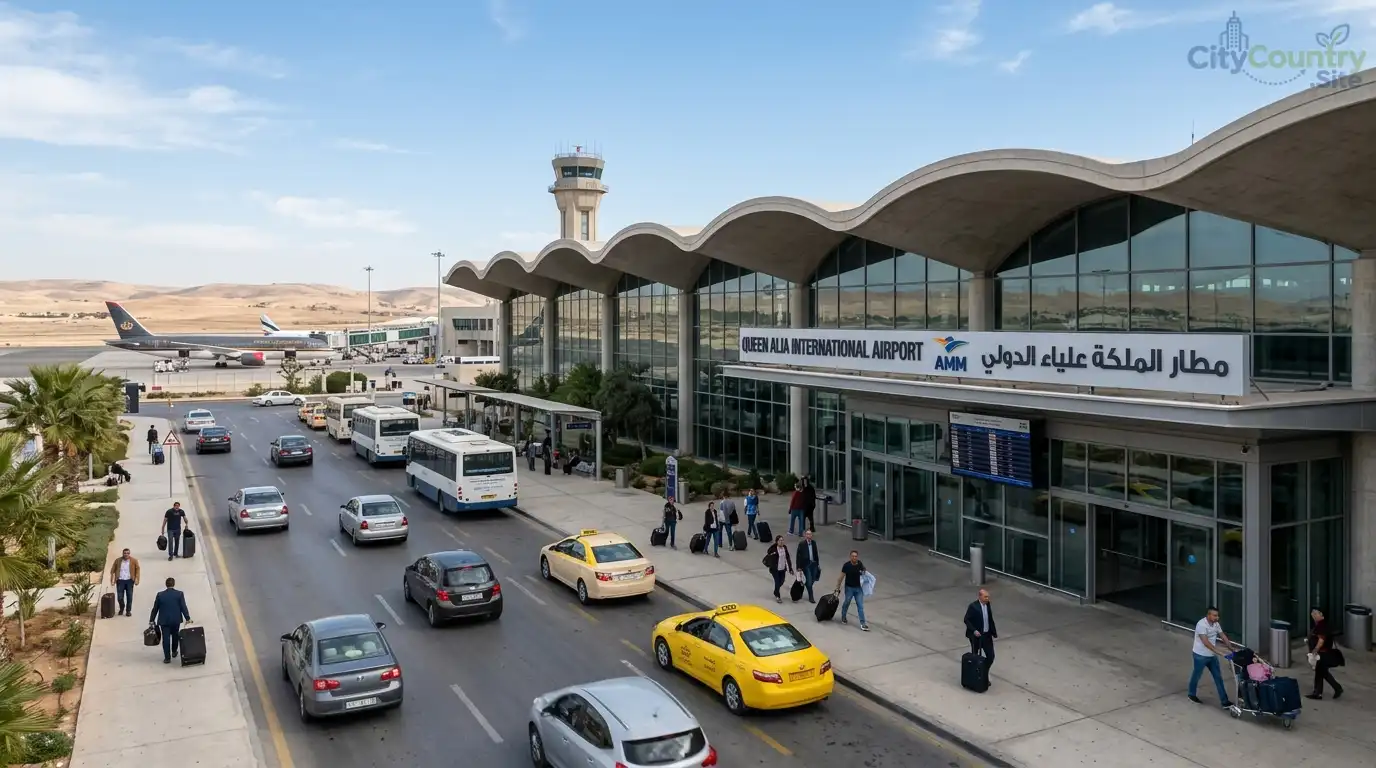
Queen Alia International Airport (IATA: AMM) is named after Queen Alia — the third wife of King Hussein I, who died in a helicopter crash in 1977. The airport is located approximately 35 km south of central Amman in the Al Jiza area. A beautifully designed new terminal — designed by Sir Norman Foster and Partners and opened in 2013 — has transformed the airport into a genuinely impressive gateway with graceful undulating arches inspired by the Jordanian desert landscape.
The airport is the hub of Royal Jordanian Airlines — a well-regarded carrier known for excellent Levantine hospitality and outstanding Arab cuisine on board. International connections include London Heathrow, Frankfurt, Paris, Istanbul, Dubai, Abu Dhabi, Cairo, Beirut, Nairobi, New York JFK, Chicago, and dozens of other destinations. Airlines including Royal Jordanian, British Airways, Lufthansa, Turkish Airlines, Emirates, flydubai, and Air Arabia serve Amman.
Getting from Queen Alia Airport to the City:
| Transport Option | Duration | Cost (Approx.) | Notes |
|---|---|---|---|
| JETT Airport Bus | 45–60 min | JOD 3.3 (~$4.70) | Air-conditioned, direct to 7th Circle |
| Uber / Careem | 35–50 min | JOD 12–20 (~$17–28) | Reliable and transparent pricing |
| Airport Taxi (metered) | 35–50 min | JOD 20–30 (~$28–42) | Official taxis; negotiate or use meter |
| Hotel transfer (pre-booked) | 40–55 min | JOD 25–40 (~$35–56) | Most comfortable; pre-arrange |
| Rental car | 40–50 min | Varies | Good for Jordan road trips |
Getting to Amman from Neighboring Countries:
| Origin | Transport | Duration | Cost (Approx.) |
|---|---|---|---|
| Dubai, UAE | Flight | 3 hours | $100–280 |
| Cairo, Egypt | Flight | 1 hour 30 min | $80–200 |
| Beirut, Lebanon | Flight | 1 hour | $80–180 |
| Istanbul, Turkey | Flight | 2 hours 30 min | $100–250 |
| Baghdad, Iraq | Flight | 1 hour 30 min | $100–220 |
| Tel Aviv (Ben Gurion) | Road via Allenby Bridge | 2–3 hrs (border formalities) | $30–60 |
The JETT Airport Bus is the finest value option for independent travelers — a comfortable, air-conditioned coach service operating between the airport and the 7th Circle area in West Amman at exceptional value. The only limitation is that it drops passengers at a single central point rather than hotel doors.
💡 Did You Know? Jordan’s Queen Alia International Airport was designed by British architect Sir Norman Foster — the same genius behind London’s Millennium Bridge, Hong Kong’s HSBC building, and Berlin’s renovated Reichstag. The airport’s sweeping arched roof structure — inspired by the Bedouin tent and the desert landscape of Jordan — is considered one of the most contextually appropriate pieces of architecture Foster has ever produced. It consistently wins design awards for its sensitive interpretation of Jordanian architectural identity.
7. Getting Around Amman
Amman is a hilly, spread-out city without a metro system — navigating it effectively requires planning, but the combination of ride-hailing apps and excellent taxis makes it very manageable.
Uber and Careem are the essential tools for visitors — widely available throughout Amman, reliably priced, and safe. A typical cross-city journey costs JOD 3–8 (~$4.20–11.30). Always use these apps for transparent pricing. Careem is particularly popular locally.
Yellow Taxis are widely available throughout the city — metered, official, and generally reliable. Ensure the meter is running before departure. Most taxi drivers speak some English. A typical city ride costs JOD 2–5 (~$2.80–7.10). Taxis can also be hired by the hour for city exploration at approximately JOD 8–15 (~$11–21) per hour.
Public Buses and Minibuses serve the major corridors between neighborhoods at very low cost (JOD 0.30–0.50) but routes can be confusing for first-time visitors. The routes are not well-signed in English.
Walking is practical and rewarding in specific areas — the Downtown/Al Balad area is very walkable; Rainbow Street and Jabal Amman are excellent for strolling; Jabal Al Weibdeh is a beautiful neighborhood for walking. Between hills and neighborhoods, the gradients and distances make walking between areas challenging. Amman’s hills are steep — allow more energy than flat-city walking would suggest.
Car Rental is available at the airport and throughout the city — genuinely useful for day trips to Petra, Wadi Rum, the Dead Sea, and Jerash. Jordanian roads outside Amman are generally excellent; driving in the city itself requires confidence in somewhat chaotic urban traffic.

8. Top Attractions & Must-See Places in Amman
Top Attractions Table
| Attraction | Type | Entry Fee | Best Time | Time Needed |
|---|---|---|---|---|
| The Citadel (Jabal Al Qal’a) | Ancient hilltop / multiple ruins | JOD 3.5 (~$5) | Morning | 2–3 hours |
| Roman Theater | Ancient Roman amphitheater | JOD 3 (~$4.20) | Morning / Evening | 1–2 hours |
| Jordan Museum | National history museum | JOD 3 (~$4.20) | Morning | 2–3 hours |
| Rainbow Street | Heritage street / cafés / culture | Free | Afternoon–Evening | 2–3 hours |
| Darat Al Funun | Contemporary art gallery | Free | Anytime | 1.5–2 hours |
| Al Husseini Mosque | Historic mosque / city center | Free (modest dress) | Morning | 30–45 min |
| Souq Jara (Friday Market) | Artisan market | Free | Friday mornings | 2 hours |
| Nymphaeum | Roman ruins | JOD 1 (~$1.40) | Morning | 45 min |
| Jordan National Gallery of Fine Arts | Art museum | JOD 2 (~$2.80) | Morning | 1.5 hours |
| Jabal Al Weibdeh Walking Tour | Heritage neighborhood | Free | Morning / Afternoon | 2 hours |
| Amman Citadel Views at Sunset | Panoramic viewpoint | Included in Citadel entry | Sunset | 1 hour |
| Dead Sea (Day Trip) | Natural wonder | JOD 20–30 (beach club) | Morning | Half–Full day |
The Citadel (Jabal Al Qal’a) is Amman’s most important and most atmospheric attraction — a hilltop that has been continuously occupied for over 9,000 years and that currently displays the concentrated ruins of Bronze Age, Roman, Byzantine, and Umayyad Islamic civilizations simultaneously. The Temple of Hercules — dating to approximately 162–166 CE — survives in partial form, its remaining columns framing views across the entire city. The Umayyad Palace (8th century CE) is the hilltop’s most complete major structure — a large domed reception hall and extensive palace complex that speaks to Amman’s importance in the early Islamic world. The National Archaeological Museum on the hilltop contains the famous Dead Sea Scrolls fragments and the extraordinary ‘Ain Ghazal statues — some of the oldest human sculptures ever found.
Standing at the Citadel’s edge at sunset, looking down at the Roman Theater in the valley below with the city spreading across the hills in every direction — the white limestone buildings catching the last golden light — is one of the most beautiful and historically overwhelming experiences available in the Middle East.
The Roman Theater is one of the best-preserved Roman performance spaces in the Arab world — a magnificent amphitheater cut into the northern hillside of downtown Amman, seating approximately 6,000 people, built during the reign of Emperor Antoninus Pius (138–161 CE). Remarkably, the theater continues to serve its original function — regular concerts and performances are held here throughout the year. The acoustic properties of the ancient stone remain excellent. Sitting in the theater on a warm evening while a performance plays on the ancient stage — with the Citadel glowing on the hill above — is one of Amman’s finest cultural experiences.
Rainbow Street (Jabal Amman, First Circle) is Amman’s most celebrated neighborhood for contemporary urban culture — a curved street of early 20th-century limestone buildings housing an extraordinary collection of cafés, restaurants, bookshops, vintage clothing stores, art galleries, and boutiques. This is where Amman’s creative class gathers — where Syrian refugees have opened new restaurants beside Palestinian-Jordanian families who have lived here for three generations, beside young Jordanian designers who studied in London and came home. The street is at its finest on a Friday morning — outdoor café tables fill, the smell of Arabic coffee and nargileh tobacco mingles with fresh bread, and the city’s social energy is at its most visible and most appealing.
Darat Al Funun — literally “little house of arts” — is one of the finest contemporary art spaces in the Arab world. Housed in three restored villas from the 1920s and 1940s perched on a hillside in Jabal Al Weibdeh, the galleries offer rotating exhibitions of Arab contemporary art of consistently high quality alongside archaeological excavations of a Byzantine church found beneath the garden. The terraced garden, with its ancient olive trees and city views, is one of the most beautiful outdoor spaces in Amman. Entry is completely free.
Jabal Al Weibdeh — the slightly quieter, more intellectual neighbor of Jabal Amman — deserves a full morning’s exploration. The neighborhood’s grid of limestone streets passes the French Cultural Center, several excellent small galleries, the Jordan National Gallery of Fine Arts, vintage bookshops, and some of Amman’s most beautiful early 20th-century residential architecture. The Café de Paris and several other historic cafés maintain the atmosphere of an earlier, more leisurely Amman.
💡 Did You Know? The ‘Ain Ghazal statues housed in the Jordan Museum are among the most extraordinary archaeological discoveries ever made. Found in 1983 during road construction in Amman’s northeastern suburbs, these 32 plaster statues — some nearly life-size, with bitumen-painted eyes — date to approximately 7000–6000 BCE, making them the oldest large-scale sculptures of human figures ever discovered. They were likely used in ancient ancestor worship ceremonies and provide a direct link between modern Amman and the Neolithic people who first settled this landscape nine thousand years ago.
9. Amman Food & Cuisine Guide
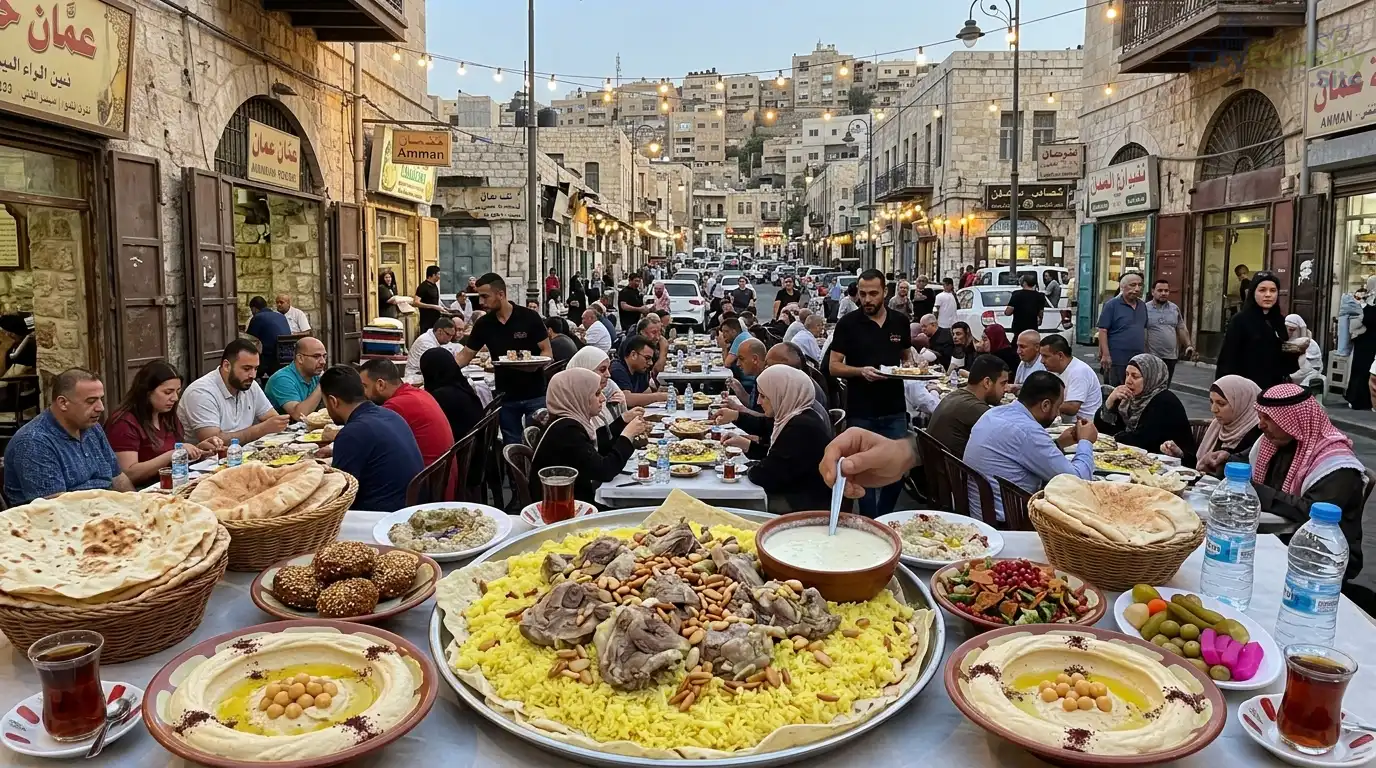
Amman is the undisputed culinary capital of the Arab world — a genuinely audacious claim, but one that a single meal at the right restaurant will instantly validate. The city’s food culture is the product of centuries of Levantine culinary sophistication layered with Palestinian, Syrian, Iraqi, Egyptian, and Circassian influences brought by successive waves of newcomers who enriched the city’s table along with everything else.
Must-Try Dishes in Amman
Mansaf — Jordan’s national dish and one of the greatest ceremonial foods in the Arab world. Whole pieces of lamb slow-cooked in a tangy fermented dried yogurt sauce called jameed — a sauce so sour and intense that it transforms the meat entirely — served over a bed of fragrant rice and flatbread, garnished with toasted nuts and fresh herbs. Eaten communally from a shared platter, traditionally standing, using the right hand to roll balls of rice and tear pieces of meat. It is simultaneously the most challenging and most rewarding dish in Jordanian cuisine. Every Jordanian considers their family’s mansaf recipe the definitive version. They are all correct.
Hummus — Amman’s hummus is extraordinary and the subject of fierce local pride. The finest versions — at specific, jealously guarded local establishments — involve chickpeas soaked overnight, cooked until impossibly smooth, blended with Levantine tahini of exceptional quality, lemon juice, and salt, then finished with the finest olive oil and eaten warm, minutes from preparation, with fresh flatbread torn and used as the only utensil. Words fail adequately to convey the gulf between this and anything sold in a Western supermarket with the same name.
Falafel — Amman’s falafel culture is sophisticated, competitive, and entirely serious. The finest versions — made from soaked raw chickpeas ground with fresh herbs, onion, cumin, and coriander, then fried in fresh oil to a crispy-outside, bright-green-inside perfection — are eaten hot from the fryer, stuffed into fresh flatbread with chopped vegetables and sesame sauce. Downtown Amman’s best falafel joints open at 7 AM and sell out by 11. Arrive early.
Maqluba — Literally “upside down” — a theatrical dish in which rice, vegetables (typically eggplant, cauliflower, and potato), and meat (chicken or lamb) are layered in a pot and slow-cooked, then flipped dramatically onto a serving platter at the table to reveal a perfect dome of flavored rice with the ingredients arranged beneath. A deeply satisfying, visually impressive, and delicious centerpiece of Jordanian family cooking.
Musakhan — Arguably the finest Palestinian contribution to Amman’s table — flatbread (taboon) topped with slow-caramelized onions, sumac, pine nuts, and roasted chicken, then baked until the bread absorbs all the juices and the onions turn sweet and jammy. The sumac’s sharp tartness against the sweet onions and rich chicken is a flavor combination of remarkable sophistication.
Kunafa — The queen of Levantine desserts — layers of shredded wheat or semolina pastry filled with fresh white cheese or sweet cream, soaked in rose-water and orange-blossom syrup, topped with crushed pistachios. Served warm, the contrast between the crispy-chewy pastry, the molten cheese, and the fragrant sweet syrup is overwhelming. The finest kunafa in Amman — debated with the intensity of football rivalries — comes from a handful of legendary establishments in downtown and west Amman.
Knafeh Nabulsiyeh — The Nablus-style version of kunafa — made with the distinctive white Nabulsiyeh cheese — is considered the original and definitive form. As Jordan hosts the world’s largest Palestinian community, the Nablus knafeh tradition is deeply embedded in Amman’s food culture.
Meze — Amman’s meze culture is extraordinary — a parade of small dishes that together constitute a complete and lavish meal. Mutabbal (smoky eggplant dip), fattoush (bread salad with sumac and pomegranate), kibbeh (ground lamb and bulgur wheat in various preparations), warak enab (stuffed vine leaves), labneh (thickened yogurt with olive oil), shanklish (aged herb-crusted cheese), and dozens of other preparations arrive in sequence and should ideally be accompanied by arak — the anise-flavored spirit of the Levant.
Best Restaurants & Food Spots
Sufra Restaurant (Jabal Amman) — Consistently one of Amman’s most celebrated traditional restaurants — a beautifully restored 1940s limestone villa serving exceptional Jordanian and Palestinian home cooking. The mansaf is extraordinary, the meze outstanding, and the setting — terracotta floors, arched windows, a garden — deeply romantic. JOD 8–18 (~$11–25) per person.
Hashem Restaurant (Downtown) — Amman’s most famous restaurant, beloved since 1952. Open since 4 AM, serving falafel, hummus, ful medames, and fresh flatbread at plastic tables on the sidewalk to a democratic mix of kings, cab drivers, intellectuals, and tourists. King Abdullah II famously ate here without announcement. The hummus is extraordinary. The cost is almost nothing. This is the essential Amman experience. JOD 1–3 per person.
Fakhreldin Restaurant (Jabal Amman) — One of Amman’s finest and most elegant restaurants — a beautifully restored 1950s villa serving outstanding Lebanese and Jordanian cuisine. The meze spread is the finest in the city; the arak selection is excellent. JOD 12–25 (~$17–35).
Saffron (InterContinental Hotel) — The best buffet spread of Jordanian and Arabic cuisines in the city — a lavish display of everything from mansaf and maqluba to mezze, fresh juices, and extraordinary desserts. JOD 15–25 (~$21–35) for the full buffet.
Reem Al Bawadi — A large, vibrant Jordanian restaurant popular with both locals and visitors — outdoor seating, excellent grills, mezze, and traditional Jordanian hospitality. Generous portions and accessible prices. JOD 5–12 per person.
Knafeh Stores (Downtown / 3rd Circle) — Several legendary knafeh shops near downtown Amman sell this extraordinary dessert from open metal trays — warm, freshly made, and sold by weight. Budget JOD 1–2 for a generous portion. Eating standing up at a plastic counter with the knafeh still hot from the oven is the only correct way.
💡 Did You Know? Mansaf — Jordan’s national dish — gets its distinctive flavor from jameed: a hard, dried form of fermented goat or sheep milk that has been preserved by salting and sun-drying until it becomes rock-hard. Jameed originated as a preservation technique for nomadic Bedouin who needed storable protein during long desert crossings. When dissolved in water and cooked with lamb, it creates a sauce of extraordinary sourness and complexity — unlike anything else in world cuisine. The finest jameed comes from the Karak region of southern Jordan, where production methods unchanged for centuries produce a product of legendary quality.
10. Amman Accommodation Guide
Amman offers a wide range of accommodation from budget guesthouses in the heart of the old city to some of the finest luxury hotels in the Middle East.
Best Areas to Stay:
- Jabal Amman / Rainbow Street: Best for atmosphere, cultural immersion, cafés, and walking access to galleries and restaurants — the clear first choice for most independent travelers
- Jabal Al Weibdeh: Best for a quieter, more artistic neighborhood experience
- Abdoun / Sweifieh: Best for upscale comfort, excellent restaurants, and a more modern Amman experience
- Downtown (Al Balad): Best for budget travelers and maximum historical proximity
- Shmeisani: Best for business travelers and mid-range options
Accommodation Price Ranges (2026)
| Category | Price/Night (USD) | Examples |
|---|---|---|
| Budget Hostel / Guesthouse | $15–35 | Cliff Hotel, Jordan Tower Hotel, various downtown guesthouses |
| Mid-Range Hotel | $60–120 | Caravan Hotel, Hisham Hotel, Days Inn Amman |
| Upscale Boutique Hotel | $120–220 | Boutique Hotel Amman, Nimeh Boutique Hotel, Art Hotel |
| Luxury Hotel | $200–500+ | Four Seasons Amman, Fairmont Amman, InterContinental Amman, Kempinski Amman |
The Four Seasons Amman is the city’s most prestigious address — a beautifully designed property on the Fifth Circle with extraordinary views, an outstanding spa, multiple excellent restaurants, and the flawless service the brand is known for globally. Rates: approximately $300–600 per night.
Nimeh Boutique Hotel in Jabal Amman is one of the finest boutique experiences in the city — a beautifully restored 1940s limestone mansion with individually designed rooms, excellent breakfast, and personal service that large hotels cannot replicate. Rates: approximately $120–200 per night.
Cliff Hotel in Downtown is Amman’s most beloved budget institution — basic, clean, brilliantly located between the Roman Theater and the souqs, and with a rooftop terrace offering extraordinary views of the Citadel. Rates: approximately $20–40 per night.
11. Best Time to Visit Amman
March through May is widely considered Amman’s finest season. The Jordanian spring is extraordinary — wildflowers carpet the hills in red, yellow, and white; the light is clear and golden; temperatures are perfect (18–25°C by day, cool evenings); and the entire country feels alive with seasonal renewal. April is arguably the single finest month — the combination of weather, light, and natural beauty makes every photograph look professionally composed.
September and October are the autumn equivalent — temperatures cooling from summer heat, clear skies, and a return of the comfortable outdoor weather that defines Amman’s finest seasons.
Summer (June–August) is warm but far more manageable than Gulf cities — 33°C maximum with low humidity and genuinely cool evenings (15–18°C) that make outdoor dining, rooftop gatherings, and Rainbow Street café culture a pleasure. This is the season when Jordanians from the Gulf and diaspora return home, giving the city a particularly lively social energy.
Winter (December–February) is cold, occasionally wet, and sometimes snowy — but for city exploration rather than site-visiting, the atmospheric cafés, the rain-polished limestone streets, and the dramatically reduced crowds make it a genuinely rewarding time. The Dead Sea remains warm year-round and is particularly pleasant as an escape from Amman’s winter chill.
Key Festivals & Events in Amman
- Jerash Festival for Culture and Arts (July–August) — Held at the extraordinary Roman ruins of Jerash, 50 km from Amman — one of the Arab world’s premier cultural events, featuring international and Arab performers in an ancient Roman theater setting. Unmissable
- Souq Jara (Friday mornings, May–October) — Amman’s most beloved weekly outdoor artisan market, held on First Circle, Rainbow Street. Craft sellers, food vendors, live music, and the full diversity of Amman’s creative community
- Amman International Film Festival (AIFF) (September) — A growing platform for Arab and international cinema that has established itself as one of the region’s significant film events
- Jordan National Day (May 25) — Independence Day celebrations throughout the city
- Christmas (December 25) — Jordan’s significant Christian community celebrates Christmas openly and joyfully — churches throughout the city hold beautiful midnight mass services; Rainbow Street decorates with lights
12. Amman Shopping Guide
Amman’s shopping scene combines excellent traditional craft markets with sophisticated contemporary boutiques and modern malls.
What to Buy:
Jordanian Mosaic Art — Jordan is one of the world’s great centers of Byzantine mosaic tradition — the famous Madaba Mosaic Map (a 6th-century Byzantine floor mosaic showing the Holy Land) is at the heart of a living craft tradition. Contemporary Jordanian artisans produce outstanding mosaic artwork — decorative panels, trays, mirrors, and jewelry — available throughout Amman’s craft shops and galleries.
Dead Sea Products — Jordan controls the eastern shore of the Dead Sea and produces excellent cosmetic and therapeutic products — mineral salts, mud, salt scrubs, and skin care lines. These are genuinely good products at significantly lower prices than similar items sold in Western markets.
Jordanian Olive Oil — Jordan produces outstanding extra-virgin olive oil from ancient olive groves in the northern highlands. The finest cold-pressed varieties make exceptional culinary souvenirs.
Embroidered Textiles (Tatreez) — Palestinian embroidery — tatreez — is one of the Arab world’s great textile traditions. Beautiful embroidered cushion covers, clothing, bags, and wall hangings are available throughout Amman, many produced by women’s cooperatives supporting Palestinian refugee communities.
Camel Leather Goods — Handmade leather bags, wallets, and sandals in camel and goat leather from Jordanian artisans.
Jordan Silver Jewelry — Traditional Bedouin-influenced silver jewelry in distinctive Jordanian styles.
Arabic Calligraphy and Art — Contemporary Jordanian artists produce beautiful calligraphic artworks and printed pieces available in galleries throughout Jabal Amman and Jabal Al Weibdeh.
Where to Shop:
Souq Jara (First Circle / Rainbow Street) — The finest artisan market in Amman, held every Friday morning from May through October. The full creative output of Amman’s artists, designers, food producers, and craftspeople concentrated in one outdoor celebration. Go early (before 10 AM) for the best selection.
Al Balad (Downtown Souqs) — The traditional souq district of Downtown Amman — Al Sukariyeh (sweets and food), Al Hashimi (spices and dry goods), and the gold souq offer authentic market shopping at genuinely local prices in a dense, atmospheric environment unchanged for decades.
Jordan Craft Center — A government-supported showcase for traditional Jordanian crafts — fixed prices, verified quality, and a good overview of the range of Jordanian craft traditions available across the country.
Wild Jordan Center (Jabal Amman) — The Royal Society for the Conservation of Nature’s shop and café sells excellent craft products made by community artisans from Jordan’s nature reserves. Beautiful natural products, ethical sourcing, and stunning views over the city from the terrace.
Mecca Mall and City Mall — The largest shopping malls in Amman — international brands, local retailers, cinema complexes, food courts, and comprehensive supermarkets. Modern, comfortable, and comprehensive.
13. Amman Nightlife & Entertainment
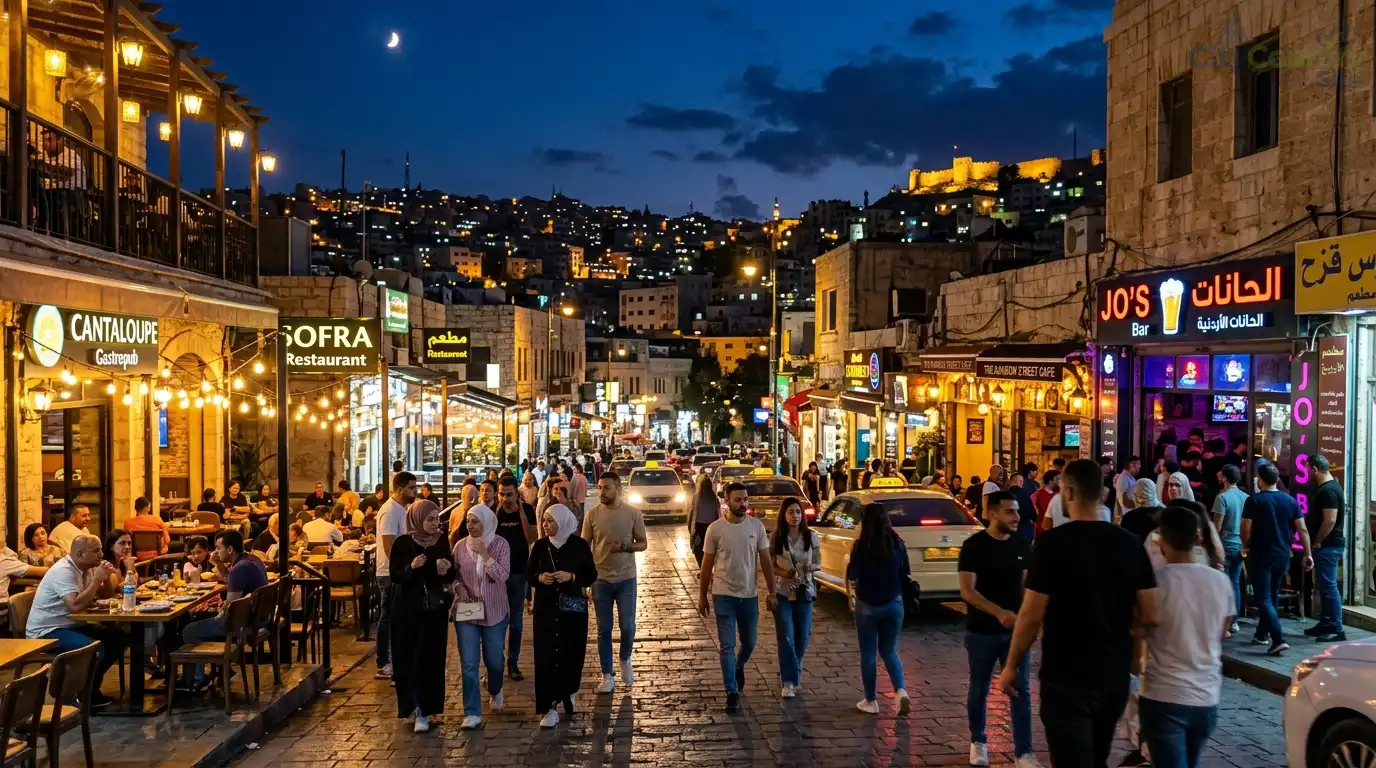
Amman has a surprisingly vibrant and sophisticated after-dark scene — considerably more active than most Middle Eastern capitals outside of Beirut. The city’s significant Christian population, its secular educated class, and its tradition of Lebanese and Syrian cultural influence have created a nightlife culture of genuine quality.
Live Music and Cultural Venues:
Jordan National Center for Culture and Arts — Regular performances of classical Arabic music, traditional Jordanian music, and contemporary Arab artistic expression. One of the finest cultural institutions in the country.
The Roman Theater — Several times each year, particularly in summer, the ancient Roman Theater hosts extraordinary outdoor concerts and theatrical performances under the stars with the Citadel glowing above. The experience of attending a classical Arabic music performance in a 2,000-year-old theater is remarkable.
Zara Cultural Center — Regular film screenings, art exhibitions, and cultural events in a comfortable cultural center near Shmeisani.
Cafés and Bars:
Books@Café (Jabal Amman) — One of Amman’s most beloved and historically significant venues — a café, bar, and bookshop that has been a social institution since the 1990s. Known for being one of the first establishments in Jordan openly welcoming to the LGBT community, it remains a gathering point for Amman’s liberal, creative class. Excellent cocktails, good food, and a warm, inclusive atmosphere.
Blue Fig Café (Jabal Hussein) — A consistently excellent café-restaurant and one of the finest spots in Amman for a long evening of good food, wine, and conversation.
Scores Sports Bar — A popular sports bar with multiple screens showing international football and a lively mixed crowd.
Tiger Lily Bar — A sophisticated cocktail bar in the Abdoun area — excellent mixology, beautiful design, and a discerning crowd.
Clubs:
Grappa Club — One of Amman’s longest-running and most popular nightclubs — attracts a well-dressed young Jordanian and international crowd with international DJs and commercial dance music.
Whispers — A popular club in the hotel district with regular themed nights and a dance-oriented crowd.
Shisha Culture:
Throughout Rainbow Street and Downtown, nargileh (shisha) cafés operate until midnight or beyond — ordering a flavored water pipe with strong Arabic coffee or fresh juice and watching the city’s social life unfold is one of Amman’s most relaxed and authentic evening pleasures.
14. Hidden Gems & Local Secrets
‘Ain Ghazal Archaeological Site — In the northeastern suburbs, the site of one of humanity’s oldest cities is largely unvisited by tourists — most of its extraordinary statues have been moved to the Jordan Museum, but the site itself offers a powerful sense of walking on ground that was continuously inhabited for thousands of years. The adjacent Neolithic village reconstruction provides excellent context.
Al Pasha Turkish Bath (Hammam) — A beautifully restored Ottoman-era hammam in the heart of Downtown Amman offering traditional steam bath, massage, and scrub treatments in a historic marble setting. One of the finest traditional hammam experiences available in Jordan. Book in advance: JOD 15–25 (~$21–35).
Dharat Al Funun Hidden Garden — Most visitors to Darat Al Funun focus on the galleries but the terraced garden — with its ancient olive trees, Byzantine ruins, and views over the valley — is one of Amman’s most beautiful hidden outdoor spaces. Sit with a coffee from the gallery café and simply be in one of the most beautiful gardens in the city.
Jabal Al Qal’a After 4 PM — The Citadel empties of tour groups in the mid-afternoon but remains open until sunset. Returning in the golden hour before closing, with the city turning pink and gold below you and the other visitors largely gone, transforms the experience entirely. The Temple of Hercules columns at sunset are among the most beautiful sights in Jordan.
The Duke’s Diwan (Downtown) — A beautifully restored old merchant’s house in Downtown Amman now serving as an informal cultural center, café, and meeting place. The owner — the legendary Mamdouh Bisharat — has maintained this remarkable space for decades as a gathering point for Amman’s intellectuals, artists, and storytellers. Completely off the tourist circuit and entirely extraordinary.
Al Weibdeh’s Hidden Staircase Streets — Jabal Al Weibdeh is threaded with narrow stone staircase streets connecting the hill’s various levels — quiet, beautiful, lined with potted plants and bougainvillea, and almost entirely unknown to visitors. The best urban walking in Amman is found on these hidden stairways.
15. Day Trips from Amman
Amman’s central position in Jordan makes it one of the finest bases for day trips in the entire Middle East — world-class historical and natural sites are accessible within a few hours in every direction.
Day Trips Table
| Destination | Distance | Travel Time | Method | Highlights |
|---|---|---|---|---|
| Jerash | 50 km north | 1 hour | Car / Bus | Best-preserved Roman city in the Middle East |
| Dead Sea | 60 km west | 1 hour | Car / Tour | World’s lowest point, therapeutic floating, mineral mud |
| Madaba and Mount Nebo | 30 km southwest | 45 min | Car / Bus | Byzantine mosaic map, Moses’s view of the Promised Land |
| Ajloun Castle | 75 km north | 1.5 hrs | Car | Crusader-era Arab Muslim castle, forested hills |
| Baptism Site (Bethany Beyond the Jordan) | 65 km west | 1.5 hrs | Car / Tour | UNESCO — where Jesus was baptized |
| Umm Qais (Gadara) | 120 km north | 2 hours | Car | Dramatic Roman ruins overlooking Galilee and Golan Heights |
| Petra | 230 km south | 3 hours | Car / Bus | One of the world’s seven wonders — Nabataean rose-red city |
| Wadi Rum | 290 km south | 3.5 hrs | Car | Extraordinary desert landscape, Bedouin culture, Lawrence of Arabia |
Jerash is the finest day trip from Amman and one of the most extraordinary archaeological sites in the Middle East. The Roman city of Gerasa — preserved under sand for centuries and excavated from the early 20th century — is the best-maintained Roman provincial city outside of Pompeii. Walking the Cardo Maximus (colonnaded main street), through the Oval Forum, past the South Theater (still used for performances), and up to the Temple of Artemis while imagining the 20,000 Romans who lived here is a genuinely profound experience. The Jerash Festival (July–August) brings spectacular performances to the ancient theaters.
The Dead Sea is one of the world’s most extraordinary natural experiences — the lowest point on earth at 430 metres below sea level, the water so saturated with salt that floating is inevitable and submersion is essentially impossible. The mineral-rich black mud from the sea floor is applied to skin and left to dry — a therapeutic ritual practiced here for millennia. The surrounding desert landscape is dramatic; the silence complete; the experience of reading a newspaper while floating effortlessly in the prehistoric sea is absurdly, wonderfully unique.
Petra — while requiring a full day rather than a quick visit — is one of the world’s greatest archaeological sites and the primary reason most international visitors come to Jordan. The rose-red Nabataean city hidden in a desert canyon — entered through the narrow Siq gorge and revealed as the breathtaking Treasury (Al Khazneh) facade — is one of the seven wonders of the modern world. Allow a full day minimum; consider a day-before overnight in Wadi Musa for the finest experience.
💡 Did You Know? The Dead Sea is shrinking at the rate of approximately 1 metre per year — a genuine environmental crisis driven by diversion of the Jordan River (which feeds it) for agricultural and municipal use by Israel, Jordan, and the Palestinian Authority. The historic waterline of the Dead Sea is now visible as a dramatic white mineral band on the cliffs 30–40 metres above the current water level. Multiple international initiatives to partially restore flows to the Dead Sea through a “Red Sea–Dead Sea Canal” project have been proposed and debated for decades.
16. Amman Local Culture, Customs & Etiquette
Amman is the Arab world’s most cosmopolitan and culturally mixed capital — a genuinely diverse society that combines conservative Bedouin traditions, sophisticated Palestinian urban culture, Iraqi intellectual influences, and the secular professional class of a modern Arab capital. Navigating this complexity requires sensitivity and awareness.
Religion: Jordan is predominantly Sunni Muslim, with a significant Christian minority (approximately 3–4% of the population, but historically very important and well-integrated into Jordanian society). Churches and mosques stand side by side in many neighborhoods. Both communities celebrate their respective holidays publicly and with genuine societal support.
Hospitality (Diafa): Jordanian hospitality is legendary and entirely genuine. If invited to someone’s home, expect to be offered coffee and tea immediately upon arrival, followed by food of extraordinary quality and quantity. Refusing repeated offers of second helpings requires persistence — declining once is taken as politeness; the offer will continue. Accept graciously and eat generously.
The Right Hand Rule: As throughout the Arab world, the right hand is used for eating, for receiving and giving, and for social interactions. The left hand is considered less clean and should not be used for these purposes.
Dress Code: More relaxed than Gulf cities but still more conservative than European capitals. In Downtown Amman and at religious sites, cover shoulders and knees. In the western neighborhoods (Rainbow Street, Abdoun, Sweifieh), Western dress is entirely normal — women wear sleeveless tops and short skirts without incident. At the Citadel, the mosques, and other religious or traditional sites, dress modestly as a sign of respect.
Coffee Culture: Offering and accepting Arabic coffee (qahwa) is a fundamental social ritual. Receiving it in a tiny handle-less cup with both hands, drinking it (or at least accepting it), and gently waggling the cup from side to side when you have had enough — signaling no more — is the correct protocol.
Photography: Ask permission before photographing people — particularly women and in conservative neighborhoods. Most Jordanians are happy to be photographed; some are not. Respect the answer graciously. Military and government facilities must never be photographed.
Tipping:
- Restaurants: 10% tip is standard and appreciated
- Taxis: rounding up is standard and appreciated
- Hotel staff: JOD 1–2 (~$1.40–2.80) per service
- Tour guides: JOD 5–10 (~$7–14) for a half day of excellent guiding
- Archaeological site guides: JOD 3–5 (~$4.20–7) for good guidance
Dos and Don’ts:
- ✅ Do accept Arabic coffee and tea when offered — refusal is genuinely impolite
- ✅ Do attempt basic Arabic greetings — “Marhaba” (hello), “Shukran” (thank you), “Yislamu” (you’re welcome) — warmly received
- ✅ Do bargain in the traditional souqs — it is expected and part of the social exchange
- ✅ Do be curious about Jordan’s complex history — Jordanians love discussing their country’s story
- ❌ Don’t discuss the Palestinian situation without inviting genuine, extended, and emotionally charged conversation — be prepared to listen as much as to speak
- ❌ Don’t make assumptions about political sympathies based on ethnicity — Jordanian identity is complex
- ❌ Don’t photograph military installations or the royal palaces
- ❌ Don’t make the left-hand error in eating or greeting situations
17. Safety & Travel Tips
Amman is one of the safest capitals in the Middle East for international visitors. Jordan’s remarkable political stability — maintained through decades of regional turmoil around it — makes it a genuine haven of security in a challenging neighborhood.
Safe Areas: The entire tourist circuit — Rainbow Street, Jabal Amman, Jabal Al Weibdeh, Downtown, Abdoun, Sweifieh — is very safe at all hours. Amman has no meaningful “unsafe areas” by any reasonable global standard.
Regional Context: Jordan borders Syria, Iraq, Saudi Arabia, Israel, and the Palestinian territories — a neighborhood that has experienced significant conflict. Jordan itself has remained remarkably stable and has not been directly affected by the conflicts surrounding it in any way that affects visitor safety. Standard government travel advisories reflect regional caution; the reality on the ground in Amman is a very safe, very normal city.
Common Concerns for Visitors:
- Taxi overcharging — some drivers quote inflated prices to tourists; use Uber or Careem for transparent pricing
- Souvenir overpricing — always bargain in the souqs
- Aggressive touts at archaeological sites (particularly Petra) — politely but firmly decline unwanted guiding services
Emergency Numbers:
- Police: 911
- Ambulance: 911
- Jordan Tourism Board (enquiries): 06-560-3360
- Tourist Police: 06-567-8100
Health Tips:
- Tap water in Amman is technically treated but bottled water is universally recommended
- Food safety is generally excellent in established restaurants; street food from busy stalls with high turnover is safe
- Altitude — Amman is at 800–1,000 metres; visitors arriving from sea level may notice slightly increased breathlessness initially
- Medical facilities in Amman are excellent — Jordan Hospital, Specialty Hospital, and King Hussein Medical Center provide high-quality care
- Comprehensive travel insurance is recommended
18. Amman Budget Tour
Daily Cost Table
| Category | Budget Traveler | Mid-Range | Luxury |
|---|---|---|---|
| Accommodation | $15–35 (hostel / guesthouse) | $70–150 (hotel) | $220–500+ (luxury hotel) |
| Food | $8–15 (hummus, falafel, local restaurants) | $25–55 (restaurant meals) | $70–180+ (fine dining) |
| Transport | $3–8 (taxis, Careem) | $15–30 (taxi, Careem) | $50–100 (private car) |
| Activities | $5–15 (Citadel, museum, Roman Theater) | $20–50 (guided tours, day trips) | $80–200+ (private guide, experiences) |
| Total/Day | ~$31–73 | ~$130–285 | ~$420–980+ |
Amman is excellent value by Middle Eastern standards — considerably more affordable than the Gulf cities, with genuinely world-class food available for a few dollars and outstanding cultural experiences at very low entry fees. The main expense driver for most visitors is day trips — particularly if visiting Petra, which has a significant entry fee of JOD 50 (~$70.50) per person.
19. Practical City Information
Visa & Entry: Jordan is extremely welcoming to international visitors. Most nationalities — including all EU member states, USA, UK, Canada, Australia, Japan, and many others — can obtain a visa on arrival at Queen Alia International Airport for JOD 40 (~$56). The visa is valid for 30 days and can be obtained within minutes at dedicated counters. The Jordan Pass — available online at jordanpass.jo before travel — combines a visa with entry to 40+ tourist sites including Petra, and represents excellent value for those visiting multiple sites. GCC citizens and citizens of several other Arab countries enter without visa. Check the Jordan Tourism Board website for current requirements.
The Jordan Pass: If visiting Petra (and you absolutely should), buy the Jordan Pass online before arrival at jordanpass.jo. It includes your entry visa (saving JOD 40) plus entry to Petra (normally JOD 50) and over 40 other sites. The Jordan Pass paying for one or more days at Petra plus the visa makes it a significant financial saving.
Currency: The Jordanian Dinar (JOD) is one of the Arab world’s strongest currencies — pegged at approximately 1 JOD = 1.41 USD. It is divided into 1,000 fils (not 100 cents). ATMs dispensing JOD are widely available throughout Amman. Credit cards are accepted at most hotels, restaurants, and larger shops. Carry JOD cash for taxis, markets, and smaller establishments.
Vaccinations: No mandatory vaccinations for most travelers. Recommended: Hepatitis A, Typhoid, Tetanus. Routine immunizations. No special requirements for travel from most Western countries.
Emergency Contacts:
- All emergencies: 911
- Tourist Police: 06-567-8100
- Jordan Tourism Board: 06-560-3360
SIM Cards & Internet: Available at the airport and throughout the city. Zain Jordan, Orange Jordan, and Umniah are the main providers. A tourist SIM with 10–15 GB of data costs approximately JOD 5–10 (~$7–14). 4G coverage is excellent in Amman and most urban areas; coverage thins in remote desert areas. Wi-Fi is available at all hotels, cafés, and most restaurants.
Power: Jordan uses Type B, C, D, F, and G plugs — a mixture of European, British, and American standards. Most sockets accept European two-pin plugs. Voltage: 230V, 50Hz. Bring a universal adapter.
Drinking Water: Tap water in Amman is technically treated but bottled water is universally recommended for visitors.
20. How to Be a Responsible Traveler in Amman
Support Refugee-Run Enterprises: Amman hosts enormous Palestinian, Iraqi, and Syrian refugee communities, many of whom have established restaurants, craft workshops, and small businesses. Several organizations — including Al Zaitouneh and Soufra — specifically support women refugees through culinary social enterprises. Eating at these restaurants and purchasing their products provides direct, meaningful economic support to vulnerable communities.
Buy Craft from Women’s Cooperatives: Organizations such as the Jordan River Foundation and Nabad support Palestinian and Jordanian women artisans producing embroidered textiles, ceramics, and craft goods. Buying from these cooperatives provides income to marginalized communities and supports the continuation of traditional craft skills.
Engage with the Archaeological Sites Responsibly: Jordan’s extraordinary archaeological heritage faces pressures from tourism and from the ongoing Syrian conflict in neighboring areas. Never touch or remove stones, artifacts, or fragments from any archaeological site. Follow all site regulations. Hire licensed guides — they provide economic benefit to local communities and add immeasurably to the quality of the experience.
Dead Sea Environmental Awareness: The Dead Sea’s ongoing shrinkage is a genuine environmental crisis. Be conscious of it; support organizations and tourism initiatives that advocate for its preservation. Consider visiting the recently developed Dead Sea Panoramic Complex which provides excellent context for the environmental situation.
Plastic Reduction: Jordan has taken steps to reduce single-use plastic. Carry a reusable bottle (Amman’s bottled water culture is a significant plastic contributor) and reusable bags for market shopping.
Tip Generously: Jordan’s tourism economy supports many families. A thoughtful tip at a restaurant, to a site guide, or to a taxi driver with a particularly good conversation is a meaningful economic contribution that costs very little in relative terms.
21. Travel Media: Documentaries, Books & Channels
Books:
- The Arab of the Future (series) by Riad Sattouf — A graphic memoir masterpiece about growing up between France, Libya, and Syria that illuminates the Arab world’s recent history with extraordinary nuance and humor
- Lawrence in Arabia by Scott Anderson — A comprehensive account of T.E. Lawrence’s extraordinary role in the Arab Revolt during World War I — much of which was conducted from Jordanian territory
- The Lemon Tree by Sandy Tolan — A profoundly moving narrative about a Palestinian family from Ramallah (near Amman) and an Israeli family — one of the finest books about the Palestinian-Israeli situation ever written
- Once Upon a Country by Sari Nusseibeh — The remarkable memoir of a Palestinian philosopher and university president that illuminates the intellectual and cultural world of the Arab Levant
- Lonely Planet Jordan — The comprehensive practical guidebook
Documentaries & Films:
- Lawrence of Arabia (1962) — David Lean’s masterpiece was filmed extensively in Jordan (Wadi Rum features prominently) and remains essential cultural context for any visitor to the country
- The Promise (2011) — A British television drama that illuminates the 1948 Palestinian exodus and its long aftermath — essential for understanding the human stories behind Amman’s Palestinian community
- Various BBC and Al Jazeera English documentaries on Jordan, Petra, and the Dead Sea are available on streaming platforms
YouTube Channels:
- Lost LeBlancs — Beautiful Amman and Jordan travel content
- Kara and Nate — Excellent Jordan road trip and Amman city guide
- Mark Wiens — Outstanding Amman food content with genuine local depth
- Jordan Tourism Board — Official destination content
22. Amman vs. Similar Cities
| Feature | Amman | Beirut (Lebanon) | Cairo (Egypt) |
|---|---|---|---|
| Historical depth | ⭐⭐⭐⭐⭐ 9,000 years of continuous habitation | ⭐⭐⭐⭐ Very rich | ⭐⭐⭐⭐⭐ Ancient Egypt to today |
| Safety | ⭐⭐⭐⭐⭐ One of region’s safest | ⭐⭐ Currently unstable | ⭐⭐⭐ Moderate |
| Food scene | ⭐⭐⭐⭐⭐ Arab world’s culinary capital | ⭐⭐⭐⭐⭐ Outstanding | ⭐⭐⭐⭐ Very good |
| Nightlife | ⭐⭐⭐⭐ Good | ⭐⭐⭐⭐⭐ Outstanding (when stable) | ⭐⭐⭐⭐ Good |
| Day trips | ⭐⭐⭐⭐⭐ Petra, Dead Sea, Jerash — world-class | ⭐⭐⭐⭐ Good | ⭐⭐⭐⭐⭐ Pyramids, Luxor — world-class |
| Affordability | ⭐⭐⭐⭐ Good value | ⭐⭐⭐ Moderate | ⭐⭐⭐⭐⭐ Very affordable |
| Cultural scene | ⭐⭐⭐⭐⭐ Outstanding | ⭐⭐⭐⭐⭐ Outstanding | ⭐⭐⭐⭐ Very good |
| Ease of travel | ⭐⭐⭐⭐⭐ Excellent | ⭐⭐ Currently complex | ⭐⭐⭐ Moderate |
Choose Amman if you want the Arab world’s finest food culture combined with outstanding ancient historical sites, a safe and politically stable environment, the warmest hospitality in the Levant, and unrivaled access to some of the world’s greatest day trip destinations — Petra, Jerash, the Dead Sea, and Wadi Rum within a few hours in every direction.
23. Amman City Travel Tips
- Buy the Jordan Pass online before arrival — it includes your entry visa and Petra entry, saving significant money
- Visit the Citadel in the late afternoon (around 4 PM) when tour groups have left and the sunset light is extraordinary
- Hashem Restaurant in Downtown is open at 4 AM and serves the finest hummus in the Arab world for almost nothing — go for breakfast
- Download Careem before arriving — the most reliable ride-hailing option in Amman
- Rainbow Street is at its best on Friday morning when Souq Jara artisan market is open
- Amman’s hills are steep — wear comfortable shoes with grip for the staircase streets of Weibdeh and Jabal Amman
- The Jordan Dinar is worth approximately $1.41 — double-check your arithmetic before paying
- Always bargain in the souq — the opening price is rarely the real price; friendly negotiation is expected
- Petra requires a full day minimum — consider staying overnight in Wadi Musa for an early start and “Petra by Night”
- Book the Al Pasha Turkish Bath in advance — one of the finest hammam experiences in the Middle East
- The Dead Sea is most enjoyable in the morning before the midday heat peaks — arrive before 10 AM
- Winter visits (December–February) offer atmospheric rain, lower crowds, and the extraordinary possibility of Amman under snow
💡 Did You Know? Amman holds the extraordinary distinction of being home to the world’s largest Palestinian refugee population — over 2 million Palestinian refugees and their descendants live in Jordan, with the vast majority in and around Amman. This community — which arrived in waves in 1948, 1967, and after — has profoundly shaped the city’s cuisine, culture, intellectual life, and commercial energy. Many of Jordan’s most celebrated restaurants, businesses, and cultural institutions were founded by Palestinian-Jordanians whose families have been central to Amman’s development for three generations. The Palestinian presence in Amman is not a story of displacement alone — it is also a story of remarkable cultural contribution.
24. Is Amman Worth Visiting?
Emphatically and enthusiastically yes — and it deserves far more than the transit-night that many international travelers give it on their way to Petra or Wadi Rum. Amman is a genuinely extraordinary city — ancient in its bones, warm in its human character, outstanding in its food, surprising in its cultural vitality, and set in a landscape of such historical density that every hilltop and every valley contains layers of human civilization stretching back to the dawn of sedentary life.
It is not a showy city. It does not compete with Dubai’s spectacle or Istanbul’s grandeur. It is something rarer — a city of genuine, quiet depth that reveals itself gradually to visitors willing to stay long enough and walk slowly enough to find it.
Amman is best suited for:
- History and archaeology enthusiasts — The Citadel, the Roman Theater, Jerash, Madaba, and the extraordinary collections of the Jordan Museum represent one of the most concentrated archaeological treasures in the world
- Food lovers — Amman is the Arab world’s culinary capital; eating here is a genuine pilgrimage for anyone who loves Levantine cuisine
- Cultural travelers — The art galleries, the contemporary cultural scene, Rainbow Street’s café culture, and the intellectual life of a city shaped by Palestinian, Iraqi, Syrian, and Jordanian traditions create one of the richest urban cultural environments in the Middle East
- Adventure and nature travelers — Petra, Wadi Rum, the Dead Sea, and the Dana Nature Reserve make Jordan one of the world’s great adventure travel destinations, all accessible from Amman
- Solo travelers — Amman is consistently rated one of the safest and most welcoming cities in the Middle East for solo travelers of all genders
- Families — Safe, clean, friendly, with world-class historical sites, the Dead Sea experience, and Jordanian hospitality that extends warmly to children
- Travelers seeking authentic Arab culture — Of all the Arab capitals, Amman offers perhaps the most balanced and accessible introduction to Arab urban life — sophisticated but not Westernized, Muslim but genuinely inclusive, ancient but completely alive
Less suited for travelers seeking beach holidays, intense party nightlife on a Beirut or Dubai scale, or those with only a single day who try to see everything — Amman rewards slow exploration more than rushed ticking of sights.
The verdict: Give Amman three days minimum — four or five is better. Spend a morning at the Citadel at sunset, eat hummus at Hashem at dawn, walk Rainbow Street on a Friday morning, visit Jerash for a day, float in the Dead Sea, and make time for at least one long meze dinner that turns into a three-hour conversation with the kind of warm, intellectually engaged, generously hospitable people that Jordan seems to produce in remarkable abundance. This city will stay with you.
25. Frequently Asked Questions About Amman
Q1: Is Amman safe for tourists — including solo female travelers?
Amman is one of the safest capitals in the Middle East for international visitors. The city has extremely low violent crime rates and a deeply ingrained culture of hospitality toward visitors. Solo female travelers report generally positive experiences, though modest dress in conservative neighborhoods and downtown areas is advisable. The western neighborhoods — Rainbow Street, Jabal Amman, Abdoun, Sweifieh — feel entirely normal for Western women. Standard urban awareness applies everywhere; specific security concerns are minimal.
Q2: Do I need a visa to visit Jordan?
Most nationalities can obtain a visa on arrival at Queen Alia Airport for JOD 40 (~$56). Alternatively, buy the Jordan Pass online at jordanpass.jo before travel — it includes the entry visa plus entry to Petra and 40+ other sites, representing significant savings. GCC citizens and many Arab nationals enter without visa. Check the Jordan Tourism Board website for your specific nationality’s requirements.
Q3: What is the Jordan Pass and is it worth buying?
The Jordan Pass (jordanpass.jo) costs JOD 70–80 depending on how many days of Petra entry you want. It includes your entry visa (worth JOD 40 on its own) plus entry to Petra for one, two, or three days (worth JOD 50 per day) plus 40+ other sites including Jerash, Petra’s sister sites, and most museums. If you are visiting Petra even for one day, the Jordan Pass is almost certainly a significant financial saving. Buy it online at least 48 hours before travel.
Q4: What is mansaf and where is the best place to eat it in Amman?
Mansaf is Jordan’s national dish — lamb slow-cooked in a fermented yogurt sauce called jameed, served over fragrant rice and flatbread with nuts. It is eaten communally and traditionally with the hands. The finest mansaf in Amman is debated with the seriousness of religious doctrine; top candidates include Sufra Restaurant (most refined version), Reem Al Bawadi (most generous portion), and various neighborhood mansaf specialists in East Amman that locals guard jealously. Any Friday family gathering will also produce extraordinary mansaf if you are lucky enough to be invited.
Q5: How many days should I spend in Amman?
Two full days covers the Citadel, Roman Theater, Jordan Museum, Rainbow Street, and a day trip to Jerash. Three days adds the Dead Sea and more leisurely city exploration. Four or five days allows you to add Madaba, Mount Nebo, and begin the southward journey toward Petra. Most travelers underestimate Amman and over-budget for Petra — a common mistake. Give the city the time it deserves.
Q6: What is the best day trip from Amman?
Jerash (50 km north, 1 hour) is the finest day trip — the best-preserved Roman provincial city in the Middle East. The Dead Sea (60 km west, 1 hour) is the most unique natural experience. Petra (230 km south, 3 hours) is the world-class wonder that justifies a full day or overnight. Madaba and Mount Nebo (30 km southwest, 45 minutes) can be combined in a half day for outstanding Byzantine mosaics and views.
Q7: Is hummus at Hashem Restaurant really that good?
Yes. The hummus at Hashem Restaurant in Downtown Amman — served warm, within minutes of preparation, with the finest olive oil, a sprinkle of paprika, and eaten with fresh flatbread torn and used as a scoop — is widely considered the finest expression of this dish available anywhere. It costs almost nothing. The restaurant has been serving it continuously since 1952. King Abdullah II has eaten here unannounced. Arrive early — the morning hours are best and it can sell out.
Q8: What is Rainbow Street and why is it so popular?
Rainbow Street in the First Circle area of Jabal Amman is Amman’s most celebrated neighborhood for contemporary urban culture — a curved street of 1920s–1940s limestone buildings housing cafés, restaurants, bookshops, vintage clothing stores, art galleries, and boutiques. It represents the creative, cosmopolitan, socially mixed side of Amman — where Jordanian artists, Palestinian professionals, Syrian newcomers, expats, and tourists share outdoor café tables and bookshop browsing in a genuinely warm social environment. The Friday morning Souq Jara artisan market (May–October) makes it the finest weekly experience in the city.
Q9: What currency should I bring to Amman?
The Jordanian Dinar (JOD) — worth approximately $1.41 — is the local currency. ATMs dispensing JOD are widely available throughout Amman. Credit cards are accepted at most hotels, restaurants, and larger establishments. Carry JOD cash for taxis, markets, street food, and smaller shops. The Jordan Pass (purchased online before travel) covers the major financial outlays of museum entries and the Petra fee, simplifying the budget significantly.
Q10: What should I NOT miss in Amman?
The six absolutely essential Amman experiences: (1) Sunrise or sunset from the Citadel overlooking the Roman Theater; (2) Breakfast hummus at Hashem Restaurant in Downtown before 9 AM; (3) An evening on Rainbow Street with shisha and Arabic coffee; (4) Browsing Darat Al Funun gallery and sitting in its terraced garden; (5) A day trip to Jerash Roman city; (6) Floating in the Dead Sea. Everything else is excellent but optional.
26. Sources & References
This article was researched using information from the following trusted sources:
- Lonely Planet Jordan — lonelyplanet.com
- TripAdvisor Amman — tripadvisor.com
- Booking.com Amman Hotels — booking.com
- Wikipedia — Amman — en.wikipedia.org
- Jordan Tourism Board — visitjordan.com
- Jordan Pass — jordanpass.jo
- Numbeo — Cost of Living Amman — numbeo.com
- Google Maps — maps.google.com
- Wikitravel Amman — wikitravel.org
- Skyscanner Jordan Flights — skyscanner.com
- World Travel Guide — worldtravelguide.net
- Jordan Ministry of Tourism — tourism.jo
- Darat Al Funun — daratalfunun.org
- Condé Nast Traveller Jordan — cntraveller.com
- UNESCO Jordan — whc.unesco.org
27. Amman Travel Guide Images