1. Facts About Muscat
| Category | Details |
|---|---|
| Country | Oman |
| Region / Province | Muscat Governorate |
| Official Language | Arabic; English very widely spoken |
| Currency | Omani Rial (OMR) — 1 OMR ≈ 2.60 USD (one of the world’s most valuable currencies) |
| Best Time to Visit | October to April (cool, dry season) |
| Time Zone | Gulf Standard Time (GST) — UTC+4 |
| Weather | Hot desert climate — extremely hot summers, mild and pleasant winters |
| Temperature | 18°C – 43°C (64°F – 109°F) depending on season |
| Map | Located on the northeastern coast of Oman, on the Gulf of Oman, between the Hajar Mountains and the Arabian Sea |
| Airport | Muscat International Airport — Muscat Governorate (MCT) — 38 km west of Old Muscat |
| Top Tourist Places | Sultan Qaboos Grand Mosque, Mutrah Souq, Royal Opera House Muscat, Bahla Fort, Mutrah Corniche, National Museum of Oman, Al Alam Palace |
| Avg. Trip Cost/Day | Budget: $60–100 / Mid-range: $150–280 / Luxury: $350–800+ |
| Nearest Major Airport | Muscat International Airport (MCT) — Oman’s primary international gateway |
| Population | Approx. 1.6 million (Muscat Governorate, 2026); Omani nationals approx. 45% |
| Famous For | The magnificent Sultan Qaboos Grand Mosque, authentic Arabian trading heritage, dramatic mountain and coastal landscapes, the finest traditional souq in the Arab world, and a quality of genuine Omani hospitality that travelers consistently describe as the warmest they have ever experienced |
2. Muscat City Overview & Background
Drive into Muscat from the airport through the Al Hajar Mountains and the city reveals itself gradually — first as a scattering of white buildings against bare rock faces, then as a wide coastal plain of low, immaculate architecture in pale stone and white paint, and finally, rounding the last headland, as a sweep of the Gulf of Oman stretching to a horizon that seems impossibly blue against the sun-bleached landscape. There are no skyscrapers. There are no towering glass facades. There are, instead, forts on every hilltop, mosques in every neighborhood, and a city that looks almost exactly as an Arabian coastal capital should look — beautiful, calm, and deeply, authentically itself.
This is Muscat’s great distinction in the modern Gulf. While Dubai built upward and outward at bewildering speed, while Doha constructed its extraordinary skyline in barely a generation, Oman’s capital chose a different path. No building in Muscat may exceed the height of a minaret. The entire city is built in a consistent palette of white and pale stone. Traditional Omani architectural elements — arched doorways, carved wooden screens, crenellated parapets — are required on all new construction. The result is a capital city that possesses something almost no other Gulf city can claim: genuine visual coherence and authentic architectural identity.
Muscat is Oman’s capital and largest urban area — a collection of distinct neighborhoods and former separate towns stretching along approximately 60 km of coastline between the mountains and the sea, linked by a series of highways and urban corridors. The population of approximately 1.6 million in the Muscat Governorate includes a significant proportion of expatriate workers, particularly from South Asia, but the Omani national presence in the city’s culture, commerce, and character is far more visible than in many Gulf cities.
What makes Muscat genuinely exceptional is the quality of the Omani people themselves. Every traveler who comes to Oman remarks on the same thing — the warmth, the genuineness, and the dignity of Omani hospitality. This is not the slick, commercially motivated friendliness of a well-trained tourist industry. It is something older and more real — the hospitality of a trading culture that has welcomed strangers for three thousand years and considers the proper treatment of guests a matter of personal and national honor.
For travelers, Muscat offers a combination almost nowhere else in the Gulf provides: a Sultan Qaboos Grand Mosque of breathtaking beauty, a Mutrah Souq of genuine trading antiquity, mountain wadis of dramatic natural splendor within an hour’s drive, coastal beaches of crystalline beauty, classical opera in a purpose-built Arabian opera house, and throughout it all, the pervading sense of a society that has modernized thoughtfully rather than frantically — that has chosen what to keep and what to build with rare intentionality.
“Of all the places I visited in the Arab world, Muscat moved me most deeply. It is a city that has remained true to itself in a region where almost everything else has changed beyond recognition. That integrity is quietly, powerfully beautiful.”
— Anonymous travel writer, National Geographic Traveller, 2024
3. Muscat History Timeline
3000 BCE and earlier — Archaeological evidence demonstrates human settlement along Oman’s northeastern coast for at least five thousand years. The strategic position of the Muscat coastline — sheltered by mountains, with natural harbors — makes it a natural center for maritime activity. Early Omanis participate in the ancient trade networks linking Mesopotamia, the Indus Valley, and East Africa.
563 BCE — Ancient Greek sources mention the area of Muscat as Cryptus Portus — “Hidden Harbor” — recognizing its significance as a sheltered maritime trading post on the route between the Persian Gulf and the Indian Ocean.
3rd century CE — Muscat is known to the Sassanid Persian Empire as a significant port. Persian commercial and cultural influence in the region is substantial.
7th century CE — Islam arrives in Oman during the lifetime of the Prophet Muhammad. According to tradition, the Prophet sent letters to Oman’s rulers in 630 CE inviting them to embrace Islam. The Omanis convert, becoming among the first non-Arabian peoples to adopt the faith. The Ibadi school of Islam — a distinct, moderate tradition separate from both Sunni and Shia Islam — takes root in Oman and remains the faith of most Omanis to this day.
9th–10th centuries — Oman and Muscat emerge as major centers of Indian Ocean maritime trade. Omani sailors develop extraordinary navigational skills and trading networks extending from East Africa to India, China, and Southeast Asia. The legendary sailor Sinbad is believed to have originated from the Omani coastal tradition.
1508 — The Portuguese under Afonso de Albuquerque capture Muscat, making it a key node in their Indian Ocean trading empire. The Portuguese build or substantially fortify Jalali and Mirani forts — twin fortresses that still guard the entrance to Muscat’s harbor — and control Muscat for 143 years.
1650 — Imam Sultan bin Saif Al Ya’arubi expels the Portuguese from Muscat after a decisive battle, ending 143 years of Portuguese occupation. The expulsion is celebrated as one of Oman’s greatest national achievements.
1650s–1740s — The Ya’arubi dynasty presides over Oman’s golden age — building an extraordinary maritime empire extending to Zanzibar, the Swahili coast of East Africa, and trading posts across the Indian Ocean. Muscat becomes one of the most important ports in the world.
1749 — The Al Bu Said dynasty — ancestors of the current ruling family — takes power. The Al Bu Said sultans continue expanding Oman’s maritime empire while managing the complex politics of the Gulf region.
1783 — The Busaid family formally establishes its sultanate. Muscat becomes the administrative center of a maritime empire that at its height extends to Zanzibar (which becomes the sultanate’s capital), Mombasa, and trading posts across the Indian Ocean.
1798 — Oman signs the Treaty of Commerce and Navigation with Britain — one of Britain’s earliest formal agreements with a Gulf ruler. The relationship between Britain and Oman — complex, sometimes tense, but ultimately enduring — shapes Omani history for the next 180 years.
1830s — Sultan Said bin Sultan moves the Omani capital to Zanzibar, reflecting the empire’s shift toward its East African possessions. Muscat enters a period of reduced imperial importance but remains the Arabian homeland of the sultanate.
1856 — Following Said bin Sultan’s death, the Omani empire splits between his sons: Thuwaini takes the Arabian territories (including Muscat) and Majid takes Zanzibar and the East African possessions. The split marks the beginning of Oman’s gradual imperial decline.
Late 19th–early 20th centuries — Oman faces internal conflict between the Sultan in Muscat and the Imamate in the interior. British support helps maintain the Sultan’s control over the coastal territories. Muscat remains a small, traditional port town.
1932 — Sultan Said bin Taimur takes power. His conservative, isolationist rule keeps Oman almost entirely closed to the outside world for nearly four decades. Muscat remains essentially unchanged — no roads in the interior, no schools, no hospitals, and virtually no contact with the modern world.
1970 — In a bloodless coup, Qaboos bin Said deposes his father Sultan Said bin Taimur with British support. The new Sultan immediately opens Oman to modernity — building roads, schools, hospitals, universities, and infrastructure throughout the country. The transformation of Oman from medieval to modern begins essentially overnight. This date is considered the beginning of the modern Omani state.
1970s–1980s — Muscat transforms rapidly under Sultan Qaboos. Oil revenues fund infrastructure development across Oman. The capital expands dramatically along the coastline.
2001 — The Royal Opera House Muscat project is announced — a statement of Sultan Qaboos’s vision for Oman as a center of cultural excellence as well as economic development.
2011 — Arab Spring protests reach Oman. Sultan Qaboos responds with economic concessions and political reforms — expanding the consultative council and increasing government employment — defusing tensions without the violence seen elsewhere.
2020 — Sultan Qaboos dies on January 10, 2020 after 50 years of rule — one of the longest-serving rulers in the Arab world. He is succeeded by his cousin Sultan Haitham bin Tariq Al Said. The transition is smooth and stability is maintained. Qaboos is mourned across Oman with genuine grief — he is widely regarded as the father of the modern nation.
2022–2026 — Muscat continues developing under Sultan Haitham’s Vision 2040 — an ambitious program to diversify the Omani economy beyond oil dependence through tourism, manufacturing, logistics, and technology. Tourism to Oman grows significantly year on year as international travelers discover one of the Gulf’s most authentic and rewarding destinations.
4. Muscat Geography & Neighborhoods
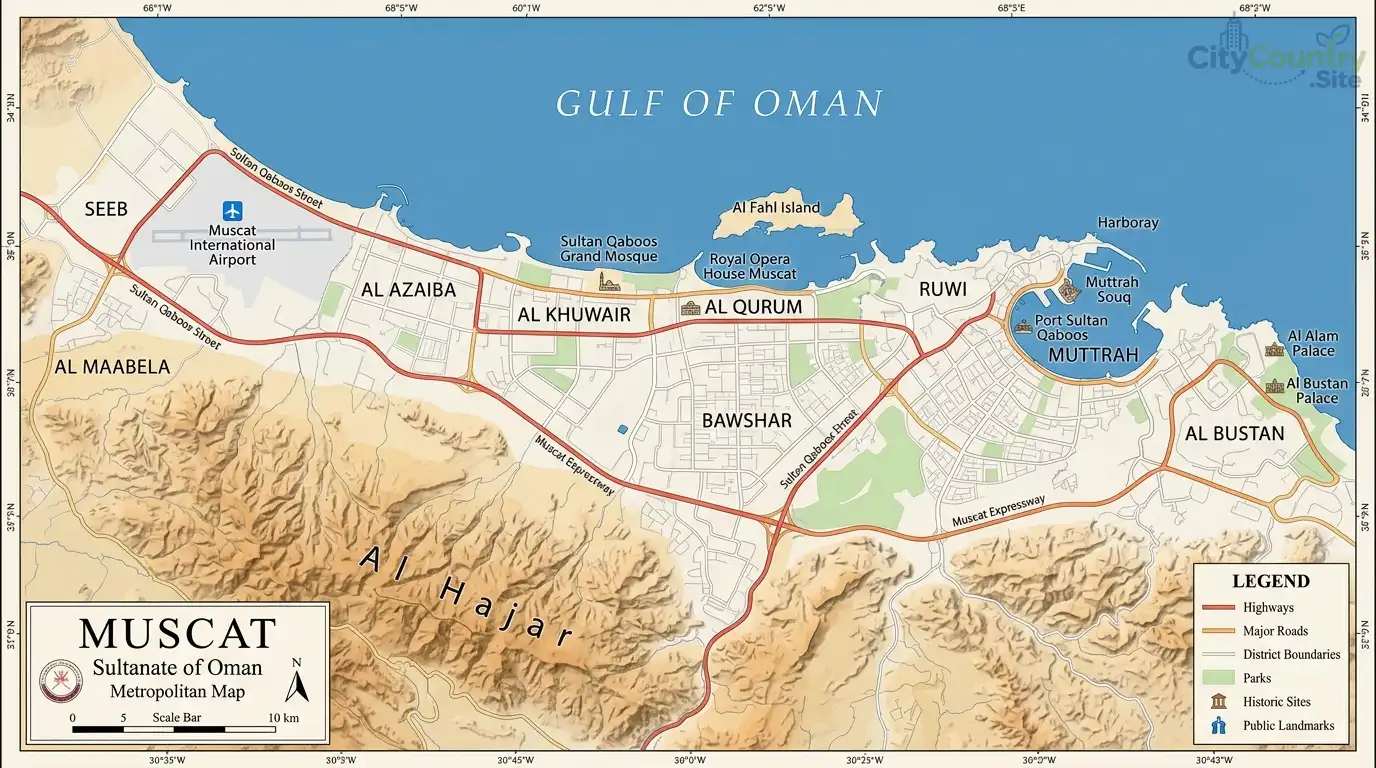
Muscat’s geography is unlike that of any other Gulf capital. Rather than spreading across a flat coastal plain, the city weaves between the sea and the Al Hajar Mountains — a dramatic range of bare, ancient rock that presses close to the coast in places, creating a series of bays, inlets, and headlands between which the city’s various districts are distributed.
The result is a capital that is not one city but a string of distinct neighborhoods, each with its own character, separated by mountain spurs and connected by coastal highways. This dispersed geography means that getting around Muscat requires planning — but it also means that each neighborhood has a strongly individual atmosphere.
Neighborhood Comparison Table
| Area | Best For | Vibe | Price Level |
|---|---|---|---|
| Old Muscat (Al Kalbuh) | History, forts, Al Alam Palace, authentic heritage | Historic, dignified, low-rise | Mid |
| Mutrah | Souq, Corniche, fish market, atmosphere | Traditional, maritime, aromatic | Budget–Mid |
| Muttrah (Corniche area) | Waterfront walking, dhow harbor | Atmospheric, photogenic, local | Budget–Mid |
| Ruwi (CBD) | Shopping, mid-range hotels, local commerce | Bustling, commercial, authentic | Budget–Mid |
| Qurum | Upscale hotels, beach, restaurants, parks | Pleasant, comfortable, expat-friendly | Mid–High |
| Al Khuwair | Government, embassies, malls, business | Administrative, modern, spacious | Mid |
| Madinat Al Sultan Qaboos (MSQ) | Upscale residences, fine dining, cultural venues | Elegant, quiet, affluent | High |
| Shatti Al Qurum | Luxury hotels, beachfront dining, nightlife | International, sophisticated, vibrant | High–Luxury |
| Al Mouj (The Wave) | Luxury marina development, golf, waterfront | Contemporary, exclusive, resort-feel | High–Luxury |
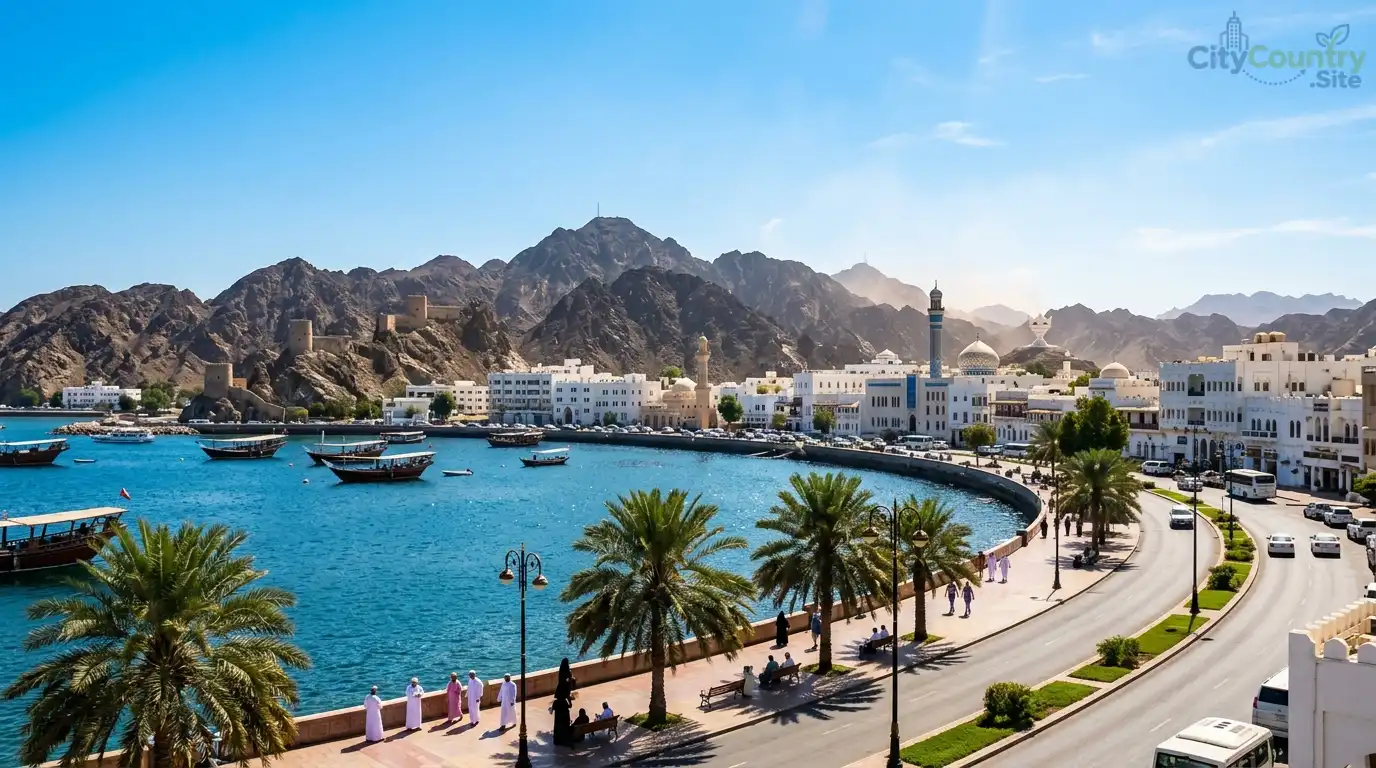
Mutrah is the soul of historical Muscat — the ancient port neighborhood built around a natural harbor, dominated by the magnificent Mutrah Souq, the elegant Corniche promenade, and the twin Portuguese forts watching from the surrounding hills. Old Muscat (Al Kalbuh) is the original royal quarter — dignified, immaculately maintained, with the Sultan’s Al Alam Palace at its center. Qurum and Shatti Al Qurum are the primary upscale residential and hotel districts — comfortable, well-served, and closest to Muscat’s beach and restaurant scene.
5. Muscat Weather & Temperature Guide
Muscat has a hot desert climate — similar to Doha but with the additional influence of the Indian Ocean monsoon (Khareef), which brings dramatic coastal humidity to southern Oman’s Dhofar region while affecting Muscat less directly. The city’s coastal position moderates temperatures slightly compared to inland Gulf cities, but the summers are nonetheless genuinely extreme.
- Cool season (winter): October to April — warm to pleasantly cool, ideal for all outdoor activities
- Hot season (summer): May to September — temperatures exceed 40°C with high humidity; outdoor activity is severely limited
Month-by-Month Weather Table
| Month | Avg Temp (°C) | Humidity | Crowd Level | Travel Recommendation |
|---|---|---|---|---|
| January | 18–26 | Low | High | ⭐ Excellent — perfect weather |
| February | 18–27 | Low | High | ⭐ Excellent |
| March | 20–30 | Low–Medium | High | ⭐ Excellent — ideal conditions |
| April | 24–35 | Medium | Medium | ✅ Good — getting warm |
| May | 29–39 | Medium–High | Low | ⚠️ Very hot — limit outdoor time |
| June | 32–41 | High | Very Low | ⚠️ Extremely hot |
| July | 33–42 | Very High | Very Low | ⚠️ Peak heat — indoor only |
| August | 33–42 | Very High | Very Low | ⚠️ Unbearable outdoors |
| September | 31–40 | High | Low | ⚠️ Still very hot |
| October | 26–35 | Medium | Medium | ✅ Good — season returning |
| November | 21–30 | Low–Medium | High | ⭐ Excellent — season begins |
| December | 18–26 | Low | High | ⭐ Excellent — peak season |
November through March is Muscat’s finest window. January and February deliver the most comfortable temperatures — mornings are genuinely cool (18°C), afternoons warm and sunny (25–27°C), and the entire city is alive with outdoor activity. March is excellent — warming pleasantly with maximum daylight.
October is transitioning out of summer — still warm but dramatically more manageable than the preceding months, and with lower accommodation prices than peak season.
May through September is brutal — temperatures regularly hit 42°C with Gulf humidity. All significant outdoor activity should be completed before 8 AM. Air conditioning is ubiquitous and essential.
💡 Did You Know? Muscat regularly records some of the highest overnight temperatures of any city on earth during summer months — the thermometer frequently fails to drop below 30°C even at midnight during July and August. This extreme nocturnal heat is driven by the combination of the Gulf’s thermal mass, trapped humidity, and the radiative heat from Muscat’s surrounding mountains. It makes Muscat’s summer nights — which in most climates offer relief from daytime heat — simply an extension of the day’s thermal punishment.

6. Muscat Airport & Getting There
Muscat International Airport (MCT)
Muscat International Airport (IATA: MCT) — officially named Muscat International Airport following a renaming from Seeb International Airport — is located approximately 38 km west of Old Muscat and about 30 km from the Qurum/Shatti Al Qurum hotel district. A new, beautifully designed terminal opened in 2018, dramatically expanding capacity and quality. The airport is the hub of Oman Air — the national carrier — and serves destinations across the Middle East, Asia, Europe, and East Africa.
Key international connections include Dubai, Abu Dhabi, Doha, Kuwait, Bahrain, London, Frankfurt, Paris, Mumbai, Delhi, Kuala Lumpur, Nairobi, and Zanzibar. Airlines including Oman Air, Emirates, Qatar Airways, flydubai, Air Arabia, IndiGo, and British Airways serve Muscat.
Getting from MCT to the City:
| Transport Option | Duration | Cost (Approx.) | Notes |
|---|---|---|---|
| Metered taxi (from airport) | 35–50 min to Qurum | OMR 8–12 (~$21–31) | Official taxis at arrivals |
| Mwasalat bus (Route 1) | 60–80 min | OMR 0.300 (~$0.78) | Very cheap; limited luggage space |
| Uber / Careem | 35–50 min | OMR 6–10 (~$16–26) | Reliable, metered |
| Hotel transfer (pre-booked) | 35–50 min | OMR 10–20 (~$26–52) | Most comfortable; pre-arrange |
| Rental car | 35–50 min | Varies | Good for independent explorers |
Getting to Muscat from Neighboring Countries:
| Origin | Transport | Duration | Cost (Approx.) |
|---|---|---|---|
| Dubai, UAE | Flight | 1 hour | $80–200 |
| Abu Dhabi, UAE | Flight | 1 hour 15 min | $90–200 |
| Dubai | Road (via border) | 4–5 hours | $20–50 (bus) |
| Doha, Qatar | Flight | 1 hour 30 min | $100–220 |
| Salalah (within Oman) | Flight | 1 hour 20 min | $50–120 |
| Musandam Peninsula | Road + ferry | 4–5 hours | Variable |
The road journey from Dubai to Muscat (via the Hatta border crossing) is a popular option for travelers already in the UAE — a beautiful 4–5 hour drive through the Hajar Mountains, past the dramatic Musandam fjords area, and along Oman’s spectacular northern coast. Several bus services operate this route.
💡 Did You Know? Oman’s national carrier Oman Air was rated among the world’s top 10 airlines for cabin crew service by Skytrax in 2024 — a reflection of the same genuine Omani hospitality that travelers experience throughout the country. The airline’s distinctive dark green livery, featuring a khanjar (traditional Omani dagger), is one of the Gulf’s most elegant airline color schemes.
7. Getting Around Muscat
Muscat’s dispersed geography — strung along 60 km of coastline — makes it one of the more challenging Gulf capitals to navigate without a vehicle. Public transport is improving but a private vehicle or ride-hailing app remains the most practical option for most visitors.
Uber and Careem are the essential tools for visitors. Both operate extensively throughout Muscat and provide transparent, metered pricing. A typical journey between major areas costs OMR 2–6 (~$5–16). For longer journeys — Old Muscat to Qurum, for example — expect OMR 4–8 (~$10–21). Always use these apps for fair pricing.
Mwasalat (Public Buses) — Muscat’s public bus system has improved significantly since 2018, with modern air-conditioned buses on several key routes. Route 1 connects the airport to Ruwi (the commercial center) via major neighborhoods. Fares are very low — OMR 0.200–0.500 (~$0.50–1.30). Not the most convenient for tourists but functional for budget travelers.
Taxis — orange-and-white metered taxis are available throughout the city. Ensure the meter is running. An alternative is negotiating a half-day or full-day hire — useful for visiting multiple attractions — typically OMR 15–25 (~$39–65) for a half day.
Car Rental is strongly recommended for independent visitors — particularly for day trips to wadis, mountains, and coastal areas. All major rental companies operate from the airport and throughout the city. An ordinary sedan suffices for city driving; a 4WD is essential for any off-road wadi exploration.
Walking is practical within specific areas — along the Mutrah Corniche, throughout Mutrah Souq, and in Old Muscat between the forts and the palace. Between these areas and other neighborhoods, the distances and heat make walking impractical for most visitors except in the coolest months.

8. Top Attractions & Popular Places in Muscat
Top Attractions Table
| Attraction | Type | Entry Fee | Best Time | Time Needed |
|---|---|---|---|---|
| Sultan Qaboos Grand Mosque | Sacred mosque / architecture | Free (non-Muslims: specific hours) | Morning (8–11 AM) | 2–3 hours |
| Mutrah Souq | Traditional market / heritage | Free | Evening (after 4 PM) | 2–4 hours |
| Mutrah Corniche | Waterfront promenade / views | Free | Sunrise / Sunset | 1–2 hours |
| Royal Opera House Muscat | World-class opera house | Free (exterior); tickets for performances | Evening | Performance dependent |
| National Museum of Oman | National history museum | OMR 5 (~$13) | Morning | 3–4 hours |
| Bait Al Zubair Museum | Private heritage museum | OMR 3 (~$7.80) | Morning | 2 hours |
| Al Alam Palace | Royal palace / ceremonial | Free (exterior viewing) | Morning | 45 min |
| Mutrah Fort | Portuguese fort / views | OMR 1 (~$2.60) | Morning | 1 hour |
| Jalali and Mirani Forts | Portuguese forts / harbor | Exterior viewing only | Any time | 30 min |
| Bait Al Baranda Museum | City history museum | OMR 1 (~$2.60) | Morning | 1.5 hours |
| Qurum Natural Park | Mangrove nature reserve | Free | Morning | 1–2 hours |
| Fish Market (Mutrah) | Local market / cultural | Free | Early morning (6–9 AM) | 1 hour |
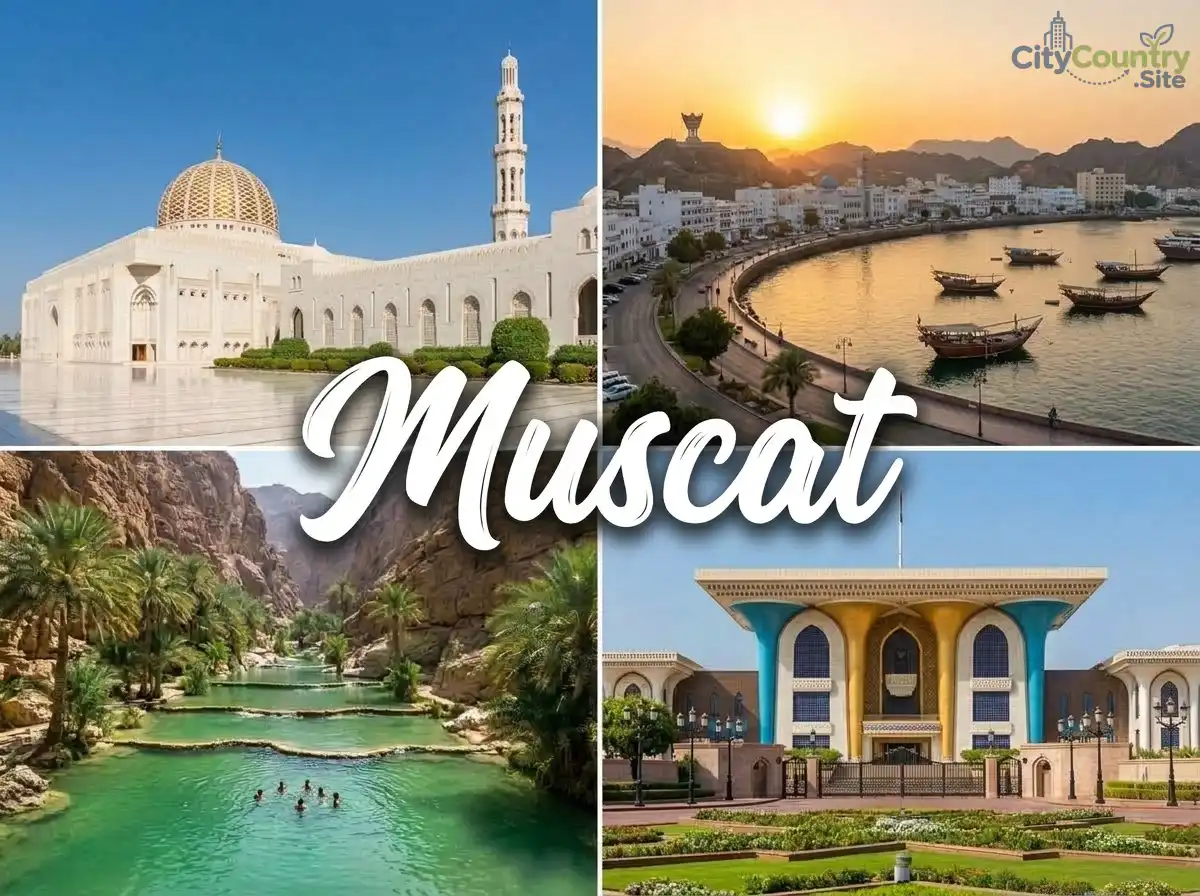
Sultan Qaboos Grand Mosque is Muscat’s defining masterpiece and one of the most beautiful mosques in the world. Built between 1995 and 2001 as Sultan Qaboos’s gift to the Omani people, it took 6 years and 300,000 tonnes of Indian sandstone to construct. Non-Muslims are permitted to enter on Saturday through Thursday mornings between 8:30 AM and 11 AM — an unusual and deeply appreciated act of openness in the Islamic world. The main prayer hall contains one of the world’s largest hand-loomed Persian carpets (covering 4,343 square metres and woven by 600 Iranian craftswomen over 4 years) and one of the world’s largest chandeliers. The exterior — white sandstone domes, soaring minarets, and Quranic calligraphy carved into every surface — is breathtaking in the morning light. Plan at least two hours. Dress very modestly — women must cover hair, shoulders, and ankles; men must wear long trousers.
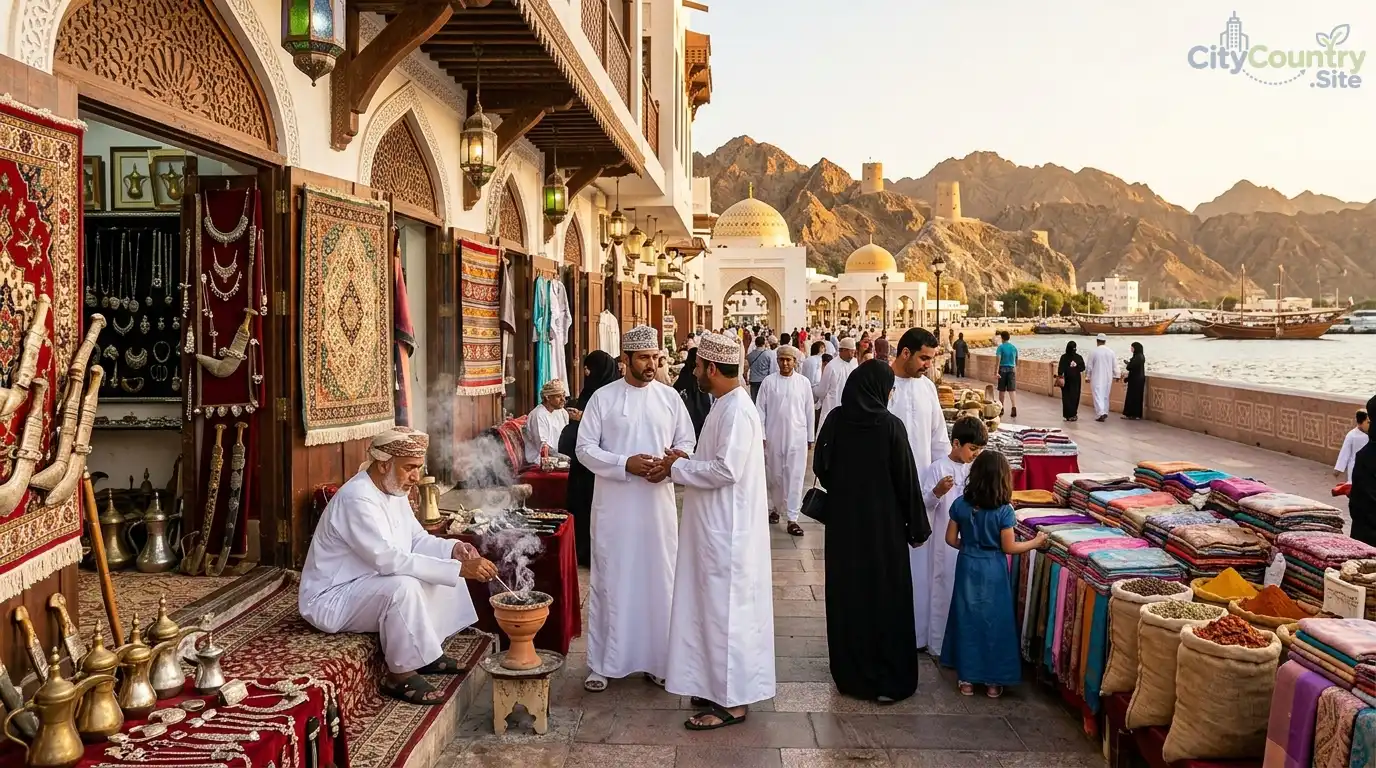
Mutrah Souq is the finest traditional market in Oman and one of the most authentic in the entire Arab world. Unlike Doha’s restored Waqif, Mutrah is genuinely old — merchants have traded in these lanes for centuries, and the accumulated patina of incense smoke, seawater, and desert dust gives it an atmosphere that no restoration project can replicate. The souq sells frankincense, silver Omani khanjar daggers, handwoven textiles, pottery, traditional Omani clothing, spices, and antiques in a labyrinthine network of covered alleys. Getting lost is mandatory and entirely pleasant. Bargaining is expected and enjoyable. The distinctive smell of frankincense — burned throughout the souq in small clay burners — will remain with you long after you leave.
The Mutrah Corniche is one of Muscat’s most beautiful urban spaces — a sweeping seafront promenade curving around the natural harbor, with the twin Portuguese forts watching from the headlands, traditional wooden dhows moored in the harbor below, and the mountains rising dramatically on all sides. Walking the Corniche at sunset, with the old city glowing in the warm light and the harbor filling with golden reflections, is quintessential Muscat.
The Royal Opera House Muscat — opened in 2011 — is one of the most beautiful concert halls in the world and a statement of extraordinary cultural ambition. Built in a magnificently detailed traditional Omani style with contemporary concert hall acoustics, it hosts international opera, ballet, orchestral performances, and classical Arabic music throughout its season (October to May). Attending a performance here — in a hall of such beauty, in a city that barely had electricity fifty years ago — is one of the most moving cultural experiences in the Gulf.
The National Museum of Oman — opened in 2016 in a dramatic contemporary building in the Diplomatic Quarter — is a world-class museum telling the complete story of Oman from ancient geology through the maritime empire to the present day. The galleries are beautifully designed, the collections extraordinary, and the interpretation thoughtful and intellectually ambitious. Do not miss the Maritime Gallery — documenting Oman’s extraordinary seafaring history — or the Diplomatic Hall documenting four centuries of Omani statecraft.
💡 Did You Know? The hand-loomed Persian carpet in Sultan Qaboos Grand Mosque’s main prayer hall — measuring 70 metres by 60 metres — is the largest hand-knotted carpet ever made. It took 600 Iranian craftswomen four years to complete and weighs 21 tonnes. It was too large to be transported in one piece; it was made in nine sections and joined seamlessly after installation. The Guinness World Records certified it as the world’s largest hand-made carpet.

9. Muscat Foods & Cuisine Guide
Omani cuisine is one of the Arab world’s most distinctive and least internationally known culinary traditions — a sophisticated reflection of Oman’s centuries of maritime trade with Persia, India, East Africa, and the wider Indian Ocean world. Muscat’s food scene ranges from authentic traditional Omani restaurants to outstanding Indian cuisine (reflecting the enormous South Asian community) to international hotel dining of considerable quality.
Must-Try Dishes in Muscat
Shuwa — Oman’s most celebrated and ceremonially important dish. Whole lamb or goat marinated for 24–48 hours in a complex spice paste of dried chili, cumin, coriander, cardamom, cloves, and rose water, then wrapped in banana leaves and slow-cooked in an underground sand oven (al tanoor) for 12–24 hours until the meat falls from the bone with extraordinary tenderness. Shuwa is the food of celebrations — Eid, weddings, and national holidays — and represents the pinnacle of Omani cooking. Finding it in restaurants requires advance notice; experiencing it in an Omani home is a profound privilege.
Omani Harees — Wheat and meat (usually chicken or lamb) slow-cooked and pounded until they form a smooth, silky, porridge-like consistency, then topped with clarified butter and ground cinnamon. Simpler than the Qatari version, deeply nourishing, and extraordinarily comforting.
Majboos — Oman’s version of the Gulf spiced rice dish — basmati rice cooked with meat, dried limes (loomi), saffron, and a complex spice blend. Each Gulf country has its own version; Oman’s tends to be slightly drier and more intensely spiced than Qatar’s machboos.
Mishkak — Small, marinated beef or chicken skewers grilled over charcoal and served with a fiery chili sauce and flatbread. Sold at street stalls throughout Muscat in the evenings — one of the city’s finest and most affordable street food experiences.
Omani Halwa — The most iconic Omani sweet — a dense, gelatinous confection of sugar, rosewater, saffron, cardamom, and ghee, studded with almonds, cashews, and dates. Its dark amber color, intensely floral aroma, and complex sweetness make it unlike any other sweet in the Arab world. Served with Omani coffee (qahwa) at every social occasion. The finest halwa in Oman comes from the Dhofar region and is available throughout Muscat in dedicated halwa shops.
Qahwa (Omani Coffee) — Omani coffee is not the strong espresso of the Western tradition or even the cardamom-spiced Turkish style of neighboring countries. It is a uniquely Omani creation — pale golden, lightly roasted, flavored with cardamom, saffron, and rose water, served in small handleless cups with dates and Omani halwa. It is simultaneously one of the most delicate and most distinctive coffee preparations in the Arab world. The ritual of serving and receiving qahwa — the host circling with a long-spouted dallah coffee pot, the guest holding a tiny cup in the right hand — is a cornerstone of Omani social life.
Mashuai — A distinctive Omani royal dish of whole roasted kingfish (safi fish) served on a bed of spiced Omani rice cooked in fish broth. One of the finest fish preparations in the Gulf, deeply satisfying and rarely found outside Oman.
Khubz Ragag — A paper-thin Omani flatbread cooked on a curved iron griddle until translucent and faintly crispy — wrapped around eggs, cheese, or sweetened with date syrup for breakfast. The Omani version of a crepe, made with extraordinary speed and lightness.
Best Restaurants & Food Spots in Muscat
Kargeen Caffe — One of Muscat’s most beloved and atmospheric restaurants — a beautifully designed outdoor restaurant and café under the shade of mature trees in the Al Ghubrah area, serving excellent Omani and Middle Eastern food with an extensive shisha menu. OMR 4–10 (~$10–26) per person. The atmosphere on a cool winter evening — string lights, the smell of frankincense, wood-fired food — is quintessential Muscat.
Bait Al Luban (Mutrah) — The finest traditional Omani restaurant in Muscat — a beautifully restored heritage building in Old Muscat serving authentic Omani cuisine including shuwa, majboos, and mashuai in a setting of genuine elegance. Excellent halwa and qahwa to finish. OMR 6–15 (~$16–39).
Ubhar Restaurant — Contemporary Omani cuisine — traditional recipes reinterpreted with modern technique and beautiful presentation. Outstanding quality, innovative menu, and warm service. OMR 8–18 (~$21–47).
Al Boom (Floating Restaurant, Mutrah) — A unique dining experience on a traditional dhow-style vessel moored in Mutrah Harbor, serving fresh seafood while the old city’s lights shimmer on the water. OMR 5–12 (~$13–31).
Mumtaz Mahal — Muscat’s most celebrated Indian restaurant — an institution of over 30 years serving outstanding North Indian cuisine with panoramic views over the Qurum coast. The tandoori dishes are exceptional. OMR 5–12 (~$13–31).
Mutrah Fish Market — For the most authentic food experience in Muscat, arrive at the Mutrah fish market before 7 AM to watch the day’s catch arrive from fishing boats, see the auction and sale, and observe the extraordinary variety of Gulf seafood. Several adjacent restaurants grill fish to order by weight at the counter. The freshest possible meal for barely OMR 2–3.
Mishkak Stalls (Evening, Ruwi and Mutrah) — Small street stalls throughout the older neighborhoods set up in the early evening selling charcoal-grilled mishkak skewers with chili sauce and bread for barely OMR 0.300–0.500 per skewer. The authentic Muscat street food experience.
💡 Did You Know? Frankincense — the aromatic resin from the Boswellia sacra tree — has been produced in Oman’s southern Dhofar region for over 5,000 years and traded throughout the ancient world. The ancient frankincense trade route from Dhofar to the Mediterranean is a UNESCO World Heritage Site. In Muscat today, frankincense is burned throughout the Mutrah Souq, at hotel lobbies, in private homes, and at social gatherings — the smell is the definitive olfactory signature of Oman. Omani frankincense is considered the finest in the world.
10. Muscat Accommodation Guide
Muscat has a well-developed accommodation sector with excellent options across most budget levels. The hotel districts of Shatti Al Qurum and Al Mouj house the finest international luxury properties; Qurum has good mid-range options; and Ruwi and Mutrah offer the most affordable accommodation with excellent cultural proximity.
Best Areas to Stay:
- Shatti Al Qurum / Qurum: Best for beach access, restaurants, international hotels, and Muscat’s liveliest after-dark scene
- Al Mouj (The Wave): Best for luxury marina experience and self-contained resort feel
- Madinat Al Sultan Qaboos: Best for quiet elegance, excellent restaurants, and cultural venues
- Mutrah / Old Muscat: Best for atmosphere, cultural immersion, and walking access to souq and Corniche
- Ruwi: Best for budget travelers — central, well-served by buses, authentic local life
Accommodation Price Ranges (2026)
| Category | Price/Night (USD) | Examples |
|---|---|---|
| Budget Hotel / Guesthouse | $30–65 | Various guesthouses in Ruwi and Mutrah |
| Mid-Range Hotel | $80–160 | Ramada Muscat, Holiday Inn Muscat, Best Western |
| Upscale Hotel | $160–280 | Grand Hyatt Muscat, Crowne Plaza Muscat |
| Luxury Hotel | $280–700+ | Al Bustan Palace (Ritz-Carlton), The Chedi Muscat, Shangri-La Barr Al Jissah |
The Chedi Muscat is consistently ranked among the finest hotels in the Middle East — a beautifully designed resort in the Al Ghubrah area with extraordinary architecture, exceptional pools, outstanding restaurants, and a spa of international reputation. The long pool, flanked by traditional Omani architectural elements and reflecting the mountain backdrop, is one of the most beautiful hotel spaces in the Gulf. Rates: approximately $350–700 per night.
Al Bustan Palace (Ritz-Carlton Muscat) is Muscat’s grandest property — a vast, domed palace hotel built in 1985 in a private bay between the mountains and the sea, entirely surrounded by Hajar Mountain rock faces on three sides and the Arabian Gulf on the fourth. The sense of seclusion is extraordinary. Rates: approximately $300–600 per night.
Shangri-La Barr Al Jissah is a magnificent beachfront resort comprising three properties at different luxury levels, set in a secluded bay about 15 km east of Muscat — a complete beach resort world with multiple pools, private beach, water sports, and outstanding dining. Rates: approximately $200–500 per night.
11. Best Time to Visit Muscat
November through March is Muscat’s golden season — and it is genuinely golden. The weather is perfection for a Gulf destination: warm, dry, clear skies, and cool enough in the evenings for comfortable outdoor dining, Corniche walking, and wadi exploration.
January and February are the finest months. Temperatures peak around 26°C in the afternoon and drop to a genuinely refreshing 18°C at night. The entire city is outdoor-oriented during these months — the Corniche, the souq, the restaurant terraces, and the mountain wadis are all at their best.
March remains excellent — warming pleasantly toward 30°C by midday but still very comfortable in the mornings and evenings.
October and November are shoulder season — temperatures falling from summer extremes but still warm (30–35°C in October). Good value, fewer crowds than January–February peak, and the beginning of the cultural season at the Royal Opera House.
April is transitional — the final acceptable month for extensive outdoor activity before the summer heat takes over.
May through September should be avoided by those sensitive to heat. Temperatures frequently exceed 42°C with high humidity. The beaches and wadis are inaccessible in any practical sense during daylight hours.
Key Festivals & Events in Muscat
- Muscat Festival (January–February) — Oman’s largest cultural and entertainment event — held annually since 1997, featuring traditional crafts, cultural performances, food exhibitions, amusement areas, and international entertainment across multiple venues throughout the city. One of the finest events of its kind in the Gulf
- Royal Opera House Season (October–May) — World-class international opera, ballet, orchestral, and Arabic music performances. Check the Royal Opera House website for the current season schedule
- Oman National Day (November 18) — The anniversary of Sultan Qaboos’s birthday (now commemorating the modern state), celebrated with fireworks over Mutrah Corniche, military ceremonies, cultural events, and the remarkable spectacle of the entire population simultaneously turning out in white dishdashas (for men) and elegant traditional dress (for women)
- Muscat International Book Fair (February) — One of the Arab world’s major literary events, attracting publishers and readers from across the region
- Khareef Festival (Salalah) (July–August) — While not in Muscat, this celebrated festival in southern Oman’s Dhofar region attracts thousands and is accessible by domestic flight from Muscat
12. Shopping Guide
Muscat offers some of the finest traditional craft shopping in the Arab world alongside modern malls with good international retail.
What to Buy:
Frankincense — The most quintessentially Omani purchase. Oman’s finest frankincense — the pale, high-grade hojari variety from the Dhofar region — is available throughout Muscat in specialist incense shops and the souq. Buy it as raw resin (to be burned on charcoal), as incense sticks, or as commercially packaged gifts. Also look for frankincense-based skin care products — Oman’s cosmetics industry has developed excellent frankincense body creams, soaps, and oils.
Omani Khanjar (Traditional Dagger) — The curved silver dagger worn by Omani men at ceremonial occasions — and depicted on the Omani national flag — is the most distinctive and iconic Omani artifact. Quality ranges from functional decorative pieces (OMR 20–50) to genuine antique silver masterpieces (OMR 500–5,000+). Buy from reputable dealers in Mutrah Souq or specialist craft shops.
Omani Silver Jewelry — Traditional Omani silver jewelry — elaborate necklaces, bangles, anklets, and rings in distinctive Omani styles — is among the most beautiful in the Arab world. The city of Nizwa is the center of Omani silversmithing; Muscat’s shops carry excellent selections.
Omani Halwa — The dense, aromatic sweet made with sugar, rosewater, saffron, and ghee is the definitive Omani edible gift. Beautifully packaged in traditional wooden boxes, it travels well and is universally received as a distinctive and precious gift. Available throughout the souq and in specialist halwa shops.
Omani Pottery and Ceramics — Traditional Omani pottery from villages in the Hajar Mountains — hand-thrown, unglazed terracotta in distinctive Omani forms — makes a beautiful and authentic souvenir.
Pashmina and Omani Textiles — The souq carries a wide selection of imported and locally made textiles. The traditional Omani mussar (men’s head cloth) in its distinctive colored woven pattern makes an unusual and authentic textile souvenir.
Oud Perfume — Similar to Qatar and the wider Gulf, Muscat’s souq perfume section is an olfactory paradise of oud-based perfumes, incense, and blended fragrances. Omani oud houses are renowned throughout the Gulf for quality.
Where to Shop:
Mutrah Souq — The most important, most atmospheric, and most authentic shopping destination in Muscat. Spend several hours in the covered alleys, bargaining for khanjar daggers, silver jewelry, frankincense, and Omani crafts. The frankincense and incense section is particularly extraordinary — dozens of varieties, presented with the seriousness of a wine merchant’s cellar.
Nizwa Souq (Day Trip) — The finest craft souq in all of Oman — and specifically the finest place to buy Omani silver, pottery, and antiques. Worth the 1.5-hour drive from Muscat specifically for the shopping.
Muscat Grand Mall — The city’s largest and most comprehensive shopping center — international brands, local retailers, a large hypermarket, cinema, and food court. Modern, comfortable, and fully air-conditioned.
Al Mouj Marina Walk — Luxury boutiques, jewelry stores, and lifestyle shops in a beautiful waterfront marina setting. More relaxed and pleasant than the enclosed malls.
City Centre Muscat (Seeb) — Large modern mall near the airport area with comprehensive retail including Carrefour supermarket — useful for provisions before road trips.
13. Muscat Nightlife & Entertainment
Muscat’s entertainment scene is notably more conservative than Dubai or even Doha — alcohol is available only in licensed hotel establishments, and the social culture is more family-oriented and traditional. However, the city offers genuine quality in its cultural programming and evening experiences.
Cultural Performances:
Royal Opera House Muscat — The crown jewel of Muscat’s cultural life. The Royal Opera House season (October through May) brings the finest international opera companies, ballet troupes, and orchestras to Muscat alongside exceptional Arabic and Omani music performances. The building itself — a masterpiece of traditional Omani architecture with world-class acoustic engineering — is worth visiting even without a performance ticket. Tickets range from OMR 10–80 (~$26–208) depending on performance and seating.
Royal Oman Symphony Orchestra — The national orchestra performs a full season of classical concerts — a remarkable achievement for a country that had no formal music education sector fifty years ago.
Bait Al Baranda Cultural Events — Regular film screenings, lectures, and cultural events at this excellent small museum in Mutrah.
Evening Experiences:
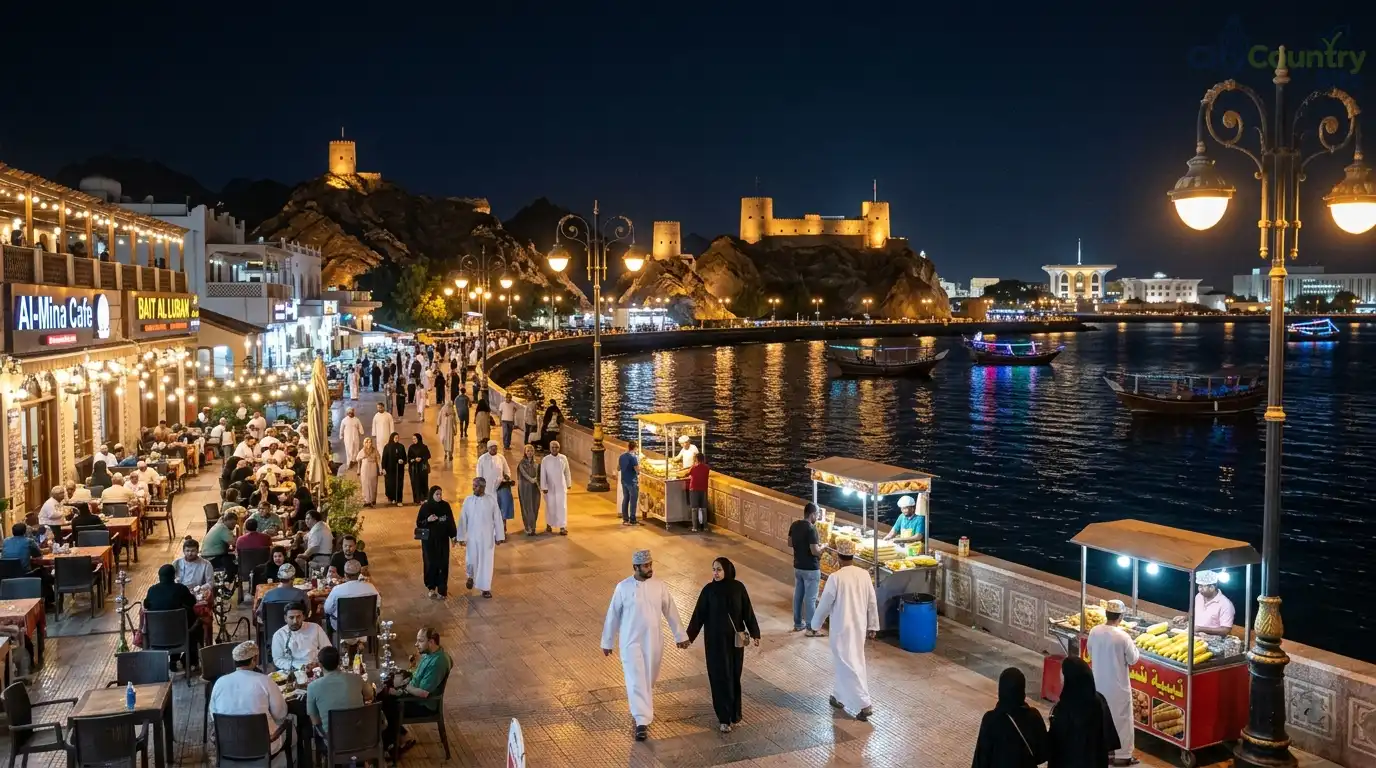
Mutrah Corniche at Sunset and After — Muscat’s finest free evening experience. The Corniche fills with families, couples, and individuals walking, sitting on the seafront benches, and watching the harbor lights come on as the sky darkens. The smell of frankincense drifts from the souq. Dhow lights reflect in the harbor. This is Muscat at its most beautiful and most human.
Kargeen Caffe (Evening) — The city’s most beloved outdoor café-restaurant transforms in the evening into one of Muscat’s most atmospheric social spaces — under the trees, with string lights, shisha fragrance, and the warmth of excellent Omani and Middle Eastern food.
Shisha Culture — Throughout Mutrah and Ruwi, shisha cafés operate until midnight or beyond — offering flavored water pipe alongside karak chai and fresh juices in outdoor settings of varying elegance. Social, relaxed, and authentically Omani.
Hotel Bars and Lounges:
Alcohol is served in licensed hotel restaurants, bars, and some clubs:
The Piano Lounge (Al Bustan Palace) — An elegant lounge bar in one of the Gulf’s finest hotels — excellent cocktails and live piano music in a setting of old-world Arabian grandeur.
The Chedi Bar — The bar at The Chedi Muscat is one of the finest hotel bar experiences in the Gulf — beautifully designed, exceptional drinks, and a quiet, sophisticated atmosphere.
Trader Vic’s (Various hotels) — The well-known international tiki bar chain has a Muscat outpost that is reliably popular with the expat community.
14. Hidden Gems & Local Secrets
Qantab Fishing Village — A small, traditional fishing village tucked into a cove just 15 km east of Old Muscat — completely bypassed by most tourists yet extraordinarily beautiful. Traditional wooden fishing boats are pulled up on a narrow beach beneath dramatic mountain cliffs. The village’s small restaurant serves the freshest grilled fish imaginable, eaten at plastic tables looking directly at the sea. Simple, perfect.
Al Hajar Mountain Viewpoints — The highway between Muscat and the airport passes through a dramatic mountain cutting. Several unmarked viewpoints along the old road (parallel to the expressway) offer extraordinary panoramic views over the city, the coast, and the mountains in the early morning light. Known primarily to local photographers.
Qurum Natural Park Mangroves at Sunrise — The mangrove lagoon of Qurum Natural Park, accessible by kayak from several operators, is extraordinarily beautiful at dawn — pale light filtering through mangrove canopies, herons fishing in the shallows, the city beginning to stir beyond the treeline. A world away from the urban environment that surrounds it.
Al Bustan Palace Gardens (Non-Guests) — The extraordinary gardens of the Al Bustan Palace Ritz-Carlton — set in a private bay completely surrounded by bare Hajar Mountain rock faces — can be experienced by booking a meal at one of the hotel’s restaurants. The walk from the restaurant terrace to the private beach at sunset is one of the most dramatic natural settings of any hotel in the world.
Old Muscat Evening Walk — After visiting the forts and palace during the day, return to Old Muscat in the early evening when the tour groups have gone. The Royal Gate area, the walls, and the waterfront take on a completely different, more intimate atmosphere in the soft evening light with a handful of local families strolling the promenade.
Muttrah Fish Auction (Pre-Dawn) — Arriving at the Mutrah fish market at 5 AM — before most of the city is awake — to watch the night’s catch arrive by boat and go through rapid-fire auction is one of the most extraordinary and entirely unscripted spectacles in Muscat. The variety of Gulf seafood, the speed of the auction, and the raw maritime energy of the scene are unforgettable.
15. Day Trips from Muscat
Muscat’s position at the foot of the Hajar Mountains, between the Gulf of Oman and the Empty Quarter, makes it an outstanding base for exploring some of the most dramatic natural and historical landscapes in Arabia.
Day Trips Table
| Destination | Distance | Travel Time | Method | Highlights |
|---|---|---|---|---|
| Wadi Shab | 130 km south | 2 hours | Car | Turquoise wadi pools, gorge swimming, caves with waterfalls |
| Nizwa | 165 km southwest | 2 hours | Car | Ancient fort, famous Friday goat souq, silversmith workshops |
| Wadi Bani Khalid | 200 km south | 2.5 hrs | Car | Crystal-clear swimming pools, lush vegetation, cave system |
| Bimmah Sinkhole | 120 km south | 1.5 hrs | Car | Dramatic natural limestone sinkhole with turquoise water |
| Sur and Ras Al Jinz | 220 km south | 3 hours | Car | Sea turtle nesting beach, dhow-building yard, coastal scenery |
| Jebel Akhdar (Green Mountain) | 175 km southwest | 2.5 hrs | 4WD | Rose gardens, terraced villages, extraordinary mountain scenery |
| Musandam Peninsula | 520 km (by road) | Fly or ferry | Charter flight / boat | Dramatic fjords (Oman’s Norway), dolphin watching, diving |
| Adam (meteor impact site) | 380 km southwest | 4 hours | Car | Ancient meteorite impact crater, desert landscape |
Wadi Shab is arguably the finest natural day trip destination in all of Oman — a dramatic gorge of emerald-green pools threaded through sheer limestone cliffs, accessible by a 20-minute boat crossing and then a 45-minute walk through the wadi floor. The water is crystalline, the swimming extraordinary, and at the innermost accessible point, a narrow cave opening leads to a hidden chamber with a waterfall falling into a pool inside the mountain. One of the most beautiful natural experiences in Arabia. Go on weekdays to avoid weekend crowds.
Nizwa is Oman’s most historically important inland city — the ancient capital of the interior, dominated by a magnificent circular Nizwa Fort (one of Oman’s largest), and home to the finest traditional souq in the country. The Friday goat souq — where Omani men in white dishdashas and colourful turbans conduct the ancient business of livestock trading with the unselfconscious confidence of a tradition unchanged for centuries — is one of the most authentic cultural experiences available to any visitor in Oman. The surrounding region of Jebel Akhdar (Green Mountain) — at 3,000 metres, one of Oman’s highest areas — offers terraced rose gardens, pomegranate orchards, and ancient mountain villages of extraordinary beauty.
Bimmah Sinkhole is one of Oman’s most photographed natural features — a dramatic circular sinkhole about 40 metres wide and 20 metres deep, filled with turquoise water of surreal clarity where the freshwater and seawater mix. Steps lead down to the water’s edge; swimming is permitted and the water temperature is perfect. Easily combined with a Wadi Shab day trip.
Ras Al Jinz Turtle Reserve — on Oman’s eastern tip — hosts one of the world’s largest nesting populations of green sea turtles. Between May and September, dozens to hundreds of turtles emerge from the sea each night to lay eggs; between August and December, hatchlings emerge and make their journey to the sea. A deeply moving wildlife experience, managed with impressive conservation sensitivity.
16. Muscat Local Culture, Customs & Etiquette
Oman has a deeply traditional and values-driven society, but it is also one of the most tolerant and welcoming societies in the Arab world. Omanis are extraordinarily proud of their culture and deeply appreciative of visitors who engage with it respectfully.
Ibadi Islam: Most Omanis follow the Ibadi school of Islam — a moderate, tolerant tradition that differs from both Sunni and Shia Islam in several important ways. Ibadism emphasizes personal piety, justice, scholarship, and peaceful coexistence. This moderate religious tradition helps explain the distinctive quality of Omani social culture — less conservative in some respects than Saudi Arabia, deeply religious in character, and genuinely hospitable to people of all faiths.
The Dishdasha: Omani men almost universally wear the dishdasha — a long, collarless white robe — in public. The color, quality, and immaculate presentation of the dishdasha are matters of significant personal pride. Senior Omanis add a kuma (embroidered cap) or mussar (colored turban). The ceremonial khanjar dagger is worn at formal occasions. For visitors, the dishdasha represents a culture of dignity and traditional identity that is genuinely moving to observe.
Hospitality as Sacred Duty: Omani hospitality (diyafa) is not merely a custom — it is a moral and religious obligation. Being welcomed into an Omani home, offered dates and qahwa coffee, and treated with generous warmth is an experience that virtually every visitor to Oman describes as the most memorable aspect of their visit. If offered hospitality, accept it graciously. Cup the dallah (coffee pot) cup in your right hand, receive the coffee with a slight bow, and hold your cup out for a refill until you signal you have had enough by gently tilting the cup from side to side.
Dress Code: More relaxed than Saudi Arabia but still conservative relative to Western norms. Cover shoulders and knees in public spaces throughout the year. Swimwear is appropriate only at beaches and hotel pool areas. The Sultan Qaboos Grand Mosque requires full modest dress — women must cover hair, shoulders, wrists, and ankles; men must wear long trousers. Bring a light scarf.
Photography: Never photograph Omani women without explicit permission — this is a serious cultural boundary. Government buildings, military installations, and the Sultan’s palaces must not be photographed. The natural landscape, old buildings, souqs (with permission from individuals), and cultural sites are freely photographable.
Tipping:
- Restaurants: 10–15% tip at sit-down restaurants — appreciated and meaningful in local currency (OMR)
- Taxi drivers: rounding up is appreciated
- Hotel staff: OMR 0.500–1 (~$1.30–2.60) per service
- Tour guides and drivers: OMR 5–10 (~$13–26) per day — important income supplement
- Wadi guides: OMR 2–5 (~$5.20–13) for half-day guidance
Dos and Don’ts:
- ✅ Do accept any offer of dates, qahwa, or halwa — refusing is genuinely rude
- ✅ Do remove shoes before entering homes and some traditional establishments
- ✅ Do greet people with “As-salamu alaykum” (peace be upon you) — even basic Arabic greetings are deeply appreciated
- ✅ Do bargain respectfully in the souq — it is expected and part of the social ritual of commerce
- ❌ Don’t point the soles of your feet at people or sacred objects
- ❌ Don’t display physical affection between unmarried couples in public
- ❌ Don’t photograph individuals without permission — particularly women
- ❌ Don’t criticize the Sultan — Qaboos is revered as a founding father; Haitham as his successor is regarded with similar respect
17. Safety & Travel Tips
Muscat is one of the safest capital cities in the world — consistently ranking at or near the top of global safety indexes. The combination of low crime, an efficient police force, an educated population, and a deeply embedded culture of social harmony makes Oman genuinely exceptional.
Safe Areas: The entire city — Mutrah, Old Muscat, Qurum, Shatti, Ruwi, and all tourist areas — is safe at all hours. The concept of “unsafe areas” as understood in many African or Asian cities simply does not apply in Muscat.
Main Practical Concerns:
- Summer heat is the primary genuine safety risk — never underestimate heat stroke danger above 40°C; hydrate constantly and minimize outdoor exposure between 10 AM and 5 PM
- Wadi safety — Wadis (mountain valleys) can flash flood with no warning during rain in the mountains even on a clear day in Muscat. Never camp in a wadi bed; always check weather forecasts before wadi excursions and exit the wadi immediately if you hear rushing water
- Road safety — Oman’s road fatality rate is above the global average, driven by high speeds and desert road conditions. Drive carefully, observe speed limits (monitored by radar cameras throughout), and avoid driving at night on unlit mountain roads
- Ocean currents — The Gulf of Oman has strong currents at some beaches; check local advice before swimming in unfamiliar locations
Emergency Numbers:
- Police: 9999
- Ambulance / Fire: 9999 (unified emergency number)
- Royal Oman Police: 80077444 (non-emergency inquiries)
- Muscat Private Hospital: 24 583600
Health Tips:
- Drink only bottled water — Oman’s tap water is generally treated but bottled water is universally preferred
- Carry sun protection and apply generously — Oman’s clear sky and reflective surfaces (white buildings, sand, sea) amplify UV exposure significantly
- Medical facilities in Muscat are good — the Aga Khan Hospital, Khoula Hospital, and several private clinics provide reliable care
- Travel insurance with medical coverage is strongly recommended
18. Muscat Budget Tour
Daily Cost Table
| Category | Budget Traveler | Mid-Range | Luxury |
|---|---|---|---|
| Accommodation | $30–65 (guesthouse) | $100–200 (hotel) | $300–700+ (luxury resort) |
| Food | $8–15 (local restaurants, mishkak stalls) | $30–60 (restaurant meals) | $80–180+ (fine dining) |
| Transport | $5–12 (Careem, bus) | $20–45 (taxi, Careem) | $60–130 (private car) |
| Activities | $5–20 (mosques, forts, museums, Corniche) | $30–70 (guided tours, day trips) | $80–250+ (private guide, helicopter tours) |
| Total/Day | ~$48–112 | ~$180–375 | ~$520–1,260+ |
Muscat is moderately expensive by global standards — significantly more affordable than Doha’s luxury positioning but more expensive than most Southeast Asian capitals. Budget travelers who choose guesthouses in Ruwi or Mutrah and eat at local restaurants can travel reasonably for $60–80 per day excluding accommodation. The Omani Rial’s high value (1 OMR ≈ $2.60) can be psychologically jarring until the conversion becomes intuitive.
19. Practical City Information
Visa & Entry: Oman has dramatically liberalized its visa policy in recent years as part of its tourism growth strategy. Citizens of 103 nationalities — including all EU member states, USA, UK, Canada, Australia, Japan, and most Western nations — can obtain a tourist e-visa online at evisa.rop.gov.om before travel. Standard single-entry tourist e-visa: OMR 20 (~$52) valid for 10 years with each visit up to 30 days (extendable). GCC citizens enter without visa formality. Check the Royal Oman Police website for your specific nationality’s current requirements.
Omani Rial Note: The Omani Rial is divided into 1,000 baisa — one of the few currencies in the world that uses a thousandths denominator. Prices appear with three decimal places (e.g., OMR 0.500 = 50 cents). This initially confuses many visitors; it becomes intuitive quickly. The OMR is pegged to the USD at approximately 2.60:1 — making it one of the world’s most valuable currencies.
Vaccinations: No mandatory vaccinations for most travelers entering from non-endemic countries. Recommended: Hepatitis A, Typhoid, Tetanus, and routine immunizations. Yellow fever certificate required if arriving from endemic countries.
Emergency Contacts:
- All emergencies: 9999
- Royal Oman Police (non-emergency): 80077444
- Oman Tourism (enquiries): 800 77700
SIM Cards & Internet: Available at the airport and throughout the city. Omantel and Ooredoo Oman are the two main networks. Omantel (also marketed as Oman Mobile) offers the best coverage throughout the country including remote areas. A tourist SIM with 10–15 GB of data costs approximately OMR 3–5 (~$7.80–13). 4G coverage is excellent in Muscat; coverage thins in some remote mountain and desert areas. Wi-Fi is available at all hotels and most cafés and restaurants.
Power: Oman uses Type G plugs — UK-style three-pin square plugs — at 240V, 50Hz. The same standard as the UK; visitors from other countries need a universal adapter.
Drinking Water: Muscat’s tap water is desalinated seawater — technically safe but bottled water is universally preferred. Available everywhere at low cost (OMR 0.100–0.200 per bottle).
Alcohol: Available only in licensed hotel restaurants and bars and some international club settings. Not sold in supermarkets or convenience stores. Well-stocked hotel bars exist throughout the Qurum and Shatti Al Qurum hotel district.
20. How to Be a Responsible Traveler in Muscat
Respect the Dress Code Genuinely: Oman’s dress code is a genuine expression of deeply held cultural and religious values — not merely a bureaucratic requirement. Dress modestly throughout the city and particularly at the Sultan Qaboos Grand Mosque with the same seriousness you would bring to any sacred space anywhere in the world.
Engage with Omani Artisans Directly: Oman’s traditional crafts — silversmithing, pottery, weaving, and khanjar manufacture — are practiced by artisans whose families have maintained these skills for generations. Buying directly from craftspeople in Mutrah Souq or Nizwa Souq puts the full value of your purchase in their hands and validates the continuation of their traditions. Ask about the craft; show genuine interest; the conversation will be as valuable as the purchase.
Wadi Environmental Ethics: Oman’s wadis — among the most pristine natural environments in Arabia — are under growing pressure from day-trip tourism. Never leave litter in wadis; do not use soap or shampoo in wadi pools (it damages the ecosystem); stay on established walking routes; and never enter a wadi during or after rain without local guidance.
Wildlife Respect: Oman has exceptional sea turtle protection programs at Ras Al Jinz and other beaches. Never approach nesting turtles unguided; never use flash photography near turtles; book official guided nocturnal turtle experiences rather than going independently. Similarly, never purchase shells, coral, or wildlife-derived products.
Support Community-Based Tourism: Several organizations in Oman support village-based tourism initiatives in the Jebel Akhdar and Jebel Shams areas, connecting visitors with local families for home-cooked meals and overnight stays in traditional mountain houses. These initiatives provide direct economic benefit to communities that often have few alternative income sources.
Water Responsibility: Oman’s water supply comes entirely from energy-intensive desalination and groundwater extraction in one of the world’s most water-stressed environments. Be genuinely conservative — take shorter showers, reuse towels, avoid unnecessary water waste.
21. Travel Media: Documentaries, Books & Channels
Books:
- Arabia Through the Looking Glass by Jonathan Raban — A beautifully written account of traveling through Arabia in the 1970s that includes Oman and provides essential cultural context for understanding the society you are visiting
- Travels in Oman by Philip Ward — A comprehensive and evocative account of traveling through all of Oman’s regions
- The Merchant of Zanzibar by various historians — Several excellent books trace the Omani maritime empire and its connection between Muscat and Zanzibar
- The Empty Quarter by Wilfred Thesiger — The classic account of crossing the Rub’ al Khali desert — crossing from and returning to the Omani hinterland — by one of the 20th century’s greatest travel writers
Documentaries & Films:
- Various BBC Natural World documentaries feature Oman’s extraordinary wadis, sea turtles, and Arabian wildlife
- National Geographic productions on Arabian Peninsula wildlife regularly feature Omani locations
- Several international travel documentary series have featured Muscat and Oman in recent years — search streaming platforms for current availability
YouTube Channels:
- Lost LeBlancs — Beautiful Oman and Muscat travel content
- Kara and Nate — Excellent Oman road trip and Muscat content
- Mark Wiens — Good Muscat food content
- Oman Tourism — Official destination content with high production values
22. Muscat vs. Similar Cities
| Feature | Muscat | Doha (Qatar) | Abu Dhabi (UAE) |
|---|---|---|---|
| Authenticity | ⭐⭐⭐⭐⭐ Most authentic Gulf capital | ⭐⭐⭐⭐ Very authentic | ⭐⭐⭐ Moderate |
| Natural scenery | ⭐⭐⭐⭐⭐ Mountains + sea + wadis | ⭐⭐⭐ Desert + sea | ⭐⭐⭐⭐ Good |
| Museum quality | ⭐⭐⭐⭐⭐ National Museum + Bait Al Zubair | ⭐⭐⭐⭐⭐ MIA + NMoQ | ⭐⭐⭐⭐⭐ Louvre Abu Dhabi |
| Traditional souq | ⭐⭐⭐⭐⭐ Finest in Gulf | ⭐⭐⭐⭐⭐ Souq Waqif | ⭐⭐⭐ Good |
| Nightlife | ⭐⭐ Conservative | ⭐⭐⭐ Moderate | ⭐⭐⭐⭐ Very good |
| Day trip options | ⭐⭐⭐⭐⭐ Extraordinary — wadis, forts, mountains | ⭐⭐⭐ Good | ⭐⭐⭐⭐ Very good |
| Luxury hotels | ⭐⭐⭐⭐⭐ World-class | ⭐⭐⭐⭐⭐ World-class | ⭐⭐⭐⭐⭐ World-class |
| Value for money | ⭐⭐⭐⭐ Good | ⭐⭐⭐ Moderate | ⭐⭐⭐ Moderate |
| Omani hospitality | ⭐⭐⭐⭐⭐ Unrivaled | — | — |
Choose Muscat if you want the Gulf’s most authentic cultural and historical experience combined with extraordinary natural landscapes — dramatic mountain wadis, pristine beaches, and ancient forts — and the warmest, most genuine hospitality in Arabia. Muscat is for travelers who want to understand the Arab world rather than simply visit its most spectacular recent buildings.
23. Muscat City Travel Tips
- Visit between November and March — summer heat is genuinely extreme and limits the city’s finest outdoor experiences severely
- The Sultan Qaboos Grand Mosque requires full modest dress — bring a scarf for women and long trousers for men; no shorts or sleeveless tops
- Visit the Grand Mosque on a weekday morning (8:30–11 AM) when it is open to non-Muslims — arrive by 9 AM for the best light
- Mutrah Souq is finest in the early evening (after 4 PM) — cooler, more atmospheric, more people
- Always bargain in the souq — the first price is rarely the best; friendly negotiation is expected and enjoyed
- The Omani Rial is worth approximately $2.60 — double-check your mental arithmetic before paying
- Download Careem and Uber before arrival — essential for fair-priced transport in this dispersed city
- Never enter a wadi without checking the weather forecast — flash floods kill visitors every year
- Omani halwa and frankincense are the finest souvenirs — buy from specialist shops rather than hotel lobbies
- Attend a performance at the Royal Opera House if your visit falls within the October–May season
- The best fish eating in Muscat costs almost nothing — find a local restaurant near Mutrah Fish Market
- Qahwa coffee and dates will be offered at every opportunity — always accept graciously
💡 Did You Know? Oman has the longest continuously ruling royal dynasty in the Arab world — the Al Bu Said dynasty has governed Oman since 1749, making it older than the United States of America. The current Sultan Haitham bin Tariq Al Said is the 14th ruler of the dynasty. This extraordinary continuity of governance — through Portuguese colonialism, the collapse of the pearl trade, oil discovery, and rapid modernization — is one of the most remarkable political survival stories in history and helps explain the deep stability and cultural confidence that define modern Omani society.
24. Is Muscat Worth Visiting?
Absolutely — and it is, in this writer’s view, the most underrated capital city in the Middle East. While Dubai attracts the world’s attention with its architectural extremes and Doha builds its cultural institutions at staggering speed, Muscat quietly offers something neither of them can replicate: genuine authenticity.
The Sultan Qaboos Grand Mosque is one of the most beautiful buildings on earth. The Mutrah Souq is the finest traditional market in Arabia. The National Museum is a world-class institution. The Royal Opera House represents cultural ambition of the highest order. The wadis, mountains, and coastline surrounding the city are among the most dramatic natural landscapes in the Gulf. And throughout all of it, the Omani people — warm, dignified, proud of their traditions, and genuinely delighted by curious visitors — provide a quality of human encounter that travelers consistently describe as the most memorable aspect of their journey.
Muscat is best suited for:
- Cultural and history enthusiasts — Three thousand years of maritime trading history, Portuguese forts, Omani silver craftsmanship, and the magnificent heritage of the Omani empire are all concentrated around this extraordinary coastline
- Architecture lovers — The Sultan Qaboos Grand Mosque, the Royal Opera House, and the consistent visual coherence of the whole city represent a quality of built environment rare in the modern Gulf
- Natural adventure seekers — Wadi swimming, mountain trekking, turtle watching, and diving are all accessible within hours of the city
- Food and culture travelers — Omani cuisine is one of the Arab world’s great undiscovered culinary traditions
- Luxury travelers — The Chedi, Al Bustan Palace, and Shangri-La set the global standard for resort hospitality
- Couples and honeymooners — The combination of stunning natural settings, romantic luxury resorts, and the quality of service makes Oman one of the world’s finest honeymoon destinations
- Thoughtful independent travelers who want to engage genuinely with a culture rather than observe it from the distance of a tour bus
Less suited for travelers seeking the extreme urban spectacle of Dubai, vibrant commercial nightlife, or beach package holidays in the Caribbean or Maldives sense.
The verdict: Give Muscat four days minimum — five or six is better. Add a road trip to Nizwa and Jebel Akhdar, a wadi day at Wadi Shab, and an evening performance at the Royal Opera House. Stay somewhere beautiful — the Chedi or Al Bustan if budget allows; a Mutrah guesthouse if it doesn’t. Walk the Corniche at sunrise. Get lost in the souq. Accept every offer of qahwa. This is one of the genuinely great travel experiences that the world has not yet fully discovered. Come before it does.
25. Frequently Asked Questions About Muscat
Q1: Is Muscat safe for tourists — including solo female travelers?
Muscat is one of the safest cities in the world for all travelers, including solo women. Oman consistently ranks at or near the top of global safety indices. The combination of extremely low crime, a respectful social culture, and an efficiently policed environment makes Muscat genuinely safe. Solo female travelers report feeling more comfortable and respected in Muscat than in most other cities they have visited in the region. Dress modestly and be aware of cultural norms; practical safety is not a concern.
Q2: Do I need a visa to visit Oman?
Citizens of 103 nationalities can obtain a tourist e-visa online at evisa.rop.gov.om before travel — OMR 20 (~$52), valid for 10 years with each visit up to 30 days. GCC citizens enter without visa. The application is straightforward and typically processed within hours. Check the Royal Oman Police website for your specific nationality’s current requirements before booking travel.
Q3: Can non-Muslims visit the Sultan Qaboos Grand Mosque?
Yes — the Sultan Qaboos Grand Mosque welcomes non-Muslim visitors on Saturday through Thursday mornings from 8:30 AM to 11 AM (closed Friday and during prayer times). This is one of the most gracious acts of religious openness in the Islamic world. Dress very modestly — women must cover hair, wrists, and ankles; men must wear long trousers. No shorts. No sleeveless tops. Photography is permitted in the exterior areas and some interior spaces. Arrive by 9 AM for the most comfortable experience.
Q4: What is the Omani Rial and how does it work?
The Omani Rial (OMR) is one of the world’s most valuable currencies — pegged to the USD at approximately 1 OMR = 2.60 USD. It is divided into 1,000 baisa (not 100 cents as with most currencies). Prices in Oman display three decimal places — OMR 0.500 equals 50 baisa or approximately $1.30. ATMs dispense Omani Rials; credit cards are accepted at most hotels, restaurants, and malls. Carry some OMR cash for markets, taxis, and smaller vendors.
Q5: What is Wadi Shab and how do I visit it?
Wadi Shab is approximately 130 km south of Muscat (about 2 hours by car). From the parking area, a short boat crossing takes you to the start of the wadi walk. The trail follows the wadi floor for approximately 45 minutes through increasingly dramatic limestone gorges, passing several crystal-clear turquoise swimming pools. The final accessible pool requires swimming through a narrow cave entrance to reach a hidden chamber with a waterfall. Wear water shoes, bring snacks and water, and visit on a weekday to avoid crowds. Never visit after rain due to flash flood risk. Entry is free; the boat crossing costs OMR 0.500 each way.
Q6: How do I get from Dubai to Muscat?
The Muscat–Dubai flight takes barely 1 hour and costs $80–200 depending on airline and timing. Flydubai and Air Arabia offer the most affordable connections. The road journey via Hatta (through the Hajar Mountains) takes approximately 4–5 hours and is scenically beautiful — several bus services operate this route for $20–50. Driving yourself allows maximum flexibility and is recommended for those wanting to explore Oman’s northern coast at their own pace.
Q7: What is the Royal Opera House Muscat and how do I get tickets?
The Royal Opera House Muscat is a world-class performing arts venue hosting international opera, ballet, orchestral concerts, and Arabic music performances from October through May. It is architecturally extraordinary — one of the most beautiful concert halls in Asia. Tickets range from OMR 10–80 (~$26–208) depending on performance and seating category. Book online at rohmuscat.org.om well in advance for major international productions, which sell out quickly. The Opera House also hosts Arabic and Omani music performances that provide an accessible, affordable introduction to the venue.
Q8: Is Muscat good for families with children?
Muscat is an excellent family destination — safe, clean, spacious, and with a wide range of family-appropriate activities. The Grand Mosque (educational and architecturally awe-inspiring), wadi swimming (magical for older children), sea turtle watching at Ras Al Jinz (unforgettable), the National Museum (engaging exhibits), and the Qurum Beach area are all excellent for families. Several resort hotels (particularly Shangri-La Barr Al Jissah) have outstanding children’s facilities. The main family consideration is summer heat — November to March is ideal for family visits.
Q9: What makes Omani hospitality different?
Omani hospitality — diyafa — is regarded across the Arab world as the gold standard of the tradition. It is rooted in the Ibadi Islamic teaching that the proper treatment of guests is a religious obligation, not merely a social nicety. The offer of dates, qahwa coffee, and halwa at every social encounter is a ritual expression of this obligation. Omanis are warm, curious about visitors, and genuinely proud to welcome people to their country. The experience of being invited for coffee in an Omani home, or simply engaging a stranger in conversation at the souq, consistently produces the most memorable moments of any visit to Oman.
Q10: What is frankincense and where can I buy the best quality in Muscat?
Frankincense is the aromatic resin harvested from Boswellia sacra trees growing in Oman’s southern Dhofar region — traded for over 5,000 years as the most prized incense and perfume material in the ancient world. It was burned in Egyptian temples, carried by the Three Wise Men, and used in religious ceremonies across the ancient Mediterranean and Middle East. The finest grade — Hojari — is pale green-white, and burns with a clear, citrusy, fresh resinous fragrance. Buy from the frankincense dealers in Mutrah Souq — ask specifically for Dhofari Hojari grade. Prices range from OMR 2–20 (~$5–52) per 100 grams depending on quality. Also available as pre-packaged gifts, essential oils, and cosmetic products throughout the city.
26. Sources & References
This article was researched using information from the following trusted sources:
- Lonely Planet Oman — lonelyplanet.com
- TripAdvisor Muscat — tripadvisor.com
- Booking.com Muscat Hotels — booking.com
- Wikipedia — Muscat — en.wikipedia.org
- Oman Tourism — experienceoman.om
- Numbeo — Cost of Living Muscat — numbeo.com
- Google Maps — maps.google.com
- Wikitravel Muscat — wikitravel.org
- Skyscanner Oman Flights — skyscanner.com
- World Travel Guide — worldtravelguide.net
- Royal Oman Police (visas) — evisa.rop.gov.om
- Royal Opera House Muscat — rohmuscat.org.om
- Sultan Qaboos Grand Mosque — sqgm.gov.om
- Condé Nast Traveller Oman — cntraveller.com
- UNESCO Oman — whc.unesco.org
27. Muscat Travel Guide Images