
1. Facts About Kigali
| Category | Details |
|---|---|
| Country | Rwanda |
| Region / Province | Kigali Province (independent city-province) |
| Official Languages | Kinyarwanda, English, French; Swahili also official |
| Currency | Rwandan Franc (RWF) — approx. 1 USD ≈ 1,330 RWF (2026) |
| Best Time to Visit | June to September; December to February (dry seasons) |
| Time Zone | Central Africa Time (CAT) — UTC+2 |
| Weather | Subtropical highland climate — mild year-round with two rainy seasons |
| Temperature | 15°C – 27°C (59°F – 81°F) — one of Africa’s most pleasant climates |
| Map | Located in central Rwanda on a series of hills, approximately 1,500 m above sea level |
| Airport | Kigali International Airport (KGL) — 8 km east of city center |
| Top Tourist Places | Kigali Genocide Memorial, Kimironko Market, Inema Arts Center, Presidential Palace Museum, Nyamirambo, Rwanda Art Museum |
| Avg. Trip Cost/Day | Budget: $40–65 / Mid-range: $100–180 / Luxury: $220–500+ |
| Nearest Major Airport | Kigali International Airport (KGL) — primary international gateway |
| Population | Approx. 1.4 million (city); 1.8 million (metro area, 2026) |
| Famous For | Africa’s cleanest and safest capital, extraordinary national recovery, gorilla trekking gateway, and a model of 21st-century African urban development |
2. Kigali City Overview & Background
There is a moment that happens to almost every visitor to Kigali — usually within the first hour. You have been warned, perhaps, about coming to Rwanda. You carry in your mind the weight of what happened here in 1994. You arrive expecting to find a place marked by trauma, still navigating its shadows. And then the taxi from the airport crests a hill and Kigali opens before you: a city of sweeping green valleys, red-earth hills crowded with neat buildings, wide clean boulevards lined with flowering trees, and a skyline of gleaming new towers catching the equatorial sun.
It is not what you expected. And that unexpected quality — that extraordinary, hard-won beauty — is exactly what makes Kigali one of the most compelling cities in Africa.
Kigali is Rwanda’s capital and largest city, spread across a series of rolling hills in the heart of the country at an elevation of approximately 1,500 metres (4,900 feet) above sea level. It is consistently ranked as Africa’s cleanest city — not by a small margin but by a dramatic one. The streets are genuinely spotless; plastic bags have been banned since 2008; the city operates a monthly community cleaning day called Umuganda in which every citizen participates. Walking Kigali’s streets, you will be struck first by their cleanliness and then by something harder to name — a quality of purposefulness, of a city and a people building something deliberately, with full awareness of what came before and fierce intention about what comes next.
Rwanda’s story — from the 1994 genocide against the Tutsi, in which approximately 800,000 people were killed in 100 days, to the country’s extraordinary renaissance as one of Africa’s fastest-growing and best-governed nations — is one of the most remarkable in modern history. Kigali sits at the center of that story. Visiting the Kigali Genocide Memorial is among the most important and affecting experiences available to a traveler anywhere on earth. But Kigali is also a living, thriving, forward-looking city — with an outstanding restaurant scene, a vibrant arts culture, excellent hotels, and a warmth of welcome from its people that is not merely tourist-friendly politeness but something deeper and more genuine.
For the growing number of travelers who are moving beyond the traditional African safari circuit and seeking cities with genuine historical depth, human stories of resilience, and emerging creative energy, Kigali is one of the most important and rewarding destinations on the continent.
“Kigali surprised me more than any city I have visited in Africa. I expected sorrow and found extraordinary hope. I expected scars and found beauty. I expected to be moved by what happened here, and I was — but I was more moved by what is happening here now.” — Anonymous travel journalist, Condé Nast Traveller feature, 2024
3. Kigali History Timeline
~10th–15th century CE — The hills of central Rwanda are settled by Bantu-speaking agricultural communities. The Kingdom of Rwanda gradually consolidates under the Tutsi monarchy (Mwami), developing a sophisticated feudal social structure over several centuries.
1600s–1700s — The Kingdom of Rwanda expands its territory and refines its social organization. The capital shifts periodically between hilltop settlements across the central highlands. The area around modern Kigali is part of this broader kingdom but not yet a primary center.
1895 — German colonists arrive in Rwanda and establish it as part of German East Africa. The colonial administration uses and amplifies existing Hutu-Tutsi social distinctions, introducing identity cards that rigidly categorize the population along ethnic lines — a policy with catastrophic long-term consequences.
1907 — German colonial administrator Richard Kandt establishes a post at Kigali — formally founding the city as an administrative center. The name is derived from the Kinyarwanda word “Gali,” meaning “broad” or “wide.”
1916 — Belgian forces occupy Rwanda during World War I, taking control from the Germans. Belgium administers Rwanda as a League of Nations mandate, intensifying ethnic categorization through the infamous Hamitic hypothesis — a pseudoscientific racial classification system.
1933 — Belgium introduces mandatory ethnic identity cards distinguishing Hutu, Tutsi, and Twa. This administrative entrenchment of ethnic categories will prove catastrophic in the following decades.
1959 — The Hutu Revolution — a series of anti-Tutsi pogroms — begins, with tens of thousands of Tutsi killed and hundreds of thousands fleeing to neighboring countries. Kigali begins developing as a more formal urban center.
1962 — Rwanda gains independence from Belgium on July 1. Kigali becomes the capital of the new Republic of Rwanda under President Grégoire Kayibanda. The new state is established along ethnic lines that entrench Hutu political dominance.
1973 — General Juvénal Habyarimana seizes power in a coup, beginning a two-decade dictatorship. Kigali grows as a city but anti-Tutsi discrimination continues and intensifies.
1990 — The Rwandan Patriotic Front (RPF), composed largely of Tutsi refugees from Uganda, invades northern Rwanda, beginning a civil war. Habyarimana’s government responds with increased persecution of Tutsi civilians.
April 6, 1994 — President Habyarimana’s plane is shot down over Kigali. Within hours, the genocide against the Tutsi begins. Over the following 100 days, an estimated 800,000 to 1,000,000 Tutsi and moderate Hutu are systematically killed. The world, shamefully, does not intervene. The genocide ends in July 1994 when RPF forces take control of the entire country.
July 1994 — The RPF, led by Paul Kagame, establishes a transitional government. The scale of devastation — physical, human, psychological — is almost incomprehensible. The country begins, from ruins, to rebuild.
1994–2000 — The government of national unity begins the extraordinary process of reconstruction. Gacaca community courts are established to process hundreds of thousands of genocide cases at a community level. Reconciliation programs begin.
2000 — Paul Kagame becomes President of Rwanda. His government launches Vision 2020, an ambitious development program aimed at transforming Rwanda into a middle-income, knowledge-based economy.
2000s — Rwanda enacts sweeping reforms. Plastic bags are banned (2008). Women achieve the world’s highest proportion of female parliamentary representation. English replaces French as the primary language of instruction. The economy grows at an average of 8% per year.
2010s — Kigali transforms dramatically. New hotels, roads, business parks, and cultural institutions are built. The city becomes a hub for international conferences, with the Kigali Convention Centre — a spectacular domed structure — becoming the symbol of the new Rwanda.
2019 — The African Union summit is held in Kigali. Rwanda’s reputation as Africa’s most organized and forward-thinking state attracts growing international investment and tourism.
2024–2026 — Kigali continues its rapid development. The city consistently ranks as Africa’s most livable, cleanest, and safest capital. Tourism grows year on year, with the city attracting a new generation of curious, engaged international travelers.
4. Kigali Geography & Neighborhoods
Kigali is built across a dramatic landscape of steep hills, deep valleys, and narrow ridgelines at the geographic heart of Rwanda — often called the “Land of a Thousand Hills” (Pays des Mille Collines). The city spreads across three main hills and the valleys between them, creating a topography that makes every approach and departure a dramatic visual experience.
The Nyabugogo River and its tributaries flow through the valleys between the hills. The city has no flat center in the conventional sense — instead, neighborhoods cling to hillsides and spread along ridges, connected by a network of roads that wind constantly up and down.
Neighborhood Comparison Table
| Area | Best For | Vibe | Price Level |
|---|---|---|---|
| Kiyovu | Luxury hotels, embassies, quiet elegance | Upscale, leafy, diplomatic | High–Luxury |
| Kimironko | Local market, authentic Kigali life, budget eats | Busy, residential, real | Budget–Mid |
| Nyamirambo | Street food, nightlife, Muslim quarter, culture | Lively, authentic, diverse | Budget–Mid |
| Remera | Mid-range hotels, airport proximity, restaurants | Commercial, convenient, accessible | Mid |
| Gikondo | Industrial, local transport hub, budget stays | Functional, local, less touristy | Budget |
| Kacyiru | Government buildings, international organizations | Administrative, quiet, ordered | Mid–High |
| Norrsken / Kigali Heights | Business, co-working, modern cafés, tech scene | Contemporary, innovative, global | Mid–High |
Kiyovu is Kigali’s most upscale residential and diplomatic area — wide, tree-lined streets, walled compounds, and the city’s finest hotels and restaurants. Nyamirambo is the opposite in every way — loud, colorful, fragrant, and alive with street food stalls, music, and the kind of authentic urban energy that polished neighborhoods deliberately design out. It is Kigali at its most human, and it is essential. Kimironko is home to the city’s most vibrant local market — a sprawling, colorful maze of food, fabrics, crafts, and commerce that represents the commercial heartbeat of everyday Kigali.
5. Kigali Weather & Temperature Guide
Kigali enjoys one of the most pleasant climates in Africa, thanks entirely to its elevation. At approximately 1,500 metres (4,900 feet) above sea level, the city avoids the crushing heat of the African lowlands. Temperatures are remarkably consistent year-round — typically ranging from 15°C at night to 27°C in the afternoon — without the dramatic extremes experienced in most African cities.
Rwanda has two rainy seasons and two dry seasons, driven by the Inter-Tropical Convergence Zone:
- Long dry season: June to September
- Short dry season: December to February
- Long rainy season: March to May
- Short rainy season: October to November
Month-by-Month Weather Table
| Month | Avg Temp (°C) | Rainfall | Crowd Level | Travel Recommendation |
|---|---|---|---|---|
| January | 16–26 | Low–Medium | Medium | ✅ Good — short dry season |
| February | 16–27 | Low | High | ⭐ Excellent — dry and clear |
| March | 16–25 | High (Long Rains begin) | Low–Medium | ⚠️ Getting wetter |
| April | 15–24 | Very High | Low | ⚠️ Heaviest rains — lush but wet |
| May | 15–24 | High | Low | ⚠️ Still wet |
| June | 15–26 | Very Low | High | ⭐ Excellent — dry season begins |
| July | 14–26 | Very Low | Very High | ⭐ Excellent — peak season |
| August | 15–27 | Very Low | Very High | ⭐ Excellent — gorilla trekking peak |
| September | 15–27 | Low | High | ⭐ Excellent |
| October | 16–26 | Medium–High | Medium | ✅ Good — short rains beginning |
| November | 16–25 | High | Low–Medium | ⚠️ Short rainy season |
| December | 16–26 | Low–Medium | Medium | ✅ Good — improving |
June through September is Kigali’s finest season — dry, clear, and with the best conditions for gorilla trekking in the nearby Volcanoes National Park. July and August are peak months; book accommodation and gorilla permits many months in advance.
February is an excellent shoulder alternative — dry, slightly less crowded than the July-August peak, and with more affordable accommodation rates.
The rainy season (March–May) brings daily afternoon downpours but the city remains functional, the landscapes turn extraordinarily lush and green, and accommodation prices drop noticeably.
💡 Did You Know? Kigali’s average annual temperature varies by only about 3°C across the entire year — one of the most stable temperature ranges of any capital city on earth. This extraordinary consistency is entirely due to its equatorial location combined with high-altitude moderation. It is genuinely comfortable to be outdoors in Kigali in every month of the year.
6. Kigali Airport & Getting There
Kigali International Airport (KGL)
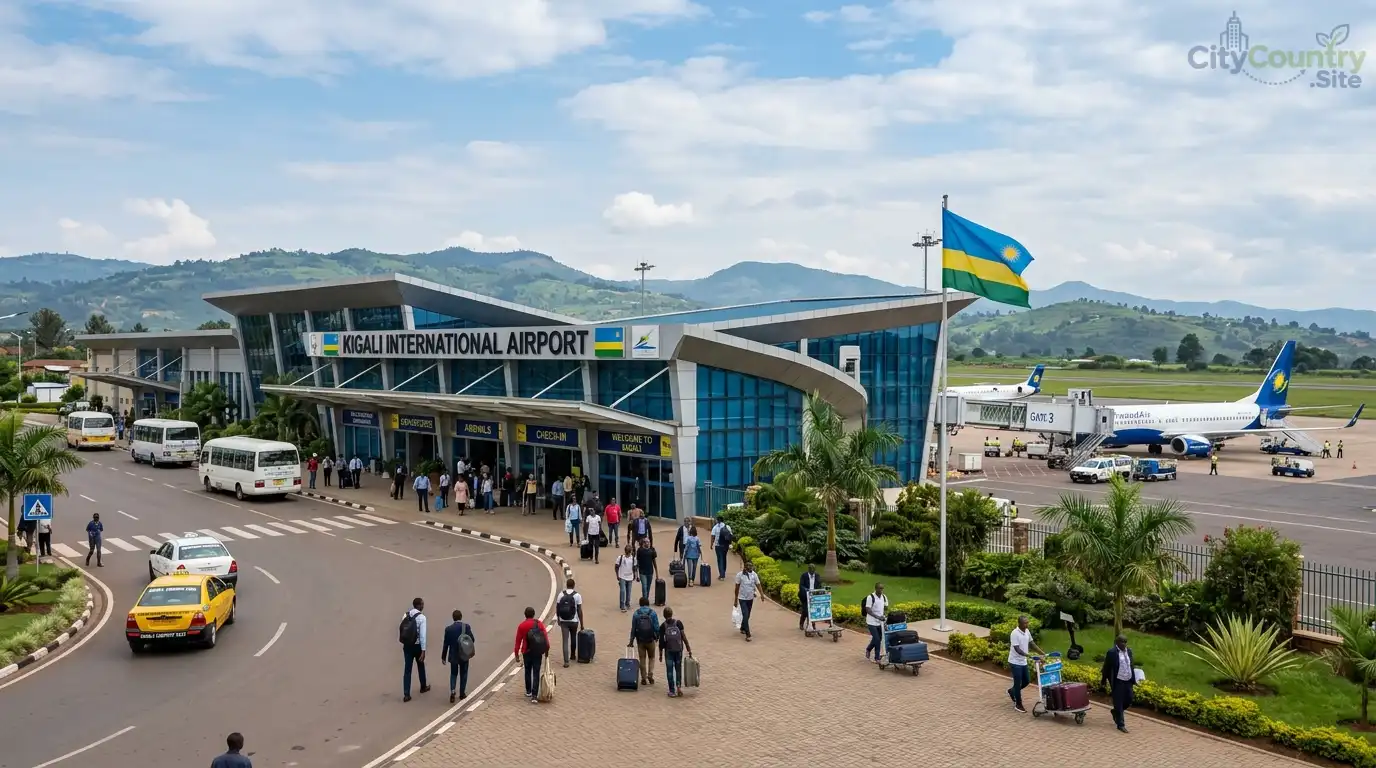
Kigali International Airport (IATA: KGL) is located approximately 8 km east of the city center in the Kanombe district — a relatively short distance that makes transfers quick and straightforward.
The airport is the primary hub for RwandAir, Rwanda’s national airline, which has developed into one of Africa’s more respected carriers, serving destinations across Africa, Europe (London, Brussels, Paris), the Middle East, and Asia. International carriers including Qatar Airways, Ethiopian Airlines, Kenya Airways, Brussels Airlines, and Turkish Airlines also serve Kigali, connecting it well to global networks.
New Bugesera International Airport, located approximately 40 km southeast of the city, was under construction as of 2026 and expected to eventually replace or supplement KGL for international traffic. Check its operational status at time of travel.
Getting from Kigali Airport to the City Center:
| Transport Option | Duration | Cost (Approx.) | Notes |
|---|---|---|---|
| Taxi (booked at airport counter) | 20–30 min | $10–20 (USD) | Reliable, metered or fixed rate |
| YegoCab (ride-hailing app) | 20–30 min | $8–15 | Rwanda’s main ride-hailing app |
| Hotel shuttle | 25–35 min | Free or $10–15 | Pre-arrange with your hotel |
| Moto-taxi (motorcycle taxi) | 15–20 min | $2–4 | Cheap but not ideal with luggage |
| Public bus (tap tap) | 40–60 min | $0.30–0.50 | Very cheap, crowded, not tourist-friendly |
Getting to Kigali from Neighboring Countries:
| Origin | Transport | Duration | Cost (Approx.) |
|---|---|---|---|
| Nairobi, Kenya | Flight | 1 hr 40 min | $100–250 |
| Kampala, Uganda | Bus (Jaguar / Scandinavia Express) | 8–10 hours | $15–30 |
| Bujumbura, Burundi | Bus | 5–6 hours | $10–20 |
| Dar es Salaam, Tanzania | Flight | 2 hours | $100–200 |
| Entebbe, Uganda | Flight | 1 hour | $80–180 |
💡 Did You Know? RwandAir has positioned itself as the preferred airline for travel within East and Central Africa, operating one of the youngest and most modern fleets on the continent. Rwanda’s aviation ambitions are directly connected to its broader strategy of positioning Kigali as Africa’s Singapore — a small, landlocked nation compensating for geographic limitations with exceptional connectivity, efficiency, and service quality.
7. Getting Around Kigali
Kigali is a hilly city and not the most pedestrian-friendly for large distances — but within neighborhoods, walking is pleasant and safe.
YegoCab is Kigali’s primary ride-hailing app — reliable, metered, and the recommended way for tourists to get around. Download it before or immediately on arrival. A typical city ride costs RWF 2,000–5,000 (~$1.50–4).
Moto-taxis (motorcycle taxis) are ubiquitous, cheap, and fast — the dominant mode of local transport. Helmets are mandatory and provided. A short ride costs RWF 500–1,500 (~$0.40–1.10). Perfectly safe for short trips in good weather, though less practical with luggage.
Taxis — white vehicles with a yellow stripe — are available throughout the city. Negotiate or confirm the fare before boarding. A full city crossing costs approximately $5–10.
Public buses (Tap-taps) run fixed routes throughout the city for RWF 250–500. Not the most tourist-friendly option due to route complexity, but used by locals and budget travelers.
Walking is very pleasant in the city center, Kiyovu, and along the main commercial boulevards. The hills make longer walks physically demanding but scenically rewarding — the views from ridge roads across Kigali’s valleys are frequently stunning.
Bicycle rental is available at some guesthouses and tour operators. The hills make cycling challenging but exhilarating for the fit traveler.
8. Top Attractions & Best Places in Kigali
Top Attractions Table
| Attraction | Type | Entry Fee | Best Time | Time Needed |
|---|---|---|---|---|
| Kigali Genocide Memorial | Memorial / museum | Free (donations welcome) | Morning | 2–3 hours |
| Kimironko Market | Local market | Free | Morning | 1.5–2 hours |
| Inema Arts Center | Contemporary art gallery | Free | Any time | 1–2 hours |
| Presidential Palace Museum | History museum | RWF 5,000 (~$4) | Morning | 1.5–2 hours |
| Rwanda Art Museum (Nyamirambo) | National art museum | RWF 3,000 (~$2.25) | Morning | 1.5 hours |
| Nyamirambo Walking Tour | Cultural neighborhood tour | $15–25 (guided) | Morning | 2–3 hours |
| Kigali Convention Centre | Architecture / viewpoint | Free (exterior) | Any time | 30 min |
| Caplaki Crafts Village | Craft market | Free | Morning–Afternoon | 1–2 hours |
| Kandt House Museum | Colonial history museum | RWF 3,000 (~$2.25) | Morning | 1–1.5 hours |
| Mount Kigali | Hill / green space / views | Free | Morning | 1–2 hours |
| Urugwiro Village (State House Gardens) | Presidential gardens | By appointment | Morning | 1 hour |
| Rebero Hill | Scenic viewpoint | Free | Sunrise / Sunset | 1 hour |
The Kigali Genocide Memorial is the most important experience available to a visitor in Rwanda. Located on the site where over 250,000 genocide victims are buried, the memorial combines a moving outdoor memorial garden with an extraordinarily well-designed museum that tells the history of the genocide — from its colonial-era origins through the hundred days of 1994 to the aftermath and the country’s remarkable recovery. Allow a minimum of two hours and prepare yourself emotionally. This is not an easy visit but it is a profoundly important one — a testament to what humans are capable of at their worst and, ultimately, to the extraordinary resilience of which they are also capable.
The Inema Arts Center is Kigali’s most vibrant cultural institution — a dynamic gallery and studio space in Kacyiru founded by brothers Innocent and Emmanuel Nkurunziza, showcasing contemporary Rwandan and East African art with energy, intelligence, and joy. The work here is not folkloric or tourist-oriented — it is genuinely contemporary, politically engaged, and often brilliant. Don’t miss it.
The Nyamirambo Walking Tour is consistently rated one of the best urban cultural experiences in East Africa. Led by local guides from the Nyamirambo Women’s Center, the tour winds through the neighborhood’s market streets, mosques, traditional shops, and food stalls, providing intimate access to a side of Kigali that most visitors in their comfortable city-center hotels never see. Essential.
The Presidential Palace Museum in Kanombe preserves the residence of former President Juvénal Habyarimana — still containing the wreckage of the plane whose shooting down on April 6, 1994 triggered the genocide. Haunting, historically essential, and unlike anything else in Africa.
💡 Did You Know? Rwanda’s parliament has the highest percentage of female representatives of any national legislature in the world — over 60% of seats are held by women as of 2026. This is not accidental: Rwanda’s post-genocide constitution mandated a minimum of 30% female representation, and women’s active roles in the country’s reconstruction created a political culture that far exceeded the minimum. Kigali is governed and administered at the highest levels with a female presence that many Western democracies are still far from achieving.
9. Kigali Food & Cuisine Guide
Kigali’s food scene is one of Africa’s most underrated and, for the adventurous traveler, one of its most rewarding. The city combines traditional Rwandan cuisine — hearty, bean-forward, and deeply nourishing — with a sophisticated international dining scene reflecting the city’s growing status as a continental business and conference hub.
Must-Try Dishes in Kigali
Ugali (Ubugali) — The foundational starch of the Rwandan table — a thick, dense porridge made from maize or sorghum flour, cooked until it forms a solid mass. Served as an accompaniment to stews, beans, and meat dishes. Its bland neutrality is the perfect counterpoint to richly spiced accompaniments.
Isombe — Cassava leaves cooked with eggplant and peanuts into a rich, earthy, slightly bitter stew. One of Rwanda’s most distinctive dishes and one that appears at every traditional meal.
Ibirayi na Inyama (Potatoes and Meat) — A warming stew of tender beef or goat with potatoes, tomatoes, onions, and fresh herbs. Simple, satisfying, and ubiquitous at local restaurants.
Ibiharage (Beans) — Rwandan cuisine is built on beans — dozens of varieties, cooked to silky tenderness with onions and seasoning. Often served alongside rice, plantain, or ugali. At their best, Rwandan beans are as satisfying as any bean dish in the world.
Brochettes — Grilled meat skewers — goat, beef, or chicken — marinated and charred over charcoal. Found at street stalls and restaurants throughout the city. The quintessential Kigali street food experience. Cost: RWF 500–1,500 (~$0.40–1.10) per skewer.
Sambaza — Small fried fish from Lake Kivu, typically eaten whole with a squeeze of lemon and hot sauce. Crispy, salty, and addictive.
Matoke — Cooked green bananas, stewed until soft and tender. A starchy, mildly sweet accompaniment widely eaten in Kigali alongside meat and bean dishes.
Akabanga — Rwanda’s famous super-hot chili oil — a few drops will transform any dish. Made from a local chili variety of extraordinary heat, it is sold in tiny bottles throughout the city and makes an excellent (and genuinely unique) souvenir.
Best Restaurants & Food Spots
Chez Lando — A Kigali institution and arguably the finest traditional Rwandan restaurant in the city. The buffet spread of traditional dishes — isombe, beans, plantain, rice, meats, and soups — is extraordinary in its variety and quality. Beloved by both locals and visitors. RWF 8,000–15,000 (~$6–11) for a full meal.
Repub Lounge — The most consistently praised restaurant among Kigali’s mid-range options — excellent grilled meats, great salads, cold Mutzig beer, and a warm outdoor terrace. RWF 10,000–25,000 (~$7.50–19) per person.
Meze Fresh — A health-conscious café serving fresh salads, wraps, smoothies, and grain bowls. A welcome contrast to heavy traditional fare and extremely popular with the expat and digital nomad community.
Kimironko Market Food Stalls — For the most authentic budget eating in Kigali, head to the market’s inner food section — local women serving rice, beans, plantain, and brochettes from metal trays for under RWF 2,000 (~$1.50) per plate.
Question Coffee (multiple locations) — Kigali’s most beloved specialty coffee chain, dedicated to serving Rwanda’s extraordinary single-origin arabica coffee directly from the farms where it is grown. The best cup of coffee in East Africa at an exceptionally fair price. RWF 2,000–4,000 (~$1.50–3).
Nyamirambo Brochette Stalls — Evenings in Nyamirambo are defined by the smoke and sizzle of charcoal grills. Pull up a plastic stool at any busy brochette stall, order a plate of skewers, a cold Primus beer, and chips, and eat like a local for under $5.
💡 Did You Know? Rwanda is one of Africa’s finest coffee-producing nations, growing high-altitude arabica at elevations between 1,500 and 2,500 metres across the country’s volcanic hillsides. Rwandan coffee — particularly washed-process coffees from the Western Province — is among the most sought-after single-origin coffee in the world’s specialty coffee industry. When you drink a cup in Kigali, the beans were likely grown within 200 km of where you’re sitting.
10. Accommodation Guide for Kigali City
Kigali has excellent accommodation across all budget levels — from backpacker hostels to some of the finest hotels in East Africa.
Best Areas to Stay:
- Kiyovu: Best for luxury, quiet, and proximity to the finest restaurants and embassies
- Remera: Best for mid-range travelers — near the airport, good restaurant selection, convenient transport
- Nyamirambo: Best for budget travelers wanting authentic neighborhood immersion
- City Center / Kacyiru: Best for business travelers and conference attendees
Accommodation Price Ranges (2026)
| Category | Price/Night (USD) | Examples |
|---|---|---|
| Budget Hostel / Guesthouse | $15–35 | Discover Rwanda Youth Hostel, Heaven Boutique Guesthouse, various B&Bs |
| Mid-Range Hotel | $60–130 | Hotel Mille Collines, Kigali Serena Hotel (mid rooms), Hotel des Mille Collines |
| Upscale Hotel | $130–220 | Marriott Kigali, Radisson Blu Kigali |
| Luxury | $220–500+ | One&Only Nyungwe House (near city), Four Points Sheraton, Kigali Marriott suites |
Hotel des Mille Collines — known internationally as the “Hotel Rwanda” — holds deep historical significance as the site where hotel manager Paul Rusesabagina sheltered over 1,200 Tutsi refugees during the genocide. The hotel has been renovated and operates as a comfortable mid-range property today. Staying here carries obvious historical resonance. Rates: approximately $100–180 per night.
The Marriott Kigali is the city’s most prestigious international hotel — beautifully located in the city center with excellent facilities, a rooftop pool, and outstanding service. Rates: approximately $200–350 per night.
Discover Rwanda Youth Hostel is the best backpacker option — clean, social, centrally located, and run by a team with genuine hospitality. Regular cultural evenings and excellent travel advice. Dorm beds from $15; private rooms from $35.
11. Best Time to Visit Kigali
June through September is the best time to visit Kigali and Rwanda. The long dry season delivers clear skies, manageable temperatures, and — most critically — the best conditions for gorilla trekking in Volcanoes National Park. July and August are peak months, particularly popular with international visitors combining Kigali with a gorilla trek. Book gorilla permits and accommodation well in advance — ideally three to six months ahead for July and August.
December to February offers the short dry season — another excellent window with fewer crowds than the July-August peak and slightly lower accommodation rates. February is a particularly sweet spot.
March to May is the long rainy season. Heavy afternoon downpours are daily events. Gorilla trekking continues but conditions on trails are more challenging. The city and countryside are brilliantly green and photogenic. Accommodation prices drop noticeably. Not a bad time to visit if you accept the rain.
October and November bring the short rains — manageable, with many dry days, and representing a good budget-season compromise.
Key Festivals & Events in Kigali
- Kwita Izina Gorilla Naming Ceremony (September) — Rwanda’s most beloved annual event, in which newly born mountain gorillas are given names in a ceremony attended by thousands and broadcast nationally. One of the most joyful wildlife conservation events in the world
- Kigali Up Music Festival (August) — East Africa’s most celebrated music festival, bringing together African artists across genres for several days of outdoor performances
- Umuganura (National Harvest Festival) (August) — Rwanda’s traditional harvest celebration, recently revived as a national holiday
- Rwanda Film Festival (various) — Annual showcase of Rwandan and African cinema, held in various Kigali venues
- Genocide Memorial Week (April 7 — Kwibuka) — A solemn national week of commemoration beginning on April 7, the anniversary of the genocide’s start. Visitors should be aware of the gravity of this period
- Kigali Jazz Junction (annual) — A popular jazz festival attracting musicians from across the continent
12. Shopping Guide
Kigali’s shopping scene is modest by global standards but has developed significantly, with a growing range of high-quality local crafts, design goods, and specialty food products.
What to Buy:
Imigongo Art — One of Rwanda’s most distinctive and unique art forms — geometric abstract patterns created using cow dung mixed with natural clay, painted in traditional black, white, and earth tones. Originally from the Eastern Province, Imigongo panels and decorative pieces are Kigali’s most recognizable and visually striking souvenir.
Agaseke Baskets (Peace Baskets) — Intricate, tightly woven coiled baskets in traditional Rwandan patterns. Historically used as wedding gifts by Rwandan brides, they have become a symbol of Rwanda’s craft heritage and post-genocide reconciliation. Many are made by women’s cooperatives. Prices: $10–60 depending on size and complexity.
Akabanga Chili Oil — The tiny orange bottle of Rwanda’s legendary super-hot chili oil. Cheap, unique, lightweight, and universally appreciated as a gift for food-loving friends. Available everywhere.
Rwanda Coffee and Tea — High-quality, specialty-grade Rwandan arabica coffee beans and highland teas make outstanding, lightweight souvenirs that directly support Rwandan farmers.
African Fabric and Clothing — Beautiful printed fabrics and tailored clothing available throughout the city’s markets and boutiques.
Contemporary Rwandan Art — Original paintings, prints, and sculptures by Rwandan artists available at the Inema Arts Center and associated galleries.
Where to Shop:
Kimironko Market — Kigali’s largest and most vibrant market. Vegetables, fruits, fresh fish, fabrics, second-hand clothing, household goods, and crafts fill a sprawling covered complex with an energy that is pure Kigali. The best place to buy baskets, fabrics, and fresh produce at genuine local prices. Go in the morning.
Caplaki Crafts Village — A dedicated crafts market near the Kigali Convention Centre, housing dozens of artisans selling Imigongo art, baskets, jewelry, woodcarvings, and textiles under one roof. Prices are negotiable.
Inema Arts Center Shop — The finest selection of contemporary Rwandan art and design goods in the city, with price points ranging from affordable prints to significant original works.
Kigali City Tower Mall and Crystal Ventures Complex — Modern shopping malls with a mix of local and international retail, supermarkets, pharmacies, and food courts. More functional than atmospheric but convenient.
Question Coffee Shops — Buy beautifully packaged bags of single-origin Rwandan coffee — the best edible souvenir from the country.
13. Kigali Nightlife & Entertainment
Kigali’s nightlife is livelier and more sophisticated than most first-time visitors expect. The city has a genuine after-dark scene — bars, live music venues, rooftop terraces, and clubs — reflecting the energy of a young, educated, and internationally connected urban population.
Rooftop Bars & Cocktail Spots:
Repub Lounge — The most consistently popular outdoor bar in Kigali — a sprawling open-air terrace with cold Primus and Mutzig beers, excellent cocktails, and the relaxed atmosphere of a city that knows how to enjoy itself.
Chic Bar (Hotel des Mille Collines) — Poolside drinks at the “Hotel Rwanda” with city views. Historical atmosphere and excellent cocktails in equal measure.
Marriott Rooftop Bar — The best panoramic view of the city skyline, best appreciated as the sun sets over the hills and the city lights begin to appear. Premium prices; premium experience.
Sundowner, Heaven Restaurant — A beautiful garden terrace restaurant and bar in Kiyovu, widely considered Kigali’s most romantic evening setting. Excellent cocktails, outstanding food, extraordinary views.
Clubs & Live Music:
Papyrus Bar — One of Kigali’s most popular clubs, drawing a young Rwandan and expat crowd with a mix of Afrobeats, hip-hop, and house music. Open late on weekends.
K-Club — Kigali’s most established nightclub — loud, energetic, and authentic. The music ranges from Congolese rumba and East African pop to international hip-hop.
Inema Arts Center — Regular evening events including live music, spoken word, and art openings in a vibrant cultural setting. One of the best evening experiences in the city.
Cultural Evenings:
The Nziza Rwandan Traditional Dance Group performs at various Kigali venues and hotel events — a spectacular display of traditional Intore warrior dancing with elaborate costumes and thunderous drumming. Ask your hotel or a tour operator for current performance schedules.
14. Hidden Gems & Local Secrets
Rebero Hill — A quiet, forested hill in the eastern part of the city with perhaps the finest panoramic view of Kigali available from any accessible viewpoint. At sunset, the entire city spreads across its valleys and ridges below you in a carpet of red rooftops, green trees, and golden light. Almost no tourists come here.
Ruganda Jazz Lounge — A small, intimate jazz bar in Remera that draws serious musicians and enthusiasts for regular live performances with absolutely no tourist affectation. Ask locally for the current schedule.
Nyamirambo Women’s Center — Beyond their acclaimed walking tours, the center itself — a community space for women’s economic empowerment — offers cooking classes in traditional Rwandan cuisine, craft workshops, and a genuinely moving insight into the quiet, powerful work of women in post-genocide Rwanda.
Kigali’s Sunday Football Culture — On Sunday afternoons, the city’s community football pitches come alive with intense local matches. Pull up a hillside and watch — the passion, the skill, and the communal joy of Rwandan football culture is one of the city’s most authentic and freely available experiences.
Kacyiru Evening Food Market — A small but excellent evening street food market in Kacyiru where office workers and young professionals gather after work for brochettes, chips, and cold beer. Completely local, completely unpretentious, and a wonderful place to spend an evening conversation with Kigali’s young, educated urban class.
The Hôpital Roi Faycal Murals — A series of powerful public murals along the road to the hospital, commissioned from Rwandan artists, depicting themes of healing, reconciliation, and national identity. Overlooked by virtually all visitors and profoundly moving.
15. Day Trips from Kigali
Rwanda is a small country — roughly the size of Maryland — meaning that virtually every major attraction is accessible as a day trip or short overnight from Kigali. This makes the city an outstanding base for exploring the entire country.
Day Trips Table
| Destination | Distance | Travel Time | Method | Highlights |
|---|---|---|---|---|
| Volcanoes National Park | 115 km north | 2.5–3 hrs | Taxi / Tour | Mountain gorilla trekking, golden monkeys, Dian Fossey tomb |
| Lake Kivu (Gisenyi/Rubavu) | 160 km west | 2.5–3 hrs | Bus / Taxi | Spectacular volcanic lake, beaches, boat trips, Congo views |
| Nyungwe Forest National Park | 226 km southwest | 4–5 hrs | Tour / Taxi | Chimpanzee trekking, canopy walk, 300+ bird species |
| Akagera National Park | 100 km east | 2 hrs | Taxi / Tour | Big Five safari (lions, elephants, rhinos, buffalos, leopards) |
| Musanze (Ruhengeri) | 105 km north | 2 hrs | Bus / Taxi | Gateway to gorillas, Musanze Caves, twin lakes |
| Bisoke Volcano | 120 km north | 2.5 hrs | Tour | Day trek to crater lake summit |
| Huye (Butare) | 135 km south | 2.5 hrs | Bus / Taxi | National Museum of Rwanda, Nyabisindu royal palace |
| Kibuye (Karongi) | 130 km west | 2.5 hrs | Bus / Taxi | Stunning Lake Kivu peninsula, Church Memorial Site |
Mountain gorilla trekking in Volcanoes National Park is Rwanda’s — and arguably East Africa’s — single most extraordinary wildlife experience. Groups of maximum eight people spend between one and eight hours hiking through volcanic forest to spend one hour with a habituated gorilla family. The encounter — face to face with these magnificent, gentle, profoundly human-like animals in their natural highland forest habitat — is among the most affecting wildlife experiences on earth. Gorilla permits cost $1,500 per person and must be booked through the Rwanda Development Board, ideally months in advance.
Lake Kivu is one of Africa’s Great Lakes — a vast, deep, strikingly beautiful body of water bordered to the west by the Democratic Republic of Congo. The lakeside town of Gisenyi (Rubavu) offers beaches, boat trips, fresh fish restaurants, and one of the most dramatic landscapes in the region. A full day here, watching fishing boats and the blue water of the lake stretching toward Congo, is deeply restorative.
Akagera National Park on Rwanda’s eastern border was extensively damaged during the genocide years but has undergone one of Africa’s most remarkable conservation recoveries, reintroducing lions in 2015 and black rhinos in 2017 to restore the full Big Five to Rwanda. Safaris here are significantly more affordable and less crowded than Kenya or Tanzania.
💡 Did You Know? Rwanda is home to approximately half of the world’s remaining mountain gorilla population — a species that numbers only around 1,000 individuals in total. Conservation efforts in Rwanda, Uganda, and the Democratic Republic of Congo have actually increased gorilla numbers from a low of around 620 in the 1980s — one of the very few cases of a critically endangered great ape species increasing in population.
16. Kigali Local Culture, Customs & Etiquette
Kigali is a remarkably orderly, respectful, and culturally self-aware city. Its people are warm and welcoming to visitors who approach them with courtesy and genuine interest.
The Umuganda Community Spirit: On the last Saturday of every month, Rwanda observes Umuganda — a national community service day from approximately 7 AM to 11 AM during which all citizens (and many resident foreigners) participate in community cleaning, construction, or social projects. Public transport largely stops and shops close during this period. As a visitor, you are welcome to join — it is one of the most authentic cultural experiences available in Kigali and a direct explanation of why the city is so clean.
Genocide Sensitivity: Rwanda’s genocide history is woven into the fabric of the city’s identity. Approach the subject with deep respect and appropriate gravity. Do not make jokes about it. Do not ask people which ethnicity they are — ethnic identity cards were a tool of genocide and the distinction between Hutu and Tutsi is officially minimized in post-genocide Rwanda. If people wish to discuss their experiences, listen with full attention and humility.
Dress Code: Kigali is a relatively conservative city by contemporary standards. Smart casual dress is appropriate for most situations. Very revealing clothing (short shorts, crop tops) is not illegal but is considered disrespectful in many neighborhoods and inappropriate in religious or government settings.
Photography: Ask before photographing individuals. Rwanda has some restrictions on photography in government areas and near military installations. The Kigali Genocide Memorial has specific photography guidelines — follow them carefully.
Plastic Bags: Rwanda’s plastic bag ban is completely serious and actively enforced. Your airport bags will be inspected and any plastic bags removed on arrival. Carry reusable bags for all shopping.
Tipping:
- Restaurants: 10% tip is standard at tourist-oriented establishments; not expected at local eateries
- Gorilla trekking guides: $20–50 is standard for an excellent trekking experience
- Hotel porters: RWF 1,000–2,000 (~$0.75–1.50)
- Taxi / moto-taxi: rounding up is appreciated; not obligatory
- Tour guides: $10–20 per day for good service
Dos and Don’ts:
- ✅ Do participate in Umuganda if you are present on the last Saturday of the month
- ✅ Do try to learn a few words of Kinyarwanda — even “Muraho” (hello) and “Murakoze” (thank you) delight locals enormously
- ✅ Do dress modestly when visiting memorials, churches, and government areas
- ❌ Don’t litter — anywhere, ever. Rwanda’s cleanliness is a matter of genuine national pride
- ❌ Don’t ask people their ethnicity
- ❌ Don’t photograph the Presidential Palace without permission
- ❌ Don’t compare Rwanda only to its genocide — the country’s present and future are what its people most want to discuss
17. Safety & Travel Tips
Kigali is consistently ranked as Africa’s safest capital city — and by most accounts one of the safest cities for tourists anywhere in the world. Violent crime against visitors is extremely rare. The streets are safe at night. The police are visible and generally professional.
Petty Crime: Pickpocketing and bag snatching exist at a low level, primarily in crowded market areas. Keep valuables secure, particularly in Kimironko Market. Do not display expensive jewelry or equipment unnecessarily.
Traffic: Kigali’s road network is being upgraded but steep hills and motorbike taxis create hazards. Be careful when crossing roads; use designated crossings where available.
Common Scams:
- Overcharging tourists for taxis — use YegoCab app for transparent pricing
- “Guided tour” offers near the genocide memorial from unofficial guides — arrange tours through the memorial itself or reputable operators
- Currency exchange at unofficial rates — use banks or official exchange bureaus
Emergency Numbers:
- Police: 112
- Ambulance: 912
- Fire: 111
- Rwanda Investigation Bureau: 3512
Health Tips:
- Malaria is present in Rwanda, including in Kigali at lower risk levels. Take antimalarial medication and use mosquito repellent, particularly at dusk and dawn
- Yellow fever vaccination is required for entry into Rwanda — carry your vaccination certificate
- Drink bottled or filtered water — do not drink tap water
- Medical facilities in Kigali are among the best in East Africa; the King Faisal Hospital and Rwanda Military Hospital are the main international-standard options
- Altitude — at 1,500 metres, some visitors experience mild breathlessness on arrival, particularly after physical exertion. This typically resolves within 24 hours
18. Kigali Budget Tour
Daily Cost Table
| Category | Budget Traveler | Mid-Range | Luxury |
|---|---|---|---|
| Accommodation | $15–35 (hostel / guesthouse) | $70–130 (hotel) | $200–450+ (luxury hotel) |
| Food | $8–15 (local markets, street food, brochettes) | $25–50 (restaurant meals) | $60–120+ (fine dining) |
| Transport | $3–8 (moto-taxi, YegoCab short rides) | $15–30 (taxi, YegoCab) | $40–80 (private car, transfers) |
| Activities | $5–20 (memorial, markets, arts center) | $25–60 (guided tours, day trips) | $100–1,500+ (gorilla permit, private guides) |
| Total/Day | ~$31–78 | ~$135–270 | ~$400–2,150+ |
Note: The gorilla trekking permit alone costs $1,500 per person — this single activity dramatically affects any budget calculation for Rwanda as a destination. Budget accordingly if gorilla trekking is part of your plan. All other aspects of Kigali and Rwanda travel are affordable by international standards, making the permit the primary significant expense.
Kigali is more expensive than many East African cities but provides excellent value relative to what it offers — safety, cleanliness, infrastructure quality, and the extraordinary gorilla trekking experience nearby are well worth the additional cost compared to more budget-oriented destinations.
19. Practical City Information
Visa & Entry: Rwanda operates one of Africa’s most progressive visa policies. Citizens of most African Union member states can enter visa-free. Citizens of most other countries can obtain a visa on arrival or an e-visa online at irembo.gov.rw before travel. Standard tourist e-visa: $50 USD for a 30-day single-entry visit. Some nationalities are eligible for extended or multiple-entry visas. Check current policies at the Rwanda Directorate General of Immigration.
Required Documents:
- Valid passport (minimum 6 months validity)
- Yellow fever vaccination certificate — mandatory for all visitors; you will be refused entry without it
- Return ticket
- Proof of accommodation
Vaccinations: Yellow fever certificate is mandatory. Additionally recommended: Typhoid, Hepatitis A, Tetanus, Rabies (for extended rural stays), Meningitis, and routine immunizations. Malaria prophylaxis is recommended — consult a travel medicine specialist.
Emergency Contacts:
- Police: 112
- Ambulance: 912
- Tourist Police: 0788-311-155
SIM Cards & Internet: Available at the airport on arrival and throughout the city. MTN Rwanda and Airtel Rwanda are the main providers. A tourist SIM with 10 GB of data costs approximately RWF 5,000–8,000 (~$4–6). Rwanda has excellent 4G coverage throughout Kigali and most urban areas. Internet speeds are among the best in East Africa — Rwanda has invested heavily in fiber optic infrastructure.
Power: Rwanda uses Type C and Type J plugs, voltage 230V, 50Hz. European round two-pin adapters work in most sockets. Bring a universal adapter for safety.
Drinking Water: Tap water in Kigali is technically treated but bottled or filtered water is recommended for visitors. Bottled water is inexpensive and widely available.
20. How to Be a Responsible Traveler in Kigali
Respect the Plastic Ban: This is law, not suggestion. Do not bring plastic bags into Rwanda. Use the reusable bags you are given or bring your own.
Participate in Umuganda: If you are in Kigali on the last Saturday of any month, participate. It requires nothing more than showing up and working alongside your neighbors for a couple of hours. It is the most powerful cultural experience available in Rwanda and you will understand the country better for having done it.
Buy Gorilla Permits Ethically: The $1,500 gorilla permit fee goes directly to conservation efforts and community development around Volcanoes National Park — this is not exploitative pricing but a deliberate conservation financing mechanism. Buying through the official Rwanda Development Board (not third-party scalpers) ensures the money reaches its intended destination.
Support Genocide Memorial Survivor Organizations: Several organizations supporting genocide survivors operate in Kigali. Purchasing from their craft cooperatives, attending their events, or making a donation is a meaningful and appropriate way to engage with the city’s healing process.
Buy Local Craft, Not Imports: Rwanda’s craft industries — particularly basket weaving, Imigongo art, and coffee — involve thousands of rural women and small-scale producers. Buy these products directly from artisans or cooperatives wherever possible.
Environmental Responsibility: Rwanda’s extraordinary natural environments — gorilla habitat, cloud forests, volcanic parks — are fragile and irreplaceable. Follow all guide instructions in national parks. Do not approach wildlife independently. Stay on marked trails.
Be Present with the History: The Kigali Genocide Memorial deserves your full, undistracted attention. Put your phone away except where photography is permitted. Listen. Read. Reflect. The 800,000 people commemorated there deserve at least two hours of your complete presence.
21. Travel Media: Documentaries, Books & Channels
Books:
- We Wish to Inform You That Tomorrow We Will Be Killed With Our Families by Philip Gourevitch — The definitive account of the Rwandan genocide, essential reading before any visit. Brilliantly written and profoundly important
- A Sunday at the Pool in Kigali by Gil Courtemanche — A novel set in the early 1990s at the Hotel des Mille Collines. Beautiful and devastating
- Left to Tell by Immaculée Ilibagiza — A remarkable survivor memoir of a Tutsi woman who survived the genocide in hiding. One of the most moving books about Rwanda
- The Antelope’s Strategy by Jean Hatzfeld — Part of Hatzfeld’s Rwanda trilogy, focusing on the reconciliation between survivors and perpetrators in post-genocide Rwanda
Documentaries & Films:
- Hotel Rwanda (2004) — Don Cheadle’s powerful dramatization of hotel manager Paul Rusesabagina sheltering refugees during the genocide. Essential context for visiting Kigali; note that Rusesabagina’s later conviction in Rwanda for terrorism-related charges adds complexity to his portrayal as a hero
- Ghosts of Rwanda (2004, PBS Frontline) — A devastating documentary about the international community’s failure to intervene during the genocide
- Sometimes in April (2005) — HBO film about the genocide, filmed partly on location in Rwanda
- The Uncondemned (2015) — Documentary about the first international prosecution of sexual violence as a war crime, arising from the Rwandan genocide
YouTube Channels:
- Mark Wiens — Excellent Kigali food content
- Wolters World — Accessible Rwanda travel guide content
- Hungry Passport — Kigali food and culture
- Experience Rwanda (Rwanda Development Board) — Official tourism content
22. Kigali vs. Similar Cities
| Feature | Kigali | Nairobi (Kenya) | Addis Ababa (Ethiopia) |
|---|---|---|---|
| Safety | ⭐⭐⭐⭐⭐ Africa’s safest capital | ⭐⭐⭐ Moderate (varies by area) | ⭐⭐⭐ Moderate |
| Cleanliness | ⭐⭐⭐⭐⭐ Africa’s cleanest | ⭐⭐ Below average | ⭐⭐ Below average |
| Wildlife access | ⭐⭐⭐⭐⭐ Gorillas, Big Five | ⭐⭐⭐⭐⭐ Nairobi National Park, Masai Mara | ⭐⭐⭐ Good national parks |
| Cultural depth | ⭐⭐⭐⭐ Extraordinary post-genocide story | ⭐⭐⭐⭐ Very rich, diverse | ⭐⭐⭐⭐⭐ Ancient civilization |
| Infrastructure | ⭐⭐⭐⭐⭐ Excellent | ⭐⭐⭐ Good in places | ⭐⭐⭐ Moderate |
| Affordability | ⭐⭐⭐ Moderate (gorilla permits are expensive) | ⭐⭐⭐ Moderate | ⭐⭐⭐⭐ Affordable |
| Food scene | ⭐⭐⭐⭐ Very good | ⭐⭐⭐⭐⭐ Outstanding | ⭐⭐⭐⭐⭐ Outstanding |
| Ease of travel | ⭐⭐⭐⭐⭐ Excellent | ⭐⭐⭐⭐ Good | ⭐⭐⭐ Moderate |
Choose Kigali if you want Africa’s most organized, safest, and cleanest urban experience combined with access to the world’s finest gorilla trekking, an extraordinarily moving historical story of genocide and recovery, a vibrant arts scene, and the growing energy of one of the continent’s most intentionally developed cities.
Kigali City Travel Tips
- Book gorilla permits months in advance — particularly for July and August visits. Go to rdb.rw directly
- Do not bring plastic bags into Rwanda — they will be confiscated at the airport
- Download YegoCab before arriving — it is essential for fair-priced transport throughout the city
- Carry your yellow fever vaccination certificate — you cannot enter Rwanda without it
- The last Saturday of each month is Umuganda — participate if you can; if not, plan around reduced transport and closed shops
- Take antimalarial medication and use repellent daily — Kigali has lower but present malaria risk
- The Nyamirambo Women’s Center walking tour is the single best cultural experience in the city — book in advance
- Visit Kimironko Market in the morning when it is at its most vibrant and food stalls are freshest
- Rwanda uses USD widely at hotels and gorilla permit offices — bring USD cash in addition to local currency
- Question Coffee serves the best coffee in East Africa — visit at least once daily
- Kigali is significantly more expensive than other East African cities outside of the gorilla permit — budget accordingly
- Rwanda’s healthcare is among the best in East Africa — King Faisal Hospital is the best option for medical emergencies
💡 Did You Know? Rwanda has been ranked as the easiest country in Africa to do business by the World Bank’s Ease of Doing Business Index for multiple consecutive years. This business-friendly environment — characterized by low corruption, efficient bureaucracy, and transparent regulation — is a direct result of deliberate government policy and is widely cited as a model for African development. The Kigali Innovation City project aims to make Kigali a continental hub for technology and innovation by 2030.
23. Is Kigali Worth Visiting? — Final Verdict
Absolutely and without reservation, yes. Kigali is one of the most important and most affecting travel destinations in Africa — a city that challenges you, moves you, surprises you, feeds you extraordinarily well, and sends you home changed in ways you may not fully understand until you are back in your ordinary life.
It is not a city to visit for beach relaxation or historical architecture in the conventional sense. It is a city to visit for human stories — the most important human story of the late 20th century told with dignity and unflinching honesty at the Genocide Memorial, and the equally remarkable story of what a people and a nation can build from absolute devastation when given the conditions to do so.
Kigali is best suited for:
- Thoughtful, historically curious travelers who engage with the cities they visit rather than merely touring them
- Wildlife enthusiasts for whom gorilla trekking is a bucket-list ambition — Kigali is the gateway
- Business and conference travelers — Kigali’s excellent infrastructure, safety, and connectivity make it East Africa’s premier conference destination
- Solo travelers — Few cities in Africa are as consistently safe, navigable, and welcoming for solo visitors
- Digital nomads — Excellent internet, growing co-working infrastructure, reasonable living costs outside of luxury options, and an inspiring city energy make Kigali increasingly popular for location-independent workers
- Africa first-timers — Kigali’s safety, cleanliness, English-friendliness, and organized infrastructure make it perhaps the most accessible introduction to sub-Saharan Africa available
- Families — Safer, cleaner, and more organizationally straightforward than most African capitals
Less suited for travelers seeking cheap backpacker adventure (Kigali is relatively expensive), those uninterested in engaging with the genocide history (it would be missing the point of the city), or those primarily seeking Indian Ocean beaches or North African culture.
The verdict: Give Kigali a minimum of three days — four or five is better. Add gorilla trekking and Lake Kivu to make a full Rwanda week. Come with an open heart and a willingness to be moved. This city — this country — will meet you there.
24. Frequently Asked Questions About Kigali City
Q1: Is Kigali safe for tourists?
Kigali is consistently rated Africa’s safest capital city and one of the safest cities in the world for tourists. Violent crime against visitors is extremely rare. The streets are safe at night. The police are visible and professional. Basic urban precautions — securing valuables in crowded areas, using reputable transport apps — are all that is required. Solo female travelers rate Kigali particularly highly for safety and positive local interactions.
Q2: Do I need a visa to visit Kigali / Rwanda?
Citizens of most African Union countries enter visa-free. Citizens of most other nations can apply for an e-visa online at irembo.gov.rw before travel, or obtain a visa on arrival. Standard tourist e-visa cost is $50 USD for 30 days. A Yellow Fever vaccination certificate is mandatory for all visitors — you will be refused entry without it.
Q3: How much does gorilla trekking cost from Kigali?
The gorilla trekking permit costs $1,500 USD per person for a one-hour visit with a mountain gorilla family in Volcanoes National Park. This is obtained through the Rwanda Development Board (rdb.rw). Transportation from Kigali to Musanze (the gateway town) costs an additional $20–60 by bus or taxi. Budget lodges near the park start from $80–150 per night; luxury lodges from $400–1,000+.
Q4: What is the best time to visit Kigali?
The best time is June through September — Rwanda’s long dry season. July and August are peak months with the finest weather and busiest gorilla trekking season. December to February is the second-best window — the short dry season with fewer crowds and slightly lower prices. The rainy seasons (March–May and October–November) are manageable and significantly cheaper.
Q5: What currency should I bring to Kigali?
The local currency is the Rwandan Franc (RWF). USD is widely accepted at hotels, gorilla permit offices, and upscale restaurants. ATMs dispensing RWF are widely available throughout Kigali. Bring USD cash for gorilla permits (often preferred), and use ATMs or bank exchanges for local currency. As of 2026, 1 USD ≈ 1,330 RWF.
Q6: Is it culturally appropriate to ask Rwandans about the genocide?
This requires sensitivity and good judgment. Rwandans vary enormously in their willingness to discuss personal genocide experiences with strangers. The Kigali Genocide Memorial is the appropriate place to learn the history. If a Rwandan person chooses to share personal experiences with you, receive them with full respect and attentiveness. Do not initiate such conversations unless someone clearly opens the door. And never, under any circumstances, ask someone their ethnicity.
Q7: How do I get from Kigali to the gorillas?
Volcanoes National Park is approximately 115 km northwest of Kigali — about 2.5–3 hours by road. Options include hiring a private car ($80–120), taking a public bus to Musanze and then a taxi to the park ($10–20 total), or booking a package through a tour operator. Most visitors who trek drive up from Kigali the day before and stay near the park. The Rwanda Development Board runs the treks; daily briefings begin at 7 AM at park headquarters in Kinigi.
Q8: What is Umuganda and what happens if I’m in Kigali during it?
Umuganda is Rwanda’s monthly community service day, held on the last Saturday of every month from approximately 7 AM to 11 AM. During this period, most shops and businesses close, and public transport largely stops operating. All citizens and many resident foreigners participate in community cleaning and improvement projects. As a visitor, you are welcome to join — ask your guesthouse or hotel how to participate. It is a remarkable cultural experience and a genuine explanation of why Kigali is so extraordinarily clean.
Q9: How long should I spend in Kigali?
A minimum of two full days covers the essential experiences — the Genocide Memorial, Nyamirambo Walking Tour, Kimironko Market, Inema Arts Center, and good meals at local restaurants. Three to four days allows you to explore more deeply, take a day trip to Musanze or Lake Kivu, and absorb the city’s rhythms at a comfortable pace. Most travelers combine Kigali with gorilla trekking and Lake Kivu for a 7–10 day Rwanda trip.
Q10: Is English widely spoken in Kigali?
Yes — English is one of Rwanda’s four official languages and is the primary language of business, education, and government. Most people working in tourism, hotels, restaurants, and shops in Kigali speak functional to excellent English. Kinyarwanda is the language of daily life; learning a few words (“Muraho” — hello; “Murakoze” — thank you) is warmly appreciated.
25. Sources & References
This article was researched using information from the following trusted sources:
- Lonely Planet Rwanda — lonelyplanet.com
- TripAdvisor Kigali — tripadvisor.com
- Booking.com Kigali Hotels — booking.com
- Wikipedia — Kigali — en.wikipedia.org
- Rwanda Development Board (RDB) — rdb.rw and visitrwanda.com
- Numbeo — Cost of Living Kigali — numbeo.com
- Google Maps — maps.google.com
- Wikitravel Kigali — wikitravel.org
- Skyscanner Rwanda Flights — skyscanner.com
- World Travel Guide — worldtravelguide.net
- Rwanda Directorate General of Immigration — immigration.gov.rw
- Kigali City Website — kigalicity.gov.rw
- Human Rights Watch Rwanda — hrw.org
- Condé Nast Traveller Rwanda — cntraveller.com
- UNESCO Rwanda — whc.unesco.org
26. Mandalay Travel Guide Images