1. Facts About Doha
| Category | Details |
|---|---|
| Country | Qatar |
| Region / Province | Doha Municipality |
| Official Language | Arabic; English very widely spoken |
| Currency | Qatari Riyal (QAR) — pegged to USD; 1 USD = 3.64 QAR |
| Best Time to Visit | November to March (cool, dry season) |
| Time Zone | Arabia Standard Time (AST) — UTC+3 |
| Weather | Arid desert climate — extremely hot summers, mild winters, virtually no rain |
| Temperature | 14°C – 43°C (57°F – 109°F) depending on season |
| Map | Located on the eastern coast of the Qatar Peninsula, on the western shore of the Arabian Gulf |
| Airport | Hamad International Airport (DOH) — 9 km south of city center |
| Top Tourist Places | Museum of Islamic Art, The Pearl-Qatar, Souq Waqif, Katara Cultural Village, Aspire Zone, National Museum of Qatar, Msheireb Downtown |
| Avg. Trip Cost/Day | Budget: $80–130 / Mid-range: $180–320 / Luxury: $400–1,000+ |
| Nearest Major Airport | Hamad International Airport (DOH) — one of the world’s finest airports |
| Population | Approx. 2.4 million (metro area, 2026); Qatari nationals ~15% of population |
| Famous For | The FIFA World Cup 2022 host city, one of the world’s wealthiest nations per capita, the Museum of Islamic Art, Souq Waqif, the spectacular Corniche waterfront, and transforming from a pearl-diving village into a global metropolis in barely fifty years |
2. Doha City Overview & Background
Stand on Doha’s Corniche at dusk and you will understand immediately what makes this city unlike anything else in the world. To your right, the turquoise waters of the Arabian Gulf stretch toward the horizon, golden in the fading light. To your left, a skyline of breathtaking architectural ambition rises from the desert — towers that twist, spiral, angle, and soar in forms that would have been structurally impossible twenty years ago. Dhow boats with triangular sails drift across the water in front of glass towers containing some of the finest art museums on earth. And somewhere behind you, in the dense golden light of the old souq, the smell of oud incense drifts across alleyways where merchants have traded for centuries.
Doha is a city of extraordinary contradictions and extraordinary ambition — and it carries both qualities with a confidence that is entirely its own.
Qatar’s capital and only major city sits on the eastern coast of the Qatar Peninsula, jutting into the Arabian Gulf between Saudi Arabia and Bahrain. With a metropolitan population of approximately 2.4 million — of whom only about 300,000 are Qatari nationals, the rest being expatriate workers and residents from across South Asia, Southeast Asia, and the wider world — it is a city of remarkable demographic complexity.
What makes Doha genuinely extraordinary is the speed and scale of its transformation. In 1950, it was a small fishing and pearl-diving village of barely 14,000 people, with no paved roads, no running water, and no electricity. Today it is a global city of gleaming towers, world-class museums, five-star hotels, international airlines, and ambitions that extend to hosting the FIFA World Cup (which it did, spectacularly, in 2022) and positioning Qatar as one of the world’s leading centers of culture, finance, and diplomacy.
That transformation — accomplished in barely 70 years using revenues from the world’s third-largest natural gas reserves — represents perhaps the most dramatic urban development story in human history. Walking Doha is to walk through the evidence of what extraordinary wealth, focused vision, and relentless ambition can build. Not everything about that story is comfortable or uncomplicated — the conditions of migrant workers who built the city deserve honest acknowledgment — but the city itself is undeniably, dramatically impressive.
For travelers, Doha offers a genuinely compelling combination: outstanding museums of global caliber, one of the finest traditional souqs in the Arab world, luxury hospitality that sets the global standard, a desert landscape of haunting beauty just beyond the city limits, and a cultural richness rooted in Bedouin tradition, Islamic scholarship, and the pearl-diving heritage of the Arabian Gulf.
“Doha is what happens when a society decides that everything is possible and has the resources to prove it. I have never been anywhere quite like it.”
— Anonymous architecture critic, The Guardian, 2023
3. Doha History Timeline
Pre-historic and ancient era — The Qatar Peninsula has been inhabited since at least 50,000 BCE, with archaeological evidence of prehistoric settlement throughout the coastal areas. The peninsula’s strategic position between Mesopotamia and the Indian Ocean trade routes made it an important stopping point for ancient maritime commerce.
3rd millennium BCE — The Dilmun civilization — centered in modern Bahrain but extending along the Gulf coast — influences the Qatar Peninsula. Archaeological sites near Doha show evidence of Dilmun-period settlement and trade.
7th century CE — Islam arrives on the Qatar Peninsula during the rapid expansion of the early Muslim Caliphate. The peninsula’s tribes convert to Islam and it becomes part of the broader Islamic world.
16th century — Portuguese maritime explorers and traders establish control over Gulf trade routes, building forts and trading posts along the coast. The Qatar Peninsula is peripherally affected but the Portuguese presence is primarily along the Omani and Persian coasts.
18th century — The Al Thani tribe — ancestors of Qatar’s current ruling family — begin establishing dominance in the Qatar Peninsula, migrating from the Najd region of central Arabia. They settle around the area of Doha (then known as Al Bidda) and establish themselves as the peninsula’s primary political authority.
1820 — Britain signs the General Treaty of Peace with Gulf sheikhs, bringing the Qatar Peninsula into the British sphere of influence and suppressing Gulf piracy. Qatar becomes part of Britain’s informal empire of Gulf client states.
1868 — Britain formally recognizes Mohammed bin Thani of the Al Thani family as Qatar’s primary chief, effectively establishing the foundations of the modern Qatari state and the Al Thani dynasty’s political primacy.
1871 — The Ottoman Empire extends its authority to Qatar, competing with British influence. Qatar oscillates between Ottoman and British influence for the following decades.
1916 — Qatar becomes a British Protectorate — with Britain controlling Qatar’s foreign affairs while the Al Thani family governs internally. The protectorate relationship shapes Qatar’s modern institutions and international orientation.
1930s–1940s — The collapse of the pearl trade — devastated by Japanese cultured pearls — plunges Qatar into severe economic hardship. The pearl-diving industry that had sustained Qatari society for centuries effectively ceases within a decade.
1939 — Oil is discovered in Qatar by Anglo-Persian Oil Company geologists at Dukhan on the western coast. Production is delayed by World War II but the discovery transforms Qatar’s future entirely.
1949 — Oil exports begin. Qatar’s revenues begin growing and the transformation of Doha commences — slowly at first, then with accelerating pace.
1971 — Qatar achieves full independence on September 3, as British forces withdraw from the Gulf. The state becomes the independent State of Qatar under Sheikh Ahmad bin Ali Al Thani. Doha becomes the capital of a sovereign nation.
1971 — Qatar joins the Arab League and the United Nations. The country begins building the institutions of a modern state.
1995 — Sheikh Hamad bin Khalifa Al Thani deposes his father in a bloodless coup and assumes power. His rule marks the beginning of Qatar’s most dramatic period of transformation — massive investment in infrastructure, education, culture, and international influence.
1996 — Al Jazeera is launched — the Arabic-language satellite news channel that transforms media across the Arab world and puts Doha on the global map as a center of information and influence.
2003 — Qatar adopts a new constitution providing for a partially elected legislature. Sheikh Hamad continues modernizing Qatar’s institutions and global profile.
2006 — Doha hosts the 15th Asian Games — Qatar’s first major international sporting event and a preview of its capacity to organize global events at the highest level.
2010 — FIFA awards Qatar the 2022 FIFA World Cup — a decision that shocks the football world and becomes one of the most controversial in FIFA history. The announcement launches the largest construction program in Qatari history.
2013 — Sheikh Tamim bin Hamad Al Thani becomes Emir after his father’s abdication — one of the youngest heads of state in the world. His rule continues Qatar’s ambitious development trajectory.
2017 — Saudi Arabia, UAE, Bahrain, and Egypt impose a blockade on Qatar — severing diplomatic ties and land, sea, and air connections — in a diplomatic crisis that lasts until 2021. Qatar responds by dramatically expanding domestic food production and diversifying international trade routes.
2021 — The blockade is lifted as Gulf states reconcile. Qatar’s resilience during the blockade demonstrates the country’s capacity for self-sufficiency and international relationship management.
November–December 2022 — Qatar hosts the FIFA World Cup 2022 — the first World Cup in the Middle East and the most watched in history. Over one million visitors come to Doha. The stadiums, infrastructure, and organization receive widespread praise despite ongoing controversies about migrant worker conditions and human rights.
2024–2026 — Doha consolidates its post-World Cup legacy, converting stadiums to other uses, expanding tourism infrastructure, and continuing its positioning as a global hub for business, culture, and diplomacy.
4. Doha Geography & Neighborhoods
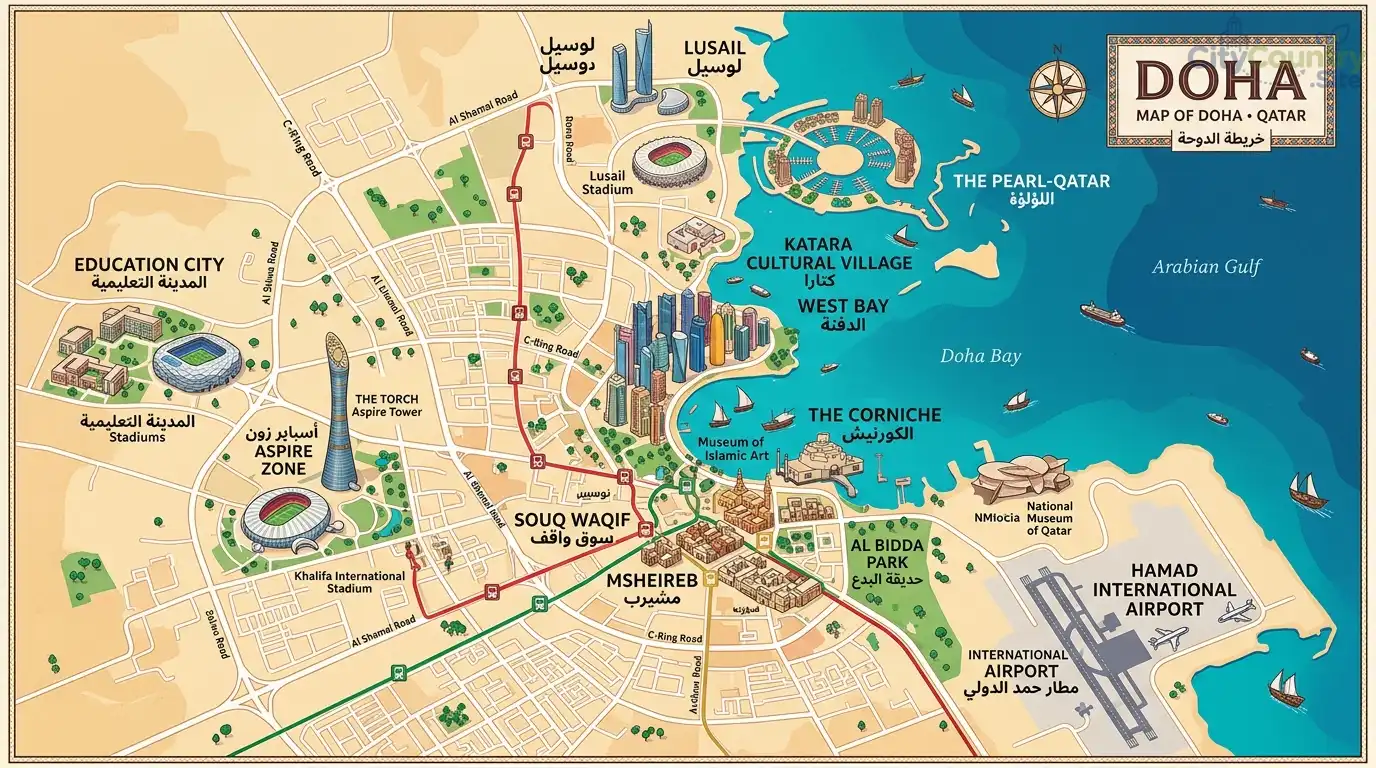
Doha occupies a broad, flat coastal plain on the eastern shore of the Qatar Peninsula, facing the Arabian Gulf. The city is almost entirely flat — Qatar’s highest point is barely 100 metres above sea level — with the urban area spreading inland from the waterfront Corniche in a series of concentric rings of development.
The Corniche — a beautifully maintained 7-km seafront promenade curving around Doha Bay — is the geographic and visual heart of the city, with the West Bay skyscraper district rising dramatically behind it and the historic Souq Waqif a short walk to the south.
Neighborhood Comparison Table
| Area | Best For | Vibe | Price Level |
|---|---|---|---|
| West Bay (Diplomatic Quarter) | Luxury hotels, towers, business | Modern, gleaming, international | High–Luxury |
| Souq Waqif Area | History, culture, street food, atmosphere | Traditional, atmospheric, tourist-friendly | Budget–Mid |
| The Pearl-Qatar | Luxury living, waterfront dining, marina | Upscale, cosmopolitan, European-feel | High–Luxury |
| Msheireb Downtown | Heritage, art, new urbanism | Cultural, walkable, sophisticated | Mid–High |
| Katara Cultural Village | Art, theater, beach, culture | Elegant, cultured, family-friendly | Mid–High |
| Al Sadd | Local life, mid-range hotels, authentic | Residential, authentic, less touristic | Budget–Mid |
| Lusail City | New development, F1 circuit, future district | Ultra-modern, spacious, ambitious | Mid–Luxury |
| Al Waab / Aspire Zone | Sports, families, parks, malls | Active, suburban, family | Mid |
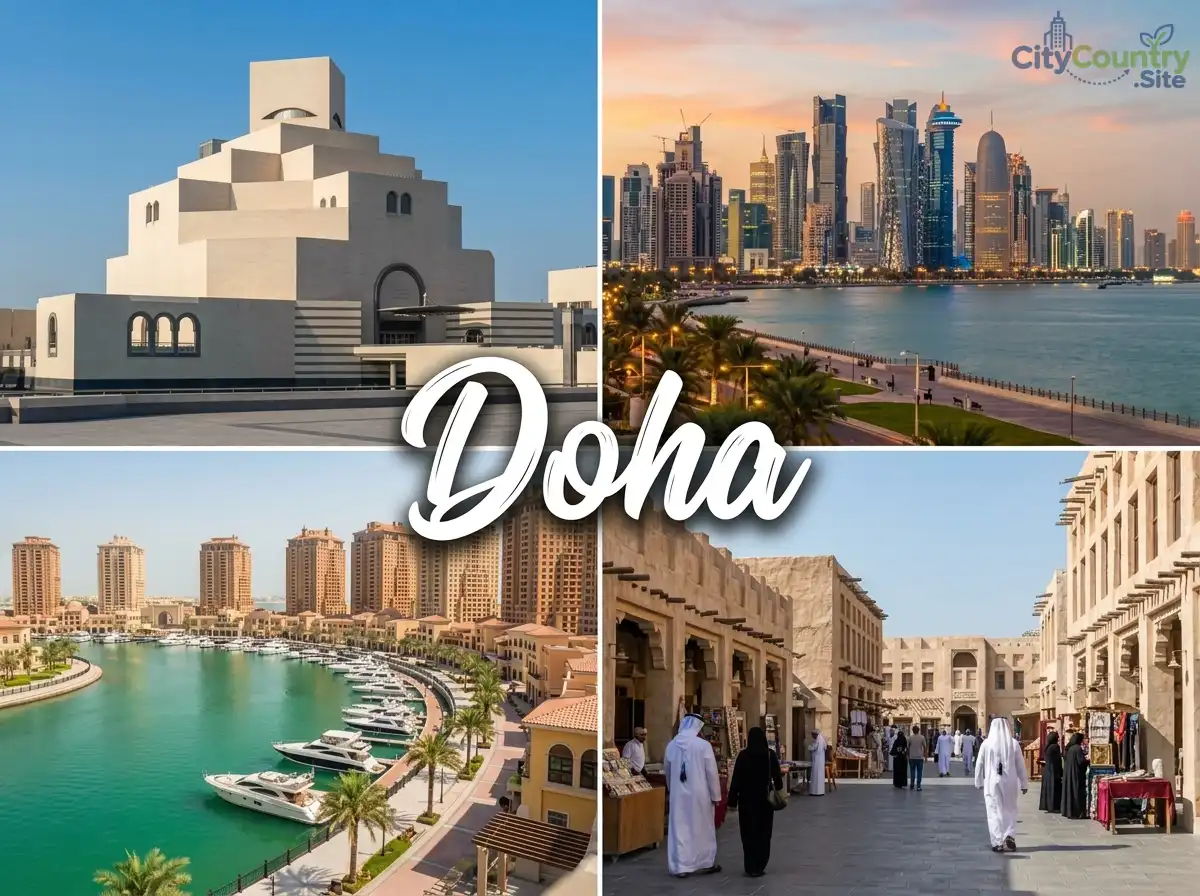
West Bay is Doha’s most spectacular neighborhood — the cluster of extraordinary towers (including the twisted Tornado Tower and the distinctive Al Bidda Tower) that defines the city’s skyline and houses its finest hotels, corporate headquarters, and the diplomatic community. Souq Waqif is the soul of traditional Doha — a beautifully restored Ottoman-era market of narrow alleys, shisha cafés, traditional restaurants, and hundreds of shops selling spices, fabrics, and artisan goods. The Pearl-Qatar — an artificial island connected to the mainland — is a Mediterranean-style marina development of extraordinary luxury, with yacht berths, high-end restaurants, and boutique shopping in a setting of fountains and palm-lined promenades.
5. Doha Weather & Temperature Guide
Doha has a hot desert climate — one of the most extreme on earth for a major inhabited city. The key variable is not rainfall (there is almost none) but temperature — and the difference between Doha’s winter and summer is dramatic enough to make them feel like different cities.
- Cool season (winter): November to March — warm to pleasantly cool, outdoor life is at its finest
- Hot season (summer): June to September — temperatures reach 43°C+ with extreme humidity from the Gulf; outdoor activity is severely limited
- Shoulder seasons: April–May and October — transitional, manageable with care
Month-by-Month Weather Table
| Month | Avg Temp (°C) | Humidity | Crowd Level | Travel Recommendation |
|---|---|---|---|---|
| January | 14–22 | Low | High | ⭐ Excellent — perfect weather |
| February | 14–23 | Low | High | ⭐ Excellent |
| March | 17–27 | Low–Medium | High | ⭐ Excellent — warming pleasantly |
| April | 22–33 | Medium | Medium | ✅ Good — getting warmer |
| May | 27–38 | Medium–High | Low | ⚠️ Hot — limit outdoor time |
| June | 30–41 | High | Very Low | ⚠️ Extremely hot and humid |
| July | 32–43 | Very High | Very Low | ⚠️ Hottest month — indoor only |
| August | 32–43 | Very High | Very Low | ⚠️ Unbearable outdoors |
| September | 29–40 | High | Low | ⚠️ Still very hot |
| October | 24–35 | Medium | Medium | ✅ Good — improving |
| November | 19–28 | Low | High | ⭐ Excellent — season begins |
| December | 15–23 | Low | High | ⭐ Excellent — peak season |
November through March is Doha’s golden season — outdoor life is glorious, the Corniche comes alive, the souq fills with visitors, and the city operates at full cultural vibrancy. December and January are the finest months — temperatures are positively cool by Gulf standards (14°C at night), perfect for walking, outdoor dining, and desert excursions.
June through September is for those with no choice. Temperatures regularly exceed 43°C and the combination of heat and Gulf humidity creates a “feels like” temperature of 50°C+. All outdoor activity is essentially limited to the brief hours around dawn.
💡 Did You Know? Doha experienced one of the highest temperatures ever recorded in any inhabited city on earth during the summer of 2023 — surpassing 50°C at peak. The city’s response has been remarkable: air-conditioned bus stops, outdoor cooling systems, and even air-conditioned outdoor markets ensure that life continues through the summer. Doha has essentially engineered its way around an otherwise uninhabitable climate.

6. Doha Airport & Getting There
Hamad International Airport (DOH)
Hamad International Airport (IATA: DOH) is consistently ranked among the world’s finest airports — winning Skytrax’s World’s Best Airport multiple times and providing a first arrival experience that genuinely sets the tone for what Doha aspires to be. The airport opened in 2014, replacing the old Doha International Airport, and was designed by HOK architects as a statement of Qatari ambition and hospitality.
Located approximately 9 km south of the city center, it is the hub of Qatar Airways — consistently ranked among the world’s top three airlines and one of the most impressive carriers in global aviation. Qatar Airways operates a vast international network, making Doha one of the world’s most connected transit hubs — a reason why millions of travelers pass through who may never have specifically planned to visit Qatar.
The airport’s interior is famous for its Lamp Bear — a giant yellow teddy bear sculpture by Urs Fischer that greets arriving passengers in the terminal — and its extraordinary retail and dining facilities, which are widely considered the finest of any airport in the world.
Getting from Hamad International Airport to City Center:
| Transport Option | Duration | Cost (Approx.) | Notes |
|---|---|---|---|
| Doha Metro (Red Line) | 25–35 min | QAR 2–5 (~$0.55–1.40) | Excellent, clean, easiest option |
| Uber / Careem | 20–30 min | QAR 40–70 (~$11–19) | Reliable, app-based |
| Hotel Limousine | 20–30 min | QAR 80–150 (~$22–41) | Most comfortable; pre-book |
| Airport Taxi | 20–30 min | QAR 60–100 (~$16–27) | Available at taxi rank |
The Doha Metro — opened in 2019 — connects directly from the airport to the city center and is the finest value option. Clean, air-conditioned, efficient, and an extraordinary achievement for a city that had no metro at all until six years ago.
Getting to Doha from Neighboring Countries:
| Origin | Transport | Duration | Cost (Approx.) |
|---|---|---|---|
| Dubai, UAE | Flight | 1 hour 15 min | $80–200 |
| Abu Dhabi, UAE | Flight | 1 hour 30 min | $90–220 |
| Riyadh, Saudi Arabia | Flight | 1 hour 10 min | $80–180 |
| Kuwait City | Flight | 1 hour | $90–200 |
| Muscat, Oman | Flight | 1 hour 30 min | $100–220 |
| Bahrain | Road / causeway | Not currently available (diplomatic) | — |
💡 Did You Know? Qatar Airways operates one of the world’s largest and youngest aircraft fleets — flying to over 160 destinations across six continents. The airline’s Hamad International Airport hub handles over 50 million passengers annually — extraordinary for a country of barely 3 million residents. Qatar’s aviation strategy — building one of the world’s great airlines as a vehicle for global influence — is widely studied as a model of small-state soft power projection.
7. Getting Around Doha
Doha has transformed its urban transport infrastructure dramatically since the World Cup preparations, and navigating the city is considerably easier than it was even five years ago.
Doha Metro is the city’s newest and finest transport option — three lines (Red, Green, Gold) connecting the airport, West Bay, Souq Waqif, Msheireb, Education City, and other key destinations. Clean, air-conditioned, punctual, and inexpensive (QAR 2–5 per journey). The metro has transformed urban mobility in Doha and is by far the recommended way to get between major attractions.
Uber and Careem operate extensively throughout Doha. Careem is the region’s own ride-hailing platform — reliable, widely used, and preferred by many residents. A typical city ride costs QAR 20–60 (~$5.50–16.50). Always use these apps rather than hailing taxis on the street for transparent, fair pricing.
Taxis — official cream-colored taxis with meters — are widely available but less convenient than app-based rides. Ensure the meter is running before departure.
Walking is practical in specific areas — along the Corniche, throughout Souq Waqif, in Msheireb Downtown, and around The Pearl-Qatar marina. Beyond these areas, the heat (in summer) and the distances between attractions make walking impractical. Between November and March, the Corniche walk from West Bay to Souq Waqif (about 6 km) is one of the finest urban waterfront walks in the Gulf.
The Pearl Monorail — a small monorail system within The Pearl-Qatar island — provides entertainment as much as transport, connecting the island’s various districts.
Car rental is widely available and useful for desert day trips and visiting attractions not on the metro network. Drive on the right side of the road.
8. Top Attractions & Best Places in Doha
Top Attractions Table
| Attraction | Type | Entry Fee | Best Time | Time Needed |
|---|---|---|---|---|
| Museum of Islamic Art (MIA) | World-class art museum | Free | Morning | 3–4 hours |
| Souq Waqif | Traditional market / heritage | Free | Evening (cooler) | 2–4 hours |
| National Museum of Qatar | National identity museum | QAR 50 (~$14) | Morning | 3–4 hours |
| The Pearl-Qatar | Luxury marina / waterfront | Free | Evening | 2–3 hours |
| Katara Cultural Village | Arts / culture / beach | Free | Afternoon | 2–3 hours |
| Corniche Promenade | Waterfront walk / views | Free | Sunrise / Sunset | 1–3 hours |
| Msheireb Museums | Heritage / urban history | QAR 30–50 each | Morning | 2 hours (each) |
| Aspire Zone and Torch Hotel | Sports complex / architecture | Free (grounds) | Morning | 1.5 hours |
| Al Zubarah Fort and Archaeological Site | UNESCO World Heritage | QAR 30 (~$8) | Morning | 2–3 hours (day trip) |
| Desert Safari (inland sea / Khor Al Udeid) | Desert / dunes | $60–120 (tour) | Morning | Half–Full day |
| Losail International Circuit | F1 / motorsport | Event tickets | Race days | Event dependent |
| 3-2-1 Qatar Olympic and Sports Museum | Sports history | QAR 50 | Morning | 2 hours |
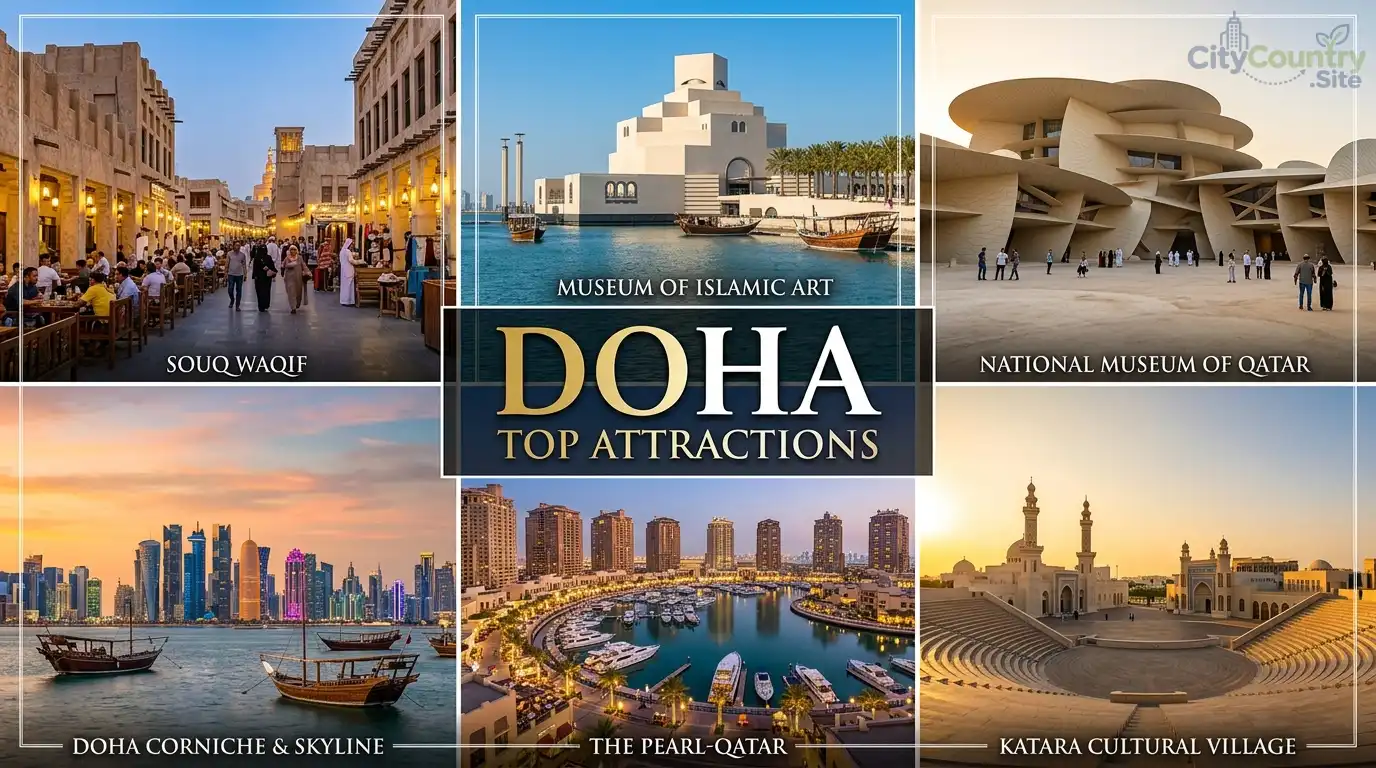
The Museum of Islamic Art (MIA) is Doha’s crown jewel and one of the world’s great museums. Designed by the legendary I.M. Pei (his last major project, completed in 2008 at the age of 91) and sitting on its own island connected to the Corniche by a causeway, the building is an architectural masterpiece — a pure geometric form of white limestone that references Islamic architectural principles in a completely contemporary language. The collection inside — spanning 1,400 years of Islamic art from Spain to Central Asia — is extraordinary. Calligraphy, ceramics, textiles, jewelry, manuscripts, and metalwork of the highest quality fill galleries of beautiful simplicity. Entry is completely free. This is one of the finest free museums in the world.
Souq Waqif is Doha’s most beloved and atmospheric attraction — a beautifully restored Ottoman-era market covering several city blocks of narrow, covered alleyways. The souq sells spices, fabrics, perfumes, oud incense, traditional clothing, falconry equipment, live animals (including exotic birds and falcons), handicrafts, and antiques. Dozens of restaurants and shisha cafés fill its lanes with the smell of grilling meat and fragrant tobacco smoke. In the evening, the whole complex glows with warm light and fills with Qataris in white thobes and women in black abayas alongside tourists from everywhere on earth. It is the most atmospheric public space in Qatar — and one of the finest traditional markets in the Arab world.
The National Museum of Qatar — opened in 2019, designed by Jean Nouvel — is one of the most architecturally extraordinary museum buildings on earth. Inspired by the desert rose — a crystalline mineral formation that occurs in the Qatari desert — the building’s interlocking disc shapes spiral around an ancient palace complex, creating a structure that is simultaneously ancient and futuristic. The exhibition inside tells the complete story of Qatar — from the ancient seafloor geology that created the peninsula, through the Bedouin and pearl-diving heritage, to the oil era and the country’s modern transformation. Brilliantly designed and deeply moving.
Msheireb Downtown Doha is perhaps the most thoughtful of all Doha’s developments — a deliberate attempt to create a walkable, human-scale, sustainable urban neighborhood at the heart of the city. Built on the site of the original Doha townsite and completed in phases since 2016, Msheireb integrates traditional Qatari architectural elements into a contemporary urban design of genuine quality. The four Msheireb Museums — housed in preserved pearl merchant houses — tell the story of Doha’s urban history with outstanding scholarship and care.
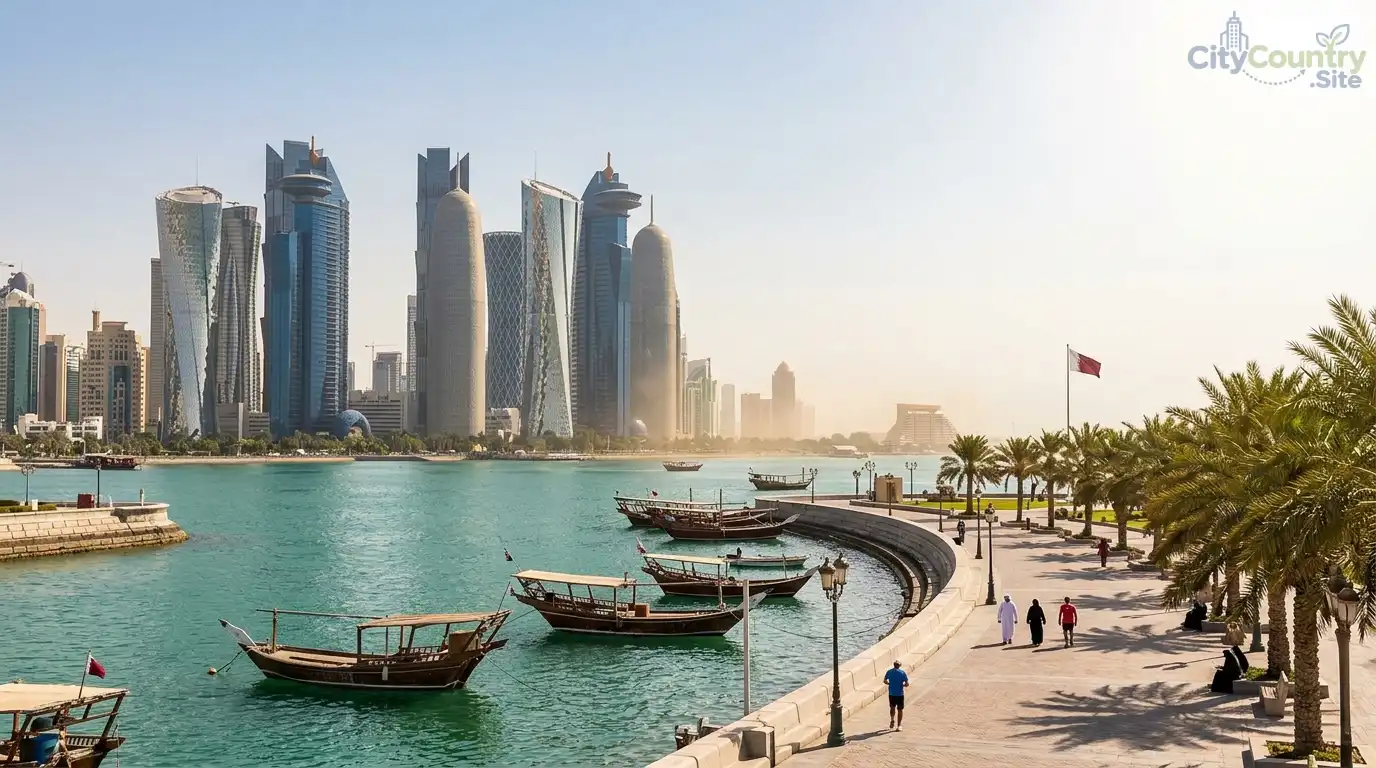
The Corniche Promenade is the finest free experience in Doha — a beautifully maintained 7-km waterfront walkway curving around Doha Bay, with the West Bay skyline on one side and the open waters of the Arabian Gulf on the other. At dawn, the light is extraordinary; at sunset, it is unforgettable. Dhow boats sail across the bay. The skyline glows. And somewhere in the middle distance, the Museum of Islamic Art sits on its island like a perfectly proportioned jewel.
💡 Did You Know? The Museum of Islamic Art was designed by I.M. Pei at the age of 91 — making it one of the finest late-career masterpieces in architectural history. Pei, already famous for the Louvre Pyramid in Paris and the National Gallery East Building in Washington D.C., spent six months traveling through Egypt, Tunisia, Syria, and Iran studying Islamic architecture before beginning the design. He died in 2019 at the age of 102, having seen the museum become one of the world’s most celebrated cultural institutions.
9. Doha Food & Cuisine Guide
Doha’s food scene is one of the most diverse and sophisticated in the Middle East — a reflection of the city’s extraordinary demographic mix and its ambition to position itself as a global destination. Traditional Qatari cuisine exists alongside Lebanese, Persian, Indian, Pakistani, Filipino, Japanese, Italian, and every other cuisine imaginable.
Must-Try Dishes in Doha
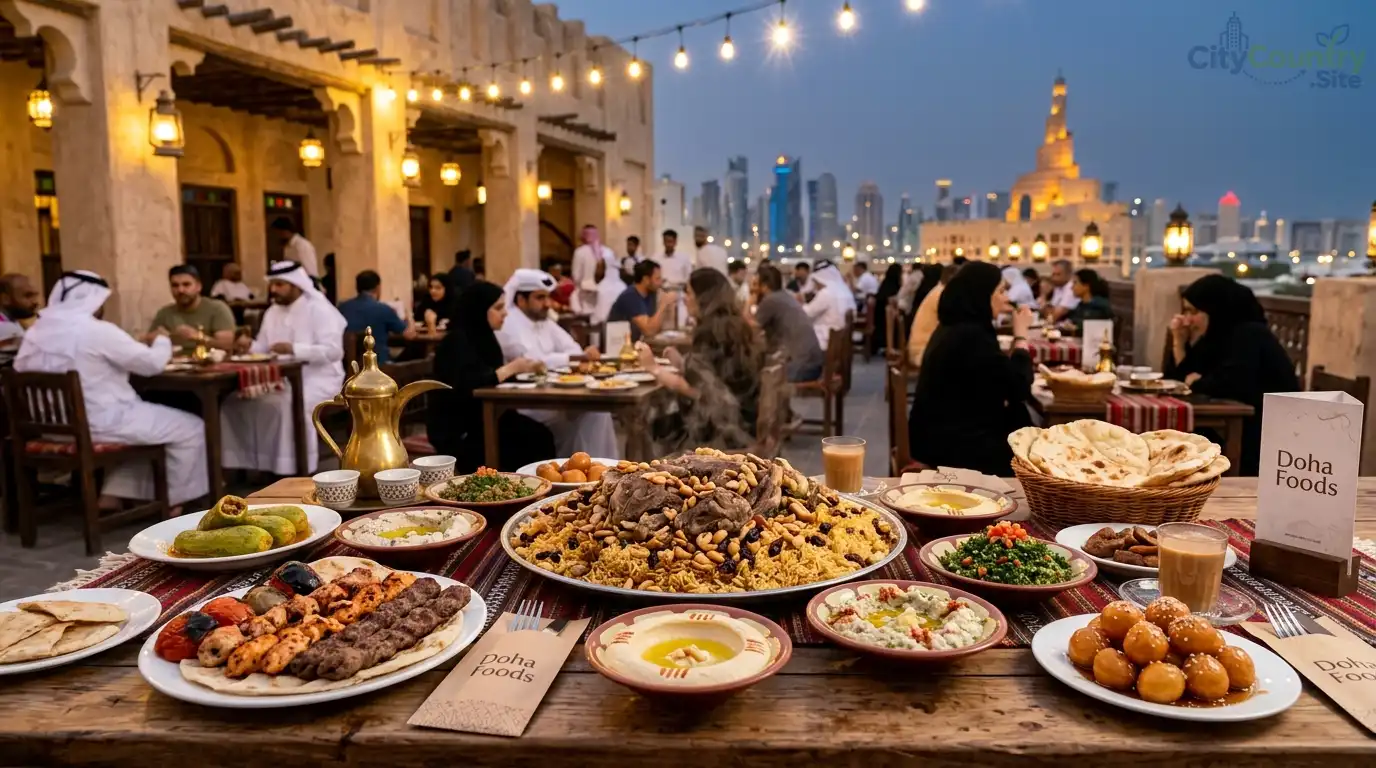
Machboos (Kabsa) — Qatar’s national dish and the definitive Qatari meal. Long-grain basmati rice slow-cooked in a rich broth of meat (lamb, chicken, or fish), dried limes (loomi), rose water, and a complex blend of Gulf spices — cinnamon, cardamom, coriander, cumin, and dried black lemon. The rice absorbs the meat’s flavor completely, creating a deeply aromatic, subtly spiced dish of extraordinary comfort. Served with tomato sauce (dakous) and yogurt.
Harees — Whole wheat grains slow-cooked with meat (usually chicken or lamb) until they break down into a smooth, porridge-like consistency, then seasoned with clarified butter and cumin. Simple, ancient, profoundly nourishing. A traditional Ramadan dish and Eid celebration food. Eaten across the Gulf for over a thousand years.
Margoog — A hearty stew of meat and vegetables — typically lamb with potatoes, carrots, tomatoes, and onions — cooked with wheat flatbread broken into the stew. The bread absorbs the broth and swells, creating a thick, filling, immensely satisfying one-pot meal. Quintessential Qatari home cooking.
Balaleet — One of Qatar’s most distinctive and surprising dishes — vermicelli noodles cooked with sugar, cardamom, and rose water, topped with a fried egg. The combination of sweet, fragrant noodles and savory egg is unusual but deeply traditional, typically eaten for breakfast or as a sweet-savory snack throughout the day.
Madrouba — Slow-cooked chicken and rice dish in which the rice is cooked until completely broken down into a thick, creamy consistency, seasoned with saffron, cardamom, and clarified butter. Rich, golden, aromatic. A festive dish served at special occasions.
Luqaimat — Small, golden deep-fried dough balls drizzled with date syrup and sesame seeds. Qatar’s most beloved street dessert — eaten hot from the fryer, crispy outside and pillowy inside, the date syrup adding deep caramel sweetness. Found throughout Souq Waqif and at traditional dessert stalls.
Karak Chai — The Gulf version of Indian masala chai — strong black tea brewed with evaporated milk, cardamom, and saffron. Thick, sweet, warming, and completely addictive. Drunk throughout the day from tiny plastic cups at teashops across the city. The social glue of Qatari daily life.
Fresh Seafood — Qatar’s coastal location makes seafood central to traditional cuisine. Hamour (grouper) — Qatar’s most prized fish — is served grilled, fried, or in curries throughout the city. Fresh prawns from the Gulf are outstanding. The fish souq near the old port serves the finest and freshest.
Best Restaurants & Food Spots
Al Aker Kitchen (Souq Waqif) — One of the finest traditional Qatari restaurants in the city — an atmospheric venue in the souq serving authentic machboos, margoog, and harees in a beautifully decorated traditional setting. Essential. QAR 60–150 (~$16–41) per person.
Parisa Persian Restaurant (Souq Waqif) — Doha’s finest Persian restaurant — set in a beautifully decorated traditional building with fountain courtyard, serving extraordinary lamb kebabs, saffron rice, fesenjan (pomegranate and walnut stew), and fresh herbs. QAR 80–200 (~$22–55).
Izel (The Pearl) — Outstanding modern Mediterranean cuisine in a beautiful waterfront setting overlooking The Pearl marina. One of Doha’s finest dining experiences. QAR 150–350 (~$41–96).
Jiwan (Museum of Islamic Art) — The restaurant within the MIA building serves excellent modern Middle Eastern cuisine in an extraordinary architectural setting. Worth visiting for the space alone. QAR 100–250 (~$27–69).
Al Marsa Floating Restaurant — A unique dining experience on a boat moored in Doha Bay — fresh Gulf seafood in a setting of genuine romance, with the city skyline glowing behind you across the water. QAR 120–280 (~$33–77).
Luqaimat Stalls (Souq Waqif) — For the finest quick, cheap, authentic eating in Doha, the luqaimat stalls in the souq sell hot date-syrup doughnuts for barely QAR 10–15 and are always busy with local families. Join the queue.
Karak Chai Teashops (Al Sadd and Souq Waqif) — Dozens of small teashops across the city serve outstanding karak chai for QAR 1–3 per cup. The teashop culture — men gathered around tiny cups of tea in heated conversation — is one of the most authentic and accessible social experiences in Qatar.
💡 Did You Know? Qatar has the world’s largest per-capita consumption of karak chai — the spiced, milky Gulf tea that is drunk at every social occasion, business meeting, and family gathering throughout the day. A Qatari family may drink 10–15 cups per person per day during social visits. The ritual of preparing and serving karak — in specific glasses, at the right temperature, with exactly the right ratio of milk to tea to cardamom — is considered a social art of considerable importance.
10. Doha Accommodation Guide
Doha has one of the world’s finest luxury hotel sectors — a concentration of five-star properties that is remarkable even by global standards. Mid-range options are growing but the city’s accommodation market skews heavily upscale.
Best Areas to Stay:
- West Bay: Best for luxury and business — the finest hotels, most spectacular views, closest to the corporate and diplomatic center
- Souq Waqif Area: Best for atmosphere and culture — walking access to the souq and waterfront
- The Pearl-Qatar: Best for a self-contained luxury experience — marina setting, restaurants, boutiques
- Msheireb: Best for those prioritizing culture, walkability, and heritage
- Al Sadd: Best for budget and mid-range travelers wanting a more local, authentic experience
Accommodation Price Ranges (2026)
| Category | Price/Night (USD) | Examples |
|---|---|---|
| Budget Hotel / Apartment | $40–80 | Various apartment hotels in Al Sadd |
| Mid-Range Hotel | $90–180 | Souq Waqif Boutique Hotels, Grand Heritage Doha |
| Upscale Hotel | $180–350 | Mondrian Doha, Marsa Malaz Kempinski |
| Luxury Hotel | $350–1,000+ | Mandarin Oriental, Four Seasons Doha, St. Regis Doha, Raffles Doha |
The Four Seasons Hotel Doha is consistently among the finest hotels in the Gulf — a beautifully designed property on the Corniche with extraordinary views of the bay and skyline, outstanding restaurants, an exceptional spa, and service of the very highest standard. Rates: approximately $400–800 per night.
The Souq Waqif Boutique Hotels — a collection of eight boutique hotels converted from traditional buildings within the souq itself — offer the most atmospheric and culturally immersive accommodation in Doha. Staying within the souq, waking to the call to prayer and the smell of incense, is a completely different experience from the West Bay towers. Rates: approximately $150–280 per night.
Grand Heritage Doha near Souq Waqif is excellent mid-range value — comfortable, well-located, and with a helpful staff. Rates: approximately $100–160 per night.
11. Best Time to Visit Doha
November through March is Doha’s season — and there is really no close second. These five months deliver the Gulf’s finest weather: warm, dry, sunny days with temperatures in the 18–27°C range and cool evenings ideal for outdoor dining, walking the Corniche, and desert excursions. The entire city comes alive during this period.
December and January are peak months — the weather is at its finest and Doha’s cultural calendar is at its fullest. Book accommodation well in advance.
February and March offer excellent weather with slightly fewer visitors than December–January. March begins warming but remains very comfortable.
October is a transitional month — temperatures are dropping from summer highs but still reach 32–35°C during the day. Manageable for those who prefer fewer crowds and lower prices.
April and early May are the shoulder seasons — warming rapidly, with temperatures in the mid-to-upper 30s°C. Outdoor time should be limited to early morning and evening.
June through September is the genuine off-season — extreme heat, extremely high humidity, and outdoor activity reduced to near zero. Hotels offer dramatically reduced rates during this period. The city remains fully functional — just entirely indoors. Only recommended for business travelers or those with no seasonal flexibility.
Key Festivals & Events in Doha
- Qatar National Day (December 18) — The most important national celebration — fireworks over the Corniche, military parades, cultural performances, and the entire city draped in maroon and white. Extraordinary atmosphere
- Doha Jewellery and Watches Exhibition (February) — One of the world’s largest luxury goods events, attracting buyers and designers from across the globe
- Qatar International Food Festival (March/April) — A celebration of Qatar’s extraordinary food diversity — local, regional, and international cuisine across multiple venues
- Qatar ExxonMobil Open (Tennis) (January) — ATP World Tour event attracting top-ranked players to Doha’s Khalifa International Tennis and Squash Complex
- Doha Film Institute Qumra (March) — Qatar’s premier film development festival — supporting emerging filmmakers from across the Arab world
- Ramadan (dates vary) — The holy month transforms Doha’s atmosphere entirely. Iftar (breaking fast at sunset) becomes the city’s primary social ritual; restaurants fill at dusk; the souq is at its most atmospheric after midnight prayers
- Qatar Prix (F1, Lusail Circuit) (November) — The Formula 1 Qatar Grand Prix at the Lusail International Circuit brings racing teams and fans from across the world
12. Shopping Guide for Doha tour
Doha is one of the Middle East’s premier shopping destinations — a combination of the finest traditional souq trading in the Arab world and some of the most spectacular modern retail environments on the planet.
What to Buy:
Oud Perfume and Incense — Qatar’s most distinctive luxury souvenir. Oud — extracted from agarwood trees — is the world’s most expensive perfume ingredient, with top-quality Qatari oud selling for thousands of dollars per kilogram. Blended oud perfumes, oud chips for burning, and oud incense sticks are available throughout Souq Waqif’s perfume alley in an extraordinary range of quality and price.
Traditional Qatari Jewelry — Gold and silver jewelry in traditional Gulf styles — elaborate necklaces, bangles, and rings — available in the gold souq section of Waqif. Beautiful, authentic, and competitively priced compared to European markets.
Khanjar (Traditional Dagger) — The ornate ceremonial dagger of the Gulf — with its distinctive curved blade and silver-handled scabbard — is one of the region’s most distinctive decorative objects. Available in antique and reproduction versions throughout the souq.
Pashmina and Silk Fabrics — High-quality shawls, scarves, and fabrics from across the Islamic world — Central Asia, Iran, Kashmir — available in Souq Waqif’s fabric section.
Saffron and Gulf Spices — The finest Iranian saffron, dried limes (loomi), rose water, cardamom, and various Gulf spice blends make outstanding lightweight culinary souvenirs.
Falconry Equipment — Qatar and the broader Gulf region are the global center of the ancient art of falconry — a UNESCO Intangible Cultural Heritage practice. Souq Waqif’s falconry section sells hoods, gloves, perches, and bells for falcons, as well as live birds. Even if you are not a falconer, the falconry souq is one of the most extraordinary market experiences in the Arab world.
Qatari Contemporary Art — Doha’s growing gallery scene produces Qatari and broader Arab contemporary art of increasing international recognition.
Where to Shop:
Souq Waqif — The most important and atmospheric shopping destination in Doha. Spend several hours browsing the spice alley, perfume souq, fabric section, antiques lane, falconry area, and food market. Bargaining is appropriate for most goods; fixed prices at some established shops.
Villaggio Mall — Doha’s most famous mall and one of the world’s most theatrical retail environments — an indoor Venetian-style canal runs through the mall, complete with gondola rides, beneath a painted sky ceiling. International luxury brands, restaurants, and a large ice-skating rink. Bizarre and wonderful.
Place Vendôme Qatar — A spectacular Parisian-themed mall in Lusail City — one of the world’s most ambitious retail developments, with a glass-domed atrium inspired by the Galerie des Glaces at Versailles.
Mall of Qatar — One of the largest malls in the Middle East — 500+ stores, international brands, entertainment center, cinemas, and extensive food options.
The Pearl-Qatar Boutiques — Luxury fashion boutiques, jewelry stores, and lifestyle shops line the marina walkways of The Pearl — more pleasant for browsing than enclosed malls.

13. Doha Nightlife & Entertainment
Doha’s entertainment scene is more varied than many visitors expect for an Islamic country, though it differs fundamentally from Western nightlife cultures. Alcohol is available in licensed hotel bars and restaurants but not in public spaces or at the souq.
Cultural Evenings:
Katara Cultural Village hosts an extraordinary year-round calendar of events — theater, opera, film screenings, art exhibitions, traditional music performances, and beach events. The village’s architecture — combining traditional Islamic design with contemporary amphitheater and gallery spaces — is beautiful, and events range from free to ticketed. One of the finest cultural venues in the Gulf.
Qatar National Theater — Regular performances of Arabic drama, dance, and music in a world-class venue. Programming reflects both traditional Qatari and pan-Arab artistic culture.
Dhow Cruise — An evening cruise around Doha Bay on a traditional wooden dhow, with the skyline and the MIA building illuminated against the night sky, is one of Doha’s most romantic and distinctive experiences. Several operators offer dinner cruises. QAR 100–300 (~$27–82) per person depending on inclusions.
Hotel Bars and Lounges:
Alcohol is served in licensed hotel restaurants and bars and in a few designated restaurants and clubs. Options include:
Skyview Bar (Four Seasons) — Doha’s finest cocktail experience — a rooftop bar with panoramic views of the bay and skyline, exceptional cocktails, and an atmosphere of understated luxury.
Wahm (Mondrian Doha) — The Mondrian Hotel’s spectacular lobby bar — one of the most architecturally dramatic spaces in any hotel in the Gulf. Outstanding cocktails in a setting of extraordinary design.
51 East (W Doha Hotel) — A long-running popular bar attracting a cosmopolitan crowd of expats and visitors. Reliable cocktails and a lively atmosphere.
Shisha Culture:
Shisha cafés throughout Souq Waqif are perhaps Doha’s most authentic evening entertainment — ordering a flavored water pipe (shisha) with karak chai or fresh juice, settling into cushioned outdoor seating, and watching the souq’s evening parade of humanity is a completely Qatari pleasure. No alcohol involved; deeply social; open until very late.
The Corniche at Night — Walking the Corniche after dark is one of Doha’s finest free experiences. The skyline is extraordinarily beautiful when lit — the towers’ architectural lighting, the MIA glowing on its island, and the dhows’ reflections on the dark water create a visual spectacle unlike any other city in the world.
14. Hidden Gems & Local Secrets
Al Wakrah Heritage Village — About 20 km south of Doha, the beautifully restored fishing village of Al Wakrah preserves the architecture, traditions, and atmosphere of pre-oil Qatar in a way that the modernized capital cannot. The waterfront, the old mosque, the restored merchants’ houses, and the small beach create a genuinely evocative glimpse of historical Qatar. Almost no tourists visit.
Al Thakhira Mangroves — In northern Qatar, approximately 80 km from Doha, the Al Thakhira mangroves are one of the most unexpected natural environments in the Gulf — dense, green mangrove forests rising from the shallow coastal waters, accessible by kayak or paddleboat. The contrast with the surrounding desert is surreal and beautiful. Flamingos, herons, and various wading birds are common.
Barzan Watchtowers (Umm Salal Mohammed) — Ancient mud-brick watchtowers rising from the desert landscape north of Doha — built in the 18th and 19th centuries to guard water supplies and observe approaching visitors. Almost entirely unknown to tourists, they stand in quiet, beautiful isolation against the desert sky.
Al Shahaniya Camel Racing Track — Qatar’s camel racing season runs from October to March, with races held at the Al Shahaniya track about 35 km west of Doha. Watching camels race — piloted by remote-controlled robot jockeys (which replaced child jockeys in 2004) — while Qatari owners chase alongside in Land Cruisers shouting encouragement is one of the most distinctively Qatari experiences available. Free to attend; races typically early morning.
Falcon Souq Evening Visit — The Souq Waqif falconry section is magical at any time but particularly extraordinary in the early evening, when Qatari falconers bring their prized birds for assessment, trading, and socializing. Falcons — some worth tens of thousands of dollars — perch calmly on gloved hands while their owners discuss pedigree and performance with the expert precision of horse breeders. A window into one of Qatar’s most important and ancient cultural traditions.
Zekreet Peninsula — About 80 km west of Doha, the Zekreet Peninsula is a dramatic landscape of flat-topped limestone mesas rising from white sand and turquoise sea — one of the most beautiful and least-visited natural landscapes in Qatar. The peninsula houses the Richard Serra Sculpture — two enormous steel sculptures by the American minimalist artist, rising from the desert landscape. The juxtaposition of contemporary art and ancient geology in complete solitude is extraordinary.
15. Day Trips from Doha
Qatar is a small country — the entire peninsula is about the size of Connecticut — meaning that virtually every attraction can be reached as a day trip from Doha.
Day Trips Table
| Destination | Distance | Travel Time | Method | Highlights |
|---|---|---|---|---|
| Inland Sea (Khor Al Udeid) | 80 km south | 1.5 hrs | 4WD / Tour | Dramatic sand dunes meeting the sea — Qatar’s natural wonder |
| Al Wakrah Heritage Village | 20 km south | 25 min | Car / Taxi | Restored fishing village, traditional architecture, beach |
| Al Zubarah Fort and Town | 105 km northwest | 1.5 hrs | Car | UNESCO World Heritage Site — best-preserved Ottoman fort in Qatar |
| Al Thakhira Mangroves | 80 km north | 1 hour | Car | Kayaking through mangroves, flamingos, natural beauty |
| Camel Racing (Al Shahaniya) | 35 km west | 40 min | Car | Traditional camel racing with robot jockeys — Oct–Mar season |
| Zekreet Peninsula | 80 km west | 1.5 hrs | Car / Tour | Desert mesas, Richard Serra sculpture, solitude |
| Barzan Watchtowers | 30 km north | 35 min | Car | Ancient mud-brick towers, desert landscape, history |
| Purple Island (Al Bahriyah) | 60 km north | 1 hour | Car / Kayak | Tidal island, flamingos, mangroves, historical ruins |
Inland Sea (Khor Al Udeid) — Qatar’s most extraordinary natural attraction — a tidal inlet where the Arabian Sea penetrates deep into the desert, surrounded by enormous golden sand dunes that can be climbed, sandboarded, and driven on by 4WD. The sight of ocean meeting desert dunes in perfect silence is one of Qatar’s defining images. Accessible only by 4WD — join an organized desert safari from Doha ($60–120 including transport, dune bashing, sandboarding, and BBQ dinner) or rent a 4WD and drive independently with a GPS and satellite phone.
Al Zubarah — Qatar’s only UNESCO World Heritage Site — is a remarkably well-preserved 18th-century fortified merchant town on the northwest coast. The Al Zubarah Fort (1938) houses an excellent archaeological museum; the ghost town behind it — the walls of hundreds of houses visible in the desert silence — is one of the most evocative archaeological sites in the Gulf. The drive through Qatar’s interior, past date palm groves and desert villages, is itself rewarding.

16. Local Culture, Customs & Etiquette
Qatar is a Muslim country with conservative social values, but it is also one of the world’s most internationally experienced nations. The culture’s approach to visitors combines genuine hospitality with clear expectations of basic respect.
Islamic Culture: Qatar follows Sunni Islam under the Maliki and Hanbali schools. Friday is the holy day — many businesses close or operate reduced hours on Friday morning. The call to prayer (adhan) sounds five times daily from mosques throughout the city — a constant, beautiful reminder of the city’s religious identity.
Ramadan: During the holy month (dates vary annually), Muslims fast from dawn to dusk. Non-Muslims are not required to fast but must not eat, drink, or smoke in public during daylight hours. Restaurants and cafés open after dark for iftar (the breaking of the fast) and the city’s atmosphere transforms — becoming more social and vibrant after sunset than at any other time of year. Ramadan is one of the most fascinating times to visit Doha for culturally curious travelers.
Dress Code: Qatar has a formal dress code law requiring modest clothing in public spaces. For visitors:
- Women: Cover shoulders and knees in public. An abaya is not required but loose, modest clothing is appropriate. Swimwear at hotel pools and beaches is fine
- Men: Shorts are generally acceptable in malls and tourist areas; long trousers are better in traditional areas and the souq
- At mosques: Both men and women must dress very modestly; women must cover their hair
Public Behavior: Public displays of affection between unmarried couples are not permitted. Excessive alcohol consumption in public spaces is illegal. Loud or boisterous behavior in religious areas is inappropriate.
Photography: Ask permission before photographing Qatari women. Government buildings, military installations, and the Emir’s palaces must never be photographed. General city photography — the Corniche, the souq, the museums — is freely permitted and encouraged.
Hospitality (Diyafa): Qatari hospitality is legendary. If you are invited into a Qatari home or receive an offer of karak chai or dates, accept graciously — refusal is culturally offensive. When offered refreshments, drink with your right hand.
Tipping:
- Restaurants: 10–15% is appreciated; some upscale restaurants add a service charge automatically
- Taxis and Uber: rounding up is appreciated
- Hotel porters: QAR 5–10 per bag
- Tour guides: QAR 50–100 for excellent service
Dos and Don’ts:
- ✅ Do dress modestly in public areas — it is both legally required and culturally respectful
- ✅ Do try karak chai in a traditional teashop — it is the most authentic Qatari beverage experience
- ✅ Do visit Souq Waqif in the evening when it is most atmospheric and cool
- ✅ Do respect prayer times — be quiet near mosques during the call to prayer
- ❌ Don’t consume alcohol outside of licensed hotel bars and restaurants
- ❌ Don’t photograph people without permission — particularly Qatari women
- ❌ Don’t display affection publicly between unmarried couples
- ❌ Don’t point the soles of your feet toward people or religious objects when sitting
17. Safety & Travel Tips
Doha is one of the safest cities in the world for tourists — consistently ranked in the top tier of global safety indices. Qatar has extremely low crime rates, an efficient police force, and a government deeply invested in presenting Qatar as a welcoming, secure destination.
Safe Areas: The entire tourist circuit — West Bay, Souq Waqif, The Pearl, Corniche, Katara, Msheireb — is completely safe at all hours. Qatar has essentially no “unsafe areas” for tourists in the conventional sense.
Main Concerns:
- Summer heat is the primary safety risk — never underestimate the danger of extreme heat and humidity; stay hydrated, stay in shade or air conditioning, and limit outdoor exposure
- Traffic — Doha has a high vehicle density and drivers can be aggressive; use pedestrian crossings and be careful crossing roads
- Dress code violations — While enforcement varies, technically dress code violations can result in a fine; dress modestly to be safe and respectful
Emergency Numbers:
- Police: 999
- Ambulance: 999
- Fire: 999 (all emergencies use 999)
- Qatar Tourism hotline: 800-2000
Health Tips:
- Dehydration is a serious risk in summer and even in winter given the dry air — drink water constantly
- All tap water in Qatar is desalinated and technically safe to drink; bottled water is universally preferred
- Medical facilities in Doha are excellent — Hamad Medical Corporation is the main public system; numerous private hospitals and clinics serve expatriates and visitors
- No specific vaccinations are required for entry but routine immunizations and hepatitis A are recommended
- Health insurance with adequate coverage is strongly recommended; medical care is expensive for uninsured visitors
18. Doha Budget Tour
Daily Cost Table
| Category | Budget Traveler | Mid-Range | Luxury |
|---|---|---|---|
| Accommodation | $40–80 (apartment hotel) | $120–250 (hotel) | $350–1,000+ (5-star) |
| Food | $15–25 (karak, local restaurants) | $40–80 (mid-range restaurants) | $100–250+ (fine dining) |
| Transport | $5–12 (Metro, Uber) | $20–45 (Uber, taxis) | $60–150 (private car) |
| Activities | $0–20 (free museums, Corniche) | $30–80 (tours, paid museums) | $100–300+ (private tours, desert safari) |
| Total/Day | ~$60–137 | ~$210–455 | ~$610–1,700+ |
Doha is expensive by global standards — particularly for accommodation, which skews heavily toward the luxury end. However, many of the city’s finest experiences — the MIA museum, the Corniche walk, Souq Waqif browsing, the National Museum — are free or very inexpensive. Budget travelers who choose apartment hotels in Al Sadd and eat at local restaurants and teashops can manage on $80–100 per day outside accommodation.
19. Practical City Information
Visa & Entry: Qatar has one of the world’s most generous visa-on-arrival policies, reflecting its ambition to attract international visitors. Citizens of over 95 nationalities — including all EU member states, USA, UK, Canada, Australia, Japan, and many others — receive free visa on arrival for up to 30 days, extendable online. Citizens of GCC countries (Saudi Arabia, UAE, Kuwait, Bahrain, Oman) enter without a visa. The Hayya Card — introduced for the World Cup — continues as a convenient pre-registration system for some nationalities. Check Qatar’s Ministry of Interior website for current requirements.
Currency: The Qatari Riyal (QAR) is pegged 1:1 to the US dollar at QAR 3.64 — making currency conversion straightforward. USD is not widely accepted in shops and restaurants; exchange at the airport or ATMs for QAR. ATMs are plentiful throughout the city. Credit cards (Visa, Mastercard) are accepted virtually everywhere.
Vaccinations: No mandatory vaccinations for most nationalities. Routine immunizations and Hepatitis A recommended. Yellow fever certificate required if arriving from endemic countries.
Emergency Contacts:
- All emergencies: 999
- Qatar Tourism: 800-2000
- Hamad Medical Corporation: 16060
SIM Cards & Internet: Available at the airport. Ooredoo and Vodafone Qatar are the two networks. Tourist SIMs with data are available from QAR 50–100 (~$14–27) depending on data allowance. 5G coverage is available throughout Doha — Qatar was among the first countries to deploy 5G networks. Wi-Fi is available at all hotels, malls, and most restaurants. Internet speeds are excellent.
Power: Qatar uses Type D and G plugs — UK-style three-pin square plugs are standard. Voltage: 240V, 50Hz. Bring a universal adapter if not using UK-standard plugs.
Drinking Water: Qatar’s tap water is desalinated and technically safe but bottled water is universally preferred. Available everywhere at very low cost (QAR 1–3 per bottle).
Alcohol: Available only in licensed hotel restaurants and bars and a few designated establishments. Not sold in supermarkets, convenience stores, or public areas. The Qatar Distribution Company (QDC) in Industrial Area sells alcohol to licensed non-Muslim residents — not accessible to tourists in practice.
20. How to Be a Responsible Traveler in Doha
Acknowledge Migrant Worker Issues: The construction of Doha’s extraordinary infrastructure — the World Cup stadiums, the metro, the towers — was accomplished by approximately 2 million migrant workers from South Asia and Southeast Asia under conditions that drew significant international criticism for labor rights violations, excessive working hours in extreme heat, and inadequate living conditions. Qatar has implemented kafala system reforms since 2020 — including the right to change employers without permission and a minimum wage — but challenges remain. Engaging honestly with this history and supporting organizations that advocate for migrant worker rights is part of responsible travel to Qatar.
Support Qatari Cultural Institutions: The MIA, National Museum, Msheireb Museums, Katara, and Fire Station Artists in Residence are all Qatari cultural investments that genuinely deserve visitor engagement. Pay entry fees where charged; buy from museum shops; attend cultural events. These institutions represent Qatar’s investment in its own cultural identity beyond oil wealth.
Respect the Dress Code: Following Qatar’s dress code requirements is not merely legal compliance but genuine cultural respect for the values of the society you are visiting. Pack modestly and embrace the opportunity to engage with a culture on its own terms.
Water Consciousness: Qatar’s water comes entirely from energy-intensive desalination — one of the most resource-demanding processes in the world. Be conscious of water use: shorter showers, no running taps, reuse hotel towels.
Desert Environment: If visiting the Inland Sea or desert areas, stay on established tracks to protect fragile desert ecosystems. Take all rubbish out of desert areas. Never remove rocks, fossils, or natural objects.
Engage Authentically: Qatar’s rapid modernization has created a culture that is simultaneously confident in its traditions and navigating enormous change. Engage with Qatari culture — visit the camel racing, drink the karak chai, visit a mosque (the Sheikh Mohammed bin Abdul Wahhab Mosque welcomes non-Muslim visitors), and show genuine curiosity about the traditions of the society you are visiting.
21. Travel Media: Documentaries, Books & Channels
Books:
- Qatar: A Modern History by Allen J. Fromherz — The definitive academic history of Qatar from its origins to the present, providing essential context for understanding what you are visiting
- City of Gold: Dubai and the Dream of Capitalism by Jim Krane — While focused on Dubai, provides outstanding context for understanding the entire Gulf development model and Doha’s place within it
- The Architecture of the Islamic World (various) — Essential contextual reading for appreciating the MIA collection
- Sandstorm: Libya in the Time of Revolution by Lindsey Hilsum — Broader Middle East context
Documentaries & Films:
- Generation Messi and various FIFA World Cup 2022 documentaries available on streaming platforms document Doha’s preparation and hosting of the tournament
- Al Jazeera English documentaries — Numerous excellent documentaries about Qatar, the Gulf, and the Arab world produced by Doha’s own international broadcaster
- Qatar: The Richest Poor Country (Vice) — A frank examination of Qatar’s wealth and inequality
YouTube Channels:
- Mark Wiens — Excellent Doha food content with genuine local insight
- Kara and Nate — Doha travel guide content
- Qatar Tourism — Official destination content with high production values
- Lost LeBlancs — Doha and Qatar travel vlog
22. Doha vs. Similar Cities
| Feature | Doha | Dubai (UAE) | Abu Dhabi (UAE) |
|---|---|---|---|
| Museum quality | ⭐⭐⭐⭐⭐ World-class MIA, NMoQ | ⭐⭐⭐⭐ Very good | ⭐⭐⭐⭐⭐ Louvre Abu Dhabi |
| Traditional atmosphere | ⭐⭐⭐⭐⭐ Finest souq in Gulf | ⭐⭐⭐ Good | ⭐⭐⭐ Moderate |
| Luxury hotels | ⭐⭐⭐⭐⭐ World-class | ⭐⭐⭐⭐⭐ World-class | ⭐⭐⭐⭐⭐ World-class |
| Nightlife | ⭐⭐⭐ Conservative but present | ⭐⭐⭐⭐⭐ Outstanding | ⭐⭐⭐⭐ Very good |
| Crowd levels | ⭐⭐⭐⭐ Less crowded than Dubai | ⭐⭐ Very crowded | ⭐⭐⭐ Moderate |
| Affordability | ⭐⭐ Expensive | ⭐⭐ Expensive | ⭐⭐ Expensive |
| Cultural depth | ⭐⭐⭐⭐⭐ Exceptional | ⭐⭐⭐ Moderate | ⭐⭐⭐⭐ Very good |
| Desert experience | ⭐⭐⭐⭐⭐ Inland Sea — unique | ⭐⭐⭐⭐ Very good | ⭐⭐⭐⭐⭐ Exceptional |
Choose Doha if you want the Gulf’s finest museum culture, the most authentic traditional souq experience in the region, a slightly less frenetic atmosphere than Dubai with equally world-class luxury, and the distinctive fascination of a city that represents one of the most extraordinary economic and social transformations in human history.
23. Doha City Travel Tips
- Visit between November and March — summer heat is genuinely extreme and limits outdoor experience severely
- The Doha Metro is excellent — use it for airport transfers and between major attractions
- Souq Waqif is best experienced in the evening — cooler, more atmospheric, more people
- The Museum of Islamic Art is completely free — one of the world’s great free museums; allocate a minimum of 3 hours
- Dress modestly throughout the city — cover shoulders and knees in public spaces
- Karak chai at a local teashop costs barely $0.50 and is the most authentic Qatari experience available
- Download Careem (not just Uber) — often better pricing and availability in Qatar
- The Corniche walk at sunrise is one of the Gulf’s finest free experiences — do it before the heat builds
- Luqaimat (date-syrup doughnuts) at Souq Waqif cost barely $3 and are one of the Gulf’s greatest street food pleasures
- During Ramadan, eat privately during daylight hours and join iftar celebrations at sunset
- Desert safaris to the Inland Sea should be booked through reputable operators with proper 4WD vehicles
- Qatar has effectively zero crime for tourists — relax and enjoy the city freely
💡 Did You Know? Qatar has the highest GDP per capita of any country on earth — approximately $80,000–100,000 USD per Qatari national per year, driven by the world’s third-largest natural gas reserves. This extraordinary wealth — concentrated among a citizen population of barely 300,000 — funds the museums, the architecture, the airlines, the universities, and the global sports events that have put Doha on the world map in barely two generations. The Qatari national who passes you in the souq in a white thobe is, statistically, among the wealthiest individuals on earth.
24. Is Doha Worth Visiting?
Yes — more emphatically than most travelers currently appreciate. Doha has spent years being dismissed as merely a stopover — a transit point for Qatar Airways passengers heading to Southeast Asia or Africa. Those who stay discover one of the most intellectually stimulating, architecturally extraordinary, and culturally surprising cities in the world.
It is not without complications. The ethics of Qatar’s labor practices, the speed of its transformation, and the tensions between its traditional Islamic values and its global ambitions are all real and deserve honest engagement. But the city itself — its museums, its souq, its waterfront, its desert, its food — is genuinely remarkable.
Doha is best suited for:
- Architecture and design enthusiasts — The concentration of extraordinary contemporary architecture (I.M. Pei, Jean Nouvel, Rem Koolhaas, Norman Foster, and more) in a single small city is unmatched anywhere on earth
- Museum and art lovers — The MIA, the National Museum, the Msheireb Museums, and the growing gallery scene represent one of the most ambitious cultural investments by any government in history
- Food adventurers — Traditional Qatari cuisine is genuinely extraordinary and largely unknown outside the Gulf; Doha’s restaurant diversity reflects its global connections beautifully
- Luxury travelers — Doha’s five-star hotel sector sets the global standard for service and facility
- History and culture enthusiasts — The layers of Bedouin tradition, pearl-diving heritage, Islamic scholarship, and 70-year modernization are endlessly fascinating
- Photographers — The combination of extraordinary contemporary architecture, traditional souq atmosphere, desert landscapes, and the theatrical light of the Gulf makes Doha one of the world’s finest photography destinations
- Travelers curious about the Arab world — Doha is the Arab world’s most accessible and visitor-friendly introduction to Gulf culture
Less suited for travelers seeking beaches and casual outdoor life (the heat makes this seasonal at best), vibrant party nightlife (limited by Islamic social norms), or budget backpacker experiences (Doha is consistently expensive).
The verdict: Give Doha three full days minimum — four is better. Combine with a desert safari to the Inland Sea, an evening at the Souq, morning at the MIA, and a walk along the Corniche at sunrise. Add a day trip to Al Zubarah or the mangroves. This is a city that rewards the curious traveler who engages beyond the surface. Come with an open mind, dress respectfully, drink the karak chai, and prepare to be genuinely, thoroughly impressed.
25. Frequently Asked Questions About Doha
Q1: Is Doha safe for tourists?
Doha is one of the safest cities in the world for tourists. Qatar consistently ranks at or near the top of global safety indices. Crime against tourists is extremely rare. The main practical safety concern is the extreme summer heat — which is genuinely dangerous if underestimated — rather than human threat. Women travelers, including solo female travelers, report exceptionally positive safety experiences in Doha.
Q2: Do I need a visa to visit Qatar?
Citizens of over 95 nationalities receive a free visa on arrival valid for 30 days, extendable. This includes all EU member states, USA, UK, Canada, Australia, Japan, South Korea, and many others. GCC citizens enter without any visa formality. Check Qatar’s Ministry of Interior website for your specific nationality’s current requirements before travel.
Q3: Can I drink alcohol in Doha?
Alcohol is available in licensed hotel restaurants and bars and some designated establishments. It is not sold in supermarkets, convenience stores, or public spaces. Major hotels all have licensed bars. Drinking in public, on the street, or in non-licensed venues is illegal. This is not as restrictive as it sounds in practice — every major hotel has multiple licensed venues.
Q4: What is the dress code in Doha?
Qatar has a formal dress code law requiring modest clothing in public spaces. Women should cover shoulders and knees; men should avoid shirtless or very short shorts in public areas. Swimwear is appropriate at hotel pools and designated beaches. At mosques, both genders must dress very modestly and women must cover their hair. The dress code is taken seriously — dress modestly as a basic sign of respect for the host culture.
Q5: What is the best way to get around Doha?
The Doha Metro is excellent — clean, air-conditioned, cheap, and covering the main tourist circuit including the airport. Careem and Uber are the recommended options for journeys off the metro network. Both are widely available, reliable, and transparently priced. Taxis are available but less convenient. Walking is practical in the Corniche, Souq Waqif, and Msheireb areas in cooler months.
Q6: Is Qatar expensive to visit?
Qatar is expensive by global standards — particularly for accommodation, which skews heavily toward four and five-star options. However, many of Doha’s finest experiences — the MIA museum, the National Museum, the Corniche walk, Souq Waqif — are free or very inexpensive. Food at local restaurants and teashops is affordable. The main budget items are accommodation and any luxury activities or fine dining. A realistic minimum daily budget (excluding flights) is approximately $80–130 in modest accommodation.
Q7: What is the Museum of Islamic Art and why is it special?
The Museum of Islamic Art (MIA) is one of the world’s great cultural institutions — a collection spanning 1,400 years of Islamic art from Spain to Central Asia, housed in a building designed by I.M. Pei and described by many architectural critics as one of the finest museum buildings of the 20th century. The collection includes extraordinary calligraphy, ceramics, textiles, jewelry, metalwork, and manuscripts. Entry is completely free. It is the most important single reason to visit Doha for culturally curious travelers.
Q8: What is Souq Waqif and is it worth visiting?
Souq Waqif is Doha’s beautifully restored traditional market — a dense network of covered alleyways selling spices, perfumes, fabrics, falconry equipment, traditional crafts, and antiques, surrounded by dozens of restaurants and shisha cafés. It is the most atmospheric and authentically Arab space in Qatar — and one of the finest traditional markets in the entire Gulf region. It is absolutely worth visiting — multiple times, at different hours. Evening visits (after 6 PM) are the most atmospheric.
Q9: When is the worst time to visit Doha?
June through September is extremely challenging — temperatures regularly exceed 43°C with very high Gulf humidity creating “feels like” temperatures above 50°C. Outdoor activity is essentially impossible during daylight hours. If you must visit in summer, every movement between air-conditioned spaces should be minimized and timed carefully. The museums and malls are beautiful in any season; the Corniche is only pleasant from November to March.
Q10: What is the FIFA World Cup 2022 legacy in Doha?
The 2022 FIFA World Cup — hosted by Qatar from November 20 to December 18, 2022 — left Doha with eight world-class stadiums (several of which have since been repurposed as community and sporting facilities), a completed metro system, dramatically expanded hotel capacity, upgraded road infrastructure, and the Museum of Football (3-2-1 Qatar Olympic and Sports Museum). The tournament brought over one million visitors to Qatar and placed Doha firmly on the global tourism map. The legacy infrastructure continues to benefit residents and visitors.
26. Sources & References
This article was researched using information from the following trusted sources:
- Lonely Planet Qatar — lonelyplanet.com
- TripAdvisor Doha — tripadvisor.com
- Booking.com Doha Hotels — booking.com
- Wikipedia — Doha — en.wikipedia.org
- Qatar Tourism — visitqatar.com
- Numbeo — Cost of Living Doha — numbeo.com
- Google Maps — maps.google.com
- Wikitravel Doha — wikitravel.org
- Skyscanner Qatar Flights — skyscanner.com
- World Travel Guide — worldtravelguide.net
- Qatar Ministry of Interior (visas) — moi.gov.qa
- Museum of Islamic Art — mia.org.qa
- Hamad International Airport — dohahamadairport.com
- Condé Nast Traveller Qatar — cntraveller.com
- UNESCO Qatar — whc.unesco.org
27. Doha Travel Guide Images