
1. Facts Yerevan
| Feature | Details |
|---|---|
| Country | Armenia |
| Region / Province | Yerevan Municipality (self-governing capital city) |
| Official Language | Armenian |
| Currency | Armenian Dram (AMD) |
| Best Time to Visit | April–June & September–October |
| Time Zone | Armenia Time (UTC+4) |
| Average Trip Cost Per Day | Budget: $20–35 / Mid-range: $55–100 / Luxury: $140–300+ |
| Nearest Major Airport | Zvartnots International Airport (EVN) — 12 km from city center |
| Population | Approx. 1.1 million (city); 1.4 million (metro area) |
| Famous For | Pink tufa stone architecture, cognac, ancient churches, Mount Ararat views, vibrant café culture |
2. Yerevan City Overview & Background
On a clear morning in Yerevan — and there are many clear mornings, because this sun-drenched city sits at 900 meters above sea level in a natural basin that catches the light magnificently — you step outside your hotel and look south. And there, rising above the rooftops with impossible, snow-draped majesty, is Mount Ararat. The great biblical mountain. The resting place of Noah’s Ark according to tradition. At 5,137 meters, it dominates the southern horizon with a presence so commanding that it takes a moment to process the fact that it stands entirely within Turkey, not Armenia — visible from the capital of the country that considers it its most sacred symbol, yet permanently beyond reach.
That bittersweet, complicated relationship between Armenia and its most iconic mountain — eternally visible, eternally inaccessible — somehow captures the essence of Yerevan itself: a city of extraordinary resilience, deep cultural pride, creative energy, and a particular quality of melancholy beauty that is entirely its own.
Yerevan — the capital of Armenia and one of the world’s oldest continuously inhabited cities — is having a remarkable moment. Long overshadowed by its Caucasus neighbors Tbilisi and Baku in the Western travel imagination, the city has emerged in recent years as one of the most genuinely exciting, most culturally rich, and most personally rewarding travel destinations in the entire region. Its famous pink and honey-colored tufa stone buildings glow in the afternoon sun. Its café culture is sophisticated and serious. Its food — Armenian cuisine is one of the great underrated culinary traditions of the ancient world — is extraordinary. And the warmth, intelligence, and cosmopolitan character of its people create a social environment that draws many visitors back repeatedly.
Yerevan is also, at the moment, one of the most rapidly changing cities in the former Soviet space. A significant influx of Russian and Ukrainian digital nomads and entrepreneurs since 2022, combined with sustained investment in Armenia’s tech and creative sectors, has energized the city’s already vibrant cultural scene while keeping prices relatively accessible — a combination that will not last indefinitely, which makes now an excellent time to visit.
A Brief History of Yerevan
Yerevan is genuinely ancient — its history stretches back nearly three millennia, making it one of the oldest continuously inhabited urban settlements in the world.
782 BC — The Urartian fortress of Erebuni is established by King Argishti I on the hilltop now within modern Yerevan’s city limits — this is the city’s foundation date and the origin of the name “Yerevan.” Remnants of the fortress survive and are visitable today.
6th–4th centuries BC — The region passes through Persian rule; the settlement remains an important regional center.
1st century BC — Under the Artaxiad dynasty, Armenia reaches its greatest territorial extent under Tigranes the Great; the broader region flourishes.
301 AD — Armenia becomes the world’s first nation to adopt Christianity as its state religion under King Tiridates III and the missionary Saint Gregory the Illuminator — a moment of profound significance that defines Armenian cultural identity to this day.
Arab, Byzantine, Seljuk, and Mongol periods (7th–15th centuries) — Yerevan passes through successive conquests; the city’s population and significance fluctuate dramatically.
1500s–1800s — Yerevan is contested between the Ottoman and Persian (Safavid) empires; it serves as the capital of the Erivan Khanate under Persian control.
1827 — Russian Imperial forces capture Yerevan from Persia; Armenia becomes part of the Russian Empire.
1915 — The Armenian Genocide — the systematic mass murder and deportation of Armenians by the Ottoman Empire — kills an estimated 1–1.5 million Armenians; it remains the defining trauma of Armenian collective memory.
1918–1920 — Brief independence as the First Republic of Armenia.
1920 — Soviet takeover; Yerevan becomes the capital of the Armenian Soviet Socialist Republic.
1920s–1991 — Soviet development transforms Yerevan from a modest town into a genuinely modern capital; population grows from ~30,000 to over one million.
1988 — Devastating Spitak earthquake kills 25,000 across Armenia; Yerevan suffers less than northern cities but the trauma is nationwide.
1991 — Armenia declares independence; Yerevan becomes the capital of the new republic.
1998–present — Gradual political and economic development; the 2018 Velvet Revolution brings reformist Prime Minister Nikol Pashinyan to power peacefully; Yerevan’s cultural and culinary scene develops rapidly.
2020 — The 44-Day War over Nagorno-Karabakh results in significant territorial losses for Armenia; a painful moment for Yerevan and the country.
2022–2026 — Significant influx of Russian and Ukrainian digital nomads energizes Yerevan’s economy and cultural scene; the city establishes itself firmly on the international travel map.
“Yerevan is a city that has survived everything — genocide, earthquake, empire, Soviet rule, and modern war — and yet walks through its own streets with a lightness and warmth that is completely unexpected and utterly captivating.” — Robert Fisk, Journalist and Middle East Correspondent

3. Yerevan Geography & Neighborhoods
City Layout
Yerevan occupies a natural bowl-shaped basin in central Armenia, surrounded by hills and mountains on most sides with the Ararat Plain opening to the south. The city sits at approximately 900–1,000 meters above sea level — high enough for a pleasant dry climate but not high enough to cause altitude concerns.
The Hrazdan River gorge cuts through the city from north to south — a surprisingly dramatic natural feature given the surrounding flat urban landscape, with steep canyon walls dropping 30–40 meters below street level in places.
The city radiates outward from the central Republic Square — the grand Soviet-era plaza that remains the social and geographical heart of Yerevan — along wide boulevards and a relatively legible grid that makes navigation straightforward.
Neighborhood Comparison Table
| Neighborhood | Best For | Vibe | Price Level |
|---|---|---|---|
| Center (Kentron) | Everything — hotels, restaurants, museums, nightlife | Cosmopolitan, busy, café-rich | Mid–Luxury |
| Republic Square area | Iconic architecture, grand hotels, evening fountains | Soviet-monumental, beautiful, tourist-friendly | Mid–Luxury |
| Northern Avenue (Hanrapetutyan) | Shopping, cafés, evening promenading | European pedestrian boulevard, elegant | Mid |
| Cascade area | Art, rooftop views, galleries, expat cafés | Artistic, international, uphill | Mid–Luxury |
| Mashtots Avenue | Bookshops, cafés, young professionals | Intellectual, leafy, creative | Mid |
| Arabkir | Local residential, good restaurants, authentic | Quieter, genuine, less touristy | Budget–Mid |
| Shengavit / Erebuni | Budget guesthouses, local life, historic fort | Working-class, authentic | Budget |
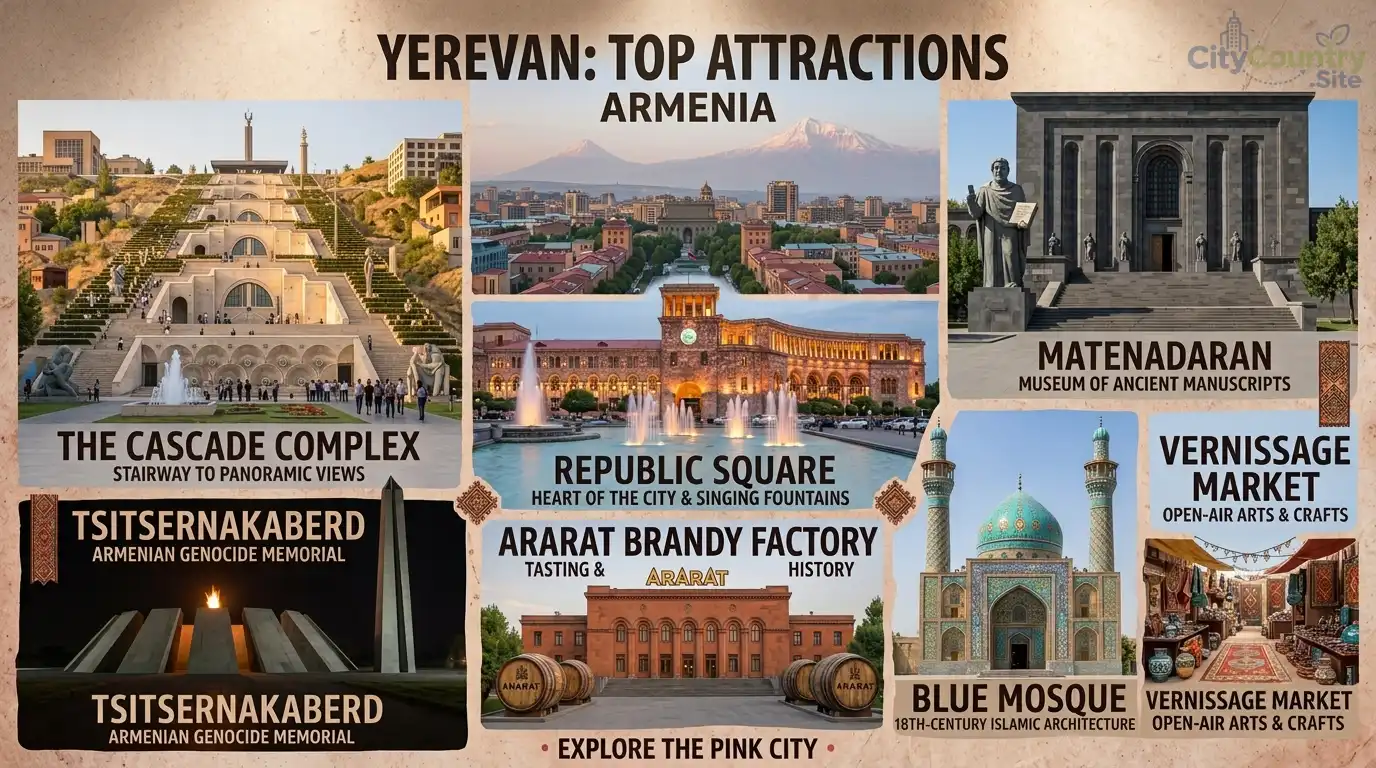
4. Yerevan Top Attractions & Extra Ordinary Places
Top Attractions Table
| Attraction | Type | Entry Fee (2026) | Best Time to Visit | Time Needed |
|---|---|---|---|---|
| Republic Square | Grand city plaza | Free | Evening (musical fountains) | 1 hour |
| Cascade Complex | Monumental stairway / art | Free (escalators inside) | Afternoon/sunset | 2–3 hours |
| Erebuni Fortress Museum | Ancient Urartian fortress | AMD 1,500 | Morning | 1.5–2 hours |
| Armenian Genocide Memorial (Tsitsernakaberd) | Memorial complex | Free | Morning | 2 hours |
| History Museum of Armenia | National history museum | AMD 1,500 | Morning | 2–3 hours |
| Matenadaran Manuscript Museum | Ancient manuscripts | AMD 3,000 | Morning | 2 hours |
| Vernissage Market | Open-air craft market | Free | Fri–Sun morning | 1.5–2 hours |
| Yerevan Brandy Factory (Ararat) | Distillery tour/tasting | AMD 3,000–8,000 | Morning | 1.5 hours |
| Blue Mosque | Historic mosque | Free | Morning | 30 min |
| GUM Market | Soviet-era covered market | Free | Morning | 1 hour |
| National Gallery of Armenia | Art museum | AMD 1,500 | Morning | 2 hours |
| Lovers’ Park (Влюбленных парк) | Romantic park | Free | Afternoon | 1 hour |
The Cascade Complex
The Cascade is Yerevan’s most dramatic architectural feature and most beloved public space — a monumental stairway of 572 steps built into a hillside above the city center, decorated with fountains, flowers, and extraordinary outdoor sculptures by artists including Fernando Botero (whose enormous bronze figures dot the lower terraces). Inside the Cascade, escalators carry visitors up through the Cafesjian Museum of Art — a world-class contemporary art collection donated by Lebanese-American philanthropist Gerard Cafesjian — before delivering them to a terrace with arguably the finest view of Yerevan and Mount Ararat available anywhere in the city.
Coming down the Cascade’s outdoor steps at sunset, with the pink stone buildings of Yerevan glowing in the fading light and Ararat turning purple-pink to the south, is one of the most purely beautiful urban experiences in the entire Caucasus.
Armenian Genocide Memorial — Tsitsernakaberd
No visit to Yerevan is complete without paying respects at Tsitsernakaberd — the national memorial to the Armenian Genocide, located on a hilltop west of the city center. The memorial complex consists of a 12-slab basalt monument representing the twelve lost Armenian provinces, a central eternal flame, and a slender 44-meter needle symbolizing the rebirth of the Armenian people. The adjacent Genocide Museum — one of the world’s most carefully curated genocide memorial museums — provides comprehensive historical documentation of the 1915 events. This is a place of profound solemnity and immense historical weight; visiting with quiet respect and an open heart is essential.
Matenadaran — The Manuscript Repository
The Matenadaran is one of the world’s great treasure houses of ancient manuscripts — a repository of over 23,000 ancient manuscripts and 500,000 archival documents spanning Armenian, Arabic, Persian, Hebrew, Greek, and other languages. The collection represents thousands of years of human intellectual and artistic achievement, and includes some of the world’s oldest surviving illustrated manuscripts. Housed in a beautiful purpose-built building on a hilltop with a commanding view down Mashtots Avenue, the Matenadaran is a UNESCO Memory of the World registered institution and one of Yerevan’s most profound cultural experiences.
Did You Know? Armenia was the world’s first nation to adopt Christianity as its state religion in 301 AD — predating the Roman Empire’s adoption of Christianity by over a decade. This early adoption of Christianity is the foundation of Armenian national identity and explains the extraordinary density of ancient churches and monasteries scattered across the country — many of them within easy reach of Yerevan on day trips.
5. Yerevan Food & Cuisine Guide
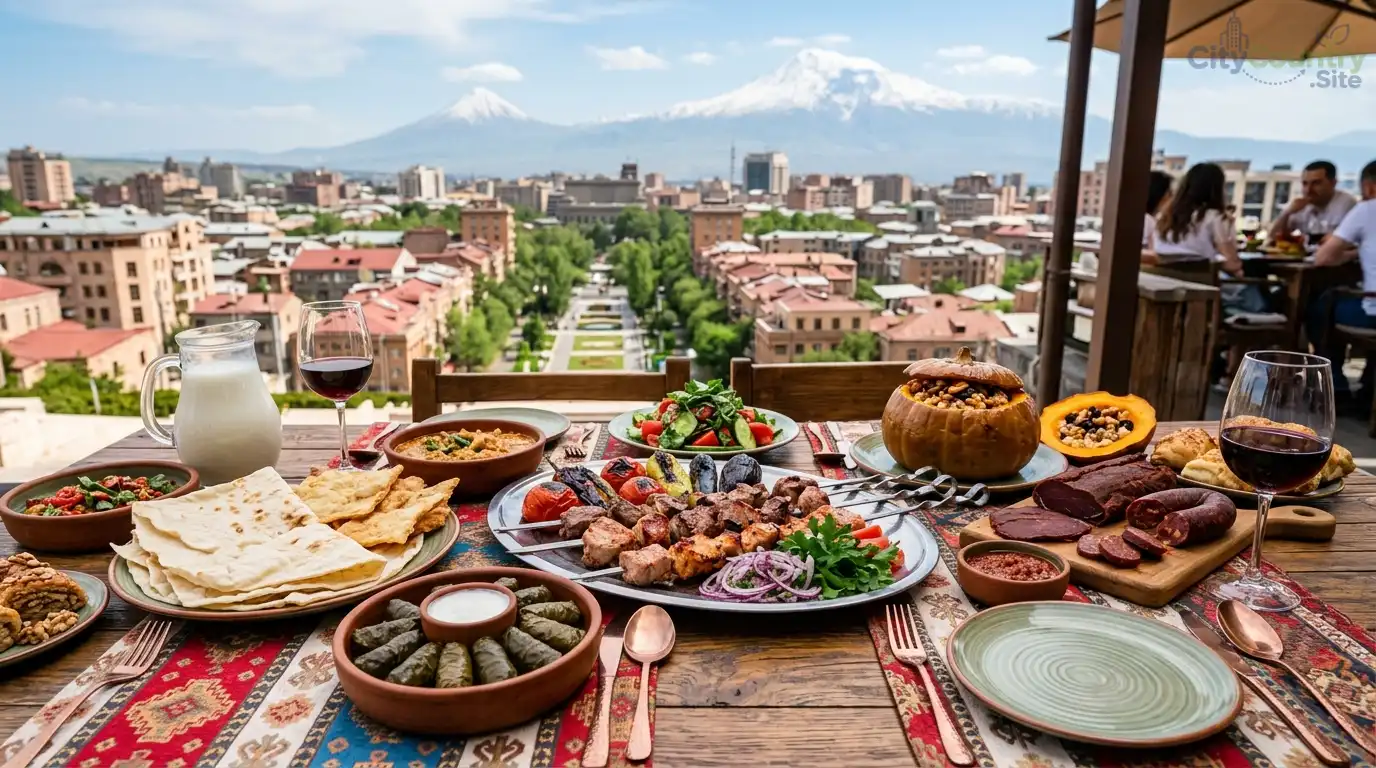
Armenian cuisine is one of the great culinary traditions of the ancient world — a rich, fragrant, and deeply satisfying food culture rooted in the fertile Ararat Plain’s agriculture, the country’s winemaking tradition (Armenia is one of the world’s oldest wine-producing regions), and centuries of cross-cultural exchange between Persian, Byzantine, Arab, Ottoman, and Russian influences.
Signature Armenian Dishes
Khorovats is Armenia’s national dish and greatest culinary pride — a barbecue tradition of extraordinary sophistication. Unlike the simple kebab found across the region, Armenian khorovats involves specific cuts of pork, lamb, or vegetables marinated in pomegranate juice and spices, then grilled over charcoal with careful attention to temperature and timing. The quality of khorovats in Yerevan — particularly at specialist restaurants and family gatherings — is genuinely exceptional.
Dolma — stuffed grape leaves with minced meat and rice — is a beloved staple, and Armenian dolma has a particularly refined character that has won UNESCO Intangible Cultural Heritage recognition alongside Azerbaijan’s similar tradition.
Lavash — the thin, soft unleavened flatbread baked in a tonir (underground clay oven) — is Armenia’s bread of life. The process of making lavash, involving women working together to stretch and bake the enormous sheets of dough, is itself a UNESCO-recognized cultural practice. Lavash comes to the table warm from the tonir at virtually every Armenian restaurant.
Harissa is a thick, porridge-like dish of slow-cooked wheat and chicken — ancient, deeply nourishing, and considered a national comfort food of profound cultural significance.
Manti are tiny boat-shaped dumplings filled with minced meat, baked until golden, and served with yogurt and sumac — a delicate, beautiful dish of Armenian-Turkish culinary heritage.
Ghapama is a festive dish — a whole pumpkin stuffed with rice, dried fruits, butter, and honey, roasted whole — typically served at weddings and celebrations; an extraordinary visual and culinary experience.
Armenian cognac (brandy) is the country’s most famous export — produced in the Ararat Valley from local grape varieties. Ararat brand (owned by Pernod Ricard) is the most famous, and a tour and tasting at the Yerevan Brandy Factory is one of the city’s essential experiences.
Where to Eat
- Caucasus Tavern — definitive traditional Armenian cuisine; the khorovats is among the city’s best; excellent wine list
- Tavern Yerevan — excellent mid-range Armenian food in a beautiful setting popular with both locals and visitors
- Anteb Restaurant — authentic Armenian home cooking; small, personal, excellent
- Sherep — one of the city’s finest contemporary Armenian restaurants; creative interpretations of traditional dishes
- Pandok Yerevan — beloved institution for traditional Armenian food at very fair prices
- Janapar Trail Café — excellent café with good food, popular with hikers and travelers
- GUM Market food stalls — for the most authentic and affordable eating: fresh lavash, dolma, gata (Armenian pastry), and local cheeses
Did You Know? Armenia is home to the world’s oldest known winery — the Areni-1 winery complex, dating to approximately 4100 BC, was discovered in 2011 in the village of Areni, near the town of Areni that still produces Armenia’s most celebrated wine. This makes Armenian winemaking tradition 6,000 years old — older than Egyptian pyramids and predating most ancient civilizations.
6. Yerevan Accommodation Guide
Yerevan offers excellent accommodation across all budget levels, with a particularly strong and growing selection of characterful boutique hotels in the city center.
Budget (Under $25/night)
- Envoy Hostel Yerevan — the best-known backpacker hostel in the city; excellent social atmosphere; good central location; very popular with solo travelers
- Repat Armenia Hostel — good facilities; friendly; popular with young travelers
- Yerevan Hostel — reliable budget option with helpful staff
Mid-Range ($40–100/night)
- Tufenkian Historic Yerevan Hotel — beautifully designed boutique hotel in a renovated historic building; excellent value; warm Armenian hospitality
- Best Western Plus Congress Hotel — reliable international standard; excellent location near Republic Square
- Hotel Nare — excellent mid-range boutique; good location; consistent quality
- Ararat Hotel — well-positioned; good facilities; popular with business travelers and cultural visitors
Luxury ($120–350+/night)
- The Alexander, a Luxury Collection Hotel — Yerevan’s most prestigious luxury address; extraordinary service; beautiful building on Republic Square
- Marriott Armenia Hotel — landmark luxury hotel on Republic Square; exceptional facilities and city views
- Ani Plaza Hotel — elegant and refined; excellent service; beautiful interiors; slightly more intimate than the large international brands
7. Getting to Yerevan
By Air
Zvartnots International Airport (EVN) is Armenia’s main international gateway, located 12 km west of Yerevan city center. The airport was significantly expanded and modernized in the 2000s and handles a growing range of international connections.
Key connections:
- Moscow (Aeroflot, Armavia, S7) — 3 hours; historically the most frequent connection; check current status
- Dubai, Abu Dhabi — 3.5–4 hours; excellent connections
- Istanbul (Turkish Airlines, Pegasus) — 2.5 hours; popular routing for European visitors
- Vienna, Paris, Amsterdam — 4–5 hours direct on Austrian Airlines and Air France
- Beirut — 1.5 hours; significant Lebanese-Armenian diaspora connection
- Tehran — 1.5 hours; important regional connection
- Tbilisi — 1 hour; the most popular Caucasus multi-city routing
Airport to city center:
- Bus (No. 116): AMD 100 (~$0.25) — extremely cheap; takes 30–45 minutes to Republic Square
- Yandex Go/GG Taxi: AMD 2,500–4,000 (~$6.50–$10) — most convenient; 20–30 minutes
- Official taxi: AMD 4,000–6,000 — slightly more expensive; no pre-booking needed
By Land
- Tbilisi (Georgia): approximately 5–6 hours by marshrutka or private taxi — the most popular overland Caucasus connection; no rail link exists
- Tehran (Iran): approximately 10–12 hours by bus
- No direct land connection to Turkey — the Armenia-Turkey border has been closed since 1993 due to political disputes
8. Getting Around the City
Yerevan Metro
Yerevan has a single-line metro with 10 stations running roughly north-south through the city center. Clean, reliable, and inexpensive — fare of AMD 100 (~$0.25) per journey, loaded onto a metro card. The metro serves the main central areas but has limited network coverage; most visitors use it selectively and supplement with ride-hailing.
Stations are worth noting for their Soviet-era architecture — particularly Yeritasardakan (Youth) and Republic Square stations, both featuring beautiful mosaic and marble work.
Ride-Hailing
GG Taxi (local) and Yandex Go are the dominant ride-hailing platforms in Yerevan — both transparent, reliable, and very affordable. A typical city center journey costs AMD 600–1,500 ($1.50–4). inDrive is also available. These apps are essential for efficient city navigation and eliminate any taxi fare negotiation.
Walking
Central Yerevan — particularly the area encompassing Republic Square, Northern Avenue, the Cascade area, Mashtots Avenue, and the city parks — is wonderfully walkable. The city center is compact, relatively flat (aside from the Cascade hill), and well-maintained. Many visitors find they can reach most attractions on foot from a central hotel. The Hrazdan Gorge walking path is a beautiful riverside route that few tourists discover.
9. Best Time to Visit
Month-by-Month Weather & Travel Table
| Month | Avg Temp (°C) | Rainfall | Crowd Level | Travel Recommendation |
|---|---|---|---|---|
| January | -6–3°C | Low | Very Low | Cold; snow possible; cheapest prices ⚠️ |
| February | -4–5°C | Low | Very Low | Still cold; occasional snow ⚠️ |
| March | 2–13°C | Medium | Low | Warming; spring flowers beginning ✅ |
| April | 8–19°C | Medium | Medium | Beautiful spring; recommended ✅✅ |
| May | 13–25°C | Low–Med | High | Perfect weather; best spring month ✅✅✅ |
| June | 18–31°C | Low | High | Warm and sunny; excellent ✅✅ |
| July | 22–35°C | Very Low | Medium | Very hot; clear Ararat views ✅ |
| August | 22–34°C | Very Low | Medium | Hot; excellent for day trips ✅ |
| September | 16–29°C | Low | High | Perfect autumn; best month ✅✅✅ |
| October | 9–21°C | Low–Med | High | Excellent; wine harvest; beautiful light ✅✅ |
| November | 2–11°C | Medium | Low | Cooling; fewer crowds; peaceful ✅ |
| December | -4–4°C | Low | Low–Med | Cold; Christmas atmosphere; New Year’s Eve ✅ |
Best months overall: May, September, October — and October specifically for the wine harvest and extraordinary autumn light on the pink stone buildings.

10. Yerevan Local Culture, Customs & Etiquette
Armenian culture is ancient, proud, deeply family-oriented, and shaped by a history of extraordinary resilience in the face of persecution. Understanding this cultural context transforms good travel into meaningful travel.
The Armenian Character
Armenians are — genuinely and not as a tourism marketing claim — among the most hospitable people in the world. The tradition of welcoming guests (“Barev Dzez” — “welcome” in Armenian) is deeply embedded in the culture, and invitations to share food, coffee, or brandy from people you have only just met are common and sincere.
This hospitality is connected to a deep family-centeredness — Armenian culture revolves around family in ways that feel both traditional and intensely warm. Family gatherings (particularly around lavish tables of food) are the foundation of social life.
The Genocide and Collective Memory
The Armenian Genocide of 1915 remains the central trauma of Armenian collective memory and shapes cultural and political identity profoundly. As a visitor:
- Visit Tsitsernakaberd with genuine respect and appropriate quiet
- Be aware that this is not a historical abstraction for Armenians but a living wound
- Never dismiss or question the genocide — it is a matter of profound personal importance to virtually every Armenian you meet
- Acknowledge it if the subject arises; listening is more valuable than speaking
Religious Life
The Armenian Apostolic Church — one of the world’s oldest national churches — is central to Armenian identity even among those who are not deeply practicing. Churches are active places of worship; visit with respect, cover shoulders and knees, and observe those who are praying with quiet deference.
Social Customs
- Coffee (Armenian coffee — thick, strong, Turkish-style) is the essential social offering; always accept a cup
- Toast at dinner — particularly with Armenian brandy or wine — follows a tradition similar to Georgian toasting; the eldest or most honored guest often gives the first toast
- Bring a small gift when invited to an Armenian home — sweets, flowers, or wine are all appropriate
Tipping
- Restaurants: 10% is appreciated; service charge sometimes included
- Taxis: Rounding up is courteous; not obligatory
- Hotel staff: AMD 500–1,000 for helpful service
- Tour guides: AMD 3,000–7,000 per day for good service
11. Safety & Travel Tips
Yerevan is an exceptionally safe city for travelers — consistently ranking among the safest capitals in Europe and the former Soviet space. Violent crime against tourists is extremely rare, and the general security atmosphere is relaxed and welcoming.
Key Safety Considerations
Traffic: Yerevan drivers are assertive and pedestrians do not always have clear right-of-way. Use designated crossings and be alert at intersections. The underground pedestrian crossings (perekhods) at busy intersections are the safest option.
Political sensitivity: Armenia’s relationship with Turkey (closed border, genocide non-recognition) and Azerbaijan (ongoing Nagorno-Karabakh conflict aftermath) are painful and politically significant topics. Be sensitive and listen rather than opine on these matters.
Common situations:
- Taxi overcharging is possible without apps — always use GG Taxi or Yandex Go
- Minor tourist-area pickpocketing at Vernissage Market during busy periods
- Currency exchange — use official obmenniki; the rate is competitive
Emergency Numbers:
- Police: 102
- Ambulance: 103
- Fire: 101
- Emergency (all): 911 (unified emergency number introduced in recent years)
Did You Know? Yerevan has been ranked as one of the safest cities in the former Soviet space for tourists by multiple international travel safety indices. Armenia’s relatively low crime rate, strong community values, and culture of hospitality toward guests create an environment in which most travelers feel entirely comfortable — including solo female travelers, who consistently report positive experiences in the city.
12. Yerevan Budget Tour
Daily Budget Table
| Category | Budget Traveler | Mid-Range Traveler | Luxury Traveler |
|---|---|---|---|
| Accommodation | AMD 7,000–15,000 ($18–38) | AMD 35,000–80,000 ($90–207) | AMD 110,000–250,000+ ($284–646+) |
| Food | AMD 3,000–7,000 ($8–18) | AMD 12,000–25,000 ($31–65) | AMD 40,000–90,000 ($103–233) |
| Transport | AMD 500–2,000 ($1–5) | AMD 3,000–7,000 ($8–18) | AMD 12,000–25,000 ($31–65) |
| Attractions | AMD 2,000–6,000 ($5–15) | AMD 8,000–20,000 ($21–52) | AMD 25,000–60,000 ($65–155) |
| Miscellaneous | AMD 1,500–4,000 ($4–10) | AMD 6,000–15,000 ($15–39) | AMD 20,000–50,000 ($52–129) |
| DAILY TOTAL | AMD 14,000–34,000 ($36–88) | AMD 64,000–147,000 ($165–380) | AMD 207,000–475,000+ ($535–1,228+) |
Exchange rate approximate: 1 USD ≈ 387 AMD (2026)
Yerevan represents exceptional value — food is remarkably affordable even at good restaurants, transport is negligible in cost, and accommodation options at all levels deliver genuine quality for the price.
13. Hidden Gems & Local Secrets
Beneath the well-trodden tourist trail, Yerevan hides extraordinary experiences.
Hrazdan Gorge Walking Path — few tourists know that a beautiful riverside walking path descends into the Hrazdan River gorge that cuts through the city. The gorge itself — 30–40 meters deep in places — creates a surprisingly wild natural corridor through the urban fabric. Walking the gorge path from the Kievyan Bridge area southward reveals waterfalls, overgrown Soviet infrastructure, cafés hidden in the canyon walls, and a completely different perspective on the city above.
Megerian Carpet Factory — Armenia’s carpet-weaving tradition is ancient and extraordinary; the Megerian Carpet factory in Yerevan offers tours of their workshop where master weavers create magnificent hand-knotted carpets using traditional designs. The factory showroom is also one of the best places to buy an authentic Armenian carpet at fair prices.
Mayr Tachar (Mother Cathedral) of Vagharshapat — technically just outside the city (in Etchmiadzin, 20 km west), but accessible as a brief evening trip rather than a day trip, the cathedral complex is the spiritual heart of the Armenian Apostolic Church and a UNESCO World Heritage Site. Attending an evening liturgy is one of the most moving religious experiences available anywhere in the Caucasus.
Blue Mosque — Yerevan’s only remaining mosque — a beautiful 18th-century Persian structure with a blue-tiled dome — sits incongruously (and beautifully) in the center of the Christian capital. Managed by the Iranian government, it functions as a cultural center and place of worship for the city’s small Muslim community. The peaceful courtyard garden is a perfect respite from the city’s energy.
Vernissage on a Saturday morning — the famous Vernissage open-air market operates on weekends and is excellent on both days, but Saturday mornings have a particular atmosphere — local artists and craftspeople setting up their stalls before the tourist crowds arrive, creating an authentic creative market atmosphere.
Did You Know? The famous Ararat Armenian brandy was reputedly a personal favorite of Winston Churchill — legend holds that Stalin gave Churchill a case of Ararat brandy at the 1943 Tehran Conference, and Churchill subsequently requested that his personal supply continue throughout the war and beyond. Whether entirely true or partly embellished, the story has become part of both Armenian brandy’s mystique and Churchill’s legendary drinking reputation.
14. Day Trips from Yerevan
Day Trips Table
| Destination | Distance | Travel Time | Travel Method | Highlights |
|---|---|---|---|---|
| Garni Temple & Geghard Monastery | 30–40 km east | 45–60 min | Tour / taxi | Only standing Greek-style temple in former USSR; UNESCO monastery |
| Khor Virap Monastery | 40 km south | 45 min | Tour / taxi | Closest Mount Ararat view; ancient monastery; biblical significance |
| Noravank Monastery | 120 km south | 1.5 hours | Tour / taxi | Stunning red rock canyon; medieval Armenian architecture |
| Etchmiadzin (Vagharshapat) | 20 km west | 30 min | Marshrutka | UNESCO World Heritage; Mother Cathedral of Armenian Church |
| Lake Sevan | 65 km northeast | 1 hour | Marshrutka / taxi | One of world’s largest high-altitude lakes; Sevanavank monastery |
| Dilijan National Park | 100 km northeast | 1.5 hours | Taxi / marshrutka | “Armenia’s Switzerland”; forest hiking; artisan village |
| Tatev Monastery & Wings of Tatev | 250 km southeast | 3.5 hours | Tour / car | World’s longest reversible cable car; stunning monastery |
| Areni Wine Village | 100 km south | 1.5 hours | Tour / taxi | World’s oldest winery; wine tasting; cave complex |
Khor Virap — The Essential Day Trip
40 km south of Yerevan, Khor Virap Monastery offers what is arguably the most iconic view in all of Armenia — the ancient monastery’s stone walls rising from the flat Ararat Plain with Mount Ararat looming directly behind, its snow-capped cone filling the sky in a composition of extraordinary beauty. This view — Armenia’s sacred mountain, unreachable and perpetually visible — is one of the most emotionally powerful landscape compositions in the entire Caucasus and has become one of the most photographed images in the region.
The monastery itself has profound historical significance — it is the site where Saint Gregory the Illuminator was imprisoned in a deep pit for 13 years before converting King Tiridates III to Christianity in 301 AD. The pit (Khor Virap means “deep pit” in Armenian) can still be descended by visitors via a narrow ladder.
16. Yerevan Shopping Guide
What to Buy in Yerevan
Armenian brandy (cognac) — the essential Yerevan souvenir; Ararat brand is the most famous but numerous smaller distilleries produce excellent quality at lower prices; available at duty-free, supermarkets, and specialist shops throughout the city.
Armenian wine — the wine renaissance in Armenia has produced genuinely excellent wines from indigenous grape varieties (Areni, Kangun, Voskehat); wine shops throughout the center stock excellent selections.
Lavash — vacuum-packed dried lavash makes an excellent and authentic edible souvenir.
Armenian ceramics — distinctive blue-glazed pottery featuring traditional Armenian patterns; beautiful and fragile; the Vernissage market has the best selection.
Duduk — the ancient Armenian double-reed wind instrument (UNESCO Intangible Cultural Heritage); the haunting sound of the duduk is the defining musical sound of Armenia; instruments and recordings available throughout the city.
Pomegranate products — the pomegranate is Armenia’s national symbol; pomegranate wine, jam, and decorative items are widely available.
Handmade jewelry — Armenian goldsmiths produce beautiful contemporary pieces drawing on ancient motifs; the Cascade area galleries have the best quality.
Where to Shop
- Vernissage Market — the essential Yerevan shopping experience; open Friday, Saturday, Sunday; paintings, ceramics, jewelry, traditional crafts, Soviet memorabilia; gentle bargaining expected
- GUM Market — Soviet-era covered market; excellent for food, cheese, dried fruits, lavash, and local products
- Northern Avenue — the city’s main pedestrian boulevard; mix of international and Armenian boutiques
- Cascade Gallery shops — quality Armenian contemporary art and crafts at the base of the Cascade
- Pandok wine shop and specialist wine shops on Mashtots Avenue — best selection of Armenian wines
17. Nightlife & Entertainment
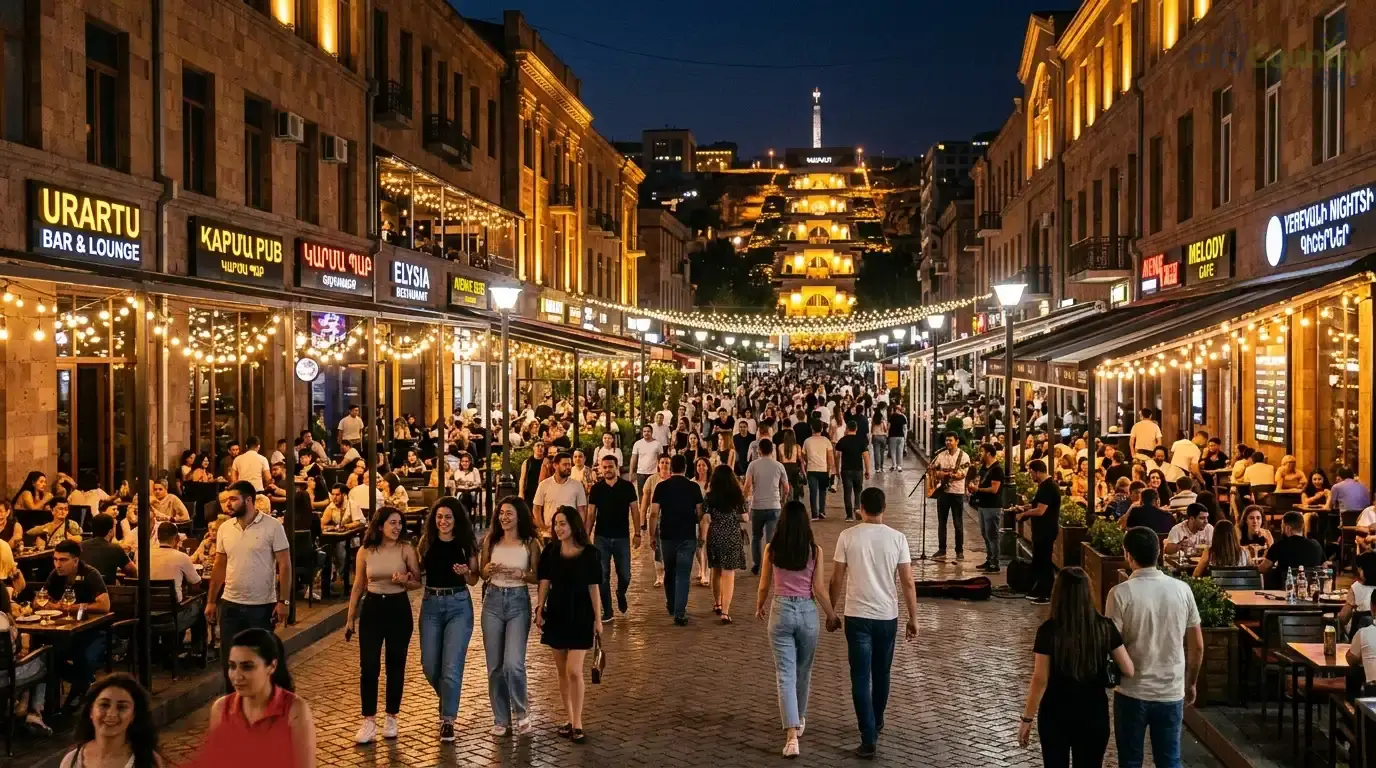
Yerevan has a nightlife scene of surprising sophistication for a city of its size — energized further by the influx of younger international residents since 2022. The city’s café culture transitions seamlessly into evening bar culture, and dedicated clubs attract both local and international music lovers.
Evening Culture
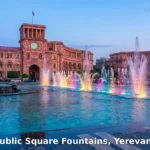
Republic Square Musical Fountains — every evening from spring through autumn, the central fountains of Republic Square perform a choreographed light-and-music show. This is not kitschy tourism — it is genuinely beautiful, and Yerevan residents young and old come to watch and walk around the illuminated square. A completely authentic local tradition and one of the simplest pleasures in the city.
The Cascade at night — the Cascade’s exterior illumination after dark transforms it into a glowing architectural landmark visible from across the city. Walking up the steps at night — with the illuminated Ararat valley below and the city lights spreading in every direction — is magical.
Live Music & Cultural Venues
- Yerevan State Academic Opera Theater — beautiful historic opera house; excellent productions of Armenian and European repertoire at remarkably affordable prices
- Armenian Philharmonic Orchestra Hall — regular symphony concerts in an excellent concert hall
- Malkhas Jazz Club — Yerevan’s legendary jazz venue; intimate, atmospheric, excellent performers; the soul of Yerevan’s music scene
- Cafesjian Center for the Arts (Cascade) — regular contemporary art exhibitions and cultural events
Bars & Nightlife
- Wine Republic — excellent wine bar focusing on Armenian wines; popular with knowledgeable wine lovers
- In Vino — sophisticated wine bar with excellent selection; great atmosphere
- Dargett Craft Beer — Armenia’s most celebrated craft brewery with a lively taproom; excellent locally brewed beers
- ULTRA — Yerevan’s most internationally respected club; electronic music; attracts quality DJs
- Paparazzi Club — popular mainstream club; mixed music; large dance floor
- Jan Jan — lively bar with live Armenian music; authentic and popular with locals
Did You Know? The duduk — Armenia’s ancient double-reed flute made from apricot wood — produces one of the most distinctive and haunting sounds in world music. The instrument is approximately 3,000 years old and is inscribed on UNESCO’s Intangible Cultural Heritage list. When you hear a duduk played live in Yerevan — its plaintive, sorrowful tone filling a stone church or a café — it is an experience that most travelers describe as unexpectedly moving.
17. Practical City Information
Visa & Entry
Armenia operates one of the region’s more liberal visa policies:
- Citizens of approximately 60–65 countries — including EU nations, USA, UK, Canada, Australia, Japan and others — can enter Armenia visa-free for 180 days (an exceptionally generous allowance)
- Citizens of Russia, CIS states, and several others also have visa-free or simplified entry
- e-Visa available at evisa.mfa.am for citizens of most other countries; straightforward process; approximately $6 USD for a 21-day visa
Note on passport stamps: Travelers with Azerbaijani stamps in their passport may face complications entering Armenia. While Armenia does not officially bar entry based on Azerbaijan stamps, the political situation creates potential sensitivity — check current information before traveling.
Health & Vaccinations
No mandatory vaccinations required for Armenia. Recommended:
- Hepatitis A — standard for Caucasus travel
- Hepatitis B — recommended
- Typhoid — if eating extensively at local establishments
Tap water in Yerevan is generally safe to drink — the city’s water supply comes from mountain springs and is treated to European standards. Many locals drink tap water directly; visitors who are cautious may prefer bottled water during an initial adjustment period.
Connectivity
- MTS Armenia, Beeline Armenia, and Ucom are the main mobile operators
- Tourist SIM cards available at the airport and throughout the center
- 10–15 GB data package: approximately AMD 3,000–5,000 (~$8–13)
- WiFi is excellent throughout central Yerevan — the city’s café culture has created an expectation of fast, reliable, free WiFi virtually everywhere
Power & Plugs
- Plug type: Types C and F (European round pins)
- Voltage: 220V / 50Hz
- Standard European adapters work throughout Armenia
18. How to Be a Responsible Traveler in Yerevan
Sustainable Tourism
- Stay in Armenian-owned boutique hotels and guesthouses — particularly in the city center; locally-owned accommodation keeps the economic benefit of tourism within the Armenian economy
- Eat at Armenian-family restaurants rather than international chains — Armenian cuisine is extraordinary and restaurants run by local families represent both better food and better economic impact
- Buy Armenian wine and brandy from small producers rather than only the large brands — Armenia’s artisan wine industry is growing and producing genuinely excellent wines that deserve direct support
Cultural Sensitivity
- Approach the Genocide Memorial with genuine solemnity — Tsitsernakaberd is not a tourist attraction but a place of deep national mourning; behave accordingly
- Respect religious spaces — Armenian Apostolic churches are active places of worship; cover shoulders and knees, speak quietly, and observe those at prayer with deference
- Be careful with political topics — Armenia’s complex relationships with Turkey and Azerbaijan involve profound pain; listen more than you speak
Environmental Responsibility
- Carry reusable bags at Vernissage and GUM markets — reducing single-use plastic in Armenia’s markets is an ongoing environmental effort
- Use public transport for day trips where possible — shared marshrutkas to Garni, Khor Virap, and other destinations are much better environmentally than solo taxi travel
- Respect monastery and nature sites — stay on paths, do not disturb wildlife, and pack out all waste
19. Comparison Table — Yerevan vs Similar Cities
| Feature | Yerevan, Armenia | Tbilisi, Georgia | Baku, Azerbaijan |
|---|---|---|---|
| Ancient History | Exceptional (2,782+ years) | Significant (1,500+ years) | Significant (2,000+ years) |
| Cost Level | Low–Medium | Low–Medium | Medium |
| Food Scene | Outstanding | Outstanding | Excellent |
| Wine/Spirits | World-class brandy + ancient wine | World-class wine | Limited |
| Architecture | Pink tufa + Soviet | Medieval wood + Soviet | Medieval + ultra-modern |
| Safety | Excellent | Very good | Very good |
| Visa Ease | Visa-free ~65 countries; 180 days | Visa-free ~95 countries | E-visa required |
| Day Trip Quality | Exceptional (monasteries, Khor Virap) | Excellent (Kazbegi, Mtskheta) | Good (Gobustan) |
| Best For | History, cognac, culture, safety | Wine, nightlife, architecture | Architecture, luxury, F1 |
20. Is Yerevan Worth Visiting?
Yes — with complete conviction, and particularly so for travelers who value depth, authenticity, and genuine human connection over Instagram-ready spectacle.
Yerevan is a city that earns your affection gradually rather than overwhelming you immediately. The first morning — the pink stone, the Ararat view, the coffee — is beautiful. The second day — Tsitsernakaberd, the Matenadaran manuscripts, the best khorovats you have ever eaten — is profound. The third day — Khor Virap at sunset, a jazz club in the evening, a chance conversation with an Armenian intellectual over cognac — is unforgettable.
The city has a quality that is genuinely rare in modern travel: it feels real. The people are not performing hospitality — they are practicing it. The food is not curated for tourists — it is simply the food they have always cooked. The history is not staged — it is everywhere, in the stone, in the language, in the faces.
Yerevan is best suited for:
- ✅ History and culture lovers — one of the world’s oldest cities; extraordinary museums and monuments
- ✅ Food and drink enthusiasts — Armenian cuisine and brandy are world-class
- ✅ Spiritual travelers — ancient churches, UNESCO heritage monasteries within day-trip range
- ✅ Budget travelers — exceptional value; among the most affordable Caucasus capitals
- ✅ Solo travelers — extremely safe; incredibly welcoming; easy to meet people
- ✅ Off-the-beaten-path seekers — still genuinely undiscovered by mass tourism
- ✅ Wine and spirits lovers — the world’s oldest winemaking culture and legendary cognac tradition
Our honest verdict: Allow 4–5 days — sufficient for the city’s main attractions, at least two day trips (Khor Virap and Garni/Geghard are essential), and enough evenings to eat, drink, and absorb the city’s remarkable character. Most visitors find themselves wishing they had allocated more time.
21. Yerevan City Travel Tips
- 📱 Download GG Taxi before arriving — the most reliable and transparent ride-hailing in Yerevan
- 🍷 Book the Ararat Brandy Factory tour in advance for weekend visits — it fills up quickly
- 🏔️ Check the weather forecast for clear days and plan your Khor Virap visit accordingly — Ararat is only visible on clear days
- ☕ Coffee culture is serious — Yerevan’s cafés serve excellent Armenian coffee; take your time and enjoy them
- 💰 Carry AMD cash for GUM Market, Vernissage, and street food — cash only at most market stalls
- 🌅 Visit Republic Square after dark — the musical fountains and illuminated buildings create one of the most beautiful evening scenes in the Caucasus
- 🎵 Go to Malkhas Jazz Club on a weekend — one of the best jazz experiences in the entire region
- 📷 The best Ararat views are in the morning — by afternoon, heat haze often obscures the mountain
- 🏛️ Pre-book popular day trip tours for Garni/Geghard and Khor Virap — these are the most popular day trips and shared tours fill up fast in peak season
- 💧 Yerevan tap water is safe — no need to buy bottled water; save plastic and money
22. Recommended Resources
Books:
- “Black Dog of Fate” by Peter Balakian — powerful memoir of Armenian-American identity and the Genocide; essential reading for understanding modern Yerevan
- “The Crossing Place” by Philip Marsden — beautifully written account of traveling through Armenia and the Armenian diaspora
- “Armenia: Travels in the Land of Noah” by Nicholas Holding — excellent practical and cultural introduction to the country
YouTube Channels:
- Bald and Bankrupt — multiple popular videos from Yerevan and Armenia
- Lost LeBlancs — quality Yerevan travel vlog content
- Mark Wiens — excellent Armenian food coverage in Yerevan
Documentaries:
- “Orphans of the Genocide” (various) — several documentaries on the Armenian Genocide provide essential historical context
- “The Promise” (2016 film) — a major Hollywood production set against the backdrop of the Armenian Genocide; useful historical context even as a dramatization
23. Frequently Asked Questions Yerevan
Q1: Do I need a visa to visit Yerevan, Armenia?
Citizens of approximately 60–65 countries — including all EU nations, USA, UK, Canada, Australia, Japan — can enter Armenia visa-free for up to 180 days — one of the most generous tourist visa allowances anywhere in the world. Russian, CIS, and several other country citizens also have simplified or visa-free access. Citizens of countries not on the visa-free list can apply for an e-visa at evisa.mfa.am for approximately $6 USD. Always check the current list at the Armenian Ministry of Foreign Affairs website before travel.
Q2: Is Yerevan safe for travelers, including solo women?
Yerevan is among the safest capitals in the former Soviet space and rates exceptionally well on international tourist safety indices. Violent crime against visitors is extremely rare. Solo female travelers consistently report feeling comfortable and safe throughout the city, including at night. Standard precautions apply — use ride-hailing rather than flagging random taxis after dark, and be alert in crowded market areas. The city’s strong community values and culture of hospitality create a genuinely welcoming environment for all travelers.
Q3: Can I see Mount Ararat from Yerevan?
Yes — on clear days, Mount Ararat is dramatically visible from throughout Yerevan, appearing to rise directly above the southern skyline. The clearest views are typically in the morning (before heat haze develops) and in cooler months (October–April). The mountain is located in Turkey — despite appearing to be part of the Yerevan landscape — and is visible across the closed Armenia-Turkey border. The best city viewpoint is from the Cascade terrace or Koktobe hill; the best overall view is from Khor Virap Monastery (40 km south).
Q4: What is Armenian brandy (cognac) and is it really good?
Armenian brandy — called cognac locally despite EU regulations restricting that term to the French region — is genuinely among the world’s finest spirits. The Ararat brand (owned by Pernod Ricard) is the most famous, with aged expressions (AKHTAMAR 10-year, NAIRI 20-year) that rival fine French cognac at considerably lower prices. Numerous smaller distilleries also produce excellent quality. A tour and tasting at the Yerevan Brandy Factory is one of the city’s essential experiences. Winston Churchill reportedly loved it; most visitors agree with him.
Q5: What is the best day trip from Yerevan?
For the single most iconic and emotionally powerful experience, Khor Virap Monastery (40 km south, 45 minutes) with its unparalleled Mount Ararat view is the top recommendation. For the finest combination of historical and natural beauty, Garni Temple and Geghard Monastery (40 km east, 45–60 minutes) — the only standing Greco-Roman style temple in the former Soviet Union combined with a stunning medieval monastery carved into a cliff face — is extraordinary. For a longer excursion, Tatev Monastery (250 km, 3.5 hours) with its Wings of Tatev cable car (the world’s longest reversible cable car) is one of the most spectacular experiences in all of Armenia.
Q6: What should I eat in Yerevan?
Your essential Yerevan food list: khorovats (Armenian barbecue — the best you will ever eat), dolma (stuffed grape leaves), manti (tiny baked dumplings), lavash (freshly baked from a tonir), Armenian cheese (especially at GUM Market), gata (sweet Armenian pastry), and whatever the seasonal fruit is (summer brings extraordinary apricots, peaches, and pomegranates). Drink Armenian wine (try the indigenous Areni grape) and Armenian brandy. Budget travelers eat extremely well at GUM Market food stalls and small neighborhood restaurants for under $8 per meal.
Q7: How do I get from Yerevan Airport to the city center?
The most convenient option is GG Taxi or Yandex Go with a local SIM card — approximately AMD 2,500–4,000 ($6.50–$10) to central Yerevan, 20–30 minutes. The No. 116 bus is extraordinarily cheap (AMD 100 = $0.25) and runs to Republic Square in approximately 30–45 minutes — perfectly adequate for budget travelers. Official airport taxis cost AMD 4,000–6,000 — convenient but not significantly better than ride-hailing. The airport is 12 km from the center — well-positioned for a major international airport.
Q8: What is the Armenian Apostolic Church and how does it affect travel?
The Armenian Apostolic Church is the national church of Armenia — founded in 301 AD when Armenia became the world’s first Christian nation. It is a unique branch of Eastern Christianity, distinct from both Roman Catholicism and Eastern Orthodoxy, with its own theological tradition, liturgy, and calendar. The church’s churches and monasteries are Armenia’s most extraordinary architectural heritage — Etchmiadzin Cathedral (UNESCO), Geghard Monastery (UNESCO), Tatev Monastery, and dozens of others are all Armenian Apostolic sites. They are open to visitors of all faiths; respectful dress (covered shoulders and knees for women) and quiet behavior are expected.
24. Sources & References
- Lonely Planet Armenia (lonelyplanet.com/armenia)
- TripAdvisor Yerevan (tripadvisor.com)
- Booking.com Yerevan (booking.com)
- Wikipedia — Yerevan (en.wikipedia.org/wiki/Yerevan)
- Armenian Tourism Committee (tourism.am)
- Numbeo — Cost of Living Yerevan (numbeo.com)
- Wikitravel Yerevan (wikitravel.org/en/Yerevan)
- World Travel Guide — Armenia (worldtravelguide.net)
- Skyscanner Armenia flights (skyscanner.net)
- UNESCO — Cathedrals and Churches of Etchmiadzin (whc.unesco.org)
- Armenian e-Visa Portal (evisa.mfa.am)
- Ararat Brandy Factory (araratbrandy.com)
- Matenadaran Official (matenadaran.am)
- IQAir — Yerevan Air Quality (iqair.com)
- CIA World Factbook — Armenia (cia.gov/the-world-factbook/countries/armenia)
25. Yerevan Travel Guide Images