
1. Facts About Vilnius
| Category | Details |
|---|---|
| Country | Lithuania |
| Region / Province | Vilnius County |
| Official Language | Lithuanian; Russian spoken by older generation; English widely spoken by younger population |
| Currency | Euro (€) — Lithuania has used the Euro since 2015 |
| Best Time to Visit | May to September (warm season); December for Christmas markets |
| Time Zone | Eastern European Time (EET) — UTC+2 (UTC+3 in summer) |
| Weather | Humid continental climate — cold winters, warm summers, beautiful spring and autumn |
| Temperature | -10°C – 25°C (14°F – 77°F) depending on season |
| Map | Located in southeastern Lithuania at the confluence of the Neris and Vilnia rivers, approximately 30 km from the Belarusian border |
| Airport | Vilnius International Airport (VNO) — 7 km south of the city center |
| Top Tourist Places | Vilnius Old Town (UNESCO), Gediminas Castle Tower, Gate of Dawn, Vilnius Cathedral, Užupis Republic, Palace of the Grand Duchy, Bernardine Garden |
| Avg. Trip Cost/Day | Budget: $40–70 / Mid-range: $90–180 / Luxury: $200–420+ |
| Nearest Major Airport | Vilnius International Airport (VNO) — Lithuania’s primary international gateway |
| Population | Approx. 590,000 (city, 2026); Lithuania’s total population approx. 2.8 million |
| Famous For | The largest Baroque old town in Northern Europe (UNESCO World Heritage), the self-proclaimed independent republic of Užupis with its own constitution and currency, one of Europe’s most remarkably preserved medieval city centers discovered by a new generation of travelers, the profound and tragic history of what was once the “Jerusalem of Lithuania” — one of the world’s great centers of Jewish learning — and a café and creative culture of surprising sophistication for a city of its size |
2. Vilnius City Overview & Background
Vilnius is a city that rewards those who arrive without expectations more richly than almost anywhere else in Europe. Come knowing nothing and you will be astonished. Come expecting a modest post-Soviet Baltic capital and you will be overwhelmed. Come having heard it compared to Prague or Krakow and you will immediately understand why the comparison is made — and why, in certain essential ways, Vilnius is actually more interesting than either.
Lithuania’s capital sits at the confluence of the Neris and Vilnia rivers in the country’s southeastern corner — geographically closer to Warsaw, Minsk, and Kyiv than to the Baltic Sea that gives the region its name. This inland position, at a geographical crossroads between Eastern and Central Europe, has given Vilnius a historical complexity and a cultural layering that is genuinely extraordinary: a city shaped by Lithuanians, Poles, Jews, Russians, Germans, Belarusians, Tatars, and Karaites across more than seven centuries of continuous urban history.
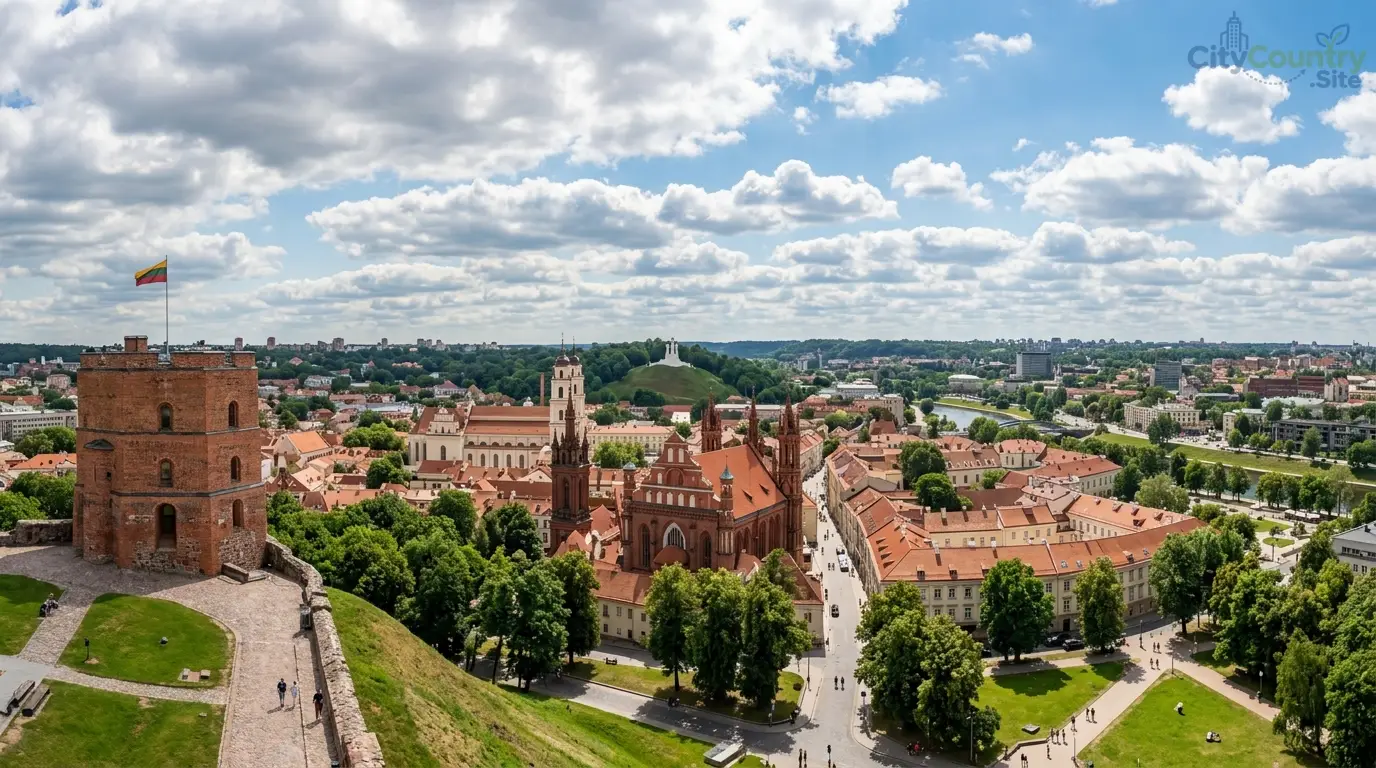
The Old Town of Vilnius — the largest surviving Baroque old town in Northern Europe and a UNESCO World Heritage Site since 1994 — is the most immediately compelling argument for visiting the city. Walking its streets — narrow cobbled lanes opening onto unexpected courtyards, past Baroque church facades of extraordinary elaboration, through archways into hidden gardens and ancient monasteries — is one of the finest urban walking experiences in Europe. The scale is human; the architectural density is extraordinary; and the sense of accumulated history is palpable in a way that reconstructed or over-restored historic centers cannot replicate.
Yet Vilnius is far more than its medieval and Baroque heritage. The city’s Užupis neighborhood — a formerly derelict riverside district that declared itself an independent republic in 1997 (complete with its own constitution, currency, president, and army of twelve people) — is one of the most joyfully creative urban expressions in Europe, drawing artists, musicians, writers, and the generally eccentric to its ramshackle streets with an energy that is entirely genuine. The city’s café culture, restaurant scene, bookshop culture, and intellectual life are of a sophistication that consistently surprises visitors.
And beneath all of this lies a historical weight that cannot be ignored. Before World War II, Vilnius was known as “The Jerusalem of Lithuania” — home to one of the world’s great centers of Jewish learning, culture, and population. The almost complete destruction of this community in the Holocaust — approximately 200,000 Lithuanian Jews killed, representing over 90% of the pre-war Jewish population — is the most profound historical fact of modern Lithuania and the context without which Vilnius cannot be fully understood.
For contemporary travelers, Vilnius offers what may be Europe’s finest combination of genuine historical depth, extraordinary Baroque architecture, bohemian creative energy, outstanding food and café culture, and the particular pleasure of discovering something genuinely remarkable that most of the travel world has not yet quite found.
“Vilnius is what I imagine Prague looked like in 1989 — beautiful, authentic, slightly rough at the edges, full of energy, and not yet overwhelmed by the tourist industry that will eventually and inevitably arrive. Go now.”
— Anonymous travel journalist, Lonely Planet Europe, 2025
3. Vilnius History Timeline
Neolithic and Bronze Age — The confluence of the Neris and Vilnia rivers has been inhabited since prehistoric times. Archaeological evidence from the Vilnius hill forts suggests settlement from at least the 1st millennium BCE. The area is part of the broader Baltic tribal territories that constitute the ancestors of the Lithuanian people.
1251 — Mindaugas — the first and only King of Lithuania — is baptized and crowns himself King, briefly uniting Lithuania under Catholic rule. Mindaugas is assassinated in 1263 and Lithuania reverts to paganism — the last European nation to remain officially pagan until 1387.
14th century — Vilnius emerges as the capital of the increasingly powerful Grand Duchy of Lithuania — one of the largest states in medieval Europe, eventually stretching from the Baltic to the Black Sea. The great Grand Duke Gediminas (ruled 1316–1341) is traditionally credited with founding Vilnius — according to legend, he dreamed of an iron wolf howling from a hilltop on the banks of the Vilnia River, which his wise men interpreted as a vision of a great city to be built on that site. Gediminas builds a castle on the hill and establishes Vilnius as his capital. The Gediminas Castle Tower — the remains of his upper castle — still stands on the hill above the city.
1387 — Grand Duke Jogaila baptizes Lithuania into Christianity — the last official conversion to Christianity in Europe — as part of his marriage to Queen Jadwiga of Poland and the creation of the Polish-Lithuanian personal union. Vilnius is established as a bishop’s seat and the construction of its great Catholic cathedral begins.
15th–16th centuries — The Grand Duchy of Lithuania reaches the peak of its power and territorial extent. Vilnius flourishes as a major European capital — a city of extraordinary ethnic and religious diversity where Lithuanian, Polish, Ruthenian, Jewish, Tatar, and Karaite communities live in remarkable (if not always harmonious) proximity. The great Vilnius University is founded in 1579 — making it one of the oldest universities in Eastern Europe and the oldest in the Baltic states.
1569 — The Union of Lublin creates the Polish-Lithuanian Commonwealth — one of the largest and most unusual political entities in European history, combining Poland and Lithuania in a federated state with an elected king and remarkable religious tolerance for its era. Vilnius becomes one of the most important cities of the Commonwealth.
17th century — Vilnius undergoes its most significant architectural transformation. The Jesuit order — invited to the city as the leading force of the Counter-Reformation — transforms the city’s churches and educational institutions in the Baroque style that will define Vilnius’s architectural character. The extraordinary Church of St. Casimir (the first Baroque church in Lithuania), the great Cathedral, the Church of St. Peter and Paul, and dozens of other Baroque religious buildings reshape the city into the spectacular architectural environment that survives today.
1655 — Russian Muscovite forces under Tsar Alexis devastate Vilnius during the Russo-Polish War — the city is occupied, extensively looted, and much of its population killed or displaced. The city recovers slowly over the following decades.
Late 17th–18th centuries — Vilnius continues developing as a center of Baroque art and architecture despite the political turbulence of the weakening Polish-Lithuanian Commonwealth. The extraordinary richness of the old town’s Baroque churches and palaces dates primarily from this period.
18th century — Vilnius becomes the center of one of the most important developments in the history of Judaism — the Gaon of Vilna (Vilna Gaon — Elijah ben Solomon Zalman, 1720–1797) establishes himself as the greatest Jewish scholar of the age, and Vilna (the Yiddish name for Vilnius) becomes the intellectual center of Ashkenazi Jewish civilization. The city’s reputation as the “Jerusalem of Lithuania” — a major center of Jewish learning, culture, and population — dates from this period and shapes the city’s character until the Holocaust’s destruction of this world.
1795 — The Third Partition of Poland ends the Polish-Lithuanian Commonwealth. Vilnius is absorbed into the Russian Empire — beginning over a century of Russian rule that will profoundly shape the city’s architecture, demographics, and cultural character.
19th century — Russian Imperial Vilnius develops rapidly — the Russian Orthodox Cathedral of the Theotokos (now the Cathedral Square’s prominent Orthodox church), various Imperial administrative buildings, and the expansion of the city’s infrastructure all reflect Russian governance. The Lithuanian national awakening — the Atgimimas — develops during this period, with Lithuanian-language press, literature, and eventually political organizations emerging against Russian repression.
1905 — The First Lithuanian Congress (Great Seimas of Vilnius) demands Lithuanian autonomy within the Russian Empire — a landmark in Lithuanian national consciousness.
1915–1918 — World War I brings German occupation of Vilnius. The city changes hands multiple times during the war.
February 16, 1918 — Lithuanian independence is declared in Vilnius — celebrated annually as Lithuania’s most important national holiday. However, the city itself remains contested — claimed by both Lithuania and the newly reconstituted Poland.
1920 — Polish forces under General Lucjan Żeligowski seize Vilnius in a staged “mutiny” — the city is incorporated into Poland as part of the Central Lithuanian Republic, despite Lithuanian protests. Vilnius is Polish (Wilno) from 1920 to 1939; the Lithuanian capital temporarily moves to Kaunas.
1939 — The Molotov-Ribbentrop Pact and the Soviet invasion of eastern Poland bring Vilnius back to Lithuanian control — the Soviet Union transfers the city to Lithuania in October 1939 as compensation for accepting Soviet military bases.
1940 — Soviet occupation of Lithuania. Mass deportations begin. Approximately 35,000 Lithuanians are deported in the first mass deportation of June 1941.
1941–1944 — Nazi German occupation. The destruction of Vilnius’s Jewish community — approximately 100,000 Vilnius Jews and the broader Lithuanian Jewish population — is one of the most complete and most rapid destructions of a Jewish community in the Holocaust. By 1944, less than 10% of Lithuanian Jews have survived. The Ponary Forest (Paneriai) — where approximately 70,000 Jews, 20,000 Poles, and 8,000 Russians were shot during the occupation — is the primary site of the Vilnius massacre.
1944–1990 — Soviet reoccupation. Vilnius becomes the capital of the Lithuanian Soviet Socialist Republic. Russian-speaking migration transforms the city’s demographics. Lithuanian language and culture are systematically suppressed alongside national identity.
1988–1990 — The Lithuanian national awakening. The Sąjūdis (Lithuanian Reform Movement) organizes massive demonstrations. Lithuania participates in the Baltic Way human chain of August 23, 1989. On March 11, 1990, Lithuania becomes the first Soviet republic to declare independence — an act of extraordinary political courage that triggers the Soviet economic blockade and eventually contributes to the Soviet Union’s dissolution.
January 1991 — Soviet Bloody Sunday — Soviet forces attack the Vilnius Television Tower and Parliament building, killing 14 Lithuanian civilians who were using their bodies to protect the buildings. The images of unarmed civilians facing Soviet tanks become some of the most powerful symbols of the Baltic resistance.
September 1991 — Lithuania’s independence is internationally recognized following the failed Soviet coup. The Soviet military withdraws. Lithuania begins its transformation.
1994 — The Vilnius Historic Centre is inscribed as a UNESCO World Heritage Site — recognition of the city’s extraordinary Baroque old town.
2004 — Lithuania joins the European Union and NATO.
2015 — Lithuania adopts the Euro.
2009 — Vilnius is designated European Capital of Culture alongside Linz — a year of extraordinary cultural programming that significantly raises the city’s international profile.
2024–2026 — Vilnius continues its remarkable development — the food and café scene is among the most exciting in Northern Europe; tourism is growing steadily as travelers discover what regular visitors have long known; and the city’s creative energy, affordability, and genuine historical depth continue producing one of Europe’s most rewarding travel experiences.

4. Vilnius Geography & Neighborhoods
Vilnius occupies a broad river valley at the confluence of the Neris and Vilnia rivers in southeastern Lithuania. Unlike the flat Baltic coastal cities of Tallinn and Riga, Vilnius has a more varied topography — gentle hills, river valleys, forested ridges, and the prominent Gediminas Hill on which the medieval castle stands — creating a varied urban landscape of considerable visual interest.
The city is significantly further from the Baltic Sea than Tallinn or Riga — approximately 300 km inland — giving it a more distinctly continental climate and a more Central European cultural feel. Its position near the Belarusian border reflects its historical role as a crossroads between Eastern and Central Europe.
Neighborhood Comparison Table
| Area | Best For | Vibe | Price Level |
|---|---|---|---|
| Old Town (Senamiestis) | History, Baroque architecture, restaurants, culture | Historic, atmospheric, beautiful | Mid–High |
| Gediminas Avenue (Gedimino pr.) | Shopping, business, cafés, central access | Modern, lively, commercial | Mid |
| Užupis | Art, cafés, creative community, bohemian atmosphere | Bohemian, artistic, charming | Mid |
| Naujamiestis (New Town) | Local cafés, independent restaurants, residential | Hip, local, creative | Mid |
| Žvėrynas | Upscale residential, parks, embassies, quiet | Elegant, green, quiet | Mid–High |
| Antakalnis | Residential, Calvary, nature, quiet | Peaceful, local, historic | Budget–Mid |
| Šnipiškės (Snipiskis) | Modern Vilnius, office towers, contemporary development | Modern, business, contrasting | Mid |
| Šeškinė / Lazdynai | Soviet-era residential architecture, local life | Authentic, Soviet-era, residential | Budget |
The Old Town (Senamiestis) — the UNESCO-listed historic center — is Vilnius’s heart and primary attraction. It is the largest surviving Baroque old town in Northern Europe, covering approximately 3.6 square kilometres and containing an extraordinary density of medieval, Renaissance, Baroque, and Neoclassical architecture. Užupis — the self-declared independent republic on the right bank of the Vilnia River — is the city’s most creatively distinctive neighborhood: a former slum transformed by artists into one of the most genuinely joyful urban spaces in Europe. Naujamiestis (New Town) — adjacent to the old town on the Gediminas Avenue side — is where the city’s most interesting contemporary café and restaurant scene has developed.
5. Vilnius Weather & Temperature Guide
Vilnius has a humid continental climate — more extreme than the coastal Baltic cities of Tallinn and Riga, with colder winters and warmer summers. Its inland position means it lacks the maritime moderation of the coastal capitals, producing a more distinctly Central European four-season pattern.
Month-by-Month Weather Table
| Month | Avg Temp (°C) | Rainfall / Snow | Crowd Level | Travel Recommendation |
|---|---|---|---|---|
| January | -10–(-3) | Snow likely | Very Low | ✅ Good — cold but atmospheric |
| February | -9–(-1) | Snow likely | Very Low | ✅ Good — often snowiest month |
| March | -3–6 | Rain / late snow | Low | ✅ Good — spring beginning |
| April | 3–13 | Medium | Medium | ⭐ Excellent — spring blooms |
| May | 8–19 | Medium | High | ⭐ Excellent — warm and beautiful |
| June | 12–22 | Medium–Low | Very High | ⭐ Excellent — long days, vibrant |
| July | 14–24 | Low–Medium | Very High | ⭐ Excellent — peak summer |
| August | 13–23 | Low–Medium | High | ⭐ Excellent — golden evenings |
| September | 9–17 | Low–Medium | High | ⭐ Excellent — golden autumn |
| October | 4–10 | Medium | Medium | ✅ Good — autumn colors |
| November | -1–4 | Medium | Low | ✅ Good — quieter, atmospheric |
| December | -7–(-1) | Snow possible | Medium | ⭐ Excellent — Christmas markets |
May through September is Vilnius’s finest season — long, warm days (though daylight hours are somewhat shorter than the coastal Baltic capitals given the more southerly position), the old town’s café terraces in full operation, the Vilnia and Neris rivers beautiful and accessible, and the city’s cultural calendar at its richest.
June and July are peak summer — warm and lively, with the old town at its most vibrant. Unlike Tallinn and Riga, Vilnius does not experience quite the same extreme white nights, but summer evenings are long and beautiful.
September and October are outstanding autumn months — warm golden days, spectacular foliage colors in the parks and forests surrounding the city, and lower tourist pressure than summer.
December brings a magical transformation — the Vilnius Christmas Market in Cathedral Square is among the finest in Eastern Europe, and snow on the Baroque rooftops creates an atmosphere of exceptional beauty.
Winter (January–February) is genuinely cold — colder than Tallinn or Riga given the inland position — but Vilnius under snow is beautiful, accommodation is dramatically affordable, and the city is entirely authentic when the tourist pressure is minimal.
💡 Did You Know? Vilnius is one of the greenest capital cities in Europe — approximately 40% of the city’s area is covered by parks, forests, and green spaces, giving it one of the highest per-capita green space ratios of any European capital. The Verkiai Regional Park on the city’s northern edge, the extensive Vingis Park on the Neris River, and the numerous smaller parks throughout the old town and residential neighborhoods give Vilnius a quality of natural environment entirely unusual for a city of its size and historical density.
6. Vilnius Airport & Getting There
Vilnius International Airport (VNO)
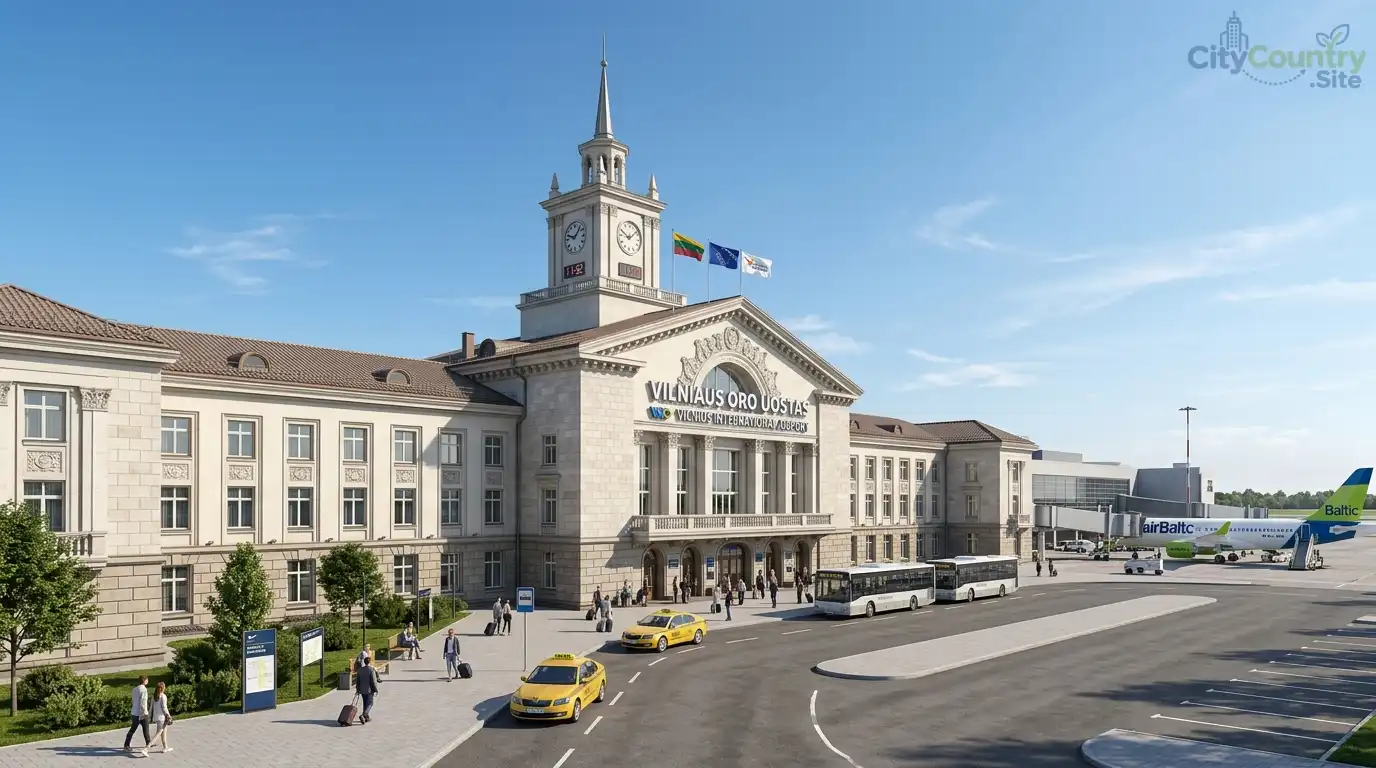
Vilnius International Airport (IATA: VNO) — officially Vilnius Airport named after Antanas Gustaitis — is located approximately 7 km south of the city center, with excellent connections by train, bus, and taxi. The airport has undergone significant development in recent years and now provides a comfortable, well-organized gateway.
Ryanair is the dominant carrier at Vilnius, with routes to numerous European destinations. Additional carriers include Wizz Air, airBaltic, LOT Polish Airlines, Finnair, Lufthansa, Turkish Airlines, easyJet, and others, serving London, Frankfurt, Warsaw, Amsterdam, Dublin, Copenhagen, Helsinki, Istanbul, and many other European cities. The route network has expanded substantially in recent years as Vilnius’s profile as a travel destination has grown.
Getting from VNO to the City Center:
| Transport Option | Duration | Cost (Approx.) | Notes |
|---|---|---|---|
| Train (from airport station) | 7 min | €0.80–1 | Excellent — fastest and cheapest option |
| Bus No. 1 | 20–30 min | €1 | Good alternative; frequent service |
| Bolt / Uber | 15–20 min | €8–14 | App-based; transparent pricing |
| Taxi | 15–20 min | €12–20 | Official taxis; agree meter before departure |
The train connection from the airport to the city center is one of the finest in the Baltic states — just 7 minutes to the central railway station at a cost of barely €1. This makes Vilnius one of the most convenient airport-to-city connections in Northern Europe.
Getting to Vilnius from Baltic/Nordic and neighboring countries:
| Origin | Transport | Duration | Cost (Approx.) |
|---|---|---|---|
| Riga, Latvia | Bus (Lux Express) | 4 hours | €10–20 |
| Tallinn, Estonia | Bus (Lux Express) | 7–8 hours | €15–30 |
| Warsaw, Poland | Bus / Train | 8–9 hrs / 9 hrs | €15–30 / €20–50 |
| Berlin, Germany | Bus (FlixBus) | 14–16 hours | €20–50 |
| Kaunas | Bus / Train | 1.5 hrs / 1.5 hrs | €4–8 |
| Helsinki, Finland | Flight | 1 hour 30 min | $60–150 |
💡 Did You Know? Vilnius is geographically closer to Minsk (Belarus) than to any of the other Baltic capitals — just approximately 170 km from the Belarusian border. This proximity to Russia’s closest ally has given Lithuania’s security situation a particular urgency following Russia’s invasion of Ukraine in 2022, and Lithuania has been one of the most vocal and consistent supporters of Ukrainian sovereignty in the EU and NATO. The Vilnius NATO Summit of July 2023 — one of the most significant in the alliance’s history — was held precisely because Lithuania has the clearest understanding of what Russian expansionism means and the most direct stake in NATO’s collective defense commitments.
7. Getting Around Vilnius
Vilnius is a very walkable city in its central areas — the Old Town, Užupis, and the Gediminas Avenue corridor are all interconnected by a pleasant network of cobbled streets and riverside promenades. For getting between the old town and outer neighborhoods, public transport and ride-hailing work well.
Walking is the primary and strongly recommended mode in the Old Town and Užupis — the medieval and Baroque streets reward slow, exploratory walking at every turn. The distance from the Cathedral to the Gate of Dawn (the full length of the old town’s main axis) is approximately 1.2 km — entirely comfortable on foot. The Neris and Vilnia riverfronts provide beautiful walking routes connecting the old town to adjacent neighborhoods.
Bolt is Lithuania’s primary ride-hailing app — the Estonian-founded service operates throughout the Baltic states and is reliable, affordable, and transparent. A typical city ride costs €4–10. Uber also operates in Vilnius.
City Buses and Trolleybuses — Vilnius’s public transport network covers the city comprehensively at very low cost (approximately €1 per journey). Electronic payment is available on most services.
City Bikes (Cyclocity) — Available from late spring to autumn at stations throughout the central city. An excellent option for exploring the riverside areas, Vingis Park, and the Art Deco neighborhoods beyond the old town center.
Electric Scooters — Multiple scooter-sharing services operate in Vilnius; popular with residents and visitors alike for short hops between neighborhoods.

8. Vilnius Top Attractions & Best Places in Vilnius
Top Attractions Table
| Attraction | Type | Entry Fee | Best Time | Time Needed |
|---|---|---|---|---|
| Vilnius Old Town (Senamiestis) | UNESCO World Heritage Baroque old town | Free | Morning / Evening | Full day |
| Gediminas Castle Tower | Medieval castle / viewpoint | €5 | Morning | 1.5 hours |
| Gate of Dawn (Aušros Vartai) | Medieval gate / sacred shrine | Free | Morning | 30–45 min |
| Vilnius Cathedral and Bell Tower | Neoclassical cathedral / national symbol | Free (crypt: €3) | Morning | 1 hour |
| Church of St. Peter and Paul | Extraordinary Baroque interior | Free | Morning | 45 min–1 hour |
| Užupis Republic | Bohemian neighborhood / art district | Free | Afternoon | 2–3 hours |
| Palace of the Grand Duchy of Lithuania | Reconstructed royal palace / museum | €6 | Morning | 2 hours |
| Vilnius University Courtyards | Historic university / architecture | €2–5 | Morning | 1 hour |
| Church of St. Anne and Bernardine | Gothic masterpiece | Free | Morning | 30–45 min |
| Paneriai Memorial (Ponary) | Holocaust memorial site | Free | Any time | 1.5–2 hours |
| Museum of Occupations and Freedom Fights (KGB Museum) | Soviet occupation museum | €5 | Morning | 1.5–2 hours |
| Bernardine Garden | Historic garden / park | Free | Morning / Afternoon | 1 hour |
The Vilnius Old Town (Senamiestis) is the city’s defining experience — the largest Baroque old town in Northern Europe, covering approximately 3.6 square kilometres and containing over 1,500 historical buildings from every period of the city’s history from the 13th century to the early 20th. Walking the old town is an experience of continuous architectural discovery — unexpected courtyards reached through narrow archways; churches of extraordinary Baroque elaboration hiding behind modest street facades; medieval towers and remnants of the city walls appearing around corners; and an overall sense of accumulated history that is genuinely overwhelming in its density.
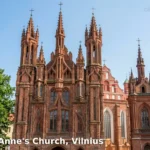
The Church of St. Anne (Šv. Onos bažnyčia) — arguably the finest Gothic building in Lithuania and one of the most beautiful Gothic buildings in Northern Europe — is the single most photographed and most beloved structure in Vilnius. Its extraordinary facade of 33 different types of brick in intricate Gothic tracery creates a delicacy and complexity that is genuinely breathtaking. Napoleon Bonaparte, passing through Vilnius in 1812, famously remarked that he would like to carry it back to Paris on the palm of his hand — a quotation that every guidebook to Vilnius repeats because it is exactly the right response.
The Church of St. Peter and Paul (Šv. Apaštalų Petro ir Pauliaus bažnyčia) — built in the 17th century on the site of a wooden church — is the most magnificent Baroque interior in Vilnius and one of the finest in Northern Europe. The entire interior — every surface of walls, ceiling, and pilasters — is covered in 2,000 stucco figures created by Italian sculptors, creating an effect of extraordinary, almost overwhelming visual richness. Angels, saints, historical figures, and allegorical representations crowd every available space. The overall effect is unlike any other church interior in the Baltic region.
The Gate of Dawn (Aušros Vartai) — the sole surviving medieval city gate, now housing a famous miracle-working icon of the Madonna — is the holiest Catholic site in Lithuania and one of the most important in Eastern Europe. The icon — Our Lady of the Gate of Dawn — is venerated by both Catholics and Orthodox Christians and draws pilgrims from throughout Lithuania, Poland, Belarus, and beyond. The small chapel above the gate is reached by an internal staircase; the image, dressed in golden robes, overlooks the gate passage below.
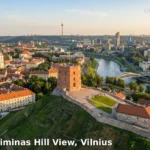
Gediminas Castle Tower — the remaining tower of the medieval upper castle on the hill that Gediminas supposedly dreamed of — provides the finest panoramic view over the old town and the surrounding river valleys. The hill itself is a pleasant walk or accessible by funicular; the view from the top — the Baroque spires of the old town below, the modern towers of Šnipiškės across the Neris, and the forested hills visible in every direction — is one of the finest in the Baltic states.
Užupis — the self-declared independent republic — is simultaneously one of Europe’s finest examples of creative urban regeneration and one of its most joyfully eccentric places. The neighborhood’s constitution (translated into over 60 languages and displayed on mirrored plaques along one of its streets) includes such articles as “Everyone has the right to be happy” and “A cat is not obliged to love its owner, but must help in time of need.” The Užupis mermaid sculpture (the neighborhood’s emblem) and the Angel of Užupis (a golden trumpet-playing angel on a column) are the primary landmarks; the real experience is wandering the slightly ramshackle streets, discovering small galleries, cafés, and studios in converted buildings, and appreciating the particular quality of a place that takes its own absurdity entirely seriously.
The Museum of Occupations and Freedom Fights (KGB Museum) — housed in the actual building that served as KGB headquarters and detention center during the Soviet occupation — is one of the most powerful and most affecting occupation history museums in Europe. The basement cells, isolation chambers, interrogation rooms, and execution cell are preserved with remarkable authenticity. The personal testimonies of former prisoners are extraordinarily moving. This is not comfortable tourism — it is essential historical witness.
💡 Did You Know? The Vilnius Old Town covers approximately 3.6 square kilometres — making it the largest medieval old town in Northern Europe by area. The UNESCO inscription specifically cites the city’s significance as an outstanding example of the synthesis of Gothic, Renaissance, Baroque, and Neoclassical architectural styles, accumulated over seven centuries of continuous urban development under Lithuanian, Polish, Russian, and Soviet governance. Over 1,500 historical buildings survive within the old town boundaries — an extraordinary density of historical architecture in a relatively small area.
9. Vilnius Food & Cuisine Guide
Lithuanian cuisine has undergone a remarkable transformation in the past decade — from a culinary tradition defined primarily by hearty peasant food to a contemporary dining scene that is among the most exciting in Northern Europe. The combination of exceptional local ingredients, a new generation of Lithuanian chefs with international training and genuine ambition, and a food-conscious local population has produced restaurants of genuine international quality at prices that remain among the most affordable in the EU.
Must-Try Dishes in Vilnius
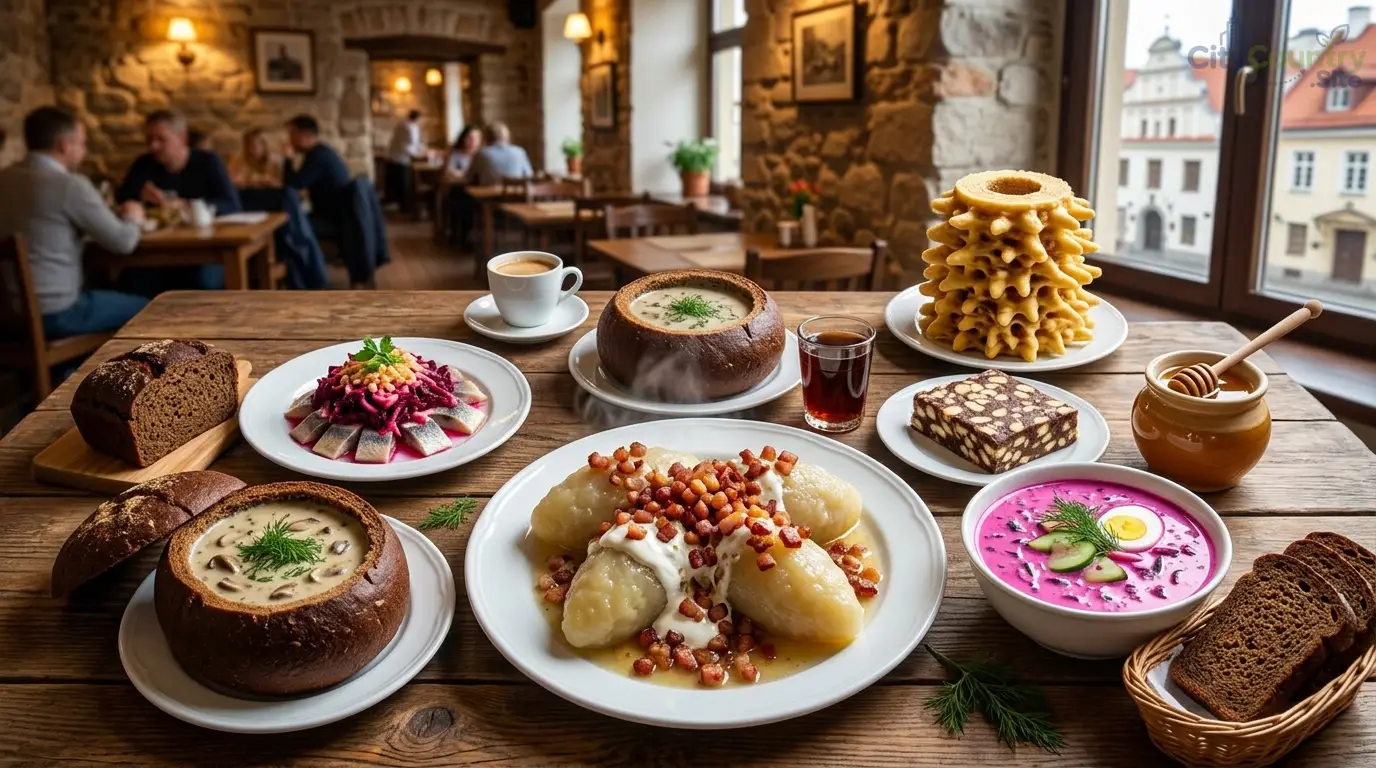
Cepelinai (Zeppelins) — Lithuania’s national dish and one of the most substantial and most satisfying dishes in European cuisine. Enormous potato dumplings — named for their airship-like shape — stuffed with minced meat (usually pork) or curd cheese, boiled until tender, and served with sour cream, bacon bits, and onion sauce. A single cepelinai weighs approximately 200–300 grams and one or two constitutes a complete and entirely filling meal. The quality of the potato dumpling — its texture, the ratio of filling to casing, the sauce — varies enormously between restaurants. The finest versions, made by grandmothers and traditional restaurants, are extraordinary. A genuinely unique Lithuanian creation.
Šaltibarščiai (Cold Beetroot Soup) — Lithuania’s most distinctive and most beloved summer dish — a cold soup of vivid pink color made from boiled beets, kefir or buttermilk, fresh cucumber, green onions, and dill, served with a hard-boiled egg and hot boiled potatoes on the side. The combination of the cold, acidic pink soup with the hot potatoes creates a contrast that is entirely unexpected and entirely wonderful. Served only in warm weather — finding it on a restaurant menu in spring is the surest sign that summer has arrived in Vilnius.
Kugelis — A dense, savory potato pudding baked in the oven until golden — made from grated potatoes, eggs, milk, and smoked bacon. Rich, deeply satisfying, and utterly Lithuanian. Available at traditional restaurants and markets; the finest version comes from home cooks who have perfected the ratio of potato to egg over decades.
Kibinai — A uniquely Lithuanian pastry of Karaite origin — a crescent-shaped pastry filled with minced lamb or beef and onions, from the culinary tradition of the Karaite people (a Turkic-speaking Jewish sect who settled near Vilnius in the 14th century, invited by Grand Duke Vytautas). Available in Vilnius but most authentically found in the Karaite settlement of Trakai (accessible as a day trip). Buttery, savory, completely delicious.
Žemaitiška Duona (Žemaitian Bread) — Lithuanian rye and wheat sourdough bread in various regional styles — darker and denser than Central European bread, with a characteristic sourness and rich flavor. The bread culture of Lithuania is less extreme than the Latvian or Estonian rye bread tradition but produces outstanding results. The finest artisan bread in Vilnius comes from several excellent bakeries in the old town and Naujamiestis.
Smoked Eel (Ungurys) — Lithuania’s rivers and the Curonian Lagoon on the Baltic coast produce outstanding smoked eel — cold-smoked over alder wood until silky, deeply flavored, and extraordinary. Available at the Hales Market and specialist food shops; one of Lithuania’s finest food souvenirs.
Midus (Lithuanian Mead) — Fermented honey wine — one of the oldest alcoholic beverages in the Baltic tradition, predating the widespread adoption of brewing and winemaking. Lithuanian mead ranges from the very sweet to the dry and complex. The finest artisan producers make mead of genuine sophistication. Available at specialist shops and some traditional restaurants throughout Vilnius.
Lithuanian Craft Beer — An extraordinary craft brewing scene has developed in Lithuania — perhaps the finest in the Baltic states, building on a pre-existing tradition of small farmhouse brewing that survived the Soviet period. Alaus Namai, Šnekutis, and several other specialist beer bars in Vilnius showcase the full range of Lithuanian craft and farmhouse brewing, which is increasingly recognized internationally.
Best Restaurants and Food Spots
Džiaugsmas (Old Town) — One of Vilnius’s finest contemporary Lithuanian restaurants — beautifully designed, outstanding seasonal ingredients, creative interpretations of traditional dishes with genuine sophistication. Excellent natural wine list. €20–40 per person.
Lokys (Old Town) — A Vilnius institution — a medieval cellar restaurant serving traditional Lithuanian and game cuisine (wild boar, elk, beaver) in one of the most atmospheric settings in the old town. Excellent for cepelinai and traditional dishes. €15–30.
Etno Dvaras (multiple locations) — The finest accessible traditional Lithuanian restaurant in Vilnius — consistently excellent cepelinai, kugelis, šaltibarščiai, and traditional cuisine in a pleasant setting. Genuinely recommended despite the slightly tourist-facing character. €10–20.
Hales Market (Old Town / Naujamestis border) — The finest food market in Vilnius — a covered market dating from the early 20th century selling outstanding smoked fish, traditional dairy, artisan bread, fresh produce, and Lithuanian food products. The morning hours (8–12 PM) provide the finest selection and most vibrant atmosphere.
Snekutis (Multiple locations) — The finest beer bar in Vilnius — the original branch on Pilies Street in the old town and the newer Šnekutis II on JPG street together constitute the definitive destination for Lithuanian craft and farmhouse beer. Hundreds of local beers on tap and in bottles; knowledgeable staff; excellent pork rinds (spirgučiai) to accompany the drinking. €2–4 per beer.
Cafe de Paris (Old Town) — A beautiful, light-filled café in the old town serving outstanding French-influenced pastries and breakfast. Consistently one of Vilnius’s finest café experiences. €5–15.
Pilies Kepyklėlė (Old Town) — The finest traditional bakery in the old town — excellent Lithuanian bread, pastries, and cakes. €2–6 per item.
💡 Did You Know? Lithuania has the most active traditional farmhouse brewing culture in the Baltic states — with hundreds of small producers making kaimiškas alus (farmhouse beer) according to traditional recipes that predate the industrial brewing era. The farmhouse brewing tradition of the Žemaitija (Samogitia) region in northwestern Lithuania — which survived the Soviet period remarkably intact — is now recognized internationally as one of the finest living examples of pre-industrial European beer culture. The Lithuanian Craft Beer movement explicitly builds on this tradition, producing beers that combine ancient recipes with contemporary techniques. A visit to Šnekutis in Vilnius is the finest way for visitors to encounter this extraordinary brewing culture.
10. Vilnius Accommodation Guide
Vilnius offers excellent value accommodation across all budget levels — and the particular advantage that several beautiful boutique hotels occupy genuinely historic buildings in the heart of the old town, providing a level of atmospheric character rare in more heavily touristed European capitals at comparable prices.
Best Areas to Stay:
- Old Town (Senamiestis): Best for atmosphere, architectural character, and walking access to all major sights — the first choice for most visitors
- Užupis: Best for those wanting the most distinctive and most creative neighborhood experience
- Naujamiestis: Best for those wanting a more local, contemporary experience close to the city’s best independent cafés and restaurants
- Near Cathedral Square: Best for central convenience and the finest morning light on the Baroque architecture
Accommodation Price Ranges (2026)
| Category | Price/Night (USD) | Examples |
|---|---|---|
| Budget Hostel | $15–38 | Jimmy Jumps House, Hostelgate, Old Town Hostel |
| Mid-Range Hotel / Guesthouse | $55–110 | Mabre Residence Hotel, Artis Centrum Hotel |
| Upscale Boutique Hotel | $110–200 | Stikliai Hotel, Artagonist Hotel, Shakespeare Hotel |
| Luxury Hotel | $200–420+ | Grand Hotel Kempinski Vilnius, Pacai Hotel, Stikliai Hotel (suites) |
Pacai Hotel — occupying a magnificently restored 17th-century Baroque palace in the old town — is one of the finest hotel experiences in the Baltic states, combining extraordinary historical architecture with contemporary luxury. Rates: approximately $200–380 per night.
Stikliai Hotel — another beautifully restored old town historical property with an outstanding restaurant — offers upscale comfort with genuine Baroque character. Rates: approximately $150–280 per night.
Jimmy Jumps House — a beloved budget institution near the old town — offers outstanding hostel facilities with a warm social atmosphere. Dorm beds from $15; private rooms from $40.
11. Best Time to Visit Vilnius
May through September is Vilnius’s finest travel window — warm temperatures, long days, the city’s outdoor culture in full operation, and the surrounding countryside at its most beautiful. June and July are peak months — maximum energy, maximum crowds, and maximum sunshine. May and September are often preferred by experienced travelers — lower crowds, golden light, and the city at its most naturally photogenic.
August is peak summer — warm, very busy, and the time when Vilnius’s café terraces and river promenades are at their most vibrant. The city’s music festival season peaks in July and August.
October brings extraordinary autumn colors — the mixed forests surrounding the city turn gold and red, the light takes on a cinematic quality, and the city feels particularly atmospheric as the tourist season ends and local life reasserts itself.
December is magical — the Vilnius Christmas Market in Cathedral Square is consistently rated among the finest in Eastern Europe, and snow on the Baroque rooftops creates an atmosphere of genuine fairy-tale beauty.
Winter (January–February) is cold — Lithuania’s inland position produces more extreme temperatures than the coastal Baltic capitals. But the city under snow is genuinely beautiful, accommodation is dramatically affordable, and the authentic local character is most visible when tourist numbers are low.
Key Festivals and Events in Vilnius
- Kaziukas (St. Casimir’s Fair, early March) — Lithuania’s most beloved annual folk festival — a massive craft and folk art market filling the old town with traditional craftspeople, food vendors, and the beginning of spring celebrations. Held annually since the 16th century
- Vilnius International Film Festival (Kino Pavasaris) (March) — One of the finest film festivals in the Baltic states — an excellent selection of European and world cinema in various old town venues
- Vilnius City Days (June) — Annual celebration of the city’s founding with concerts, street performances, and cultural events throughout the old town
- Capital Days / Užupis Day (April 1) — The Užupis Republic’s national holiday — the neighborhood celebrates its independence with markets, music, and the particular joyfulness that defines the community year-round
- Bravissimo Classical Music Festival (Summer) — Outstanding classical music performances in historical venues throughout the old town
- Vilnius Jazz Festival (October) — One of the finest jazz festivals in Eastern Europe — attracting significant international and Lithuanian jazz musicians to intimate old town venues
- Christmas Market (December–January) — Cathedral Square — consistently rated among Eastern Europe’s finest, with Lithuanian crafts, food, and mulled wine in a setting of genuine Baroque beauty
12. Vilnius Shopping Guide
Vilnius’s shopping scene combines traditional Lithuanian craft products with an emerging contemporary design scene and excellent artisan food markets.
What to Buy:
Lithuanian Amber (Gintaras) — Baltic amber — fossilized resin approximately 44 million years old — is found along the Baltic coast and in some inland deposits. Lithuania is one of the world’s largest amber producers. Vilnius has excellent amber jewelry shops throughout the old town — ranging from simple polished pieces to elaborate artistic jewelry. Buy from reputable dealers who can demonstrate the authenticity of the amber (genuine Baltic amber passes the salt water flotation test).
Lithuanian Linen — Traditional handwoven linen from Lithuanian artisans — table cloths, napkins, and clothing of outstanding quality. Lithuania’s linen weaving tradition is centuries old and produces genuinely beautiful textiles.
Wooden Crafts and Folk Art — Traditional Lithuanian wooden decorations, toys, and folk art objects — particularly the distinctive wooden sun crosses and carved religious figures from the Lithuanian folk tradition.
Lithuanian Honey and Mead — Outstanding honey from Lithuanian meadows and forests; artisan mead from traditional producers. Excellent food souvenirs.
Artisan Rye Bread — Vacuum-packed Lithuanian sourdough rye bread from artisan bakeries; a genuinely distinctive and delicious food souvenir.
Contemporary Lithuanian Design — A growing number of young Lithuanian designers produce excellent jewelry, fashion, ceramics, and homeware. The Hales Market, Design Week markets, and several old town boutiques feature outstanding contemporary Lithuanian design.
Where to Shop:
Hales Market (Halės Turgus) — A beautiful late 19th-century covered market on the edge of the old town — the finest food and craft market in Vilnius. Smoked fish, artisan bread, dairy, fresh produce, traditional crafts, and a comprehensive overview of what Vilnius eats and uses. Daily; best in the morning.
Amber shops on Pilies Street (Castle Street) — The main street of the old town is lined with amber shops of varying quality; choose carefully and buy from dealers who can demonstrate authenticity.
Uzupis Galleries and Studios — Various small galleries and artist studios in the Užupis neighborhood sell original works by Lithuanian artists and craftspeople at accessible prices.
Literati Street (Literatų gatvė) — A street in the old town famous for the hundreds of small ceramic, bronze, and mosaic artworks embedded in the walls — commemorating Lithuanian writers and cultural figures. Browse the adjacent galleries and bookshops.

13. Vilnius Nightlife & Entertainment
Vilnius has a nightlife scene that is genuinely excellent for a city of its size — driven by its large student population, its affordability relative to Western European cities, and a cultural tradition of serious engagement with music, theater, and the arts.
Live Music and Cultural Venues:
Lithuanian National Opera and Ballet Theatre (Lietuvos Nacionalinis Operos ir Baleto Teatras) — One of the finest opera houses in the Baltic states — regular opera and ballet productions in a beautiful building at very accessible prices. The quality of Lithuanian opera production is consistently excellent.
Lithuanian National Philharmonic — Regular symphony concerts in the beautiful Philharmonic Hall — outstanding quality at prices dramatically lower than comparable concerts in Western Europe.
Vilnius Jazz — A strong jazz tradition is maintained at various venues throughout the city; the Vilnius Jazz Festival in October is the most important annual event.
Bix — One of the finest live music venues in Vilnius — regular concerts from Lithuanian and international artists across multiple genres.
Bars and Nightlife:
Šnekutis (Old Town and elsewhere) — The definitive beer bar experience in Vilnius — hundreds of Lithuanian craft and farmhouse beers, knowledgeable staff, and excellent accompaniments. The most important single bar in Lithuanian beer culture.
In Vino (Old Town) — An outstanding wine bar with an exceptional selection of natural and biodynamic wines — predominantly Eastern European and small-producer wines at excellent prices. One of the most sophisticated wine bar experiences available in the Baltic states.
Keulė Rūkė (Pig Smoke, Old Town) — An irresistible bar and restaurant combining excellent Lithuanian craft beer with outstanding smoked pork and traditional food in a warm, casual atmosphere. One of the most beloved neighborhood bars in the old town.
Tappo Bar — An excellent beer-focused bar in Naujamiestis — outstanding craft beer selection, knowledgeable staff, relaxed atmosphere popular with Vilnius’s young professional class.
Club Scene:
Opium — One of Vilnius’s most respected clubs — electronic music, international DJs, and a genuinely discerning local crowd.
Cotton Club — Jazz and blues in a warm, intimate cellar setting — regular live performances and an excellent cocktail list.
Ministerija — A large-scale club venue hosting major events and international DJs in a converted government building.
14. Hidden Gems & Local Secrets
Literati Street (Literatų gatvė) — A narrow old town street that has been transformed over the years by local artists into one of the most quietly extraordinary public art installations in Europe. Hundreds of small ceramic tiles, bronze plaques, mosaics, and miniature sculptures commemorating Lithuanian writers, poets, and cultural figures are embedded in the walls, creating a continuous artistic text that extends the length of the street. Completely overlooked by many tourists focused on the major Baroque churches, it is one of the most genuinely Lithuanian experiences available in the old town.
Bernardine Cemetery — One of the oldest and most beautiful cemeteries in Lithuania — a historical burial ground of remarkable artistic quality, containing the graves of many of Vilnius’s most important historical figures. The monumental funerary sculpture and the atmospheric combination of ancient trees, weathered stone, and the sense of accumulated history make it one of the most beautiful outdoor spaces in the city. Entirely free to visit; almost entirely ignored by tourists.
The Frank Zappa Statue — In a small courtyard off Kalinausko Street near the old town, a bronze bust of Frank Zappa stands on a column — one of the most improbable public monuments in Europe. The statue was installed in 1995 as an act of joyful post-Soviet cultural assertion — Frank Zappa as a symbol of freedom from censorship and authoritarian control. It is both absurd and entirely touching, and it says something important about Lithuanian humor and the Lithuanian relationship with freedom.
Paupys Market — A beautifully designed contemporary market hall on the right bank of the Vilnia River near Užupis — opened in 2020 in a striking modern building, hosting artisan food vendors, excellent cafés, and outstanding contemporary Lithuanian produce. The finest contemporary food market experience in Vilnius and entirely new enough to remain largely undiscovered by tourist circuits.
The Hill of Three Crosses (Trijų Kryžių Kalnas) — A hill above the old town offering the finest panoramic view over Vilnius’s Baroque rooftops, church spires, and the surrounding forested hills. Three white crosses on the hilltop commemorate Franciscan monks martyred in the 14th century; the view from the hill at sunset — the entire old town glowing below, the river catching the last light — is genuinely extraordinary. Reached by a pleasant 20-minute walk from the old town through Kalnų Park.
Subačius Street Art Stairs — A long outdoor staircase connecting the lower streets of the old town with the upper neighborhoods — covered in street art and murals of considerable quality, created by Lithuanian and international artists. Unknown to most tourists and used primarily by students and residents as a shortcut between levels of the city.
15. Day Trips from Vilnius
Lithuania’s small size and excellent road network make interesting day trips easily accessible from Vilnius within 1–2 hours.
Day Trips Table
| Destination | Distance | Travel Time | Method | Highlights |
|---|---|---|---|---|
| Trakai | 28 km west | 40 min | Bus / Car / Train | Medieval island castle; Karaite heritage; Galvė Lake |
| Kaunas | 100 km west | 1.5 hrs | Bus / Train | Lithuania’s second city; excellent Art Deco; remarkable museums |
| Paneriai (Ponary) Memorial | 10 km southwest | 20 min | Train | Holocaust memorial site — where approx. 70,000 Jews were killed |
| Druskininkai | 130 km south | 2 hours | Bus / Car | Spa resort town; Grūtas Park (“Stalin World”) |
| Anykščiai | 120 km north | 2 hours | Car | Treetop walking path; beautiful Lithuanian countryside |
| Šiauliai + Hill of Crosses | 214 km north | 3 hours | Bus / Car | Lithuania’s most extraordinary spiritual site |
| Kernave | 35 km northwest | 45 min | Car | UNESCO archaeological site; ancient Lithuanian hill forts |
| Riga, Latvia | 300 km north | 4 hours | Bus (Lux Express) | Latvian capital; Art Nouveau; Central Market |
Trakai is the single finest day trip from Vilnius and one of the most beautiful day trip destinations in the Baltic states. The Trakai Island Castle — a beautifully restored 14th-century red-brick Gothic castle on an island in the middle of Lake Galvė — is one of the most iconic images in Lithuania. The lake setting, with the castle reflected in the water and surrounded by forest, is genuinely spectacular. Beyond the castle, Trakai is the home of the Karaite people — a Turkic-speaking Jewish sect invited to Lithuania by Grand Duke Vytautas in the 14th century to serve as castle guards. Their distinctive wooden houses along Karaite Street and their unique kibinai pastry tradition make Trakai a genuinely multicultural heritage experience unique in Europe.
The Hill of Crosses (Kryžių Kalnas) — near Šiauliai in northern Lithuania — is one of the most extraordinary and most moving spiritual sites in Europe. A hill of absolutely ordinary size and shape, it is covered in an estimated 100,000+ crosses of every size and style, placed by Lithuanian pilgrims over at least 150 years of devotion. The Soviet authorities bulldozed the crosses three times — and each time they were replaced within days. The sight of this mass of crosses, covering every surface and rising against the sky, is simultaneously overwhelming, beautiful, and deeply moving. A full day trip from Vilnius is required.
Kaunas — Lithuania’s second city, 100 km west — is entirely underestimated as a destination and entirely worth visiting. The city has a remarkable Art Deco old town (developed during the interwar period when Kaunas served as Lithuania’s provisional capital), excellent contemporary museums (including the extraordinary Žmuidzinavičius Museum with its devil collection), a thriving contemporary arts scene, and a quality of preserved interwar European modernism that is genuinely unique in Eastern Europe.

16. Vilnius Local Culture, Customs & Etiquette
Lithuanians have a cultural character that is in some ways similar to their Baltic neighbors — a northern reserve, directness, connection to nature — but with distinctly different historical experiences and cultural references that make them unique.
Lithuanian Identity: Lithuanians are intensely proud of their language — one of the oldest living Indo-European languages, retaining features of the reconstructed Proto-Indo-European ancestor that all other branches have lost. Lithuanian linguists study their own language as a key to ancient European linguistics. Lithuanian is also one of the most challenging languages for English speakers — but making any effort with basic greetings (“Labas” — hello; “Ačiū” — thank you; “Prašom” — please/you’re welcome) is deeply appreciated.
Historical Memory: Lithuania has a complex and layered historical identity — as the core of the medieval Grand Duchy (one of Europe’s largest states), as part of the Polish-Lithuanian Commonwealth (creating deep Polish cultural connections that are still visible in Vilnius’s architecture and demographics), as victims of both Nazi and Soviet occupation, and as survivors who built a remarkably successful modern European state from the ruins of Soviet rule. Each of these layers matters to Lithuanians in different ways, and engaging with this complexity with genuine curiosity is the most respectful approach.
Jewish Heritage: The almost complete destruction of Lithuanian Jewry in the Holocaust — approximately 200,000 people killed, representing over 90% of the pre-war population — is the most profound and most painful chapter of Lithuanian modern history. The Vilnius Gaon Jewish State Museum, the Paneriai memorial, and the Choral Synagogue (the only surviving synagogue in Vilnius from hundreds that existed before the war) are important sites of historical witness. Engage with this history with full seriousness.
Polish Vilnius: The relationship between Lithuanian and Polish identity in Vilnius is complex — the city was Polish (Wilno) for the interwar period and has a significant Polish-speaking community to this day. Polish visitors often feel an intense connection to Vilnius as part of their cultural heritage; Lithuanian identity equally emphasizes the city as the historical capital of the Lithuanian state. This is not a topic to navigate with oversimplification.
Tipping:
- Restaurants: 10% tip is standard and appreciated
- Taxis / Bolt: rounding up is standard
- Hotel staff: €1–2 per service
- Tour guides: €10–15 per day
Dos and Don’ts:
- ✅ Do visit Paneriai (Ponary) — the Holocaust memorial site 10 km from the city center — with full seriousness and appropriate respect
- ✅ Do try cepelinai at a traditional restaurant — the Lithuanian national dish is genuinely excellent when well made
- ✅ Do visit Užupis and engage with its joyful absurdity on its own terms
- ✅ Do make the day trip to Trakai — the island castle and the Karaite heritage are unique in Europe
- ❌ Don’t confuse Lithuanian and Latvian or Estonian — they are distinct languages, peoples, and cultures with different historical experiences
- ❌ Don’t skip the KGB Museum — the Soviet occupation museum is one of the most important historical experiences available in Vilnius
- ❌ Don’t dismiss Vilnius as a “lesser Prague” — it is entirely its own thing, with historical layers and cultural character that are not comparable to Bohemia
17. Safety & Travel Tips
Vilnius is a very safe city for tourists — consistently ranking among the safest capitals in Eastern Europe. Violent crime against visitors is rare. The old town, Užupis, and all tourist areas are safe at all hours.
Safe Areas: The entire tourist circuit — old town, Gediminas Avenue, Užupis, Cathedral Square — is completely safe. The city’s size and the coherence of its central districts make navigation easy and safe.
Main Practical Concerns:
- Cobblestones — Beautiful but uneven; wear appropriate footwear, particularly in wet weather
- Cold winters — Lithuania’s inland continental climate produces genuinely cold winters; dress in proper warm layers if visiting November–March
- Occasional pickpocketing in very crowded areas during peak summer — standard precautions apply
Emergency Numbers:
- All emergencies: 112
- Police: 112
- Vilnius Tourist Information: +370 5 262 9660
Health Tips:
- Medical facilities in Vilnius are adequate — Vilnius University Hospital Santaros Klinikos is the main facility for serious cases
- Tap water is safe to drink
- Travel insurance is recommended
- Tick-borne encephalitis vaccine recommended for extended hiking in forested areas
18. Vilnius Budget Tour
Daily Cost Table
| Category | Budget Traveler | Mid-Range | Luxury |
|---|---|---|---|
| Accommodation | $15–38 (hostel) | $65–130 (hotel) | $190–420+ (luxury hotel) |
| Food | $9–17 (market, local cafés) | $28–60 (restaurant meals) | $70–180+ (fine dining) |
| Transport | $1–5 (bus, train, walking) | $8–20 (Bolt, bus) | $35–70 (private car) |
| Activities | $4–12 (castle, museums) | $18–45 (guided tours, museums) | $55–160+ (private guide) |
| Total/Day | ~$29–72 | ~$119–255 | ~$350–830+ |
Vilnius is the most affordable of the three Baltic capitals — reflecting Lithuania’s somewhat lower overall cost of living. Budget travelers eating at the Hales Market and local cafés, staying in excellent hostels, and using public transport can have a genuinely rich experience for under $45 per day. Even mid-range travel offers outstanding value relative to Western European equivalents.
19. Practical City Information
Visa & Entry: Lithuania is a member of the Schengen Area and the European Union. EU citizens enter with any valid national ID. Citizens of USA, UK, Canada, Australia, Japan, and many others enter visa-free for up to 90 days within a 180-day period. Standard Schengen visa requirements apply for other nationalities.
Currency: Lithuania uses the Euro (€) — adopted in 2015. Cards are accepted universally throughout Vilnius. Contactless payment is entirely standard.
SIM Cards and Internet: Available at the airport. Tele2 Lithuania, Bite Lietuva, and Telia Lithuania are the main operators. EU visitors use their home SIM without roaming charges. Tourist SIMs with data cost approximately €8–15 for non-EU visitors. Free public Wi-Fi is available throughout the old town and in most cafés.
Power: Lithuania uses Type C and F plugs (standard European two-pin round plugs) at 230V, 50Hz.
Drinking Water: Vilnius’s tap water is safe to drink and of good quality.
20. How to Be a Responsible Traveler in Vilnius
Visit Paneriai with Full Seriousness: The Paneriai (Ponary) Forest — where approximately 70,000 Jews, 20,000 Poles, and 8,000 Russians were murdered during the Nazi occupation — is one of the most important Holocaust memorial sites in Europe. Visiting is an act of historical witness that every visitor to Vilnius should consider. The site is accessible by commuter train (10 km from the city center) and is free to visit.
Support the Vilnius Gaon Jewish Museum: The Vilnius Gaon Jewish State Museum — with several branches throughout the city — documents the extraordinary Jewish civilization that flourished in Vilnius for centuries and was destroyed in the Holocaust. Supporting this museum through paid entry and donations helps maintain this essential historical work.
Shop at Hales Market and Paupys Market: These markets directly support Lithuanian farmers, food producers, artisans, and small-scale craftspeople. Buying from market vendors rather than tourist-facing shops has direct economic impact on local livelihoods.
Engage with Užupis on Its Own Terms: The Užupis Republic is a genuine community of artists and creative people who have built something remarkable. Engage with the galleries, studios, and cafés rather than simply photographing the angel sculpture and leaving. Buy from local artists; drink coffee at independent cafés; attend cultural events when available.
Walk, Don’t Drive: Vilnius’s old town is pedestrianized and most of the city’s finest experiences are only fully accessible on foot. Walking the city reduces environmental impact, supports street-level commerce, and produces a more genuine engagement with the urban environment.
21. Travel Media: Documentaries, Books & Channels
Books:
- The Gates of the Forest by Elie Wiesel — The Nobel laureate’s deeply moving novel provides essential context for understanding the Holocaust’s destruction of the Jewish world of Eastern Europe that was centered in cities like Vilnius
- The Book Smugglers: Partisans, Poets, and the Race to Save Jewish Treasures from the Nazis by David E. Fishman — An extraordinary account of Jewish scholars in Vilnius who risked their lives to preserve Jewish cultural heritage during the Nazi occupation
- Vilnius Poker by Ričardas Gavelis — Lithuania’s most celebrated post-Soviet novel — a dark, brilliant portrait of Vilnius under Soviet rule, considered one of the finest novels of Lithuanian literature
- The Baltic Revolution by Anatol Lieven — The finest journalistic account of the Baltic independence movements; essential for understanding Lithuania’s path to independence
- Between East and West by Anne Applebaum — Excellent Baltic and Eastern European context
Documentaries:
- The Singing Revolution (2006) — Covers all three Baltic states including Lithuania’s contribution to the independence movement
- Various Holocaust documentaries covering the Lithuanian Jewish tragedy, including films specifically about the Vilna Ghetto and the Ponary massacres
- The World Was Ours — Documentary about the pre-war Jewish world of Vilnius
YouTube Channels:
- Rick Steves Europe — Good Vilnius and Lithuania episodes
- Lost LeBlancs — Beautiful Vilnius travel content
- Mark Wiens — Vilnius food content with genuine local insight
22. Vilnius vs. Similar Cities
| Feature | Vilnius | Krakow (Poland) | Prague (Czech Republic) |
|---|---|---|---|
| Old Town size | ⭐⭐⭐⭐⭐ Largest Baroque in Northern Europe | ⭐⭐⭐⭐⭐ Outstanding | ⭐⭐⭐⭐⭐ Outstanding |
| Crowds | ⭐⭐⭐⭐⭐ Still manageable | ⭐⭐ Very crowded | ⭐ Overwhelmingly crowded |
| Affordability | ⭐⭐⭐⭐⭐ Most affordable EU capital | ⭐⭐⭐⭐ Good value | ⭐⭐⭐ Moderate |
| Unique character | ⭐⭐⭐⭐⭐ Użupis, Jewish heritage, Baroque | ⭐⭐⭐⭐ Strong character | ⭐⭐⭐ Somewhat homogenized |
| Food scene | ⭐⭐⭐⭐⭐ Outstanding — rapidly developing | ⭐⭐⭐⭐ Very good | ⭐⭐⭐⭐ Very good |
| Jewish heritage | ⭐⭐⭐⭐⭐ Jerusalem of Lithuania — essential | ⭐⭐⭐⭐ Very significant | ⭐⭐⭐ Good |
| Nightlife | ⭐⭐⭐⭐ Very good | ⭐⭐⭐⭐ Very good | ⭐⭐⭐⭐⭐ Outstanding |
| Day trips | ⭐⭐⭐⭐⭐ Trakai, Kaunas, Hill of Crosses | ⭐⭐⭐⭐⭐ Auschwitz, Wieliczka | ⭐⭐⭐⭐ Very good |
Choose Vilnius if you want the largest and most genuinely un-overwhelmed Baroque old town in Northern Europe, the most affordable EU capital city experience, the extraordinary Užupis Republic, one of the world’s most profound Jewish heritage sites, and the Trakai island castle — all in a city that is discovering its international travel reputation right now, before the crowds fully arrive.
23. Vilnius City Travel Tips
- Wear comfortable shoes — the old town’s cobblestones are beautiful but demanding; good walking shoes are essential
- Cepelinai are enormous — order one to begin with; two is typically enough for a very hungry person
- The train from the airport to the city center takes 7 minutes and costs less than €1 — the finest airport transfer value in the Baltic states
- Download Bolt before arriving — the most reliable and affordable ride-hailing option in Lithuania
- Užupis is best explored slowly — take a morning to wander every alley, read the constitution plaques, and find the small galleries and studios
- Visit Paneriai — it is 10 minutes by train and one of the most important historical sites in the Baltic states
- The Hill of Three Crosses at sunset provides the finest view over the old town — plan your timing carefully
- Trakai is a must day trip — take the morning bus (40 minutes) and spend a full day at the castle and in the Karaite village
- Šnekutis for Lithuanian beer is entirely unmissable — hundreds of farmhouse and craft beers at very modest prices
- December is magical — the Christmas market in Cathedral Square is among Eastern Europe’s finest
- The KGB Museum is free — one of the most important and most affecting museums in the Baltic states
- Hales Market in the morning is the most authentic daily experience of Vilnius food culture available
💡 Did You Know? The Vilna Gaon (Elijah ben Solomon Zalman, 1720–1797) — the greatest Jewish scholar of the 18th century, who spent his entire life in Vilnius — refused all official positions and rabbinical appointments, preferring to study in private poverty. He was said to sleep only two hours per night in order to maximize his study time. By the time of his death he had produced commentaries on virtually the entire body of Jewish religious literature, from the Bible to the Talmud to the Kabbalah. His influence on Jewish scholarship — particularly on the Mitnagdim (the opponents of Hasidism) — shaped the direction of Orthodox Judaism for the following two centuries. He is buried in Vilnius; his grave has been a site of pilgrimage for Jewish visitors from around the world since his death.
24. Is Vilnius Worth Visiting? – Final Verdict
Emphatically, enthusiastically, and without reservation yes — and with the particular urgency of recommending something genuinely extraordinary before the discovery has become complete and the crowds have arrived in full. Vilnius is one of Europe’s finest and most genuinely surprising travel destinations — a city that consistently exceeds the expectations of visitors who come knowing little about it and consistently disappoints those who come expecting it to be a smaller, cheaper version of somewhere else.
It is entirely itself — a place with historical layers of extraordinary complexity, the largest Baroque old town in Northern Europe (still relatively uncrowded), the most joyfully eccentric neighborhood in the Baltic (Užupis), one of the world’s most important and most moving Jewish heritage sites, an emerging food scene of genuine excitement, a farmhouse beer culture of international distinction, and a quality of personal encounter with the city and its people that becomes more precious as travel to Europe’s more famous destinations becomes more crowded and more formulaic.
Vilnius is best suited for:
- History and architecture enthusiasts — The Baroque old town is genuinely extraordinary in its scale and preservation; the medieval and Renaissance layers beneath it are equally remarkable; and the 20th-century history — both Holocaust and Soviet occupation — gives the city a historical weight that is rare in European travel
- Jewish heritage travelers — Vilnius is one of the world’s most important Jewish heritage destinations, the center of the Ashkenazi intellectual world before the Holocaust and the site of its near-complete destruction; the Vilna Gaon Jewish State Museum and the Paneriai memorial are among the most important sites of this heritage in Europe
- Food and beer enthusiasts — The contemporary Lithuanian food scene is among the most exciting in Northern Europe; the farmhouse beer culture is unique in Europe; and everything costs a fraction of Western European equivalent quality
- Budget and independent travelers — Vilnius is the most affordable EU capital by most measures; the quality of experience relative to cost is extraordinary
- Those seeking bohemian creativity — Užupis is one of the most genuinely creative and most genuinely joyful urban spaces in Europe
- Families — Safe, compact, beautiful, with the Trakai island castle day trip providing one of the finest family experiences in the Baltic states
- Those who loved Krakow or Prague fifteen years ago — Vilnius is what those cities were before mass tourism transformed them: beautiful, authentic, slightly rough at the edges, full of energy, and genuinely discoverable
Less suited for those seeking beach holidays, Mediterranean warmth, or an overwhelmingly polished tourist infrastructure. Vilnius is a real European city of genuine historical depth that rewards engagement — those looking for a comfortable backdrop for selfies may find other destinations more accommodating.
The verdict: Give Vilnius four full days minimum — five is better. Spend a full day walking every lane of the old town. Take the morning to climb Gediminas Hill and understand the city’s geography. Spend an afternoon in Užupis discovering galleries and reading the constitution plaques. Take the train to Trakai for a day. Go to Paneriai. Eat cepelinai at a traditional restaurant. Drink farmhouse beer at Šnekutis. Visit the KGB Museum. Watch the sun set from the Hill of Three Crosses. And somewhere in those four or five days — over a glass of mead or a cup of coffee in a medieval courtyard or a cold bowl of pink beetroot soup on a warm afternoon — you will understand why the people who know Vilnius keep coming back, and why the people who have found it most recently feel a particular urgency about sharing the discovery before the secret is fully out.
25. Frequently Asked Questions About Vilnius
Q1: Is Vilnius safe for tourists?
Yes — Vilnius is very safe by European standards. Violent crime against tourists is rare. The old town, Užupis, Cathedral Square, and all tourist areas are completely safe at all hours. Standard urban precautions — secure valuables in crowded areas, be aware of your surroundings — are all that is required. Solo female travelers consistently rate Vilnius as one of the safest and most welcoming Eastern European cities for independent travel.
Q2: Do I need a visa to visit Lithuania?
Lithuania is a Schengen Area member. EU citizens enter with any valid national ID. Citizens of USA, UK, Canada, Australia, Japan, and many others enter visa-free for up to 90 days within a 180-day period. Standard Schengen requirements apply for other nationalities. Check the Lithuanian Migration Department for current requirements for your specific nationality.
Q3: What are cepelinai and where should I eat them?
Cepelinai are Lithuania’s national dish — enormous potato dumplings (named for their airship shape) stuffed with minced meat or curd cheese, served with sour cream, bacon bits, and onion sauce. A single cepelinai weighs approximately 200–300 grams; one or two is a complete meal. The finest versions are at traditional Lithuanian restaurants: Etno Dvaras (reliable, accessible), Lokys (atmospheric medieval cellar, excellent game and traditional dishes), and smaller family-run establishments in the old town and Naujamiestis. Avoid tourist-facing places with photographs of cepelinai on menu boards — the quality is generally lower.
Q4: What is Užupis and is it a real country?
Užupis is a neighborhood of Vilnius that declared itself an independent republic on April 1, 1997 (April Fools’ Day — intentionally). It has its own constitution (displayed on mirrored plaques in multiple languages along one street), its own currency (accepted in some neighborhood establishments), its own president (artist Romas Lileikis), its own anthem, and its own army of twelve people. It is not internationally recognized but the community takes its absurd independence entirely seriously in the most joyful possible way. The constitution’s articles include gems like “Everyone has the right to die, but this is not an obligation” and “Everyone has the right to understand nothing.” The neighborhood is genuinely wonderful to walk — filled with small galleries, studios, cafés, and the Angel of Užupis sculpture on a column in the main square. Cross the Vilnia River on the Užupis Bridge (decorated with padlocks) and you have entered the republic.
Q5: How many days should I spend in Vilnius?
Three full days covers the essentials — the old town (full day), Gediminas Castle, Gate of Dawn, Church of St. Peter and Paul, Užupis, KGB Museum, and the Hales Market. Four days adds Paneriai, more old town exploration, and the Trakai day trip. Five days allows everything above plus Kaunas or the Hill of Crosses and a more relaxed pace throughout. For those doing the Baltic capitals circuit (Vilnius-Riga-Tallinn by Lux Express), two to three full days in Vilnius is typically the minimum.
Q6: What is the Trakai day trip like and how do I get there?
Trakai (28 km west) is accessible by bus (approximately 40 minutes, departures every 30–60 minutes from Vilnius bus station, cost €1.50–2.50), train (approximately 35 minutes, less frequent), or car. The day trip provides: the Trakai Island Castle — a beautifully restored 14th-century Gothic castle on an island in Lake Galvė, accessible by wooden bridges; the Karaite heritage along Karaite Street; and the kibinai pastry experience (the Karaite meat pastry, best at the traditional Kibinine restaurant near the castle). Allow a full day; return on the evening bus. Trakai is the finest single day trip from Vilnius and one of the finest in the entire Baltic region.
Q7: What is the Jewish heritage of Vilnius and how can I engage with it?
Before World War II, Vilnius was one of the world’s great centers of Jewish civilization — home to approximately 100,000 Jewish residents, hundreds of synagogues, outstanding Yeshivot (centers of Jewish learning), and one of the most culturally productive Jewish communities in European history. The German occupation of 1941–1944 resulted in the almost complete murder of this community. Key sites for engaging with this heritage in Vilnius: the Vilna Gaon Jewish State Museum (multiple branches throughout the city); the Choral Synagogue (the only remaining synagogue from hundreds that existed); the Vilnius Ghetto walking route (plaques marking the former ghetto boundaries); the Paneriai (Ponary) Memorial (10 km by train — where approximately 70,000 Jews were shot); and the Tolerance Center museum. These sites deserve full, serious attention.
Q8: What should I drink in Vilnius?
The definitive Vilnius drinking experience is Lithuanian farmhouse beer (kaimiškas alus) at Šnekutis — hundreds of Lithuanian craft and farmhouse beers at very accessible prices. Midus (Lithuanian mead) is the most historically distinctive drink — available at traditional restaurants and specialist shops. Lithuanian craft beer from producers like Alaus Namai is internationally recognized and widely available. For wine enthusiasts, In Vino wine bar has one of the finest natural wine selections in the Baltic states.
Q9: What is the KGB Museum and is it important to visit?
The Museum of Occupations and Freedom Fights — housed in the actual building used as KGB headquarters during the Soviet occupation — is one of the most important and most affecting museums in Eastern Europe. The preserved basement cells, isolation chambers, interrogation rooms, and execution cell provide direct physical evidence of Soviet terror. The personal testimonies of former prisoners are extraordinarily moving. Entry costs approximately €5 and the museum deserves at least 1.5–2 hours. Yes — it is important to visit. Understanding what the Soviet occupation meant in practice — what it did to individual human beings, to families, to communities — is essential for understanding what Lithuanian independence means and why it was worth the enormous personal courage it required to achieve.
Q10: How does Vilnius compare to Riga and Tallinn?
All three Baltic capitals are genuinely excellent and genuinely different. Tallinn has the most perfectly preserved medieval old town and the most compact, intimate character. Riga has the world’s greatest Art Nouveau architecture, the most developed nightlife, and the finest market (in the Zeppelin hangars). Vilnius has the largest Baroque old town (3.6 sq km), the most complex historical layering, the most important Jewish heritage, the most creative neighborhood (Užupis), the finest individual day trip (Trakai), and the most affordable prices. Traveling all three on the Lux Express bus route (Vilnius-Riga 4 hours; Riga-Tallinn 4.5 hours) is one of Europe’s finest multi-city travel experiences and strongly recommended for anyone spending a week or more in the region.
26. Sources & References
This article was researched using information from the following trusted sources:
- Lonely Planet Lithuania — lonelyplanet.com
- TripAdvisor Vilnius — tripadvisor.com
- Booking.com Vilnius Hotels — booking.com
- Wikipedia — Vilnius — en.wikipedia.org
- Go Vilnius Tourism — govilnius.lt
- Numbeo — Cost of Living Vilnius — numbeo.com
- Google Maps — maps.google.com
- Wikitravel Vilnius — wikitravel.org
- Skyscanner Lithuania Flights — skyscanner.com
- World Travel Guide — worldtravelguide.net
- Vilna Gaon Jewish State Museum — jmuseum.lt
- Museum of Occupations and Freedom Fights — genocid.lt
- Condé Nast Traveller Baltic — cntraveller.com
- UNESCO Vilnius — whc.unesco.org
- Go Lithuania Tourism — lithuania.travel
27. Vilnius Travel Guide Images